On the morning of April 29, 1945, Lieutenant Colonel Felix Sparks gathered his officers before dawn. He was twenty-eight years old, a lean and precise commander who had spent three years learning how to carry the weight of sending men to their deaths. His soldiers trusted him completely, not because he was warm, but because he never lost control. That reputation was about to be tested in a way he could not have imagined.
Sparks commanded the 3rd Battalion of the 157th Infantry Regiment, part of the 45th Infantry Division, advancing through Bavaria in the final days of the war in Europe. His men had a final objective: a large SS training facility north of Munich. The orders were vague, as orders often were. They expected possible light resistance.
They expected a standard operation. They were wrong. Two miles away, SS Captain Heinrich Wicker was preparing for the morning with equal care. The facility commander, Martin Gottfried Weiss, had fled along with most of the senior officers and administrators.
Wicker had been left in command of a skeleton garrison and an impossible situation. He was not a fool. He understood that the Americans were coming, that the war was over, and that the only question was how the end would unfold. He made his decision.
He would not fight. He would surrender the facility through official channels, according to the rules governing such matters, and be treated as an officer under the Geneva Convention. He had prepared the paperwork. He had contacted the International Red Cross.
That morning he wore his best uniform, polished his boots, and studied his reflection. He had no idea what his facility looked like from the outside. Three miles north, Margaret Higgins was arguing with an American officer in the front seat of a military vehicle. She was twenty-four years old, a correspondent for the New York Herald Tribune, small and dark-haired and relentless.
She had been covering the European war for months, constantly pushing toward the front, fighting the military establishment’s instinct to keep women away from anything dangerous or important. She had joined an advance unit headed for the SS compound. The officer told her she could not come. She came anyway.
She carried her notebook and her camera. The 45th Division moved through the early morning light, through Bavarian villages where white sheets hung from windows as a sign of surrender, past the wreckage of a collapsing army. The column slowed, then stopped. There was a railroad track alongside the road.
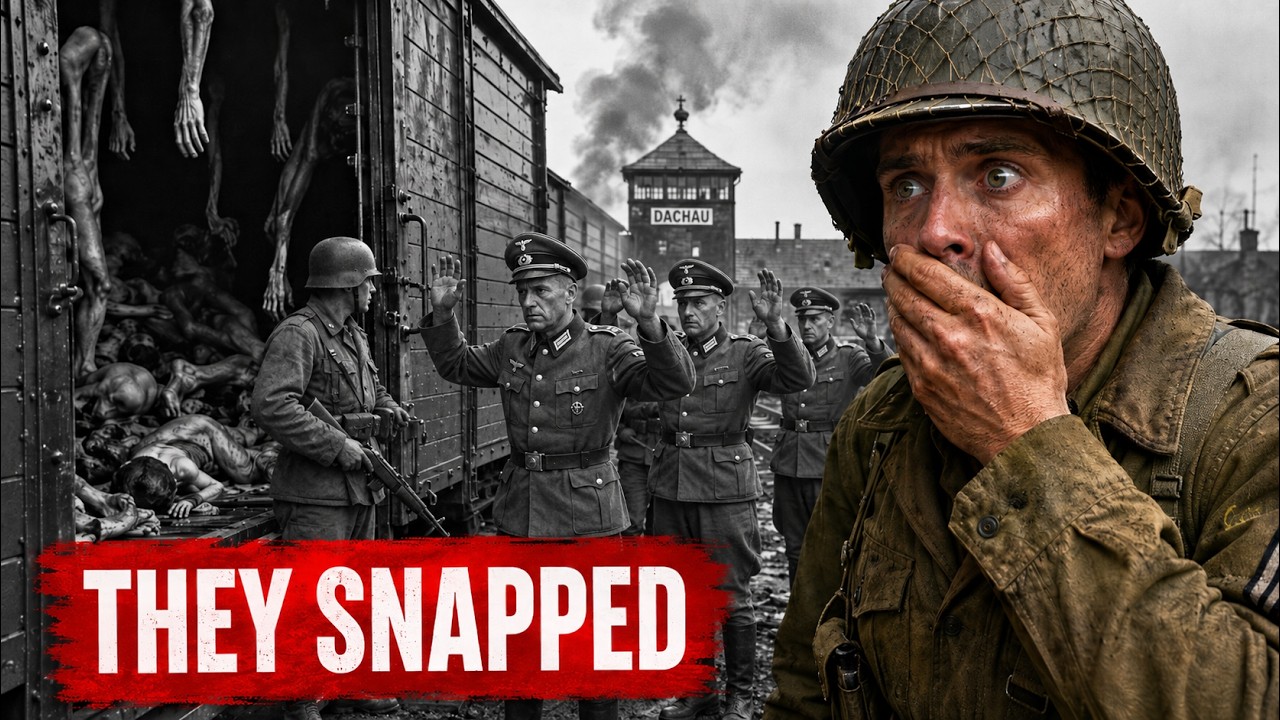
On it sat a train, thirty-nine boxcars, perfectly still in the gray morning light. Sparks drove forward to see for himself. Then they smelled it. The men smelled death at different moments, depending on their position in the column and the direction of the wind.
Some caught it from fifty meters away. Others almost reached the train before it hit them. It was not the familiar death of the battlefield. It was something older, something that had accumulated over a long time.
A sergeant pulled open the door of the first car and looked inside. He made a sound that was not a word and not a scream, just a noise forced out of him involuntarily. Inside the boxcars were bodies, dozens of them, men and women, stacked on top of each other, limbs twisted at unnatural angles. They were skeletons.
Starvation had pulled their flesh tight against their bones. Across all thirty-nine cars there were 2,310 corpses. They had been moved from another camp in the chaotic final weeks of the Reich and had died in transit from starvation, dehydration, and exposure. Some had been shot.
The train had simply been left there. The men of the 45th Division had fought in Italy and France. They had seen friends die in ways that never leave you. They thought they had seen the worst that human beings could do to one another.
They had not seen this. A nineteen-year-old from Oklahoma sat in the snow beside the tracks and buried his face in his hands, sobbing like a child. Another soldier turned and vomited. Others stood in complete silence, their faces gone somewhere far away.
Then something began to change in them. It moved through the column like a weather front. The grief remained, the shock remained, but rising through them was something else entirely, something hot and absolute. Not the directed aggression soldiers learn to use as a tool.
Something older than training, something that lives below discipline and reason. The kind of rage that does not ask permission and does not recognize boundaries. Sparks saw it happening. He gave the order to keep moving.
He told his officers to focus the men on the objective. He kept his own expression composed. But he had looked at that train, and he felt something moving through him as well. He said nothing about it.
He gave the order to advance. The column moved toward the main gate of the facility, toward the watchtowers, toward the thirty thousand people still alive inside who did not yet know the Americans had arrived. But the men who passed that train were no longer the men who had woken up that morning. Something had broken inside them.
Or perhaps something had been revealed. The main gate of Dachau was made of wrought iron, heavy and black and built to last. Across the top, in large letters, were the words the Germans had stamped into the metal at the entrance of every camp they built: Arbeit Macht Frei. Work Sets You Free.
The men of the 45th Division passed through that gate into a place that had been operating continuously since 1933. Twelve years. Dachau was the original, the model, where the machinery of systematic killing had been designed, tested, and developed before being exported across occupied Europe. The soldiers did not know any of this history.
They knew only what they could see. On both sides of the main road stood rows of wooden barracks, and from every door, every window, every gap in every wall, human beings were emerging. They were barely standing. Their eyes were huge in their sunken faces, bright and feverish, fixed on the American uniforms with an intensity that had survived everything the camp had done to their bodies.
They moved slowly, cautiously, the way people move when movement itself is painful. Some could not move at all. They lay in the doorways of the barracks and raised one hand toward the Americans. One hand, because that was all the strength they had.
Thirty thousand people. That was the number. Thirty thousand survivors inside Dachau. When the prisoners saw the American troops, they began to scream, not in terror but in joy, a great and desperate joy so overwhelming it did not sound like joy at first.
They screamed and wept and reached their thin arms toward the soldiers. Some collapsed trying to get closer. Some fell to their knees in the mud. A battle-hardened veteran later said he had to look away, not because the scene was unbearable, but because he was crying so hard he could no longer see.
Sparks moved through the camp with his officers, issuing orders in a steady voice. Establish a perimeter. Secure the garrison. Begin medical evaluations.
He was doing his job, and doing it well. But his eyes were registering everything. The barracks, the prisoners, and the facility at the far end of the compound he had not yet reached: the crematorium. The ovens were at the western edge of the camp, a low brick building, functional in design, built with the cold efficiency of people who had turned killing into an industrial process.
When the soldiers arrived, the ovens were still warm. The ashes inside were still gray and soft. There were bones in the ashes. Small bones.
A medical wing at the north end of the compound held files and instruments documenting medical experiments performed on prisoners. The soldiers who opened those files and read the first pages closed them quickly and did not speak for a very long time. This was what the men of the 45th Division were absorbing when the situation near the western wall began to unfold. Wicker had been waiting near the main gate since early morning.
When the Americans arrived, he approached with his white flag, his documents, and his polished boots. He was met by Brigadier General Henning Linden of the 42nd Division, who had reached the camp by a different route. Linden accepted the formal surrender documents. A handshake took place.
Photographs were taken. Margaret Higgins was there, recording everything, her lens moving between the two men and the gate behind them. At 3:30 in the afternoon, the transfer of Dachau was officially complete. The killing near the western wall had begun more than an hour earlier.
The SS guards who had remained in the camp had been ordered to stay in their positions and surrender peacefully. Most complied. They threw down their weapons, raised their hands, stood in groups around the perimeter, and waited. Near the coal yard on the west side of the compound, about fifty SS guards gathered.
Some were calling out in German. One shouted in broken English, “Hitler kaput. Hitler is finished. ” They thought that would help them.
The American soldiers moving through the coal yard had just come from the crematorium. They had just walked past the barracks. They had just looked into the faces of thirty thousand people who had been systematically destroyed over twelve years inside this facility. Now they were looking at fifty men in good health, in clean uniforms, alive, standing against a wall with their hands raised.
An American officer stood looking at the men against the wall. His name is uncertain in any record. No verbal order was given. He made a gesture.
A . 30 caliber machine gun was set up on its tripod in the coal yard. The gunner looked at the officer. The officer’s gesture was unmistakable.
The machine gun opened fire. It lasted about ten seconds. When it stopped, most of the fifty men were on the ground. Some were still alive.
The snow around the wall was no longer white. Sparks heard the gunfire from across the compound. He knew the sound immediately. This was not enemy fire, not a firefight.
This was something controlled and deliberate. He ran. He pushed past soldiers and prisoners, through the chaos of a facility being liberated and documented at the same time. When he reached the coal yard, he saw his men.
Some were still firing at the bodies on the ground, not for any tactical reason, but simply because they were doing it, because something inside them was not finished. Sparks drew his pistol and fired into the air. The sound cut through everything. They stopped.
In a voice carrying twenty years of command authority, he said, “Cease fire. ” The shooting stopped. The men turned and looked at him. Their faces were not the faces of men who had done something wrong and knew it.
They were the faces of men who had done something necessary and were still drowning in the feeling of it. The gunner was crying. He looked at Sparks and said three words: “Colonel, they deserved it. ”
Sparks said nothing.
He wrote about this moment later in his memoirs. He wrote that he understood exactly why it had happened, that part of him understood it not as a military failure but as a human response to something beyond the capacity of training and discipline to contain. He also wrote that he realized his mission from that moment forward was to make sure his men would never do it again. He ordered the surviving SS prisoners gathered and locked inside a building under American guard.
Not for interrogation. To protect them from his own soldiers. At a watchtower on the eastern perimeter, SS guards had descended the ladder with their hands raised. The American soldiers opened fire.
The bodies fell into the ditch below the tower. The soldiers walked to the edge of the ditch and looked down, then raised their rifles and fired again. A soldier who was present wrote to his family about it without apology. He said the word that kept echoing in his mind was “children.
” He had seen the files in the medical building. He kept firing until his weapon was empty, and then he continued. The prisoners were emerging from the barracks. They were too weak to stand, but adrenaline and hatred gave them temporary strength.
A group of prisoners found an SS guard hiding in a storage area, a young man of nineteen or twenty, and dragged him out. They had no weapons. They had what they found around them: wooden handles, stones, their hands. American soldiers stood nearby and watched.
An officer asked whether they should intervene. A sergeant looked at the officer, looked at the prisoners, and said, “No, let them finish it. ” The officer did not argue. Elsewhere, a prisoner-functionary who had collaborated with the SS was drowned in a latrine by the people he had overseen.
The American soldiers were present. No one intervened. Margaret Higgins moved through all of it, recording without yet absorbing, writing in her fast, small handwriting that grew faster and smaller as the afternoon went on. She photographed the prisoners, the barracks, the crematorium.
She photographed the moment of formal surrender at the main gate, capturing in a single image the impossible contradiction of that day: an official military handshake taking place at the entrance to a place where thirty thousand people had been systematically exterminated. She did not photograph the coal yard. It does not appear in her published work. By late afternoon, the killing had stopped.
Sparks moved through the compound and restored order with the authority of a man who had nothing left to prove and everything to lose. The surviving SS prisoners were secured. The prisoners were being cared for by medical teams. The official machinery of military occupation had begun to function.
The camp was quiet, or as quiet as a place could be with thirty thousand traumatized survivors. Three days passed. On April 30, one day after the liberation, Hitler died by his own hand in his bunker beneath Berlin. Berlin fell two days later.
German forces were surrendering across the continent. The war in Europe had only days, perhaps less, left to run. Inside Dachau, the survivors were still dying. Liberation was real.
The joy at the gate was real. But thirty thousand people who had been starved and worked and beaten to the edge of death do not recover the moment American soldiers walk through the gate. In the days after liberation, prisoners continued to die at a rate that horrified the medical teams trying to save them. Some died because their bodies could no longer process food after so long without it.
Some died of diseases that had been ravaging the barracks for months. Some died of causes the doctors simply recorded as “exhaustion,” because there was no medical term that accurately described what had been done to a human body over years in a place like Dachau. The Americans did everything they could. It was not always enough.
Then Lieutenant Colonel Joseph Whitaker arrived. He came with a team: investigators, photographers, men with notebooks, and an official army mandate. Not to investigate the liberation, the prisoners, the death train, the crematorium, or the medical building. Something else.
What happened at the western wall, at the base of the eastern watchtower, and in other places around the perimeter. The investigation was thorough. They interviewed soldiers, gathered witness statements, examined physical evidence, bullet patterns on the wall, and the photographs soldiers had taken with their personal cameras. They recorded it all in careful bureaucratic language.
The investigation’s conclusions were unambiguous. American forces had violated international law, specifically the Geneva Convention’s protection of prisoners of war who had surrendered and were no longer combatants. The report identified multiple incidents. It recommended courts-martial.
It cited the coal yard as the most serious and best-documented violation. It noted that the field commander, Lieutenant Colonel Felix Sparks, had intervened to stop the killing, which the investigators considered a mitigating factor, but not a justification. The report was signed and sent up the chain of command. It reached the office of General George S.
Patton. Patton was fifty-nine years old, one of the most decorated and most controversial military commanders in American history, a man of absolute contradictions. He had already been relieved of command once during the war for slapping a soldier in a hospital. He was also a man who had visited Dachau himself after the liberation and, according to members of his staff, became physically ill during the visit.
He had spent decades surrounded by death and violence in its most extreme forms. What he saw in Dachau made him sick. He read the Whitaker report carefully. He read the witness statements, the legal analysis, the recommendations for courts-martial.
He looked at the photographs of the dead SS guards in the coal yard. Then he looked at the photographs of the death train sitting on the tracks outside the camp, and he held the two images in his mind at once. He picked up a pen. He did not sign the court-martial recommendation.
According to members of his staff, he made his position clear before forwarding the file. His men had seen what they had seen, and he would not court-martial them for it. Dwight Eisenhower was the Supreme Allied Commander in Europe. He had visited a liberated concentration camp himself and had been changed by it.
When Eisenhower walked through Ohrdruf, a subcamp liberated weeks earlier, he ordered every American soldier in the area brought through it. He wanted witnesses. He understood with rare clarity that what the Allies had found in these camps was something history would try to minimize or deny, and that the only defense against that was a massive accumulation of direct testimony. He also understood something else.
Court-martialing the liberators of Dachau for war crimes would produce a headline that enemies of the truth would use forever. It would create a false equivalence between the men who built and ran the camps and the men who entered them and lost control for terrible moments in the face of evidence of systematic mass murder. Eisenhower was not willing to give them that weapon. He did not intervene to reverse Patton’s decision.
The report moved through the chain of command and came to rest. No courts-martial were held. No charges were brought. The file was classified and placed in the military archives, where it remained untouched for decades.
The men went home. The war in Europe ended on May 8, 1945. The soldiers of the 45th Division returned to Oklahoma, Texas, New Mexico, and the other places they had come from. They went back to their families, their towns, their lives.
Some went to college on the GI Bill. Some returned to the farms, factories, and shops they had left. They married. They had children.
They tried to build ordinary lives out of what remained of themselves. They did not talk about the coal yard. Men who commit acts in war that fall into a moral gray area tend not to talk about them. They carried it in silence.
Felix Sparks went to law school. He returned to Colorado, enrolled under the GI Bill, and built a career in law. He became a lawyer, then a judge, and eventually served on the Colorado Supreme Court, where he was known for fairness, precision, and the ability to remain calm under pressure. He was twenty-eight years old when he ran across a compound in Bavaria, fired his pistol into the air, and ordered his men to stop.
He was in his seventies and eighties when he finally began to speak publicly about that day. He wrote his memoirs, titled “The Damned War,” published in 2012, five years after his death at age ninety. In them he described April 29, 1945, in the same disciplined, precise language he had used in the courtroom for decades. He described what he saw in the death train, what he found in the coal yard, and the moment when the gunner looked at him and said those three words.
He did not say his men were right. He did not say they were wrong. He said he understood them. He said understanding and approval are not the same thing.
He said he had spent sixty years thinking about the difference between justice and the law, and that Dachau was where he first realized they are not always the same. He died in Colorado in 2007. He never regretted running across that compound. He never regretted firing into the air.
Margaret Higgins sent her story from Dachau on May 1, 1945. It was published in the New York Herald Tribune and read by hundreds of thousands of Americans. She wrote about the prisoners, the liberation, what it looked like when thirty thousand human beings who had been barely kept alive were suddenly told they were free. She did not write about the coal yard.
She covered the Korean War. She covered Vietnam. She became one of the most decorated war correspondents in American history, the first woman to win the Pulitzer Prize for international reporting, in 1951. She died in 1966 at age forty-five from a tropical disease contracted while covering Vietnam.
The last living documentation of Heinrich Wicker is from 3:30 in the afternoon on April 29, 1945. The official transfer records place him at the main gate. They record the handshake with General Linden. They record the words of formal surrender.
They are precise, bureaucratic, and completely silent about what happened to him after the last line was signed. He does not appear in any subsequent document. There is no record of his imprisonment as a prisoner of war. There is no record of his death.
There is no grave bearing his name in any database researchers have been able to find. He was there at 3:30, surrendering a camp where tens of thousands had been killed, wearing his polished boots and his formal uniform, expecting the protection that international law grants to officers who surrender. Then he vanished. At some point between 3:30 in the afternoon and the following morning, Heinrich Wicker ceased to exist in the historical record.
The Dachau massacre investigation was declassified after decades and is now preserved in the National Archives. Historians have studied it. The events of April 29 are documented and recognized. The camp itself is now a memorial.
You can visit it. You can walk through the gate with the iron words across the top. You can walk the grounds where the barracks once stood. You can stand inside the crematorium and see the ovens.
There are thirty thousand names on the memorial. There is no memorial for the SS guards who died at the coal yard wall. History made its decision about them long ago. But history must also make a decision about the men who pulled the trigger.
That is the uncomfortable place where the story of April 29, 1945 leaves you. Not in the comfortable territory of clear heroes and clear villains, but in the more difficult place where human beings did something that was at once understandable and illegal, at once a war crime and something a large portion of humanity could not fully condemn. The Geneva Convention exists for good and important reasons. It exists because the alternative, a world where prisoners are killed after surrender, is a world of endless escalation and cruelty.
But the men who violated those rules on April 29, 1945, had just walked past 2,310 corpses in a train. They had just walked through a crematorium whose ovens were still warm. They had just looked into the faces of thirty thousand people who had been systematically destroyed over twelve years by the very men they were now asked to treat as prisoners according to international protocol. There is no clean answer here.
There was no answer in 1945, and there is no answer now.