In the spring of 1945, a German SS general walked into an American command post. His boots were polished, his medals in place. He raised his arm in salute and waited. The American soldier at the desk did not look up.
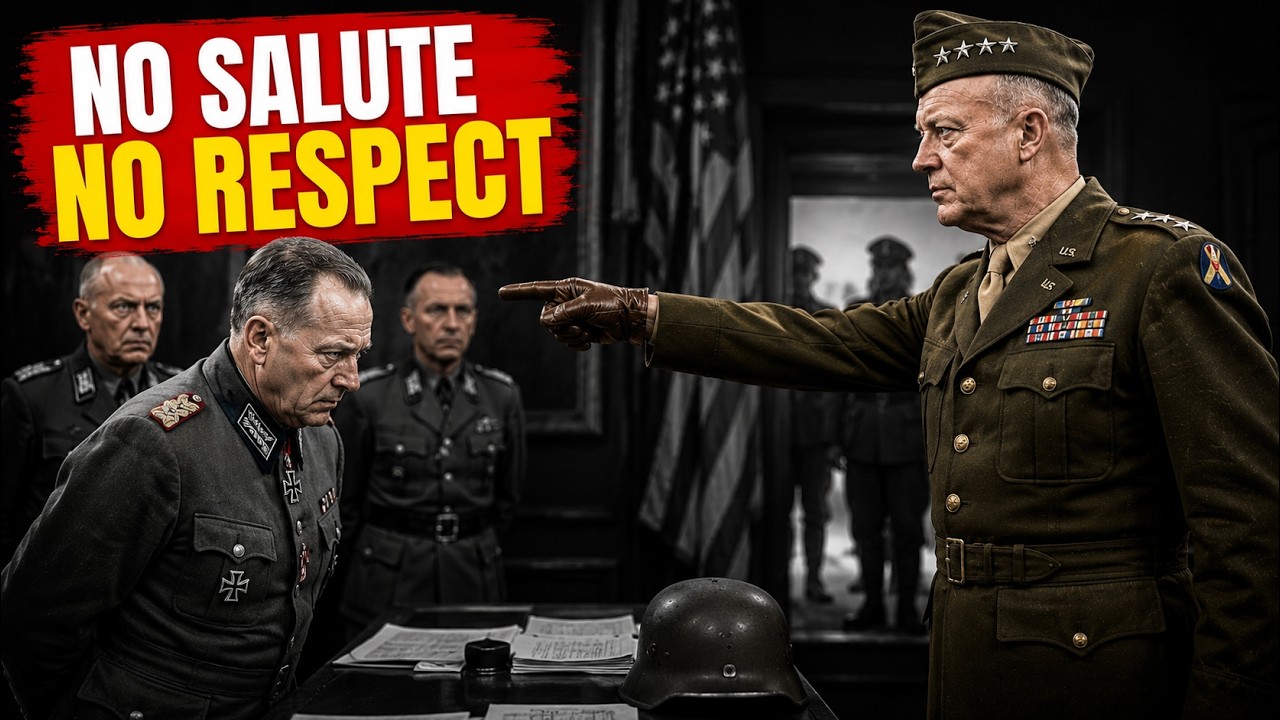
He kept writing. Thirty seconds passed, then a minute. The German’s arm stayed in the air. The American turned a page.
In that deliberate, crushing silence, the Nazi empire finally ended—not with a battle, not with a bomb, but with a young man from Ohio who simply did not care. That indifference was not accidental. It was the product of a decision made by General Dwight D. Eisenhower, and it had been building for years.
At Reims, France, at 2:41 on the morning of May 7, 1945, General Alfred Jodl sat at a plain wooden table in a small, ordinary room and signed the instrument of unconditional surrender of Nazi Germany. Eisenhower, the Supreme Allied Commander, the architect of the largest amphibious invasion in history, was not at the table. He was down the corridor in a private office, waiting for it to be over. When Jodl and the other signatories were brought to him, the meeting lasted less than sixty seconds.
Eisenhower asked one question—whether they understood the terms and were prepared to execute them. They said yes. He nodded once toward the door. To understand why that moment mattered, one must understand what the German generals expected.
For centuries, European warfare had run on an unspoken code: after a defeat, the vanquished commander surrendered his sword, and the victor acknowledged him with professional respect. This tradition had been alive as recently as 1943, when British and American commanders treated the brilliant and dangerous Erwin Rommel as a formidable professional. The German High Command carried that expectation into 1945. They had fought hard, they had lost, and now they believed the ceremony of defeat would follow.
Eisenhower had already begun to break that tradition two years earlier. In May 1943, after the collapse of the Axis position in Tunisia, General Jürgen von Arnim, the senior captured German commander, was prepared to be presented to Eisenhower. Eisenhower quietly refused to meet him. He ordered him processed as an ordinary prisoner of war.
Von Arnim was furious, his staff stunned, and even some American officers were uncomfortable. Eisenhower offered no explanation and moved on. The full reason for that refusal would not become clear until April 12, 1945, when Eisenhower drove to a place called Ohrdruf, a subcamp of the Buchenwald concentration camp system in central Germany. He went with Generals George Patton and Omar Bradley.
They had seen more war than almost anyone alive, but nothing prepared them for what was inside. The camp was littered with the bodies of slave laborers, reduced to skeletons, rotting in the spring sun. The smell hit them within twenty feet. Survivors moved toward them like figures caught between the living and the dead.
Patton, the man who had built his public identity on absolute fearlessness, walked behind a building and vomited. Bradley stood frozen, his face ashen. Eisenhower did not look away. He walked through every part of the camp deliberately—the execution shed, the torture implements, the ditches, the faces of the dead.
His jaw was clenched so tightly the muscles stood out. He was burning it in, making himself remember every detail. He turned to the American soldiers nearby and ordered them to get their cameras, to photograph everything. “Get it all on record,” he told them.
“Get the films. Get the witnesses. ” He knew that someday, someone would deny it happened. That night, he wrote to his wife, Mamie, in plain, controlled language that described what he had seen.
The emotion had not gone somewhere soft; it had gone somewhere hard and permanent. Eisenhower had finally understood exactly what the men in black uniforms were. They were not soldiers in any traditional sense. They were the administrators of a slaughter factory, and the polish on their boots and the medals on their chests were costuming.
In the days that followed, he issued an order through his command structure. It was not a dramatic announcement. The substance was simple: American soldiers would not return the salutes of SS officers and senior Nazi officials. There would be no handshakes, no fraternization.
If a captured SS general raised his arm, American soldiers were to look through him as if he were not there. If he demanded special treatment, he would receive standard prison rations and a crowded pen. The order reached every soldier, from senior generals to the youngest private on checkpoint duty. Some officers worried how Patton would react.
He agreed immediately, completely, and without qualification. Ohrdruf had reached him too. The German commanders arrived in waves, hundreds then thousands, in their staff cars and tailored uniforms, with their suitcases and personal aides, confident that the world they had inhabited for twelve years still had operational reality. It did not.
Among them was Admiral Hans Georg von Friedeburg, commander-in-chief of the German Navy, cold, formal, and precise. He had expected ceremony at Reims. Instead, he found soldiers who looked at him the way one looks at furniture. They looked through him.
It was not anger that destroyed these men—anger would have acknowledged they existed. The silence said their uniforms meant nothing. Their rank, their careers, their identities meant nothing. The man who had spent his life inside a structure that told him who he was made his calculation quickly.
On May 23, 1945, sixteen days after signing the surrender at Reims, von Friedeburg took poison in Flensburg, near the Danish border, where the remnants of the German government had gathered. He was fifty-three years old. He died with his uniform on. Alfred Jodl spent his remaining months in custody.
At Nuremberg, he was convicted on all four counts—war crimes, crimes against humanity, conspiracy to wage aggressive war—and sentenced to death by hanging. In his final statement, he said he was dying with a clear conscience for his service to the German people. He was executed shortly after 1:00 in the morning on October 16, 1946, in the prison gymnasium. It took less than two minutes.
His ashes were scattered in the Isar River near Munich. No grave, no marker, no ceremony. George Patton made a different calculation. In September 1945, as military governor of Bavaria, he began retaining former Nazi Party members in administrative positions.
Germany had to function, he reasoned, and the only people who knew how to run it were the people who had been running it. He said publicly that he saw little difference between Nazi Party membership and membership in a political party back home. The comment landed like a grenade. Eisenhower was furious and relieved him of command of the Third Army in October 1945.
On December 9, outside Mannheim, Patton’s staff car was struck by a military truck. His neck was broken. He died twelve days later in a hospital in Heidelberg, at age sixty. He never faced the public reckoning his September statements might have required, and history largely preserved him at his most heroic.
But the story does not end at Reims or Nuremberg. Beginning in 1946, American military and intelligence agencies began systematically recruiting former German scientists, engineers, and intelligence operatives. The stated purpose was to prevent their expertise from falling into Soviet hands. Wernher von Braun, who had used concentration camp slave labor to build the V-2 rockets that killed civilians across Britain and Belgium, was given an American security clearance and put to work on the rocket program that would eventually carry Americans to the moon.
Reinhard Gehlen, who had run Nazi Germany’s Eastern Front intelligence operations, was installed as the head of a West German intelligence organization funded by the CIA. These were not exceptions; they were the pattern. Some of the men whose salutes American soldiers had refused to return in 1945 were within two years receiving American government paychecks. The program operated under Eisenhower’s watch, and he did not stop it.
He made the same kind of calculation Patton had made in Bavaria—the subordination of moral complexity to operational necessity—but more carefully and more quietly. The silence of 1945 said these men were not worth acknowledging. The silence of 1947 said what they knew was worth more than what they had done. Both silences belonged to Eisenhower.
That is the part that does not resolve cleanly. He served as president for eight years, oversaw the expansion of the intelligence apparatus that employed those men, and in his farewell address in January 1961 warned of the dangers of the military-industrial complex. He knew what he was talking about because he had watched it being built. He was a man of considerable intelligence and genuine moral seriousness who operated in conditions where principle and necessity did not always point in the same direction.
The order he gave in 1945 was right. The silence in the cold room at Reims was right. But what came after was more complicated. History gives few clean endings.
It gave the gallows at Nuremberg and the image of Eisenhower standing behind his desk, asking one question and nodding toward the door. Those moments were real, and they meant what they appeared to mean. Then the next thing happened. The men turned away came back through different doors, under different arrangements.
Not most of them, but enough that the story cannot end at Reims without being incomplete. Turning away was right, but it was never enough. The harder thing—and the only thing that ultimately matters—was the remembering that changes what you build and who you allow back through the door.