In the spring of 1944, Robert Hartline was finishing his naval flight training in Corpus Christi, Texas, knowing that graduation would present a choice. He could remain in the Navy as an ensign or accept a commission as a second lieutenant in the Marine Corps. The decision was made for him in large part by a single airplane, the Chance Vought F4U Corsair. It was the fighter he wanted to fly, and that meant becoming a Marine.
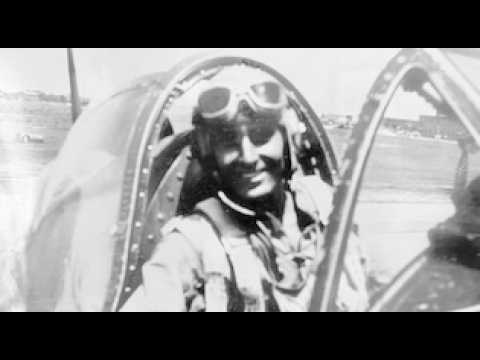
Hartline had been drawn to naval aviation almost from the moment the war began. He graduated from high school in 1942, months after the Japanese attack on Pearl Harbor, and at eighteen years old he understood that he would eventually be in the fight. He had spent his youth building model airplanes, and that experience pointed him toward the cockpit. He walked into a recruiting office in Reading, Pennsylvania, and asked to enlist as a naval aviator.
The recruiter gave him an eye test, and the results were not encouraging. His right eye tested at 20/20, but his left eye came in at 18/20, which was not good enough to qualify. He failed the test. Rather than accept that outcome, Hartline tried to improve his vision.
He drank carrot juice and performed eye exercises, though he later admitted those efforts probably did nothing. So he took another approach. He boarded a train to Philadelphia and tried again at a recruiting station there. That time, the Navy, apparently desperate for aviator candidates, accepted him.
He joined a group of about twenty prospects, who were marched through Philadelphia, given lunch at a hotel, and then loaded onto a bus bound for Embersburg, Maryland. There the Navy ran a civilian pilot training program at a small university, and the students learned to fly in a cow pasture about five hundred yards from campus. The aircraft were Piper Cubs and Aeronca Champs, light planes with little power and no room for error. Hartline and the others received thirty-five hours of instruction over three months, and his own instructor was a large man weighing about two hundred pounds.
After eight hours, the instructor climbed out of the airplane and told Hartline to take it around the pattern by himself. The first takeoff was fine, but the landing was not. With the heavy instructor no longer aboard, the Champ floated high and refused to settle onto the field. Hartline overshot the pasture, went around, tried again, was still too high, and finally put the airplane down on the third attempt.
His instructor met him on the ground and said he never thought the young cadet was coming down. From Maryland, the cadets moved to Chapel Hill, North Carolina, where they spent three months in classroom instruction each morning and compulsory athletics each afternoon. The sports were rough, ranging from football and wrestling to boxing, swimming, and obstacle courses. Hartline’s time there was marked by one memorable incident.
He fell asleep during a lecture and was put on report. He was ordered to report to a senior Navy lieutenant, a large man who looked like a former football player, and was given a rifle with instructions to march around a baseball diamond overnight to make sure the Japanese did not capture it. Decades later, when a man named Gerald Ford ran for president, Hartline recognized the face instantly and concluded that the lieutenant who had punished him at Chapel Hill was the future president, who had been stationed there at the same time. The next stop was Olathe, Kansas, where the cadets flew Stearman biplanes, a rugged trainer nicknamed the Yellow Peril because of the danger posed by inexperienced cadets at the controls.
Hartline spent three months there learning aerobatics, basic skills that were demanding precisely because the airplane was sturdy enough to survive nearly anything. From Kansas, the training moved to Corpus Christi, Texas, for advanced instruction in the SNJ, a more powerful aircraft with retractable landing gear, and the SNV, which the cadets called the Vibrator, used for instrument training at outlying fields. During one instrument flight, his instructor put the airplane through violent maneuvers under the hood, leaving Hartline unable to see outside. The instructor dove, turned, pulled up sharply, and pushed over so hard that centrifugal force held Hartline against his seat belt.
Hanging in his straps, he concluded he must be upside down. At that exact moment, however, the airplane was right side up and flying straight and level. When the instructor said, you have it, Hartline promptly rolled the airplane over. For an instant, the corrected what he believed to be an upside-down attitude, and only then was the aircraft actually inverted.
The instructor simply told him to fly back to base. The advanced training included formation flying, navigation, and gunnery practice over the Gulf of Mexico, with synchronized thirty-caliber machine guns mounted on the cowling of the SNJ. Hartline once flew an airplane that had a large hole in one propeller blade, repaired with sandpaper and a file and balanced against vibration, evidence of the hard use these training aircraft endured. During this period, a friend of his, a cadet named Arthur Lens, died in an accident that the base initially explained as flying through high-tension wires.
Hartline was chosen to escort the body home to White Plains, New York, a trip that took three days each way, with a funeral in between. Years later, he obtained the official report from the archives in Washington. The accident had occurred during a formation flight led by Lens, who had five aircraft behind him. He was leading the flight at three hundred feet near Corpus Christi when his engine failed directly over the high-tension lines.
He tried to turn back toward the airport, but an SNJ at that altitude could not recover from the stall. The airplane went through the lines, severing three cables, and crashed and burned. His cadet friends considered Hartline lucky, since bad weather kept the remaining pilots grounded for a week. On May 3, 1944, Hartline graduated from Corpus Christi and chose the Marine Corps.
He was sent to Green Cove Springs, Florida, for operational training in the Wildcat, the fighter the Japanese had first encountered at Guadalcanal, though it was already being phased out in favor of the Corsair and the Hellcat. The training lasted three months and covered fighter tactics, high-altitude gunnery, strafing, and rocket attacks. From Florida, he went to Cherry Point, North Carolina, where he was part of a group of excess pilots. To earn his flight pay, he flew as co-pilot in a PBJ, the Marine version of the Army’s B-25 Mitchell.
On one flight, the airplane carried a three-inch cannon, and the pilot was assigned to fire a single shell at a target. When he did, the aircraft seemed to stop in midair before continuing on. After Cherry Point, Hartline was assigned to fly Corsairs at Columbia, South Carolina, practicing formation flying, high-altitude gunnery, and ground-controlled approaches. By that stage of the war, American factories were producing military equipment at full capacity.
The Navy and Marine Corps alone had plants on the East Coast and two in the Midwest, operated by General Motors and Goodyear, producing some forty-six thousand aircraft in addition to the Army’s output. One special squadron based at Floyd Bennett Field in New York had between two hundred and two hundred fifty pilots, whose job for four years was simply to fly brand-new airplanes from the East Coast to the West Coast. Hartline and a few other pilots received this same assignment for five months. During those four years, fifty-seven pilots died ferrying new aircraft across the country.
Hartline personally flew twenty-one brand-new airplanes from coast to coast. He later described this as his chief contribution to the war effort. Eventually, word reached him that he was having too good a time, and he was sent to Okinawa. He joined VMF-223, a squadron he considered an honor because it had been the first Marine squadron to engage Japanese Navy pilots during the war, at Guadalcanal.
Hartline arrived with six or eight other pilots to bring the squadron up to its full complement of twenty-four. The war was already over, but the flying remained dangerous. In five months, the squadron lost three pilots in accidents. Two died in an air-to-air collision.
A third was killed flying low over an Okinawan village, crashing and killing a woman on the ground as well. From Okinawa, Hartline was sent to a small rectangular island off the west coast, roughly two miles by eight miles, which had served as a base for the Okinawa campaign and was the place where war correspondent Ernie Pyle was killed. Most personnel had already left, but one radar unit remained, and it needed a transportation officer. Hartline was relieved of his flying duties and assigned to the role.
Almost immediately, the radar outfit received orders to go home. As transportation officer, he was responsible for loading fifty-four vehicles and about 150 Marines onto an LST bound for Saipan. Shortly after the ship was fully loaded, the orders changed. They were not going to Saipan after all.
They were going to San Diego. The voyage took fifty-four days, including stops at Guam and Pearl Harbor, with forty days at sea in a landing ship that made six knots. Hartline pointed out that Columbus had crossed the Atlantic in the Santa Maria at roughly the same speed, but that ship at least had favorable winds. One night during heavy seas, the navigator, a young ensign who looked about thirteen, reported that the ship had made only three and a half miles the previous night.
After reaching San Diego, Hartline was mustered out and returned to Reading, Pennsylvania, where he was born and raised. His first job was helping build the huge knitting machines that manufactured women’s nylon stockings. He briefly considered becoming an aeronautical engineer and went as far as visiting a company in California, only to watch an engineer designing a bomb bay door, a mechanism he realized was only a small part of an airplane. Disillusioned, he returned to Pennsylvania.
He joined a small new company called the Polymer Corporation, where he worked in a laboratory developing plastics. Along with another man, he earned a patent for a process of covering metal parts with plastic so that the coating had no gaps, a method still recognizable today in the plastic-coated metal trays found in dishwashers. After leaving Polymer, he went to work for Western Electric, which had opened a plant in Reading because the town was known for its mechanics. Western Electric specialized in telephone equipment for AT&T, and the Reading plant was being built to manufacture transistors and other electronic components.
Producing integrated circuits requires depositing and evaporating metals such as gold, which requires vacuum chambers, which require pumps. Hartline had experience with pumps from his time developing the supercharger he had once wanted to design. A classmate working in human resources at Western Electric knew of his background and helped him get a job. He stayed for thirty years and retired with a pension.
Hartline never lost his interest in flying. He bought, maintained, and flew four different airplanes over the years, the last being a Cessna 172 Skyhawk. He was active in the Experimental Aircraft Association and became president of the local chapter in Reading, which built and flew more than twenty airplanes over the years. He flew into his eighties before selling his last aircraft.
Reflecting on his service, Hartline noted that the military taught him that life presents many challenges and that the task is to meet them and resolve them while keeping oneself intact. He said it taught him to maintain a positive attitude and to use his brains. He was among the youngest naval aviators in the war, part of a small group of perhaps five Navy and Marine pilots who could claim that distinction, a group that included future president George H. W.
Bush. When asked for advice to young people, Hartline, at the age of 101, offered a short and direct answer: keep your head out of your ass.