On a July morning in 1881, Charles Guiteau stepped forward in the Baltimore and Potomac railroad station in Washington and fired two shots into the back of President James Garfield. As the president collapsed onto the marble floor, Guiteau announced to the stunned crowd that he was a stalwart and that Chester Arthur was now president. He was not a revolutionary and not an anarchist. He was a failed lawyer and delusional office seeker who had spent months haunting government buildings demanding a diplomatic post in Paris on the strength of a single mediocre campaign speech he had printed at his own expense.
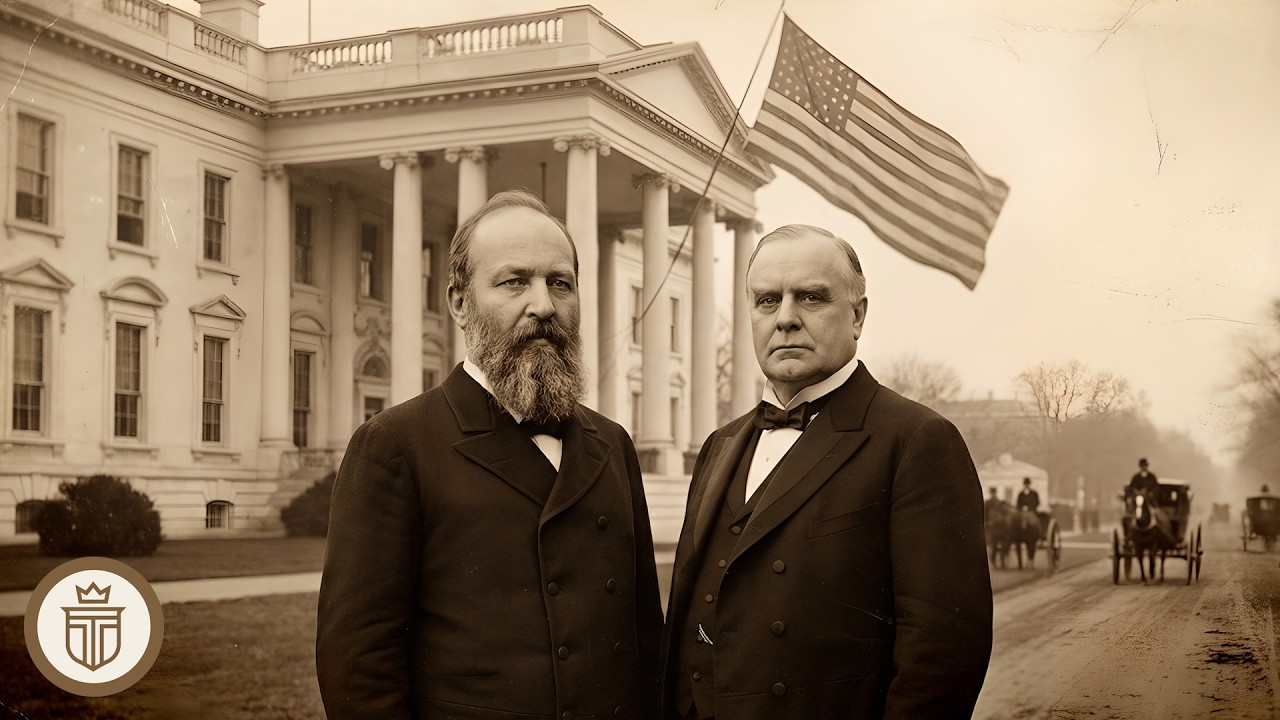
Twenty years later, another outsider approached another president. At the Pan-American Exposition in Buffalo, a Polish immigrant factory worker named Leon Czolgosz shot William McKinley at close range during a public reception. He believed the president was the enemy of good working people. He was an unemployed laborer radicalized by anarchist lectures and newspaper clippings about European assassins who killed kings in the name of revolution.
Two presidents, two assassins, two entirely different pathologies born from the same corrupt and unequal political order. Garfield’s murder exposed the rot of a system in which federal jobs were handed out as rewards for party loyalty and triggered the first major civil service reform in American history. McKinley’s murder ended an era of passive presidents who deferred to party bosses and brought Theodore Roosevelt to power with a mandate to regulate the trusts. The political system that produced both assassins ran on a single brutal principle: government jobs belonged to whoever won the election.
When a new president took office, he controlled tens of thousands of federal appointments scattered across the country. Postmasters, customs collectors, clerks, marshals, and inspectors owed their positions entirely to which party held the White House. These jobs were not filled based on competence. They were rewards distributed to local party workers, donors, and the bosses who delivered votes on election day.
Officeholders were expected to pay assessments, a percentage of their government salary kicked back to the party organization that had secured their position. The federal payroll had become an informal fundraising apparatus. In major cities, patronage sustained powerful machines like New York’s Tammany Hall, which under leaders like Boss Tweed exchanged jobs and relief for votes. Machine operatives met immigrants at the docks, helped them find housing, and in return expected reliable support at the polls.
Elections were noisy, public, and often corrupt. Multiple voting and ballot box stuffing were common enough that reformers treated them as facts of political life. The same culture extended into spectacular federal corruption. In the Crédit Mobilier scandal, railroad executives created a construction company to siphon inflated profits from federally subsidized projects and distributed discounted stock to congressmen to prevent investigation.
The Whiskey Ring saw treasury officials colluding with distillers to evade taxes. Reformers had called for competitive examinations for decades, but party bosses resisted every attempt. By 1880, the Republican Party had fractured into warring factions. The Stalwarts, led by New York Senator Roscoe Conkling, defended traditional machine politics.
The Half-Breeds favored civil service reform. Both factions wanted control of the roughly 100,000 federal posts a new president could distribute. The 1880 Republican Convention deadlocked for 35 ballots. Stalwarts pushed for Ulysses Grant’s unprecedented third term; Half-Breeds rallied behind reform-minded alternatives like James G.
Blaine. On the 36th ballot, exhausted delegates turned to a compromise: James A. Garfield of Ohio, a seasoned congressman with an image as a reformer acceptable to moderates. To please the Stalwarts, they paired him with Chester A.
Arthur as vice president, a machine politician who had served as collector of the Port of New York, one of the richest patronage strongholds in the country. Garfield won the general election and took office in March 1881. His appointment of James G. Blaine as Secretary of State enraged Stalwart leaders.
Worse, Garfield challenged Conkling’s grip on the New York customhouse by nominating William H. Robertson, a Conkling enemy, to the crucial post of collector. Conkling and his ally Thomas Platt resigned from the Senate in protest, expecting vindication. Instead, the legislature humiliated them by electing replacements.
The Stalwart machine was crumbling, and its loyalists grew desperate. Among them, or so he imagined, was Charles Guiteau. He was a drifter with a long history of failed schemes: a failed law practice, a failed religious commune, failed attempts at journalism and lecturing. He had attached himself to the 1880 campaign by distributing copies of a speech he had written supporting Garfield, and he convinced himself that this minor contribution entitled him to a diplomatic appointment.
For months he haunted government buildings demanding the consulship in Paris. Each rebuff deepened his conviction that the administration had betrayed loyal party workers like himself. He stalked the president, noting that newspapers had published Garfield’s travel schedule and that security was minimal. The idea that a president needed protection from the public had not yet taken hold in American life.
On the morning of July 2, 1881, Guiteau waited at the railroad station with a . 44 caliber revolver. As Garfield walked through the waiting room with Secretary of State Blaine, Guiteau approached from behind and fired twice. One bullet grazed the president’s arm.
The other entered his back, fractured a rib, and lodged near his spine without severing the spinal cord. Garfield remained conscious and was carried back to the White House on a mattress. What followed was a medical catastrophe that lasted eighty days. Although European surgeons had already demonstrated antiseptic techniques, many American doctors remained skeptical.
Dr. D. Willard Bliss and his colleagues repeatedly probed Garfield’s wound with unsterilized fingers and instruments, searching for the bullet. They misjudged its path entirely, exploring the right side of his back when the projectile had actually veered left.
Their probing created new channels that filled with pus and introduced massive infection into wounds that might otherwise have healed. Garfield endured severe fevers and excruciating pain. Doctors treated him with opiates that left him weak. Because he could not keep food down, they resorted to rectal feeding of beef broth, eggs, and whiskey in a desperate attempt to maintain his strength.
In early September, he was moved to a cottage in Elberon, New Jersey, in hopes that sea air would ease his suffering. It did not. On the night of September 19, 1881, he complained of severe chest pain and died. The autopsy revealed widespread sepsis, pneumonia in both lungs, and a ruptured aneurysm of the splenic artery.
At his trial, Guiteau famously declared that he had only shot the president; the doctors killed him. Historical experts who later reviewed the records concluded that Garfield might well have survived if the wound had been treated with modern antiseptic surgery or even with less invasive care. The court applied the felony murder rule regardless. Guiteau was hanged in June 1882.
Americans had followed daily bulletins on Garfield’s condition throughout that terrible summer. Editorials, sermons, and speeches portrayed him as a martyr to a corrupt political order. Reformers who had struggled for decades suddenly possessed moral authority no argument could match. Chester Arthur faced a nearly impossible situation.
His background as a machine politician made reformers suspicious. The assassin himself had proclaimed Arthur’s elevation as the purpose of the murder, linking the new president to the culture that produced Guiteau. Arthur understood that many Americans suspected conspiracy. He repositioned himself, endorsing civil service reform and calling on Congress to curb patronage abuses.
The result was the Pendleton Civil Service Reform Act of 1883. The law established a civil service commission and required that certain federal jobs be filled through competitive examinations. It prohibited covered employees from being fired for political reasons and banned the solicitation of political contributions on federal property. Initially, the statute covered only about ten percent of federal positions, but presidents could expand the protected service by executive order, and many did.
Garfield’s assassination had accomplished what decades of reform agitation could not. Twenty years later, a very different assassin emerged from a very different crisis. Leon Czolgosz was born to a Polish immigrant family near Cleveland and worked in steel mills and factories throughout his youth. He lost his position during the panic of 1893, one of the worst economic downturns in American history, and drifted through irregular employment searching for explanations of why boom and bust cycles destroyed workers’ lives.
He found those explanations in anarchist meetings and radical newspapers. He was particularly struck by reports of Gaetano Bresci, the Italian anarchist who had assassinated King Umberto I in 1900, and carried newspaper clippings about him. In May 1901, Czolgosz attended an Emma Goldman lecture that he later described as a turning point. He left convinced that the president of the United States personified the injustice of existing institutions.
Czolgosz acted alone. He read that President McKinley would attend the Pan-American Exposition in Buffalo that September. He bought a gun and a train ticket, stalked McKinley during several public appearances, and on September 6, 1901, approached the president at a reception in the Temple of Music. He carried his pistol concealed beneath a bandage wrapped around his hand and fired twice at point blank range.
McKinley died eight days later from gangrene caused by the wounds. At his brief trial, Czolgosz refused to cooperate with his lawyers. He was executed by electric chair in October 1901, just forty-five days after the shooting. His final words reportedly were that he killed the president because he was the enemy of the good people, the good working people, and that he was not sorry.
The man who replaced McKinley was forty-two years old, the youngest president in American history, and he had very different ideas about government and corporate power. Theodore Roosevelt believed the federal government should act as a counterweight to the trusts that had flourished under decades of laissez-faire policy. Under his stewardship, the government filed major antitrust cases, including the suit that broke up Northern Securities, one of the largest railroad holding companies in the country. He backed the Elkins and Hepburn Acts to regulate railroads, pressed for pure food and drug legislation, and launched an ambitious conservation program, reserving millions of acres as national forests, parks, and monuments.
Roosevelt envisioned a stewardship model of the presidency, claiming broad authority to act in the public interest. His administration confronted the trusts, built an activist administrative state staffed by experts rather than party loyalists, and expanded the professional civil service. The two assassinations trace the evolution of the American state. Garfield’s death marked the beginning of the end of an order where federal jobs were political spoils and presidents were ensnared in ceaseless factional bargaining over appointments.
McKinley’s death marked the end of an era where presidents deferred to party bosses and corporate allies, clearing the way for a more assertive presidency that claimed to speak for the national public against concentrated economic power. Guiteau was the grotesque offspring of spoils politics. Czolgosz was the product of industrial capitalism’s brutalities. Together, their bullets forced Americans to confront what the Gilded Age had actually been: a hollowed-out state captured by machines and big business, presiding over a society riven by inequality and ideological extremism.
The reforms that followed were responses to the problems those two assassinations so violently illuminated.