In August 1823, deep in the unmapped badlands of present-day South Dakota, a mountain man named Hugh Glass walked into a mother grizzly bear defending her cubs. The animal struck before he could raise his rifle, tearing open his back, breaking bones, and shredding the flesh from his shoulders. She left him in the dirt unable to stand or speak. His companions stitched what they could and concluded that no man could survive such wounds in that country.
Two stayed behind to bury him when the end came. When it did not come quickly enough, they took his rifle, his knife, his tomahawk, his powder and shot, everything he needed to live, and walked away. Hugh Glass did not die. He crawled two hundred miles to Fort Kiowa on the Missouri River, a journey that took six weeks.
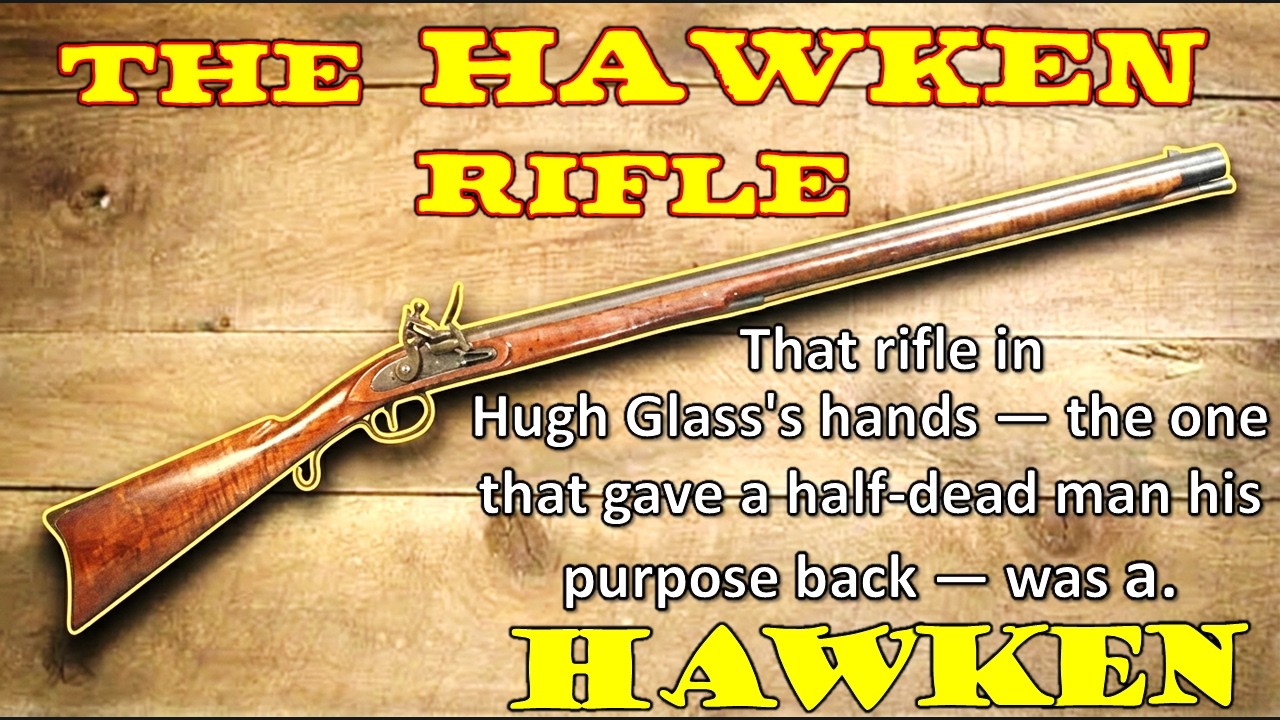
He ate insects, raw snake meat, and whatever the prairie offered a man moving on his hands and knees through hostile country. When he finally reached the fort and got a new rifle in his hands, the first thing he did was go looking for the men who had left him. The rifle in Hugh Glass’s hands, the one that gave a half-dead man his purpose back, was a Hawken. It represented a fundamental shift in the weapons of the American frontier, and its development grew directly out of what the frontier demanded.
To understand why the Hawken mattered, it is necessary to understand what it replaced and why that older weapon was failing the men who depended on it. The Kentucky long rifle had served the eastern frontier with distinction for a generation. It was slender, elegant, accurate at range, and built for the conditions of the eastern woodland, where a man had timber for cover, moderate game, and a reasonable expectation that the shot he fired would not need to stop something the size and temperament of a plains grizzly bear. The Kentucky rifle was a woodsman’s weapon.
It was not a mountain man’s weapon, because the mountain man’s world required something the Kentucky rifle could not consistently deliver: a heavy, large-caliber round that would anchor dangerous game before it covered the ground between the muzzle and the man holding it. The Hawken answered that requirement with the directness of men who understood exactly what they were building and for whom. Jacob Hawken arrived in St. Louis in 1818, a trained armorer who had spent a decade at the federal arsenal at Harpers Ferry, Virginia, working on military arms and absorbing the engineering principles that distinguished a service weapon from a display piece.
He understood metallurgy, and he understood the relationship between barrel weight, caliber, and downrange performance under field conditions. His younger brother Samuel joined him in St. Louis in 1822 after the deaths of their father and Samuel’s wife in the same year drove him west. Their formal partnership began in 1825 on the death of Jacob’s earlier business partner, James Lakenan.
What they produced from that shop on the Mississippi riverfront was not an iteration of the Kentucky rifle with heavier proportions. It was a deliberate departure from the eastern design philosophy, built around the documented demands of the men who would carry it across the Rocky Mountains and the Great Plains. The octagonal barrel ran thirty-three to thirty-six inches in browned iron, not the bright-finished lengths of the eastern makers. The bore averaged .
54 caliber, wide enough to launch a round ball of sufficient mass to bring down a buffalo with one shot placed correctly, or to arrest a grizzly charge at the distance that separated a living man from a dead one. The half-stock design, walnut or maple, ended at the midpoint of the barrel rather than extending to the muzzle, reducing weight without compromising the structural integrity that the heavy barrel required. The complete rifle came in at around ten pounds, heavy by the standards of eastern rifles, acceptable to men who understood that what they were buying was not elegance, but authority. The double set trigger system defined the Hawken reputation for accuracy under field conditions.
Two triggers. The rear trigger, when pulled first, engaged a mechanical set that reduced the pull weight of the front trigger to a matter of ounces, a hair trigger in the language of the men who used it, capable of releasing the hammer with a pressure so light that the shooter’s hand position barely registered the moment of firing. Pulling the rear trigger first, then touching the front with a breath of pressure, the shot broke at precisely the moment the sight picture was correct, not a fraction before or after. In open country, at distances where the difference between a center hit and a miss meant the difference between a full camp and an empty one, this mechanism was not a refinement, it was the margin.
The effective range of the Hawken in competent hands reached four hundred yards. At that distance, a . 54 caliber round ball launched on a charge of black powder carried sufficient energy to end any engagement the frontier was capable of producing. The shop on the St.
Louis waterfront produced approximately one hundred twenty rifles per year at its peak output. Each one was handmade, each unique in its specific dimensions, no two exactly alike. Between 1825 and 1840, during the height of the annual Rocky Mountain rendezvous that gathered trappers, traders, and mountain men from across the frontier, the brothers produced an estimated one thousand rifles. These were not mass-produced arms distributed through commercial channels.
They were purchased individually, often custom-ordered to a specific man’s requirements, built by craftsmen who understood that the rifle they were making would go places and face conditions that nothing they could do in a St. Louis workshop could fully prepare it for. The men who carried Hawken rifles into that country were the specific names that the mountain man era is remembered by. Jim Bridger carried one.
Kit Carson’s personal Hawken was bored to a remarkable . 70 caliber, a round of such mass that Theodore Roosevelt, who owned the rifle in later life, reportedly kept it as a display piece and a monument to a man whose confidence in his own marksmanship had been absolute. Jedediah Smith and William Henry Ashley carried custom-made examples on the expeditions that opened the beaver country of the upper Missouri. The rifle cost between twenty-two and thirty dollars at the St.
Louis shop in its prime. For a common laborer, that was two to three months of wages. For a mountain man heading into country where his survival depended on a single weapon performing without failure across months of extreme conditions, it was not an extravagance. It was the most rational calculation available.
Jacob Hawken died in 1849. Samuel continued to build rifles in the same style until his retirement in 1855. The shop changed hands, continued under different proprietors, and finally went dark in the early years of the twentieth century. Its tools, patterns, and surviving stock were eventually purchased by a St.
Louis antique dealer in the 1960s. By then, the breech-loading era had long since ended the practical dominance of the muzzle loader on the frontier. The Hawken’s commercial decline had begun in the mid-1850s as the cartridge revolution made the reload cycle of the muzzle-loading percussion rifle a liability that no amount of accuracy or caliber could fully offset. But the rifle did not disappear from the cultural record.
It had been carried by too many men into too many consequential places to be absorbed quietly into history. Hugh Glass limped into Fort Kiowa on October 11, 1823, emaciated and scarred, moving on legs that had not fully healed. He purchased a new rifle and set out to find the men who had left him in a South Dakota coulee with his gear stripped and his grave dug. He covered another seventeen hundred miles before the pursuit was finished.
When he finally stood in front of Jim Bridger, he looked at a teenager barely out of boyhood and walked away. Fitzgerald had joined the army by then, placing him beyond Glass’s reach by law. By the accounts that survive, Glass forgave them both. He went back to the mountains and the trade that had nearly finished him, with a rifle in his hands and the specific knowledge of a man who had tested what he was made of against the worst the frontier could produce.
The Hawken that went with him was not a symbol or a legend. It was a tool. Precise, durable, built for the country it was going into by men who understood exactly what that country required.
In the hands of the men who carried it west, it was enough.