On August 9, 1945, just three days after Hiroshima was obliterated by a single weapon, the Imperial Japanese war machine still had not surrendered. The militarists in Tokyo, sheltered in their fortified bunkers, convinced themselves that the United States could possess only one such device. They were wrong. On the coral runways of Tinian in the Marianas, a second weapon was being readied—more complex and considerably more powerful than the first.
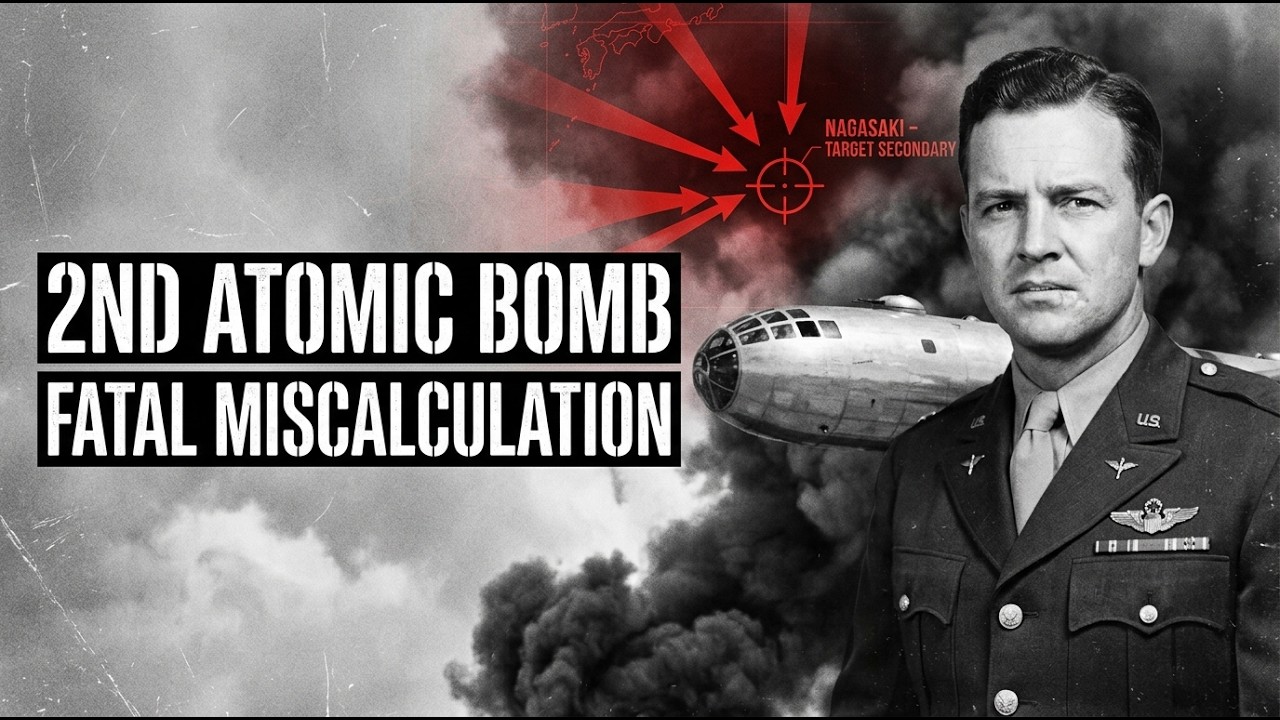
This was not a repeat of the first strike, but something entirely different, aimed at a target that was never supposed to be hit that day. To understand why a second atomic bomb was dropped and why Nagasaki became the unfortunate recipient of this plutonium core, it is necessary to consider the strategic nightmare of the Pacific theater in the summer of 1945. The United States was not fighting a conventional enemy. It was fighting a nation whose cultural and military doctrine was built around the concept of gyokusai, the shattered jewel, the honorable act of fighting to the last man, woman, and child rather than accepting the shame of capture or defeat.
The island-hopping campaign had proven this with blood. At Tarawa, Guadalcanal, Iwo Jima, and Okinawa, American forces faced an enemy whose defeat required complete annihilation. At Okinawa alone, over 100,000 Japanese soldiers and civilians died, often by their own hands rather than surrender. The Japanese high command looked at the ruins of Hiroshima and calculated coldly that the United States had played its only trump card, assuming the Manhattan Project had been a limited scientific endeavor capable of producing a single prototype.
This leads to the grim reality of Operation Downfall, the planned Allied invasion of the Japanese home islands. The Pentagon’s estimates were staggering. American casualties were projected to reach one million men. The War Department ordered 500,000 Purple Heart medals manufactured in anticipation of the slaughter.
To put that in context, the US Army is still distributing from that same batch today, having survived Korea, Vietnam, Iraq, and Afghanistan without ordering more. That was the scale of bloodshed the United States was trying to avoid. On the other side of the Pacific, the Japanese were fully aware of the impending invasion. They had devised Operation Ketsu-Go, the decisive operation, a deep defense strategy that made the German Atlantic Wall look like a simple wooden fence.
They correctly deduced that the initial American landings would target the southern island of Kyushu to establish airfields for the final push toward Tokyo. By August 1945, they had massed 14 divisions, over 900,000 troops, on Kyushu. The Imperial government had also mobilized 28 million civilian volunteers, arming schoolgirls with sharpened bamboo spears. They had stockpiled over 10,000 aircraft for coordinated kamikaze waves.
The Japanese strategy was not to win the war but to inflict catastrophic losses so Washington would be forced to negotiate a conditional peace that preserved the imperial system and avoided war crimes tribunals. It was this context that necessitated the second strike. The United States had to prove not only the ability to destroy a city with one bomb but the industrial capacity to do so repeatedly. The bomb designated for the second drop was completely different from the one dropped on Hiroshima.
Hiroshima’s weapon, nicknamed Little Boy, was a gun-type uranium device. It was simple in design, so simple that scientists at Los Alamos did not bother testing it before combat. But uranium-235 was extremely difficult and slow to enrich. The United States had essentially used its entire stockpile in Little Boy.
They needed a different fissile material: plutonium. Plutonium-239 could be produced in much larger quantities in reactors like those built at Hanford, Washington. However, plutonium came with a massive engineering headache. It had a higher rate of spontaneous fission.
If one tried the simple gun method with plutonium, the material would begin to react and melt before the two masses fully joined, resulting in a fizzle. To get a real atomic yield from plutonium, scientists had to design an implosion-type weapon. This was the device nicknamed Fat Man. Fat Man was a massive, bloated weapon, 128 inches long, 60 inches in diameter, weighing a staggering 10,800 pounds.
At its core was a solid sphere of plutonium alloy in the delta phase, weighing only 13. 6 pounds, about the size of a softball. Surrounding this core was a complex arrangement of high explosives, shaped into 32 precision lenses arranged like soccer ball panels. The idea was to detonate all 32 lenses simultaneously.
The explosion force drives inward, compressing the plutonium core to twice its normal density, pushing it into a supercritical state. In that precise microsecond, a polonium-beryllium initiator at the center releases a flood of neutrons, starting the chain reaction. If just one of those explosive lenses fired a thousandth of a second late, the shockwave would be asymmetrical, and the weapon would fail. This is why the Trinity test in New Mexico in July 1945 used a plutonium implosion device.
They had to know if the complex engineering would actually work. It did. This monster required the pinnacle of World War II aviation technology, the Boeing B-29 Superfortress, a heavy bomber so advanced that its research and development costs exceeded the entire Manhattan Project. The specific unit tasked with this unprecedented mission was the 509th Composite Group, commanded by Colonel Paul Tibbets, a highly secret independent unit stationed on the island of Tinian.
The unit’s target list had been subject to intense debate. The primary target was the city of Kokura, which housed one of Japan’s largest weapons arsenals, a vast complex producing conventional weapons, artillery, and ammunition. The secondary target was Nagasaki, a major port and vital center for shipbuilding and heavy industry, including the massive Mitsubishi shipyards, electrical equipment factories, and weapons plants that had produced the torpedoes used at Pearl Harbor. However, Nagasaki was not an ideal target for an atomic bomb.
The city lay in a series of deep valleys separated by mountains. The blast radius of an atomic weapon is more effective over flat terrain like Hiroshima. Nagasaki’s hills would act as natural blast walls. As the second week of August began, pressure mounted on the 509th Composite Group.
Weather over Japan was deteriorating with a massive typhoon system threatening to ground all bomber operations for a week. The military command in Washington wanted the second bomb dropped immediately to maintain the psychological shock. The schedule was accelerated. The plutonium core was carefully inserted into Fat Man, and the weapon was loaded into a B-29 named Bockscar, piloted by Major Charles Sweeney.
The mission was plagued by mechanical failures and unusual conditions from the moment the engines started. During pre-flight checks in the early hours of August 9, the flight engineer, Master Sergeant John Kuharek, discovered a catastrophic problem in the fuel transfer system. The B-29 was equipped with a reserve tank in the bomb bay holding 600 gallons of aviation fuel. The transfer pump that was supposed to pump that fuel into the main engine lines was completely inoperative.
This meant Bockscar was carrying an extra 3,600 pounds of dead weight it could not consume while being deprived of vital fuel for the return trip. By standard operating procedure, one does not take off with a broken aircraft, especially one loaded with an experimental 10,800-pound plutonium weapon. But this was not a routine mission. Sweeney made the tactical decision to fly with the disabled aircraft, understanding that in total war, the mission determines the level of acceptable risk.
At 3:47 a. m. , Bockscar lumbered down Tinian’s coral runway. The aircraft was massively overweight.
The four R-3350 engines screamed at maximum power, burning precious fuel just to get the beast airborne. Sweeney kept the nose low, using every inch of the 8,500-foot runway before lifting into the dark sky. Once airborne, the harsh realities of the mission profile emerged. The flight to Japan was not a direct route.
To avoid draining batteries and stressing electrical systems, the bomb was kept in a relatively inert state during takeoff. The weaponeer, Navy Commander Frederick Ashworth, had to enter the unpressurized bomb bay during flight to manually arm Fat Man, replacing green safety plugs with red ones on a device capable of vaporizing an entire city. The arming sequence was completed without error, but the mission’s difficulties were just beginning. The tactical plan required Bockscar, met by two other B-29s over Yakushima Island off the southern coast of Kyushu before proceeding to the primary target.
One aircraft carried blast measurement instruments, the other carried photographic equipment. Sweeney arrived at the rendezvous point and met one aircraft, but the photography plane was not there. Strict radio silence was imposed to avoid alerting Japanese early warning radar networks. The mission parameters set a maximum wait time of 15 minutes at the rendezvous point.
Hoping to execute the mission with full documentation, Sweeney orbited for an exhausting 45 minutes. This was a critical tactical error forced by the chaos of war. Those 45 minutes of waiting consumed thousands of pounds of fuel Bockscar desperately needed to compensate for the trapped reserve tank. The missing B-29 was actually flying at a higher altitude, following a slightly different pattern, a miscommunication that nearly doomed the entire operation.
Realizing the fuel was running low and time was lost, Sweeney and Ashworth decided to break the orbit and proceed to the primary target with just two aircraft. The target was the city of Kokura, home to one of the largest and most important weapons arsenals in the empire. But as Bockscar approached the initial point for the bombing run, environmental conditions shifted dramatically. The weather was supposed to be clear, but the city was obscured by an impenetrable haze.
The previous day, American B-29s had firebombed the neighboring city of Yawata, and the massive fires were still raging. The prevailing winds pushed a huge curtain of black smoke directly over Kokura. Additionally, some historical accounts suggest that Japanese workers at a coal factory in Kokura deliberately lit barrels of coal to create a smoke screen upon hearing the air raid sirens. The orders from General Groves and the strategic air force command were strict: the atomic bomb must be dropped visually.
The bombardier had to positively identify the target through the Norden bombsight. Radar bombing was strictly forbidden. Sweeney flew Bockscar over Kokura not once, not twice, but three separate times. For nearly an hour, the heavy bomber circled the sky above the primary target.
Japanese anti-aircraft batteries began tracking them, and radio intercepts indicated fighter squadrons were taking off from nearby airfields. Fuel indicators were dropping toward the red line. After three failed attempts, under fire, and with fuel critical, Sweeney and Ashworth made a decision: they could not stay over Kokura. They barely had enough fuel to reach the emergency airfield on Okinawa.
They had to fly to the secondary target, drop the weapon, and pray they could get the B-29 to Okinawa before the engines ran dry. Bockscar turned southwest, leaving Kokura behind, and began a desperate dash toward the western coast of Kyushu. Approaching Nagasaki at 10:50 a. m.
, the crew faced another crushing disappointment. The weather front had arrived, and Nagasaki was 70 to 80 percent covered in clouds. The visual aiming point was completely obscured. The fuel situation went from critical to catastrophic.
There was barely enough time for one pass. Commander Ashworth, the senior officer responsible for the weapon, made a command decision that directly violated his orders. He authorized a radar approach as the rigid rules of engagement collided with the immediate reality of a flashing fuel gauge. He refused to let strict rules of engagement cost them the mission.
He ordered the radar operator to guide them in. The B-29 settled at 31,000 feet. The bomb bay doors snapped open. At 11:01 a.
m. , seconds before the release point, a miracle occurred. Bombardier Kermit Beahan, staring through the Norden sight, spotted a brief opening in the cloud layer. Through that temporary gap, he saw the clear geometry of a stadium running track in the Urakami Valley, about a mile and a half north of the intended aiming point.
It was close enough. Beahan shouted that he had it, took over the drop sequence, and aligned the crosshairs on the stadium. At exactly 11:02 a. m.
, the shackles released. The 10,800-pound nightmare dropped from Bockscar’s belly. The sudden loss of five tons of weight caused the huge B-29 to lurch violently upward. Sweeney immediately threw the aircraft into a sharp 60-degree diving turn to put maximum distance between the fragile aluminum airframe and the impending nuclear flash.
The crew had exactly 43 seconds to get away. As Fat Man fell, its complex internal mechanisms awakened. Radar altimeters began measuring altitude. The weapon was designed to detonate 1,650 feet above the ground.
At this precise altitude, the initial blast wave travels downward, hits the ground, and reflects upward. This reflected wave merges with the expanding shockwave, creating a phenomenon known as the Mach stem, a consolidated wall of compressed air that sweeps across the surface parallel to the ground at hundreds of miles per hour. At 11:02 a. m.
, the radar altimeters confirmed optimal altitude. The electrical firing circuits closed. In a fraction of a millisecond, the 32 explosive lenses detonated in perfect symmetry. The conventional explosion traveled inward, crushing the softball-sized plutonium sphere.
The density of the metal doubled. The initiator released a flood of neutrons. The chain reaction began in less time than it takes a human nerve to send a signal. A substantial portion of the 13.
6 pounds of plutonium underwent fission. The resulting energy release was equivalent to 21,000 tons of TNT detonating simultaneously. The immediate result was a flash of light so intense it temporarily blinded anyone looking in its direction miles away. A wave of thermal radiation heated the air to temperatures exceeding 10 million degrees Fahrenheit at the hypocenter, hotter than the surface of the sun.
The Urakami Valley experienced instant annihilation. The massive Mitsubishi steel and arms factories lay directly beneath the explosion. They did not simply collapse. Steel structures melted.
Concrete turned to dust. Heavy machinery flew through the air like discarded toys. The thermal pulse ignited everything combustible within a two-mile radius, instantly vaporizing thousands of workers and civilians. However, Nagasaki’s geography imposed a different tactical result than the bombing of Hiroshima.
Hiroshima was built on a flat river delta, allowing Little Boy’s blast wave to expand uniformly, leveling nearly the entire city. Nagasaki was a city of hills and deep valleys. The bomb detonated directly over the Urakami Valley, surrounded by steep hills. In atomic warfare, the rules of terrain are violently inverted.
The hills did not protect the valley. Instead, they acted as the walls of a blast furnace. The kinetic energy of the shockwave hit the hills and bounced back, intensifying the pressure within the valley itself. The destruction was concentrated, contained, and absolute.
Yet, those same hills protected the rest of the city. The historic center of Nagasaki, its main commercial districts, and its key port facilities were shielded by the intervening terrain. This geographic accident limited the immediate death toll to an estimated 35,000 to 40,000 people. A horrifying number, but far lower than the casualties on Hiroshima’s flat plains, even though the Nagasaki bomb was about 50 percent more powerful.
High above the slaughter, Major Charles Sweeney was fighting for his aircraft’s survival. The first shockwave hit Bockscar like a physical punch, violently throwing the huge bomber upward. Moments later, a second wave struck, reflected from the ground. Looking back, the crew witnessed a terrifying boiling column of radioactive smoke and debris rising at thousands of feet per minute.
But Sweeney had no luxury to stare at the end of the world. The fuel gauges hovered near zero. The return flight to Tinian was arithmetically impossible. The only viable option was a desperate dash toward the recently captured island of Okinawa, hundreds of miles to the south.
The flight to Okinawa was an exercise in extreme fuel conservation. Sweeney pulled the throttles back, reduced engine rpm, and leaned the fuel mixture as much as possible without the engines stopping. The bomber descended in a shallow glide, trading altitude for distance. Approaching Yontan airfield, the situation deteriorated from critical to extreme emergency.
Sweeney tried to radio ahead to declare an emergency landing, but the radio was broken. As they crossed the runway threshold, the number two engine sputtered and died, completely out of fuel. Moments later, the number one engine stopped. The massive B-29 hit the runway pavement hard, shaking violently.
Sweeney slammed on the brakes, but the aircraft was traveling too fast. The loss of engine power meant a loss of hydraulic pressure. The brakes began to fade. The bomber raced down the runway, heading directly toward a row of parked B-24 Liberators at the far end.
Sweeney ordered the remaining engines to reverse thrust. The two remaining engines roared, trying to resist the forward momentum. Bockscar finally shuddered to a stop, its nose tilted down, feet away from the parked aircraft. When emergency crews arrived, they discovered the fuel tanks were bone dry.
The aircraft had landed literally on fumes. While Bockscar’s crew cheated death on an Okinawa runway, the strategic shockwaves of the Nagasaki bombing were hitting the Imperial Palace in Tokyo. Hours before the bomb fell, the Soviet Union had launched Operation August Storm. Joseph Stalin had shredded the Soviet-Japanese Neutrality Pact and sent over 1.
5 million battle-hardened Red Army soldiers, fresh from the destruction of Nazi Germany, to smash through the border into Japanese-occupied Manchuria. This was an unprecedented strategic catastrophe. The Japanese Kwantung Army was a hollow shell, its best units stripped away to fight the Americans. The Japanese Ketsu-Go strategy relied heavily on the assumption that the Soviet Union would remain neutral and perhaps mediate a negotiated peace.
That illusion evaporated at dawn on August 9 when news of the Nagasaki bombing reached the Supreme Council for the Direction of the War. Japanese leadership was trapped in a collapse on two fronts yet, incredibly, the military hardliners still refused to surrender. War Minister Korechika Anami argued the army must continue fighting, demanding terms the Allies would never accept. The deadlock was absolute.
Breaking it required an unprecedented intervention from Emperor Hirohito. The Emperor, traditionally a silent figurehead, realized that the combination of the Soviet invasion and America’s possession of an unlimited arsenal of atomic weapons meant the literal annihilation of the Japanese people. The Emperor ordered the government to accept the terms of the Potsdam Declaration. The Nagasaki bombing was the final punctuation mark of World War II.
It proved to the world, and specifically to Joseph Stalin, that Hiroshima was not an exception. The United States possessed the industrial capacity to produce mass destruction. This realization shifted the global paradigm immediately. The atomic bomb was no longer just a tactical weapon used to end a war but a strategic deterrent to prevent the next one.
A direct line can be drawn from the flash over the Urakami Valley to the tense standoff of the Cuban Missile Crisis 17 years later. The doctrine of mutually assured destruction, that terrifying logic that prevented the Cold War from turning hot, was born in the radioactive ashes of Nagasaki. On August 9, 1945, a second atomic bomb was dropped on a city that was never meant to be the target, because a broken fuel pump, a lost aircraft, and a curtain of smoke over Kokura conspired to redirect the course of history.
The war ended days later, and the world entered a new and terrible age.