In the summer of 1945, the war in Europe was over, but the peace had not yet settled into stability. The Allies who had defeated Germany now occupied it, administering a defeated country divided between armies that had fought toward each other from opposite ends of a continent. For the first time, Soviet and American forces were close enough to see each other clearly, and what they saw did not always produce admiration. General George S.
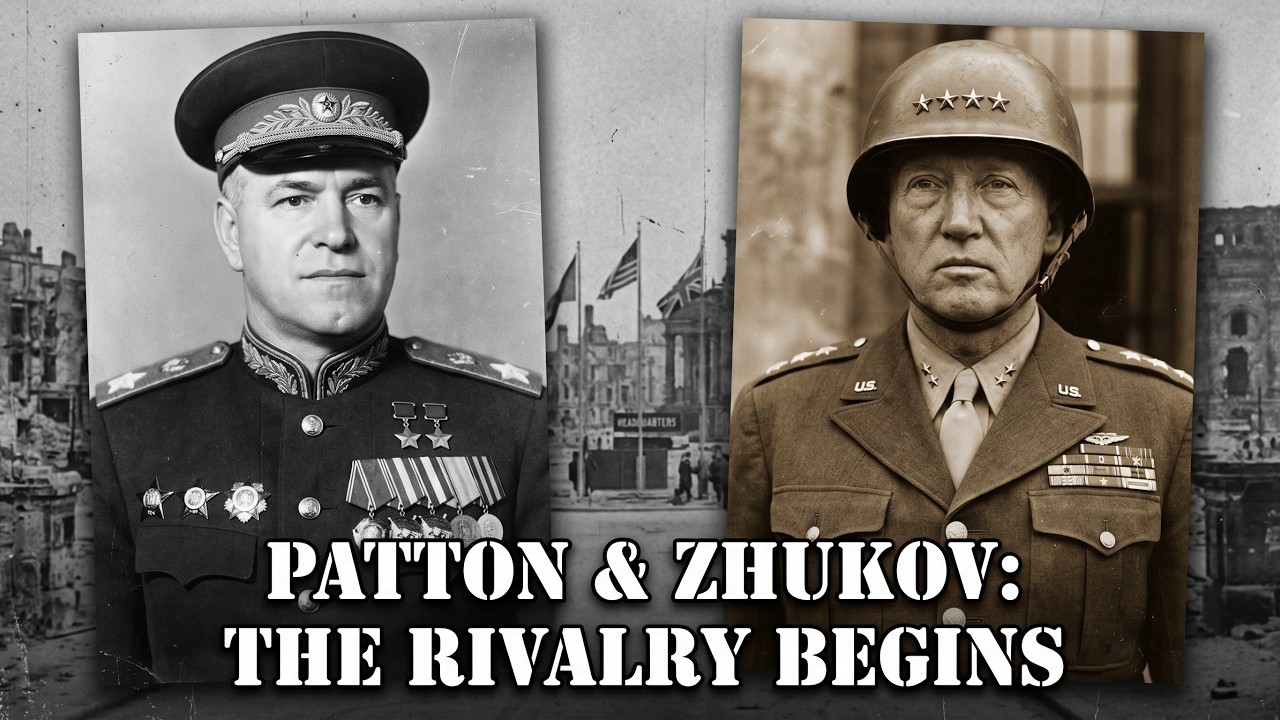
Patton had been vocal about his views on the Soviet Union for long enough that they were no secret within the Allied command. He believed the Soviet Union was not a meaningful long-term ally. He believed the expansion of Soviet power into Eastern Europe would define the next generation of European history, and he believed the time to address it was now, while American forces were still in Europe in strength, before demobilization eroded the leverage. Those views were shared, in varying degrees, by many senior American officers, but Patton was incapable of the discretion the political moment required.
Every time he spoke, the diplomatic consequences landed on Eisenhower’s desk. The Soviet commander whose path crossed Patton’s most consequentially was Marshal Georgy Zhukov, the most celebrated commander of the entire war. He had defended Moscow, broken the German army at Stalingrad and Kursk, and led the final assault on Berlin. By any measure he was one of the great commanders of the twentieth century, and he carried himself with the confidence of a man who had done things that could not be taken away from him.
The exchange that defined their relationship took place at a formal Allied military ceremony in the summer of 1945. These ceremonies were a regular feature of the occupation period, occasions when American, British, and Soviet senior officers were required to perform the rituals of Allied solidarity for the press and for diplomatic purposes. Patton attended with visible reluctance, performing his role with correctness while making no effort to conceal his feelings about the requirement. Zhukov arrived with the full apparatus of Soviet military prestige.
His uniform was extraordinary, covered in medals, orders, and decorations in a way that was visually overwhelming and clearly intended to be so. The Soviets understood that these ceremonies were performances, and they performed them with thoroughness. When the two were introduced, Patton looked at Zhukov’s uniform and said nothing for a moment. The American officers who knew him recognized the silence as the particular silence that preceded something memorable.
Then he said he had not seen that many decorations since the last time he visited a jewelry store. The Soviet interpreter translated. Zhukov’s expression did not change. Then he replied, and his interpreter rendered the words into English with visible discomfort: Marshal Zhukov noted that General Patton had fewer decorations, and perhaps this reflected fewer opportunities for distinction.
The American officers present expected the situation to deteriorate rapidly. Instead, Patton laughed. Not the polite laugh of a man performing amusement, but a genuine laugh, the laugh of a man who had been given an answer he respected. He said Zhukov had a point and he would give him that one.
The ceremony proceeded, the two men were separated by protocol, and the situation passed without the diplomatic incident that Patton’s staff had been bracing for. But something had happened in that exchange beyond the surface of the words. The two men had taken each other’s measure in the specific way senior commanders do, through the direct exchange of challenge and response, and each found in the other something he recognized. Zhukov had found a man who said exactly what he meant without calculation.
Patton had found a man who responded to a challenge without flinching and without losing his dignity. These were qualities both men valued above almost everything else, because they were the qualities that had made both of them what they were. The subsequent encounters between them were shaped by that initial exchange. They were not friends; the political and ideological distance was too great, and both were too clear-eyed to pretend otherwise.
But there was a quality of mutual recognition in their interactions that was visible to those around them, and it was different from the calculated performances of Allied solidarity that characterized most Soviet-American interactions in that period. At one smaller gathering, with fewer observers and less ceremony, Zhukov spoke to Patton in a way that was translated and recorded by the American interpreter. He said he had read the accounts of the Third Army’s advance through France and Germany, that the speed of the operation was militarily remarkable, and that he wished to acknowledge it. In the Soviet military context this was a significant statement, because the Soviet military did not distribute professional respect to foreign officers as a matter of diplomatic courtesy.
Patton received the acknowledgement with directness. He said he had read the accounts of Zhukov’s operations on the Eastern Front, that the scale of what the Soviet forces had done was beyond anything the Western Front had produced, and that any honest military assessment had to acknowledge it. He said Zhukov had fought a different war, harder in most of the ways that mattered, and that the outcome in Europe would not have been possible without what the Soviet forces had done. The American officers present were surprised.
Patton had acknowledged the Soviet contribution privately and in his diary, but never directly to a Soviet commander, in a setting where it would be reported. Zhukov was quiet for a moment after the translation. Then he said he appreciated the honesty. He said there had not been enough honesty between the Allied powers in his experience, and when he encountered it, he valued it.
Then he said something that changed the atmosphere of the room. He said he hoped the honesty that existed between soldiers would eventually extend to the governments that commanded them, because the alternative to honesty between governments was something neither soldiers nor anyone else wanted to live through again. Patton looked at him for a moment. Then he said he agreed completely, and that he was not optimistic.
Zhukov said neither was he. The two men sat with that in a room full of people who were very carefully not reacting. It was the most honest conversation the occupation period produced between American and Soviet officers of that seniority, and it happened because two men who operated the same way, directly and without performance, had recognized that quality in each other and allowed it to function without the political filters their positions normally required. After the meeting, Patton’s aide, a young officer who had been with him since the campaigns in France, asked what he made of Zhukov.
Patton was quiet for a moment, which was unusual. Then he said Zhukov was the kind of soldier any army would want and any government would eventually find inconvenient, and that this was something they had in common. He said he found it both clarifying and depressing in equal measure. The war had produced on both sides men who were capable of doing things that needed to be done and who were not particularly well designed for the world that existed after the things were done.
The aide asked whether Zhukov faced the same difficulties with his own government that Patton faced with his. Patton said he thought Zhukov’s difficulties were probably considerably more severe, given the nature of the government in question, and that this was something he would not wish on anyone, including a Soviet marshal whose decorations he had compared to a jewelry store display. Then he said Zhukov had been right about the decorations: Patton had fewer of them, and he had earned every one he had, and he was comfortable with the number. The measure of a soldier was not the decorations on his uniform but the ground he had taken, the men he had brought through, and the enemy he had broken.
By those measures, he had no complaints. Zhukov had done more than almost any soldier of the century, and acknowledging it cost him nothing. Patton returned to the administrative work of governing Bavaria, which he hated, and the multiplying political difficulties caused by his own statements. The occupation period consumed the last months of his life without giving him anything worth the consuming.
He died in December 1945. Zhukov outlived him by three decades, navigating the Soviet system with a combination of military prestige and political caution that kept him alive through purges that destroyed men with less of both. He died in 1974 as the most decorated military commander in Soviet history. Whether he thought about the American general who had compared his uniform to a jewelry store and then acknowledged the Eastern Front with a directness most Western officers never managed is not recorded.
What is recorded is that in the official Soviet military histories of the period, the assessments of Patton’s operational record were described in terms the Soviet military reserved for commanders they considered genuinely significant. That was Zhukov’s language, and in that language it meant what it meant.