A 95-ton iron machine stood on railroad tracks at the bottom of a rock canyon in Panama sometime around 1910. Its boiler was lit, and a column of coal smoke rose straight up into the wet heat. Out in front of it, an iron arm swung a steel dipper down into the face of the cut, closed its jaw on five cubic yards of rock and clay at a bite, about eight tons of the earth itself, lifted it, swung, and dropped it into a waiting railcar. Then it swung back and did it again, all day.
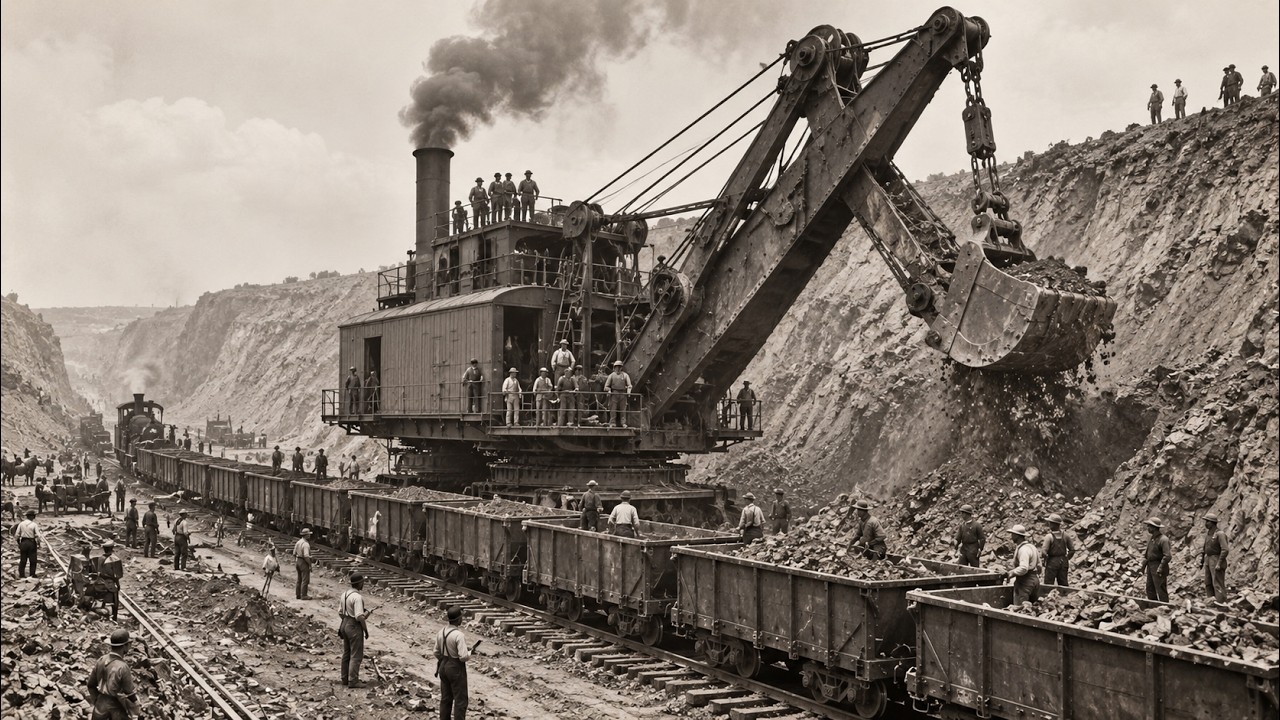
In a single day, that one machine moved more than 2,000 cubic yards of ground. A strong laborer with a shovel working the same heat for the same day moved about 12 cubic yards. One machine in one shift did the work of well over a hundred men, and it did it in rock those men could barely have scratched. The machine standing in that Panama canyon was not born in Panama.
It had a maker, a model number, and a lineage running back three-quarters of a century to a rail cut in Massachusetts and a young man who patented the idea in 1839 and was dead within the year. This is the biography of that machine, because the most important thing America built in the 1800s was not any one bridge or tower. It was the machine that could dig the ground out from under all of them. For nearly all of human history, if you wanted to move the earth, you moved it with a man’s back.
A pick to break the ground, a shovel to lift it, a wheelbarrow or cart to carry it away. On flat ground with animals, a horse-drawn scraper could peel off a thin skin of soil. That is how every canal, fortification, harbor, and road cut got dug for 10,000 years. The ceiling on all of it was the same: a man can only lift so much in a day before his body gives out.
You could throw more men at a job, and people did, thousands at a time, but every one had to be paid, fed, housed, and buried. Digging was the great fixed cost of building anything. Then the railroads came and broke that arithmetic completely. A locomotive needs a gentle, nearly flat grade, so when a line met a hill, you cut straight through it, and when it met a valley, you filled it in.
A single stretch of new line might need hundreds of thousands of cubic yards of earth moved. The whole country wanted railroads all at once in the 1830s, and the only way to feed that hunger was to throw thousands of men at it with hand tools. The bottleneck of the entire industrial age was the human back. The man who got around it was William Otis, a civil engineer from Philadelphia in his early twenties, working on railroad jobs and watching gangs of men dig.
He built a machine to do their digging for them, and on the 24th of February, 1839, he received United States patent number 1089 for a steam shovel. In its bones, it was the same machine that would stand in that Panama canyon 70 years later: a steam boiler for power, a boom, an iron arm with a dipper stick that could thrust the bucket forward into the bank, a dipper with teeth on its lip, a tangle of chains and gears, and hand-worked levers to hoist, swing, and dump the load. He mounted the whole thing on a railroad car, which was the clever part, because the machine rode into the job on the very rails it was helping to build. The one thing it could not do was spin all the way around; it swung through part of a circle and no more.
Everything else, the whole basic idea of a powered arm that bites the earth and turns to empty itself, he had from the very first. It worked. The Otis shovel moved about 300 cubic yards of earth in a day, the work of roughly 25 men in its first crude version. Engineers who wrote about these machines later reckoned a good steam shovel did the daily work of 50 to 60 laborers.
On a railroad job where you were paying, feeding, and housing every one of those men, that was a different world. William Otis never got to see any of it. A few months after receiving the patent, in that same year, he died of typhoid fever at the age of 26. The machine that would reshape the ground of an entire continent, dig the Panama Canal, open the copper mines, and grade the railroads coast to coast, outlived its inventor by more than a hundred years.
After Otis died, the steam shovel stayed a specialized thing for a long time. The first transcontinental railroad, finished on the 10th of May, 1869, thirty years after the patent, was built almost entirely by hand. The Central Pacific hired something like 15,000 to 20,000 Chinese laborers, around 90 percent of its workforce, to lay roughly 690 miles of track by hand. The Union Pacific relied heavily on Irish crews.
Picks, shovels, black powder, mule teams, and human muscle carried the whole American West. By one account, there was essentially a single steam shovel on the entire job. But the idea was loose in the world, and other builders picked it up and improved it. By the last decades of the 1800s, the center of gravity for the machine settled in the American Midwest, where two companies came to own the trade almost entirely, both named for the Ohio towns where they started.
Bucyrus was founded in 1880 in Bucyrus, Ohio, and within about 13 years had outgrown the town and moved its whole operation to South Milwaukee, Wisconsin, though it kept the Ohio name on the door. The Marion Steam Shovel Company was founded in 1884 in Marion, Ohio, by three local men. These two companies spent the next several decades in a running competition to build the biggest, strongest, most productive digging machines on Earth. It was an arms race, and the weapon was the size of the bite.
They cracked the problem Otis never had, building shovels that could swing the full circle so the machine never had to stop and reposition just to empty the bucket. It could dig, spin, dump into a car behind it, and spin back in one smooth cycle, over and over. They built them heavier and heavier, up to those 95-ton monsters with dippers that held 5 cubic yards, big enough that a single bite took about eight tons of ground. They were still mounted on rails, still fed by coal, still breathing steam, with a fireman shoveling the boiler and a crew working the levers up in the noise and heat.
The small machine that did the work of 25 men had become a machine that did the work of a hundred and more. Once you have a machine like that, it does not just do the old job faster. It makes brand new jobs possible. The first such job was the one the machine was born for: railroads.
Every railroad grade in America is an artificial thing; somebody moved that earth. Through the second half of the 1800s and into the 1900s, more and more of that grading was done by steam shovel instead of by hand. The machine at the head of a new line chewed through a hillside, loaded the spoil into cars that ran it forward to dump as fill in the next low spot, and the track crews extended the rails as the whole operation crawled across the country. The ground trains ran on was rebuilt by these machines.
The second new job was stranger: mining. In 1904, an engineer named Daniel Jackling looked at a mountain in Utah at a place called Bingham Canyon that was full of copper, but it was terrible copper. The ore was only about 2 percent metal, meaning 98 percent of everything you dug was worthless rock you would have to move and throw away. By every rule of traditional underground mining, that mountain was not worth touching.
Jackling’s idea was to stop tunneling and take the whole mountain apart from the top down, in the open air, with steam shovels and railroad cars, on a scale nobody had ever tried. Move so much rock so cheaply that even 2 percent copper turned a profit. It worked because the machine made it work. Steam shovel operations at Bingham Canyon began around 1906.
They cut the mountain into giant descending benches, wide enough to carry railroad track, and the shovels worked bench by bench, loading train after train of ore. By 1912, it had become the largest industrial mining complex in the world. That hole is still being dug today, more than a century later, and it is now the largest man-made excavation on the face of the planet. None of it makes any economic sense without a machine that can move mountains of low-value rock for almost nothing per ton.
And this was exactly the moment America was wiring itself for electricity, stringing copper through every city, home, motor, and telephone line, and later feeding two world wars. The country needed copper on a scale the old vein mines could never have supplied. A poor, stubborn mountain in Utah could answer that only because a machine had made it cheap to devour. Then history handed the machine the largest earth-moving job the world had ever attempted: Panama.
The French tried first in the 1880s, and it broke them. They poured in money and men, and about 22,000 of them died, mostly from disease, and they never finished. Part of why they failed, alongside malaria and yellow fever, was that their equipment was not equal to the ground. When the Americans took over in 1904, they brought the mature American steam shovel at full size, in quantity.
Over the course of the dig, 102 steam shovels worked the canal: 77 built by Bucyrus, 24 by Marion, and one by a third maker. The whole lineage running back to Otis showed up in the jungle 102 machines strong. The rhythm of the project came down to one cycle, repeated by dozens of machines at once. Ahead of the shovels, gangs of men drilled holes into the rock, packed them with explosive, and blew the face loose.
Then the shovel came in and ate the broken rock, dipper by dipper, loading it onto flat cars pulled up alongside. When the cars were full, a locomotive hauled the spoil away, and an empty string rolled in to take its place. Drill, blast, dig, haul, with dozens of shovels working different levels of the same canyon, day after day for years. The hardest part was a stretch called the Culebra Cut, where the route had to be carved straight through the spine of the continental divide, through solid rock, deep, for miles.
That is where the biggest shovels went, and that is where they set their records. In July of 1908, a single Marion shovel moved 53,000 cubic yards of material in 25 working days. In 1910, a Bucyrus shovel moved 70,000 cubic yards in 25 days and set the canal record. Across the whole project, an individual shovel averaged more than a million cubic yards of rock and spoil over its working life at the cut.
The total for the American effort came to around 260 million cubic yards dug out and hauled away. Trainloads of that spoil were used to build the great earthen dam and fills the canal needed. The machine did not save the men. Each of those 95-ton shovels needed a crew of four just to run it, working all day on hot iron next to the boiler, where a snapped chain or slipped load could kill you.
And a shovel mounted on rails can only dig as far as its rails reach, so ahead of every machine, a gang of about six more men kept laying and shifting track so the shovel could crawl forward. Every one of these machines put roughly ten men into harder and more dangerous work than the diggers it was supposed to save. All around the shovels was the real labor force. The steam shovel cannot drill a blast hole, cannot pick at a seam the dipper cannot reach, cannot clear a fresh landslide that buried the track overnight.
At the Culebra Cut, the slides were relentless, because the cut kept getting deeper and the walls kept giving way. On the 4th of October, 1907, the Cucaracha slide sent about 500,000 cubic yards of hillside into the cut, and it kept creeping several feet a day for ten days. In 1912, near the end, slides at Cucaracha dumped almost 3 million cubic yards back into the cut, and every bit of it had to be dug out again, work that took four and a half months. The men even had a name for the row of buildings where the shovels were serviced: Steam Shovel Row.
In 1910, part of it had to be dismantled and moved because it was about to slide into the cut itself. The men fighting that battle were mostly West Indian laborers. More than 120,000 were recruited from the islands of the Caribbean to come and dig. They drilled the rock the machines would eat, set the charges, cleared the slides, laid the track, and ran the trains.
The official death count for the American years, from 1904 to 1914, is 5,609, and many historians believe the true figure was higher. Of that official count, roughly three-quarters, 4,290 men, were from the Caribbean, dying of disease and accidents, crushed and buried in the same rock the shovels were tearing open. The machine did the digging of 100 men. It did not spare the 100 men.
The steam shovel itself kept living and growing. Steam gave way to diesel and electric power. In 1946, the Marion Steam Shovel Company quietly dropped the word steam and became the Marion Power Shovel Company. The rails gave way to caterpillar crawler tracks, so the shovel could walk itself over open ground.
Bucyrus merged with the Erie Steam Shovel Company in 1927 to become Bucyrus-Erie. Marion built a stripping shovel in the 1960s that weighed something like 15,000 tons, one of the heaviest mobile machines ever built, and also built the enormous crawler transporters NASA still uses to carry rockets to the launch pad, direct descendants of a machine for digging railroad cuts. In 1997, Bucyrus bought Marion outright, and the two Ohio names that had competed for a century became one company. Almost none of the old machines survive.
The steam shovels that dug Panama were mostly worked until they wore out, scrapped for their metal, or left to rust in the jungle. But not all of them. One Marion shovel that arrived at the canal in 1904 later went to work building railroads in Costa Rica, and it was never thrown away. It still exists, sitting in a museum in Turrialba, Costa Rica: the last surviving steam shovel that actually dug the Panama Canal, one machine out of the 102 still standing.
Every yellow excavator parked at a job site, with its boom, stick, and tooth bucket, digging, swinging, and dumping, runs the exact motion William Otis drew in 1839. Every open pit mine, every highway cut where the road slices clean between two walls of rock, every deep foundation hole in every city is a descendant of that one man’s iron arm. In the last two centuries, we rebuilt the ground itself.
We cut it, moved it, hollowed it out, with a machine that started as a sketch to save the backs of railroad diggers and ended up able to take a whole mountain apart.