In May 1973, two sisters from New Jersey stood on the side of a Florida highway, waiting for a ride. Maggie Jenkins was eighteen, strong and adventurous, with a dream of one day owning a ranch. Her sister Mary was sixteen, soft-spoken, with a singing voice that surprised people the first time they heard it. They had come to Key West for spring break and were trying to get home.
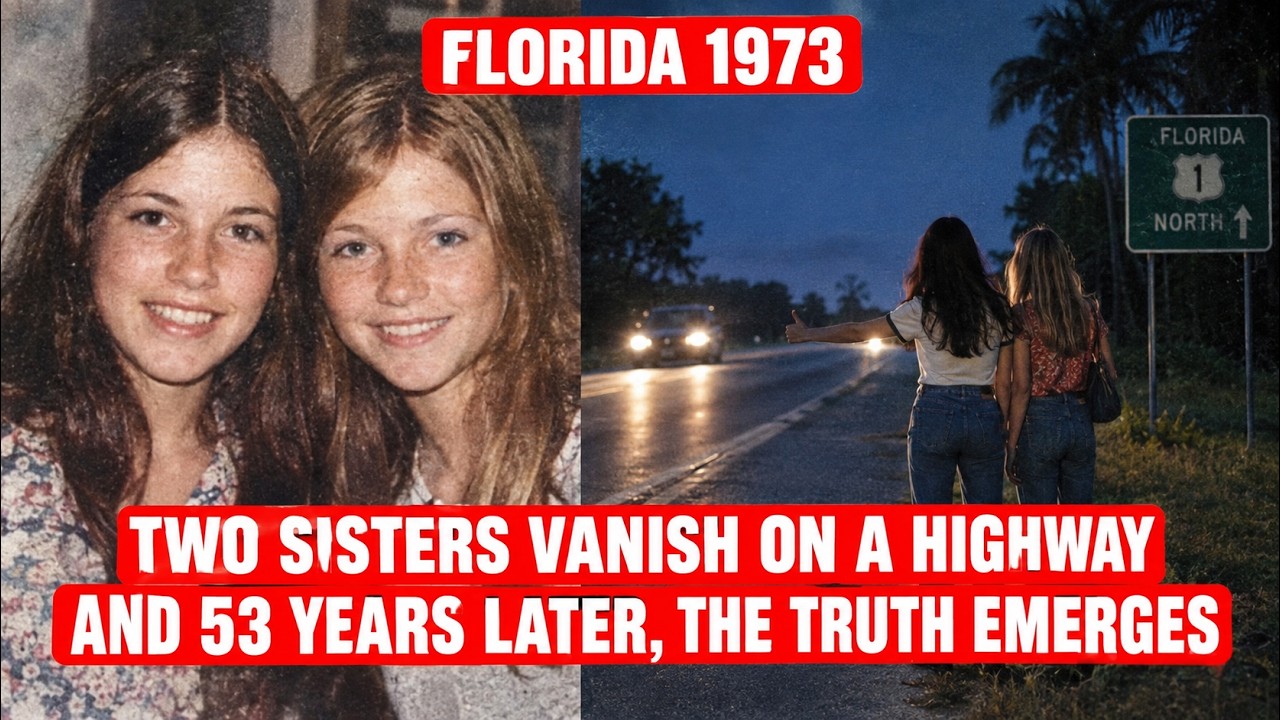
Their father had sent them money for bus tickets, but they chose to hitchhike instead. On May 2, witnesses saw them on Stock Island, just east of Key West, thumbing a ride north. Someone picked them up. That was the last time anyone saw them alive.
The next morning, a local resident walking near the highway in Kargo, nearly a hundred miles up the road, wandered about a hundred yards into the woods and found the two girls near mile marker 99. 5. Both had been severely beaten and shot. The Monroe County Sheriff’s Office processed the scene and collected what forensic evidence they could, but this was 1973.
Forensic science was still in its infancy. There were no suspects, no witnesses with a useful description, no trail to follow. Maggie and Mary were tourists from New Jersey. They had no enemies in Florida, no connection to anyone in the Keys who might have wanted them dead.
Investigators concluded they had likely been killed by a stranger, someone who saw two young women on the side of a road and made a decision. Without technology, without databases, without a mistake the killer had left visible, the case was nearly impossible to solve. Back in New Jersey, the Jenkins family was left to live with what had happened. Their father had sent bus money to keep his daughters safe, and it hadn’t been enough.
Sarah, the older sister, nineteen at the time, traveled to Florida with the family in the aftermath. She spent her life trying to understand who had done this and why. The investigation ground down the way cold cases do, not because anyone stopped caring, but because there was nowhere left to look. By the end of 1973, the case had gone cold, and it would stay that way for a very long time.
The years passed. The original detectives retired and died. The newspaper clippings faded. Sarah Jenkins grew up, built a life, and had a family of her own.
She never stopped honoring her sisters, but she made a kind of peace with not knowing. The case file sat in Monroe County, and the evidence sat in storage. Among that evidence was a blood stain on one of the victim’s clothing, smaller than a thumbprint, that would one day change everything. In 2018, forty-five years after the murders, forensic scientists at the Florida Department of Law Enforcement did something that had not been possible in 1973.
They extracted a partial male DNA profile from that blood stain. It was incomplete, a fragment of a genetic fingerprint, but it was enough to upload to CODIS, the national DNA database. The search returned no match. The killer had either never been convicted of a crime requiring a DNA sample, or his records simply did not exist.
The case stayed cold, but for the first time in forty-five years, investigators had a piece of the man who had done this. The critical break came in 2023, when the Florida Department of Law Enforcement began working with Othram, a specialized DNA laboratory in Texas built for the kind of forensic challenges traditional labs could not meet. Othram used forensic-grade genome sequencing, a process that reads far more of a DNA sample than standard testing, building what amounted to a comprehensive genetic map. With a richer profile in hand, investigators turned to a tool that had not existed in 1973 or even in 2010: investigative genetic genealogy.
The process involved uploading the crime scene profile to public ancestry databases, the same websites where ordinary people trace their family trees and connect with distant cousins. From there, investigators identified relatives of the unknown man, built family trees going back generations, and then traced those trees forward to find individuals who matched the right age, location, and history. The work pointed to a name: David Allen Snyder. Records showed he had lived in Key West between 1972 and 1974, placing him in the Florida Keys in the precise window when Maggie and Mary were killed.
He would have been twenty-two years old in May 1973. He was a local, someone who knew those roads, those islands, that stretch of highway. But David Allen Snyder was dead. He had died in Idaho in October 2008 at the age of fifty-seven, of natural causes.
There would be no arrest, no interrogation, no trial, no verdict. He had lived freely for thirty-five years after committing a double murder and had died with his secret intact. Still, investigators had one remaining option. In 2026, they located a living relative of Snyder and obtained a DNA reference sample.
That sample was sent to the Othram Crime Laboratory for analysis. The results came back on September 2, 2026, fifty-three years and four months after Maggie and Mary were found in those woods. The DNA matched. David Allen Snyder had killed them.
Monroe County Sheriff Rick Ramsay announced the identification publicly. The weight of what he was saying was not lost on anyone in the room. A man who had been twenty-two when he picked those girls up had spent his entire adult life as a free man. He had never been questioned, never been arrested, never faced a single consequence for what he did on that highway in 1973.
Ramsay said the case showed how important it was to solve crimes no matter how long it took. He noted that this was the sixty-sixth publicly announced case in Florida where Othram’s technology had been used to identify a suspect. Sixty-six families. Sixty-six cases where a killer had believed the past was buried, and sixty-six times science proved them wrong.
Three investigators went to Sarah Jenkins Barlow’s home to tell her in person. She had been nineteen when her sisters were killed. She was in her seventies when they arrived at her door. She said afterward that it was shocking, that she had never truly expected the case to be solved.
After all those years, after all the anniversaries, she had made a kind of peace with not knowing. And then the knowing came anyway. She talked about her sisters the way people talk about people they loved before tragedy defined them. Maggie was strong and adventurous.
She loved horses. She had dreams. Mary had a fantastic singing voice and was sweet in a way that deserved decades of ordinary life. Sarah said that you must not stop living because of a tragedy like this, that it is not how you honor the people you lost.
She had spent more than fifty years making good on that, traveling, living fully, carrying her sisters with her in the way the living carry the dead when they choose love over bitterness. What did it mean that David Allen Snyder was never tried? In one sense, justice in the formal legal definition, charges, a trial, a verdict, a sentence, never came for Maggie and Mary Jenkins. He escaped it.
He died in a bed somewhere in Idaho while the evidence that would have convicted him sat in a Texas laboratory, waiting for science to read it. And yet his name is now permanently and publicly attached to what he did. The children he may have had, the community he belonged to in his final years, the people who knew him as an ordinary man now know what he was. His identity as the person who beat and shot two teenage girls on a Florida highway and drove away is the permanent record.
He took their names. Science gave them back. This case was the sixty-sixth in Florida where forensic genetic genealogy broke open what time and silence had sealed. That means there are cold cases numbered sixty-seven, sixty-eight, and beyond.
Cases where a blood stain is sitting in a locker, where a family is still waiting, where the killer died thinking they were safe. The technology exists. The genealogy databases grow larger every year. The question is only time, funding, and the willingness to keep working cases that the world has long since moved on from.
Somewhere in another evidence room in another state is the sample that will answer the next family’s question. Maggie Jenkins was eighteen years old. She wanted a ranch. She loved horses.
She was strong and adventurous and full of plans for a future that someone took from her on a highway in the Florida Keys. Mary Jenkins was sixteen. She had a voice that people remembered. She was sweet and young and innocent, and she deserved to grow old.
They both deserved to grow old. That they did not is not a mystery anymore. Now it is only a truth, a hard and permanent and finally spoken truth.