On the night of November 23, 1969, Spade Cooley walked off a stage in Oakland, California, to a roar of applause. He was a convicted murderer, days away from three months of freedom he had been promised, and he had just performed for an audience of sheriff’s deputies and their families. He sat down on a folding chair backstage, told someone nearby that he had a feeling everything would be all right for him now, and collapsed. By the time an ambulance arrived, the man who had once been called the King of Western Swing was dead.
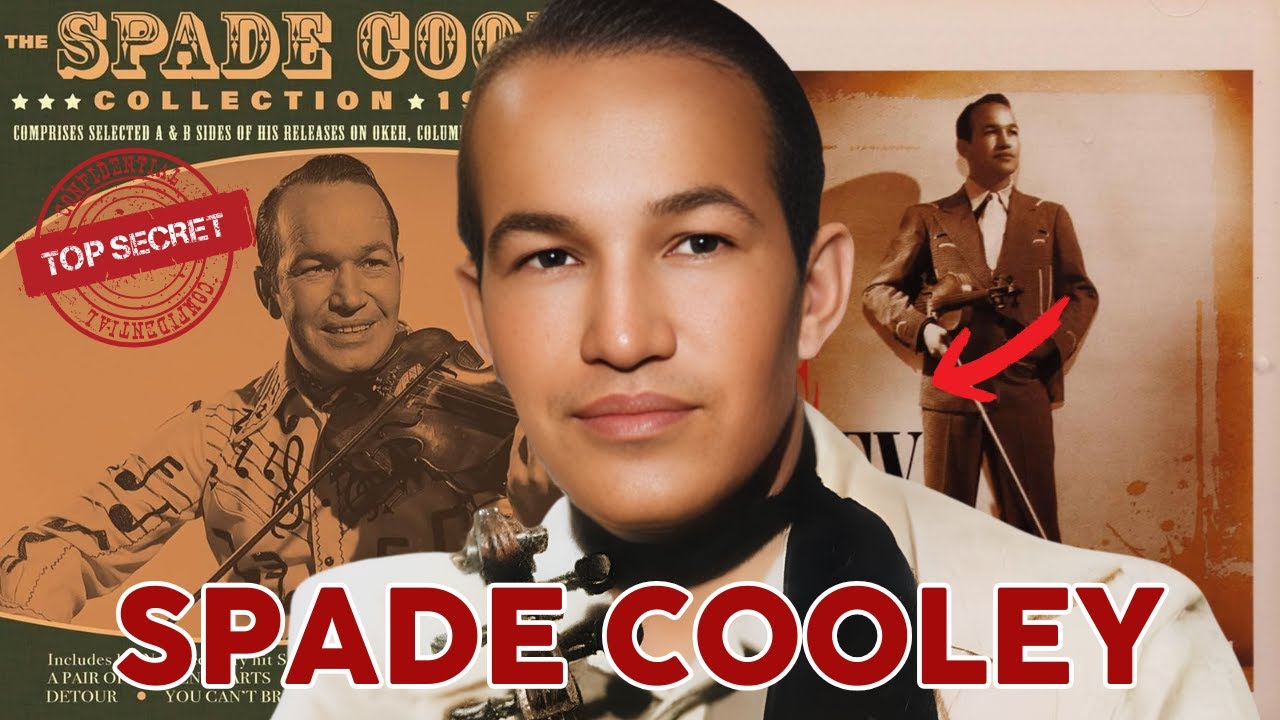
He died a prisoner of the state, in the narrow gap between his cell and his freedom, with the sound of clapping still in his ears. He had been born Donald Clyde Cooley in 1910, in a tiny Oklahoma town called Grand, in Ellis County. The West of the frontier was already gone, replaced by the hard reality of dryland farming. His father, John Cooley, was an Irish-descended fiddler and laborer.
His mother’s family claimed Cherokee roots, a heritage that in early twentieth-century Oklahoma could be a point of pride or a target for discrimination depending on the room. The boy learned early that identity was a performance. His grandfather put a fiddle in his hands, teaching him old breakdown tunes that had crossed the ocean from Scotland and Ireland, mutated in Appalachia, and settled on the plains. But the lesson that stuck was not about music theory.
It was about power. Watching his father play at barn dances, the young Donald saw how a fiddler could transform a room of exhausted farmers, control their energy, their mood, their very pulse. For a boy who felt small and powerless, the fiddle was a weapon. If you could play, you mattered.
By age eight, he was a prodigy, attacking the strings with a ferocity that amazed adults, earning coins at local dances. Then the sky turned black. The Depression arrived in Oklahoma not as a stock market crash but as a biblical plague. The rain stopped.
The wind came, lifting topsoil in choking clouds that blotted out the sun. Farmers left, moving west through the Dust Bowl years, first to Oregon, then to California. In the San Joaquin Valley, they found not paradise but labor camps, picking cotton and fruit, living in shacks of cardboard and tin. Donald had his fiddle and a new name.
Somewhere along the way, in a late-night poker game, he kept drawing spades. A player told him he was nothing but a spade. The name stuck. Spade Cooley did not pick cotton.
Spade Cooley was meant to be a star. He moved south to Los Angeles in the early 1930s. The city was booming, and the music scene was exploding. Okie migrants had brought their sounds, and country musicians were listening to jazz, to Benny Goodman and Duke Ellington, wondering why they could not do that with fiddles.
This was the birth of western swing, a high-energy hybrid that pumped adrenaline into the old hillbilly songs. Spade dove into the scene with the desperation of a drowning man, playing anywhere he could, even working as a film double. There he met a handsome young singer named Leonard Slye, who would soon become Roy Rogers. The two competed for the same roles and looked somewhat alike, but Roy had a softness the camera loved.
Spade had a darker edge. He found steady work as Roy’s double, sweating under hot lights while another man stepped in at the last moment to take the glory. It stung his pride. His real talent was leadership.
He joined a band led by a cowboy singer named Jimmy Wakely, playing at the Venice Pier Ballroom, a huge hall extending into the Pacific. Spade thought Wakely was too soft, too interested in slow sentimental cowboy songs. In a move that defined his ruthless style, he staged a coup. He whispered to the other musicians that Wakely was holding them back.
He went to the ballroom manager and promised to fill the hall every night if he took over. One evening, Jimmy Wakely arrived to find he no longer had a band. Betrayal, in show business, was just another word for ambition. Spade then built his vision.
He hired the best musicians in California, classical guitarists, accordion players who could handle jazz, a horn section that shook the room. At its peak, his orchestra numbered more than twenty members. He was a born showman, dancing with his fiddle, flirting with the front row, telling jokes, creating a persona as the genial, beloved host of the biggest party on the West Coast. By 1946, the crowds at Venice Pier were so massive they violated fire codes.
He bought a sprawling ranch in the San Fernando Valley, a fleet of Cadillacs, a yacht, and began wearing custom rhinestone suits that set a fashion trend for country music for decades. The Dust Bowl kid had become a king. But a king needs a queen, and the king demands absolute loyalty. Into his fortress walked a young singer named Ella Mae Evans.
She was barely out of her teens, innocent, with a clear, natural voice and a quiet beauty that made men stop and stare. Spade, in his thirties with a string of failed relationships behind him, saw not a singer but a prize, something pure he could possess. They married in 1945. Magazines called them the golden couple.
But the courtship was suffocating. He did not want her to have friends. He did not want her talking to other musicians. He moved her to the ranch, away from the city, away from her family, telling her it was for her safety, but really it was to isolate his victim.
As the 1940s closed, he was at the height of his career, rich, famous, feared. But inside the palace, the shadows were growing longer. Then television arrived. In 1948, the Spade Cooley Show began broadcasting on KTLA 5.
It was one of the first major variety programs in television history, and it dominated the local ratings. According to reports, the vast majority of televisions in Southern California were tuned to Spade on Saturday nights. The broadcast was a spectacle, a live, chaotic western extravaganza with cameras roaming the Santa Monica Ballroom, capturing thousands of dancers, then cutting to Spade at the center of a storm of rhinestones. Frank Sinatra, Dean Martin, Bob Hope all came to pay tribute.
Magazines published pictures of the ranch, the pool, the children, the cars. It was the ultimate California fantasy. The camera lied. While Spade charmed millions, he was systematically destroying the one person he truly loved.
His psychological collapse was slow poison fed by two main arteries: alcohol and a deep, delusional insecurity. He had always drunk, but fame turned drinking from a social habit into a dark necessity. He began drinking not for fun but to silence the noise in his head, and the whiskey only distorted it. He suffered from what could be called pathological jealousy, but the clinical term does not capture the horror he inflicted.
He became convinced Ella Mae was unfaithful. He imagined rivals everywhere. If the milkman lingered at the gate, he was sleeping with her. If a musician smiled at her during a song, they were having an affair.
He accused his closest friends. He even accused Roy Rogers. In his twisted mind, Roy was a predator trying to steal his queen. Ella Mae lived under constant surveillance.
He wired the ranch with listening devices. He hired private detectives to follow her while she shopped. He checked her car’s odometer for unexplained miles. He dictated what she wore, forbade her from wearing makeup when he was absent, and slowly cut her off from her family.
He rewrote her history, convincing himself she had been promiscuous before meeting him, waking her in the middle of the night, drunk and enraged, demanding she confess to imagined sins. When she cried and denied it, her denial only inflamed him. Silence was proof of guilt. Tears were not pain but performance.
Why did she stay? Because she was afraid of what he would do if she left. He threatened to kill her, to kill her family, to take the children. In his sober moments, he was still that charming man she had fallen for.
He would cry, apologize, buy her a fur coat or a diamond bracelet, promise to stop drinking. The outside world saw a queen. How could she tell the world the king was a monster? Who would believe her?
He was Spade Cooley, beloved by all. By the mid-1950s, the world outside the ranch was changing. Rock and roll was rising from Memphis, loud and raw and needing no fiddles. Elvis Presley, Chuck Berry, Little Richard were rewriting the rules of American music, and western swing suddenly sounded old.
The teenagers who had packed the Santa Monica Ballroom were growing up, and their younger siblings wanted the twist, not the waltz. Spade, the innovator who had modernized country music, had become the old guard. Ratings dropped. Crowds shrank.
For a man whose entire self-worth was built on being the king, the decline was catastrophic. He could not accept that tastes had changed. Narcissists do not fade gracefully. They look for someone to blame.
He blamed Ella Mae. He convinced himself the failure of his career was her fault, that her affairs had drained his energy. The logic was insane but fixed in his mind like stone. His drinking spiraled out of control.
He suffered several heart attacks in the late 1950s, and the physical weakness made him more dangerous. He compensated with more brutal control. Violence escalated from pushing and grabbing to slapping to severe beatings. The children, especially their daughter Melody, became witnesses to the war zone.
Melody was a gifted fiddler herself, and Spade adored her in his own way, exploiting her as an extension of his act. She learned to read the room by the way her father walked through the door. By 1960, the situation was critical. His business ventures were collapsing.
He invested in a water-themed amusement park meant to compete with Disneyland. It was a disaster. Money was draining away. The IRS was circling.
The pressure cooker was about to explode. Ella Mae, now in her thirties, was a ghost of the vibrant girl she had been, exhausted, bruised in body and spirit. But somewhere in that darkness, a spark of survival rekindled. She began attending a local church.
She started talking to people. She confided in a nurse friend named Dorothy about what was really happening. Once she spoke the truth aloud, it became undeniable. She realized she could not stay.
If she stayed, she would die. In early 1961, she packed her bags and the children’s bags and left. It was a declaration of war. Spade was stunned.
He could not believe she had actually left him. He swung between pleading and threatening, calling constantly, crying, promising he had changed, that he had found God, that he would stop drinking. For a few weeks, it seemed she might hold firm. She filed for divorce on March 22, 1961, citing extreme cruelty.
The newspapers picked up the story. Spade’s divorce was public humiliation. But his reaction was terrifyingly calm. He stopped shouting.
He changed tactics. He became a businessman. He told Ella Mae he accepted the divorce but that they needed to meet one last time to discuss the property settlement. He wanted to make sure she and the children were provided for.
He suggested they meet at the ranch privately to review the papers. Her friends warned her not to go, not to go alone. But Spade was persuasive, a master of seduction. He convinced her it was for the children, for a clean break.
On April 3, 1961, Ella Mae drove her car up the winding road to Willow Springs Ranch. She brought Melody with her, perhaps thinking Spade would not hurt her in front of their daughter, perhaps hoping the child’s presence would be a shield. The sun was setting over the California hills. The house was quiet.
Spade was waiting inside. He had spent the day preparing, not with legal papers but with alcohol. The bottle was his advisor, whispering to him for hours, feeding a dark story of victimhood. In his mind, he was not the abuser.
He was the deceived husband, the king whose crown was being stolen by the woman he had lifted from obscurity. When Ella Mae and Melody entered the house, the air was thick enough to choke on. Spade did not ask about divorce papers or custody arrangements. He asked about men.
Tell me about the men you have been with. It was the old interrogation. But this time, she was tired. She had filed the papers.
She had crossed the point of no return. Whatever she said, witnesses and medical evidence agree on one thing: what followed was not a passing argument but a prolonged, brutal assault. Spade did not just hit her. He punished her.
He grabbed her by the hair and smashed her head against the floor. Melody screamed. Spade turned to his daughter and forced her to watch. Look at her, he shouted.
Tell me what she is. Tell me what she did. He demanded his daughter testify against her mother to prove his delusions. When Melody, crying and paralyzed with fear, could not answer, he turned his rage back on Ella Mae.
It was not a moment of madness. It was a marathon of cruelty. He beat her until he was panting, then stopped to pour himself a drink and light a cigarette, lecturing her while she lay bleeding on the carpet. Then he would find the energy to begin again.
He kicked her. He stomped on her stomach with his cowboy boots. He burned her body with his cigar. He grabbed her by the throat and strangled her until she nearly died, then let go at the last moment so she could gasp for air, only to crush her windpipe again.
Her ribs broke. Her internal organs tore. In a moment of unimaginable desperation, Ella Mae managed to crawl toward the phone in the hallway while Spade was busy. She did not call the police.
In the twisted psychology of the battered wife, the police were an abstraction. She called the only person she thought might actually come, her nurse friend. She managed to dial the number and whisper a plea for help. Spade saw her.
He did not just hang up the phone. He ripped it from the wall. He dragged her back to the living room. Then he did something that froze the blood more than the violence itself.
He made a phone call to a business associate, perhaps about the water park project. Imagine the scene. Ella Mae lying on the floor a few feet away, her breath ragged, blood pooling around her. Melody huddled in the corner, in complete shock.
And Spade Cooley leaning against the wall, holding the receiver, discussing permits and construction costs. Yes, everything is fine, he said. Just getting some work done here at home. He was capable of switching masks in an instant.
But the body has limits. Ella Mae’s breathing grew faint. The light in her eyes finally went out. She stopped moving.
Spade stood over her. He did not panic. He did not cry. He entered damage-control mode.
The nurse, who had driven to the ranch after the cut-off call, arrived to find the house a slaughterhouse. Spade, his shirt stained with his wife’s blood, gestured vaguely at the body. She fell in the bathroom, he said. It was a lie so lazy it was an insult.
Ella Mae was fully dressed, bruised from head to toe, her face unrecognizable. A nurse checked her pulse. There was a weak, thready beat. She was still technically alive.
The nurse shouted that they had to get her to a hospital. Spade shrugged. He allowed them to call an ambulance. Ella Mae never regained consciousness.
She was pronounced dead on arrival at Santa Clara County Hospital. The autopsy read like a list of war crimes: a torn aorta, a shattered sternum, multiple skull fractures, severe internal bleeding. She had not died. She had been destroyed.
The police arrived at the ranch and found Spade sitting in the room finishing his drink. He was calm, arrogant. According to accounts, he told the officers that they could not arrest him because he was Spade Cooley, as if his fame were armor. He was handcuffed and led past the manicured lawns and the swimming pool, the flashing police lights illuminating the kingdom he had built.
The news broke the next morning, April 4, 1961. The King of Western Swing was held for the murder of his wife. The public was shocked. It was not a overdose or a car accident, the usual Hollywood tragedies.
It was a brutal, straightforward murder. Fans who had seen him smiling on television weeks before could not believe it. But as details leaked, the kicking, the cigarette burns, the horror of the teenage daughter, disbelief turned to disgust. In prison, Spade hired the best defense lawyer in California.
He planned to fight. He planned to put his dead wife on trial, claiming she was an alcoholic, mentally unstable, that she had attacked him. But he had forgotten one thing. There was a witness.
He had forced his daughter to watch. He thought he could force her into silence. He was wrong. Melody Cooley, the fourteen-year-old girl orphaned by her father, prepared to do the only thing her mother could no longer do.
She prepared to speak. The trial in the summer of 1961 was a spectacle. Fans lined up at dawn with folding chairs and picnic baskets. Spade entered the courtroom as if walking onto a stage, wearing immaculate tailored suits, smiling, waving, even signing autographs during breaks.
His defense team built a vicious narrative. Ella Mae was a drunk. Ella Mae was clumsy. Ella Mae was unstable.
They argued her injuries were the result of a tragic drunken fall in the shower, a story physically impossible given the autopsy. They portrayed Spade as a patient husband dealing with a hysterical wife. Spade sat at the defense table, nodding solemnly while his lawyers defiled the memory of the woman he had killed. But the prosecution had a weapon his charm could not neutralize.
They had the only person who had been in the room. When the bailiff called Melody Cooley’s name, a hush fell over the courtroom. A fourteen-year-old girl entered, small, pale, her eyes fixed on the floor. She took the stand and, in a trembling voice that never broke, destroyed her father.
She described how he dragged her mother by the hair. She described the sound of his fist hitting flesh. She described how he burned her mother with his cigar. Then came the moment that made jurors gasp.
She described how he forced her to watch, screaming at her to call her mother a whore. She described the horror of being trapped in that room, a hostage to his rage, watching the person she loved most in the world being destroyed. She testified that she saw her father stomp with his full weight on her mother’s stomach. The image of a cowboy boot, the symbol of rugged western romance, used as a weapon to crush a woman’s internal organs, was too brutal to ignore.
The bathtub accident theory evaporated in the face of this child’s trauma. Spade’s reaction to his daughter’s testimony was horrifying. He did not cry. He did not look ashamed.
He looked annoyed. He leaned toward his lawyer and whispered angrily. He saw Melody’s truth not as a tragedy but as an act of betrayal. She had gone off script.
The prosecution presented autopsy photographs, black-and-white images that showed the scale of the slaughter. The medical examiner testified that the victim’s heart had been literally torn by the force of the blows. This was not a fight. It was an execution.
On August 19, 1961, the jury returned. Spade stood, buttoned his jacket, adjusted his tie, and looked at the foreman with an expectant expression, as if waiting for applause. The foreman read the verdict: guilty of first-degree murder. The courtroom erupted.
Spade froze. For a split second, the mask slipped, revealing the baffled void underneath. He was confused, genuinely stunned. But the showman quickly regained control.
As the judge thanked the jurors, Spade turned to his weeping family in the gallery and gave them a thumbs-up. He smiled. He murmured that everything would be all right. The judge was not amused.
He sentenced Spade Cooley to life in prison. The king was led out the back door of the courthouse, away from the cameras, and put in a van. His suit was replaced with prison clothes. His name was replaced with a number.
He was sent to the California Medical Facility at Vacaville. For most men, a life sentence is the end of the story. But Spade Cooley was built for adaptation. He assessed his new audience.
He would not play for teenagers and old-time fans. He would play for murderers, thieves, and guards. He became the model prisoner, polite, submissive, hardworking. He used his fame as currency, telling Hollywood stories to guards, signing autographs for the warden’s children.
He was allowed to play fiddle again. He formed a prison band, training inmates with the same perfectionism he had used at the Venice Pier. The prisoners loved him. For an hour on Saturday afternoons, they were not convicts.
They were an audience. And Spade was the king again. The years passed. The world outside changed, but Spade never accepted that he would die in prison.
He began a campaign for release, calculated like any marketing plan. He wrote letters. He contacted old friends. He crafted a story of repentance.
He was a broken old man, he had heart problems, he had found God, he had served his time. He exploited the sympathy of the new governor, Ronald Reagan, a man from the same Hollywood world as Spade. The parole board received petitions. His behavior record was spotless.
In the summer of 1969, the whispers began. The board was considering his request for parole. The argument was that Spade no longer posed a threat to society, that he was just a frail old fiddler who wanted to die in his bed. On August 5, 1969, the parole board granted his request.
He was to be released on February 22, 1970. Spade was ecstatic. He immediately began planning his comeback. He was not planning to retire.
He was planning a tour, a new album, to show the world that Spade Cooley was back. His ego was staggering. He had killed his wife less than a decade earlier, and here he was planning his concert schedule. He truly believed the public would forgive him, that the applause would wash away the blood.
In November 1969, three months before his release date, the Alameda County Deputy Sheriffs’ Association decided to hold a charity event. They wanted a headliner, someone big, someone legendary. They asked the warden at Vacaville if Spade Cooley could perform. It was an unusual request, a convicted murderer performing at a law enforcement benefit.
But Spade was a trusted prisoner. The warden agreed. He would be given a temporary furlough, a few hours of freedom to perform the show. Spade saw the event not as charity but as a final rehearsal, a test run for his comeback tour.
On the afternoon of November 23, 1969, Spade Cooley walked out of the prison gates. He was not free yet, the guards were with him, but he was outside. He breathed the air. He rode in a car to an auditorium in Oakland.
He wore a suit again. He carried his fiddle case. As he walked into the building, he heard the murmur of the crowd. It was a sound he had not heard in eight years, the sound of anticipation.
Backstage, he tuned his fiddle. He looked in the mirror. He was older, yes, his face lined, his hair silver. But his eyes were the same.
The shark was still there. The emcee asked if he was ready. Spade flashed his priceless smile, the one that had hidden a thousand sins. Born ready, he said.
He stepped out from behind the curtain. The crowd was a strange assembly, members of the deputy sheriffs’ association, their wives, a handful of curiosity seekers. They knew exactly what he was. They knew he was a convicted killer, a man who had kicked his wife to death.
But they also knew the songs. In that moment, celebrity outweighed criminality. They were not applauding prisoner A-3522. They were applauding the legend.
Spade approached the microphone, cracked jokes, told them how good it was to be out of prison, drawing laughter from the men who held the keys to his cell. Then he put the fiddle under his chin. The music that followed was an eerie echo of a lost world. He played his famous song, Shame on You.
The words, sung by a man who had killed the very woman the song might have been about, took on a grotesque irony that seemed lost on the cheering crowd. Witnesses said he played that night with a ferocity they had not seen in years, as if trying to drive out demons through the strings. He played for his life. He played for the parole board.
He played for the comeback tour he was already planning in his head. The show lasted about thirty minutes. It was a triumph. The deputies gave him a standing ovation.
He basked in the applause, a warm bath of recognition and acceptance. Look, they still loved him. He was still the king. He bowed.
He waved. He turned and left the stage, the cheers following him like a loyal dog. Backstage, he was surrounded by well-wishers, including his daughter Melody, who, in a complex and painful turn, had reconciled with him in his later years. Spade sat down on a folding chair.
He was breathing heavily. According to those who were there, he turned to someone and said he had a feeling everything would be all right for him now. Moments later, he collapsed. His eyes rolled back.
His chest rose and fell once, hard. The heart that had been driven by ambition, fueled by jealousy, and hardened by narcissism finally stopped. He fell to the floor, his fiddle case still within reach. Panic set in.
The nurse who had accompanied him tried to revive him. An ambulance was called for the second time in his life. But this time it was for the killer, not the victim. It was too late.
Spade Cooley was dead. The timing was so precise it seemed like the work of a vengeful screenwriter. He died on November 23, 1969, about three months before his scheduled release date of February 22, 1970. He died in the interval between his prison and his freedom.
He died with the sound of applause still in his ears, yet he died a prisoner of the state. The universe had given him his last show, but it had denied him the encore. The news was met with a strange mix of nostalgia and indifference. Obituaries were polite, focusing on his musical contributions while treating the murder of Ella Mae Evans as a tragic footnote.
He was buried in Hayward, California. A few hundred people attended. Frank Sinatra sent flowers. Ella Mae was buried hundreds of miles away, in a grave visited by far fewer.
The story did not die. Melody Cooley, the daughter who took the stand, lived a quiet life away from the spotlight. She never gave interviews. She never wrote a book.
She refused to exploit her trauma for profit. Her silence was her final victory over her father, who had lived for fame. She chose the dignity of obscurity, dying in Arizona in 2004. For decades, the country music establishment tried to bury the story, honoring the King of Western Swing while treating the murder as a dark corner to be whispered about.
But in the end, the legacy of Spade Cooley is a cautionary tale about the poisons of power. He was a man who tried to control everything: the music, the audience, his wife. He thought he could control the narrative of his trial. He even thought he could control his own redemption.
But he could not control his heart. In the end, his body failed him, just as his conscience had failed him years before. He died believing he was about to be free.
But there is no parole from the truth of who you are.