In 1895, a man walked into his Fifth Avenue townhouse, kissed his wife, asked about the children, and then took a cab downtown to a second apartment where a second woman was raising a second child he had fathered. He paid for both households. He attended both families' milestones.
He maintained two complete lives for over a decade, and nobody said a word.
Not because nobody knew, but because in the Gilded Age, silence was not ignorance. It was a transaction. And the price of keeping quiet was always cheaper than the cost of telling the truth.
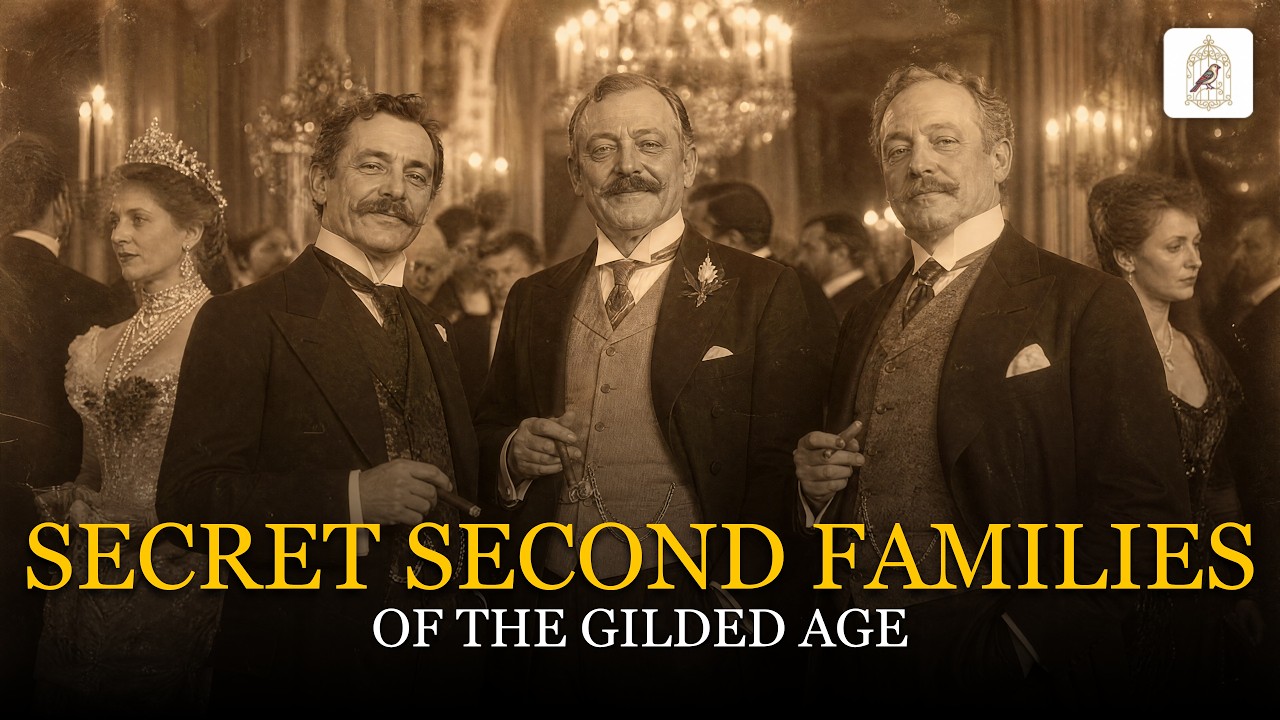
This is the story of three men who built parallel worlds with parallel families, sustained by fortunes so vast that the cost of a second life was a rounding error—until death, divorce, or a deathbed confession collapsed the architecture of silence.
The Banker Who Tried to Escape
James Stillman controlled more money than most nations, but he could not control a secret that would cost him everything. By the first decade of the 20th century, National City Bank was the largest financial institution in the United States, and James A. Stillman sat at its center.
His father had built the bank into a colossus of American finance, moving capital between railroads, steel mills, oil companies, and the government itself. The elder Stillman cultivated silence as a business strategy, and his fortune was estimated at more than $50 million.
In 1901, James A. Stillman married Anne Urquhart Potter, known in society as Fifi. The wedding was reported in every society column in New York.
The couple took their place among the city's financial elite, had children, and summered in the right places.
Somewhere downtown, in an apartment that did not appear in the social register, a woman named Florence Leeds was raising a son. Florence was a Broadway chorus girl. The son's name was J.
Ward Leeds. His father's name was James Stillman.
The arrangement was sustained by a financial architecture as carefully constructed as the bank's own ledgers. Stillman funded Florence's household through channels that kept his name off the paper trail. The money moved through intermediaries, arriving as paid rent, as accounts at stores, as cash delivered by men who understood that their employment depended on discretion.
The separate household required between $15,000 and $45,000 per year—between $500,000 and $1. 5 million in today's money.
But hidden from whom? In the Gilded Age, hidden did not mean unknown. It meant unspoken.
The servants knew. The cab drivers knew. The doormen at both addresses knew.
Colonel William d'Alton Mann, the publisher of Town Topics, almost certainly knew. His magazine was the most widely read in New York society, though no one would admit to subscribing. His business model was blackmail dressed as journalism.
When his informants uncovered an affair or an illegitimate child, he approached the subject and offered an opportunity to invest in his company. William K. Vanderbilt paid $25,000.
J. P. Morgan paid $2,500.
The payments confirmed that the secrets were real and the fear of exposure was worth almost any price.
For years, Stillman's arrangement worked. The two households operated in parallel. Fifi raised their children on Fifth Avenue.
Florence raised Jay downtown. Stillman moved between the two worlds with the efficiency he brought to managing the bank's capital flows.
In 1921, James Stillman filed for divorce and lit a fuse that would blow apart two families at once. His complaint was specific and explosive. He accused Fifi of adultery with Fred Bovay, a man of mixed Indigenous and French-Canadian heritage who worked as a guide at the Stillman family's property in Quebec.
Stillman alleged that Fifi's youngest son, Guy, who was 20 months old, was not his child.
But the real explosion came from Fifi's lawyers. They named Florence Leeds. They named Jay Ward Leeds.
They alleged that Stillman had fathered a son with a chorus girl while married to Fifi. They provided evidence.
The trial became the most sensational divorce case of the decade. Newspapers across the country published every detail. The proceedings dragged on for five years.
The legal costs exceeded $1 million. Stillman was forced to resign from the presidency of National City Bank. The institution could not afford the association.
The court's verdict was devastating. The judge refused Stillman's divorce petition on the grounds that he himself had committed adultery. You cannot accuse your wife of maintaining a secret child while maintaining one of your own.
Fifi withdrew her countersuit after receiving a $500,000 necklace, a reconciliation gift that was really a settlement by another name. The couple briefly reunited, but it did not last. Fifi divorced Stillman in 1931 and married a man 20 years her junior.
In 1926, Stillman formally acknowledged Jay Ward Leeds as his son and established a trust of $20,000 per year until Jay reached 21. The acknowledgement came too late to matter legally and too late to undo the damage. Florence Leeds disappeared from public records almost entirely.
Jay grew up with his father's money and his father's late acknowledgement, but without the Stillman name, the Stillman connections, or the Stillman social position his half-siblings inherited by birthright.
The Railroad Man Who Engineered a Perfect Escape
When Arabella Yarrington's son was born in March 1870, his father was one of the richest men in America. And his birth certificate carried another man's name.
Collis Potter Huntington was one of the Big Four who built the Central Pacific Railroad, the western half of the first transcontinental line. At his death in 1900, Huntington's estate was estimated at $50 million, roughly $1. 6 billion in today's money.
He controlled railroads, steamship lines, real estate holdings across multiple states, and political influence that stretched to Congress.
He was also, almost certainly, the father of a child born to a young woman named Arabella Yarrington in New York City. Arabella was born around 1850, probably in Virginia, almost certainly of modest means. By the late 1860s, she was in New York and in a relationship with a married railroad magnate approaching 50.
The child was born in March 1870. The birth certificate listed his father as John Worsham. The marriage to Worsham was engineered specifically to give the baby a legitimate surname.
John Worsham was a man from Richmond, Virginia who already had a legal wife. He traveled to New York, married Arabella, signed the relevant documents, and returned almost immediately to Virginia.
The child was Archer Milton Worsham. On paper, he was the son of a man who had never intended to be his father. In reality, he was the son of a man who controlled the Central Pacific Railroad.
The arrangement required collaborators. A clergyman who performed the ceremony without asking why the groom departed the next morning. A doctor who signed the birth certificate without noting the discrepancy.
Lawyers who structured financial support to flow from Huntington to Arabella without creating a direct link. Servants who maintained silence about the man who visited regularly and paid for everything.
People noticed. Archer was described by contemporaries as Collis's spitting image. But in Gilded Age New York, remarking on a powerful man's illegitimate child was an invitation to financial and social destruction.
For two decades, Arabella lived in a townhouse Collis paid for, raised a son Collis had fathered, and waited for a wife she had never met to die. Under New York's bastardy statutes, an illegitimate child was filius nullius—the child of nobody. Archer had no legal claim on Huntington's estate unless Huntington voluntarily provided one.
Arabella understood this. Her response was strategy, not despair. Over 20 years, she transformed herself from a woman of obscure origins into a figure of cultural sophistication.
She cultivated relationships with art dealers, learning the market for old masters and decorative arts. She educated herself in connoisseurship. She built connections to society figures.
She was building the social capital that would protect her if the financial arrangement collapsed.
In 1883, the variable she had been waiting for finally changed. Elizabeth Stoddard Huntington died.
Within a year, on July 22, 1884, Collis married Arabella. The kept woman became the wife. But the marriage was only half the project.
Collis legally adopted Archer Worsham, then 14 years old. The adoption erased the fiction of the Worsham marriage and replaced it with a new fiction—that Archer was Collis's adopted son, rather than his biological one.
When Collis died on August 13, 1900, the inheritance confirmed the plan's success. Arabella received more than $50 million. She became one of the wealthiest women in America.
In 1913, Arabella married Henry Edwards Huntington, Collis's nephew. Together, they assembled one of the most extraordinary private art collections in American history. They purchased Gainsborough's Blue Boy for $728,000, the highest price ever paid for a painting at the time.
Their San Marino estate became the Huntington Library, Art Museum, and Botanical Gardens, one of the finest research institutions in the world.
Archer inherited millions. He became a respected philanthropist and scholar. He founded the Hispanic Society of America in 1904.
He lived until 1955, a man of deep culture whose entire existence had been premised on a cover story invented before he could walk.
None of the tasteful plaques at the Huntington mention that the fortune flowed through a woman who spent 20 years as a kept mistress. None of them explain that the adopted son's real birth certificate listed a stranger as his father.
The difference between Stillman and Huntington was not moral. It was tactical. Stillman tried to force the system.
Huntington let it work in its own time. Stillman was impatient. Huntington was a railroad builder.
He understood that the distance between two points is covered not by speed, but by patience.
The Newspaper King Who Could Not Buy a Divorce
William Randolph Hearst controlled 28 newspapers, 18 magazines, and a film studio. But he could not control his own marriage.

By 1917, Hearst was 54 and the most powerful media figure in America. He was also irrevocably entangled with Marion Davies, a Ziegfeld girl who was 20 when they met. Hearst adored her.
He promoted her film career through his newspapers and Cosmopolitan Productions, spending millions on movies.
But Hearst was married. He had wed Millicent Wilson in 1903. She had been a showgirl herself when they met.
The marriage produced five sons, and Millicent proved to be exactly the kind of wife the Gilded Age produced. She took the name, the position, the money, and refused to let any of it go.
Hearst wanted Marion. He could not have her legally because Millicent would not give him a divorce. A divorce would require splitting a fortune that was enormous but dangerously overextended.
A settlement could force liquidations that might collapse the empire. And Millicent's social position was real and hard won. Surrendering it would mean admitting that underneath it all, she was still the girl from the chorus line.
The result was a stalemate lasting nearly four decades. Hearst lived with Marion at San Simeon, the 165-room estate on a hilltop overlooking the Pacific. Marion was the hostess, not Millicent.
She was the wife in everything but the one thing that mattered.
Around 1919, Marion Davies became pregnant, and the most powerful media mogul in America could not allow anyone to know. The pregnancy was an existential threat. A child would create a paper trail, a legal liability, and a scandal that even 28 newspapers could not suppress.
Marion was sent to France, ostensibly for a holiday. She gave birth to a daughter. The cover story exploited a coincidence of tragedy.
Marion's sister Rose had recently lost a baby. The child was registered as the daughter of Rose and George Van Cleave. On paper, she was Marion's niece.
The baby was brought back to America and raised in the Van Cleave household. Marion was a constant presence—the devoted aunt who visited with a frequency no ordinary aunt would sustain. She paid for everything.
She attended every milestone.
The Hollywood community almost certainly knew. But Hollywood understood power. Louis B.
Mayer knew. Jack Warner knew. All of them understood that Hearst's 28 newspapers could make or break a picture with a single editorial decision.
The silence about Patricia was not kindness. It was business.
On her wedding day, Hearst pulled Patricia aside and told her the truth. He was her father. Marion was her mother.
The confession was quiet, decades overdue, and delivered with the same controlled precision Hearst brought to everything. It changed nothing on paper. And then the silence resumed for another 40 years.
Hearst died on August 14, 1951, at 88, still married to Millicent, still living with Marion, still hiding Patricia. The Hearst sons arrived at the Beverly Hills house where Marion and their father had lived together. Marion was reportedly sedated.
When she woke, Hearst's body had been removed. She was not listed as a survivor in the obituary.
Marion married Horace Brown, a merchant seaman, within 11 weeks. She died in 1961. Her estate was valued at $20 million.
She left half of it to Patricia. No aunt leaves half her fortune to a niece unless the niece is something more. The will was the final coded confession.
Patricia lived for another 32 years after Marion's death. She married. She raised children.
She watched movies about her father's life, including Citizen Kane, and said nothing. She read biographies of Marion Davies and said nothing.
In 1993, Patricia was dying of cancer. She gathered her family. She told her son Arthur the truth.
All of it. Who she was, who her parents were, why it had been hidden. And she asked him to make it public.
After 73 years, she wanted the lie to end.
Arthur published the revelation. The Hearst family, after initial resistance, acknowledged the claim. The circumstantial evidence was overwhelming: the timing of the birth, the concealment in Paris, Marion's bequest of half her estate, Hearst's acknowledgement on Patricia's wedding day.
Patricia Lake died in 1993. She died as herself, the daughter of Marion Davies and William Randolph Hearst.
The Architecture of Silence

The Gilded Age did not merely tolerate double lives. It built the legal infrastructure to sustain them.
The foundation was coverture. Under this doctrine, a married woman had no independent legal existence. She could not own property.
She could not sue. A wife who discovered her husband's double life had no independent means to challenge it.
The second pillar was bastardy law. Under common law, an illegitimate child was filius nullius—no right to the father's name, no right to the father's estate, no right to support unless voluntarily provided. A wealthy man could father children across the city and owe them nothing at death as long as he signed no papers.
The third pillar was the economy of silence. Colonel Mann's Town Topics demonstrated that discretion had a market price. Every payment confirmed the same truth: the system worked because everyone within it had a financial interest in its continuation.
The double life was not expensive. It was cheap. Stillman's fortune exceeded $50 million.
The cost of maintaining Florence Leeds' household was less than one-tenth of one percent of his net worth. Huntington's railroad empire generated millions annually. Arabella's household expenses were a single line item.
Hearst spent more furnishing one room at San Simeon than it cost to hide Patricia for a decade.
The Supreme Court did not begin dismantling this architecture until the 20th century was well advanced. Levy v. Louisiana in 1968 ruled that illegitimate children had the constitutional right to sue for wrongful death.
Trimble v. Gordon in 1977 struck down state laws preventing illegitimate children from inheriting. These decisions came nearly a century after the Gilded Age.
The Longest Silences
The pattern of the hidden second family did not begin in Manhattan ballrooms. It began on southern plantations.
Thomas Jefferson's relationship with Sally Hemings lasted nearly four decades and produced at least six children. For 172 years, the Jefferson family and many historians denied the relationship entirely. DNA evidence published in 1998 confirmed it.
In 2018, the Thomas Jefferson Foundation declared the matter settled historical fact.
Strom Thurmond, the segregationist senator who ran for president on a platform of racial separation in 1948, fathered Essie Mae Washington Williams with a 16-year-old Black servant in 1925. He provided financial support throughout her life but never publicly acknowledged her. She revealed the truth only after his death in 2003.
The common thread is not race. It is power. The ability to create a child, sustain that child financially, and deny that child publicly.
The mechanism was identical. Only the color of the silence changed, and the silence lasted longer.
The Truth That Always Surfaces
Every one of these stories ends the same way. With a piece of paper, a confession, or a test that the dead can no longer prevent.
Stillman's double life ended in a courtroom, destroyed by his own petition. Huntington's double life ended in an adoption certificate and a marriage license. The truth was absorbed rather than exposed.
Hearst's double life ended on a deathbed in 1993, when Patricia Lake asked her son to tell the world who she really was.
The Gilded Age built an architecture of concealment that was extraordinary in sophistication. Coverture silenced wives. Bastardy laws erased children.
The economy of discretion purchased the compliance of servants, journalists, and neighbors.
But it could not hold forever. The will is the first crack. The deathbed is the second.
The DNA test is the third.
Three men. Three fortunes. Three hidden families.
Three different outcomes. Stillman was destroyed by his own legal gambit. Huntington engineered a transfer so clean that the institution bearing his name celebrates it to this day.
Hearst's secret outlasted every other secret of his era, surviving into the age of the internet before a dying woman finally broke it.
The harder question is who paid the price. The first wives who were deceived. The second women who were hidden.
The children who inherited a lie. Every child born in the shadows carries the same inheritance: the knowledge that they existed because someone powerful enough to create them was also powerful enough to erase them.
The truth always surfaces. The only question is how many lifetimes it takes, and who is left to hear it when it finally arrives.