On the night of June 29, 1967, a 1966 Buick Electra slammed into the rear of a tractor trailer on US Highway 90 near Biloxi, Mississippi. The car slid beneath the massive steel frame, and the roof was peeled away like the lid of a tin can. Jayne Mansfield, sitting in the front seat, was killed instantly. She was thirty-four years old.
Beside her died her lawyer and companion, Sam Brody, along with the twenty-year-old driver, Ronnie Harrison. In the backseat, her three children were thrown to the floorboards and survived with minor injuries. The collision was the final act of a life spent trading her image for power, and it was the brutal, unglamorous end of one of Hollywood’s most dazzling stars. Born Vera Jayne Palmer, Mansfield arrived in Los Angeles with a reported genius-level IQ, fluency in multiple languages, and a talent for classical violin.
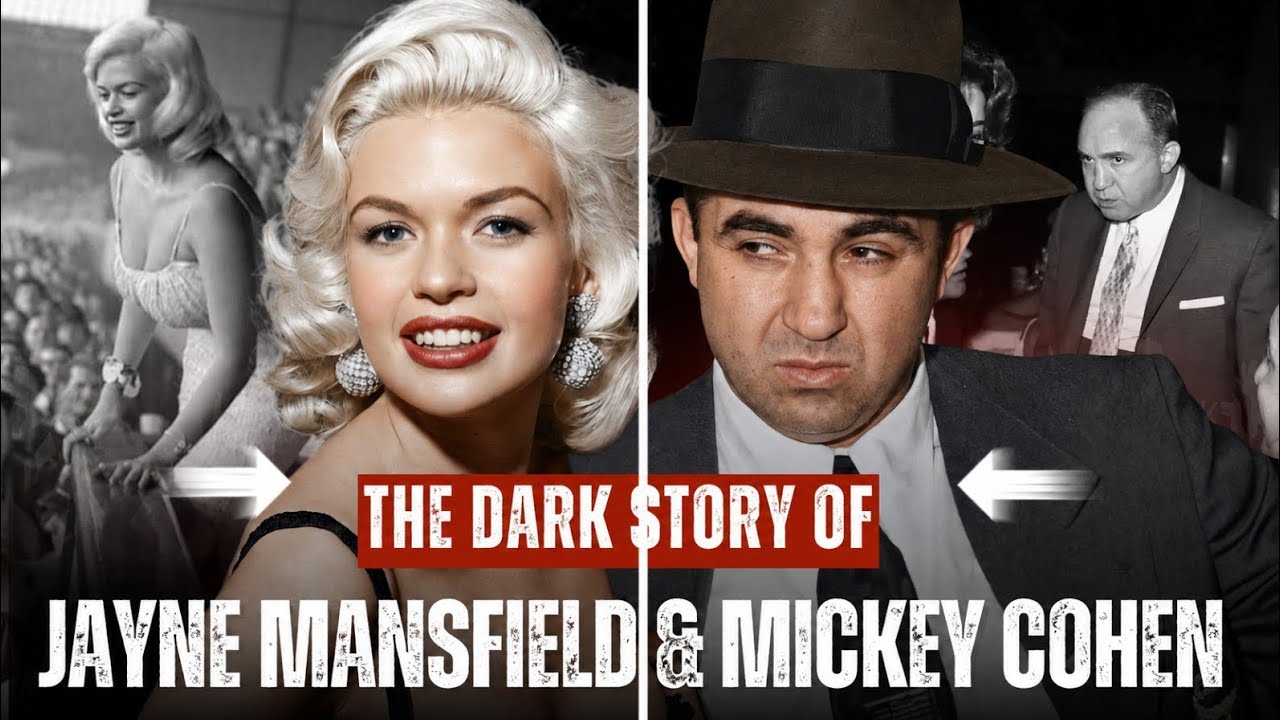
She understood early that Hollywood did not pay for intellect. Hollywood paid for spectacle. She wanted to be the most famous woman on Earth, to eclipse Marilyn Monroe, and she did not care what she had to trade to get there. She needed powerful men to keep the cameras clicking, and she found the most dangerous buyer available: Mickey Cohen.
Cohen was not a studio executive. He was the reigning king of the Los Angeles underworld, a former enforcer for Al Capone and Bugsy Siegel who had seized control of the city’s illegal gambling, extortion, and murder. He was a violent man who ordered hits and ran bookmaking operations that generated millions in untraceable cash. But Cohen had a fatal flaw for a mobster: he craved the spotlight.
Most Mafia bosses valued silence. Cohen valued headlines. He wore bespoke suits, washed his hands dozens of times a day due to severe obsessive-compulsive disorder, and demanded his associates carry only fresh, uncirculated currency because he found used bills revolting. He was a man terrified of germs yet completely desensitized to the close-range violence required to maintain his empire.
Cohen needed a distraction, something so bright and beautiful that the public would stop looking at the bodies piling up in his wake. He found it in Jayne Mansfield. Their partnership was a master class in media manipulation. When Cohen walked into Ciro’s or the Coconut Grove alone, people whispered about violence.
When he walked in with Mansfield on his arm, the violence evaporated from the narrative. The press asked her about her dress, her next movie, her measurements. They did not ask about the rival gangsters who had recently disappeared into the California desert. She giggled, she posed, and beside her, Cohen soaked up the flashes, wearing the respectability only a Hollywood starlet could provide.
The arrangement was a transaction. She gave him glamour. He gave her headlines. Every time she laughed at his crude jokes, she was whitewashing his criminal empire, normalizing a monster, turning a man who ruined lives into a harmless tabloid fixture.
The Hollywood press corps knew exactly who Cohen was. They knew about the beatings and the murders. Yet they happily published the photographs and wrote the glowing articles because scandals sold magazines. The reporters drank his free liquor, ate his free steaks, and looked the other way.
Mansfield believed she was using Cohen. She believed her high intelligence would protect her from the darker realities of his business. She was wrong. The glamorous dinners at the Mocambo were not dates.
They were heavily guarded military operations, with Cohen’s soldiers seated at adjacent tables, watching her every move. The diamond necklaces he placed around her throat were not tokens of affection. They were collars, marking her as his territory, a warning to every other man in Hollywood that she belonged to the Cohen crime family. If she tried to leave or looked at another man, the consequences would not be a broken heart.
They would be a broken jaw, a career-ending smear campaign, or a car bomb. The studios watched this unfold and turned a blind eye. 20th Century Fox, which held her contract, strictly controlled the morality of its stars, suspending them for minor infractions and dictating who they could marry. But they ignored the terrifying men lingering around her dressing room because her association with Cohen made her dangerously fascinating to the public, and the danger translated to box office revenue.
The studio profited from the very peril that surrounded her. Cohen demanded constant validation. He paraded her at charity events, brought her to boxing matches, and made sure she was photographed laughing at his side. He was siphoning her cultural capital to fund his own ego.
She realized the applause was not entirely for her. The crowds were cheering for the spectacle, the illusion of danger tamed by beauty. But the danger was never tamed. It was merely resting.
She had signed the contract, taken the diamonds, accepted the headlines. Now she had to pay the debt, and the mafia does not accept late payments. The psychological toll was devastating. She lived in a state of permanent hyper-vigilance, unable to drop the bombshell persona for a single second.
If she showed fear, the illusion would break. If she showed disgust, she would insult a man who ordered assassinations over perceived slights. She turned to alcohol to numb the terror. The champagne that had been a celebratory prop became a necessary sedative.
She could not confide in fellow actors, who would leak information to the press or distance themselves out of fear. She could not confide in the police, who had Cohen’s informants everywhere. She could not even trust her own management team, which profited immensely from the notoriety the relationship generated. Her isolation grew profound even as she stood at the center of attention wherever she went.
She tried to construct an illusion of normalcy by marrying Mickey Hargitay, a former Mr. Universe. Together they bought a sprawling Beverly Hills mansion that she painted entirely pink, installed a heart-shaped swimming pool, and filled with children and exotic pets. The Pink Palace was a psychological monument to denial, a cartoonish fortress designed to keep the harsh realities of the underworld locked outside.
But Cohen did not care about her marriage. His enforcers parked their cars in her driveway, and the predators were already inside. Hargitay, despite his Herculean physique, offered zero leverage against organized crime. Syndicate associates respected bullets, not biceps.
Cohen systematically dismantled her self-worth. He reminded her she was entirely replaceable, that without his protection the studios would discard her for a younger, more compliant blonde. He engineered a terrifying financial dependency, ensuring she lived far beyond her means so she constantly needed an influx of cash. When she ran short, he stepped in with loans, becoming her primary creditor.
She was not just emotionally and physically captive. She was financially enslaved. Every movie she filmed, every photograph she took was an attempt to service the debt. In 1961, the federal government finally moved against Cohen.
The Justice Department could not build a murder case that would stick, so they went after his untaxed income. Agents tracked his bespoke suits, his armored cars, his luxury hotel suites, and the diamonds he clasped around the necks of Hollywood starlets. They built a paper trail of a massive illicit empire and indicted him for tax evasion. The jury convicted him, and the judge sentenced him to fifteen years in federal prison.
The king of the Los Angeles underworld was sent to Alcatraz. For Mansfield, the news should have sounded like a prison break. The man who had controlled her schedule, monitored her contacts, and dictated her existence was locked in a concrete cell. With Cohen’s incarceration, the suffocating pressure of his physical presence vanished.
She mistook the silence for liberation. It was a fatal miscalculation. When a mob boss goes away, the protection disappears instantly. The massive terrifying shield Cohen had erected around her dissolved overnight.
The studios reacted with the speed and ruthlessness of apex predators. For years, they had tolerated her demands and her chaos because her association with Cohen generated a dangerous, highly profitable buzz. With Cohen in prison, the danger evaporated. She was no longer the untouchable property of a mob boss.
She was just an aging blonde actress with five children, a massive mortgage, and declining box office returns. The executives stopped sending scripts. They stopped returning calls. The lucrative studio contract simply vanished.
The media executed a similarly ruthless pivot. The gossip columnists and tabloid photographers who had built the myth of the glamorous sex symbol now deployed their sharpest critics to dissect her aging process with surgical malice. They mocked her pink mansion, ridiculed her desperate attempts to stay relevant, and published unflattering photographs of her exhaustion. The same apparatus that had built her pedestal now recognized that the spectacle of her destruction would sell twice as many magazines.
The financial panic set in almost immediately. The Pink Palace was a massive black hole, requiring astronomical monthly income for property taxes, staff, and maintenance. Both her revenue streams, the studio paychecks and the mafia cash, were severed. She accepted roles in low-budget independent films filmed on shoestring budgets in Europe.
When those were not enough, she hit the nightclub circuit, performing in sleazy, smoke-filled venues in working-class towns across America and Northern England. She sang breathy, suggestive songs to drunken, hostile audiences who heckled her and demanded she strip. She relied heavily on alcohol to endure the humiliation. The champagne of the Hollywood nightclubs was replaced by cheap vodka and plastic cups.
On the night of June 28, 1967, she finished a performance at the Gus Stevens Supper Club in Biloxi, Mississippi. She needed to travel to New Orleans for an early morning television interview, a desperate attempt to secure a television contract. She climbed into the front seat of a Buick Electra, with a twenty-year-old college student named Ronnie Harrison driving, Sam Brody beside her, and her three children asleep in the backseat. A thick fog rolled in from the Gulf Coast, dropping visibility to near zero.
Up ahead, hidden entirely by the fog, a mosquito fogging truck was moving slowly down the highway, pumping thick white clouds of insecticide into the air. Directly behind it was a massive tractor trailer crawling along at a dangerously low speed. The driver never saw it. There were no brake marks on the asphalt.
The Buick slammed into the rear of the trailer at high speed, shearing off the entire roof. Mansfield was killed on impact. In the aftermath, a sensational rumor spread that she had been decapitated, a profitable lie built from a photograph of her blonde wig lying on the blood-stained dashboard. Even in death, she was denied dignity.
Mickey Cohen, still in federal prison, showed no emotion. He had merely lost a piece of property. The studios issued brief condolences and returned to business. The physical legacy of her horrific end was entirely utilitarian.
To prevent similar tragedies, the US government mandated a heavy steel bar on the rear of all commercial trucks. Officially called the rear underride guard, the public named it the Mansfield bar. A woman whose sharp intellect and dazzling ambition defined an era was ultimately memorialized by a cold piece of industrial steel.