On the morning of May 6, 1910, as King Edward VII suffered one heart attack after another inside Buckingham Palace, his wife did something no one expected of a wronged queen. She sent for his mistress. Alice Keppel was led up a back staircase to the bedside of the dying king, where she knelt beside the man she had loved for twelve years. The woman who had spent her entire adult life mastering composure broke down completely, and members of the household had to carry her from the room.
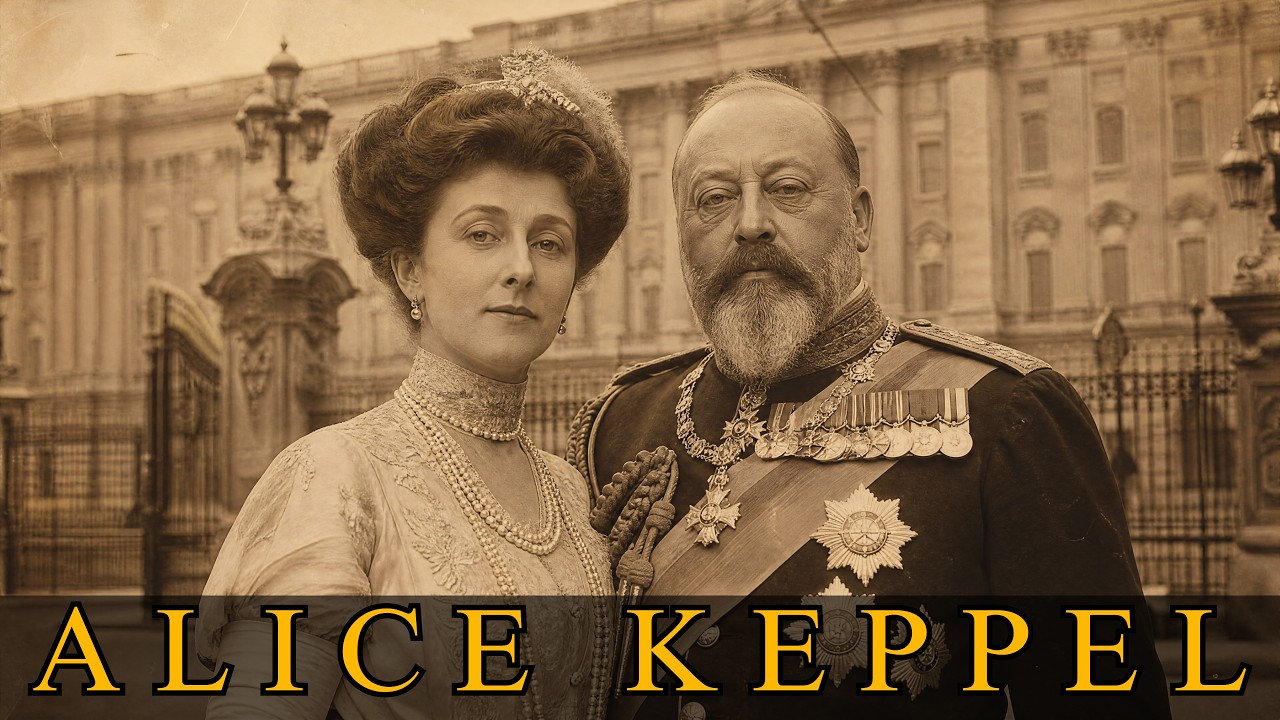
Within months, the palace would begin to behave as though she had never existed. Alice Frederica Edmonstone was born in 1868 into an old Scottish family whose name promised more than its purse could deliver. Her father was a baronet and an admiral in the Royal Navy, but the family seat at Duntreath Castle was barely affordable, and Alice entered a society where marriage was the central financial event of a woman’s life. A girl of good blood and little money stood on a knife edge, and in the brutal arithmetic of the marriage market, Alice was priced below her looks.
She had beauty, charm, and a gift for discretion, and she meant to use them. At twenty-three, she married George Keppel, a handsome, well-born, and nearly penniless younger son of the Earl of Albemarle. Theirs was an unusual arrangement, understood quietly by both. George famously remarked that he did not mind what she did so long as she came back to him in the end.
They stayed married for fifty-six years, and Alice’s admirers helped pay for the life they built together. Her biographer put it bluntly: Mrs. Keppel regarded adultery as a sound business practice. In the winter of 1898, at Sandown Park racecourse, Alice was introduced to Albert Edward, Prince of Wales, the nearly sixty-year-old heir to the throne who had spent decades in enforced idleness, filling his time with pleasure.
He did not need another beauty, but Alice gave him something rarer: calm. She could tease him without wounding him, manage him without letting him feel managed, and she never gave him a moment’s anxiety that she might embarrass him. The attachment settled into something that looked like a second marriage. When Edward became king in 1901, Alice was not dropped.
The reason was Queen Alexandra, the gentle, increasingly deaf Danish wife who had long resigned herself to her husband’s infidelities. Alice never humiliated the queen, never flaunted her position, and treated Alexandra with scrupulous respect. The queen, who had disliked the previous royal mistress, found she could tolerate Alice Keppel, and even be fond of her. Edward did not hand Alice money.
He handed her something better: access. Through his private money manager, Sir Ernest Cassel, she was placed into investments, including shares in a rubber company worth the modern equivalent of millions of pounds. The Keppel family was lifted, funded, and secured. Alice understood that favor was fragile, and she converted the fleeting thing into the lasting thing while she still had the chance.
She also became something without name or office: a channel between the king and his government. She could calm Edward when his temper froze a dinner table. One former governor of India recalled that when the king was at odds with the Foreign Office, it was through Mrs. Keppel that a wiser course could be pressed.
She moved with the king through his seasonal round, from Marienbad to Biarritz, and at her houses in Portman Square and Grosvenor Street, the king came to unbend. The whole arrangement ran on discretion. Everyone who mattered knew, and nobody said. But the ground beneath her was no firmer than one failing heart.
In the last April of his life, the king sailed home from France unwell and did not mend. Alice, closer to him than anyone, saw the danger before the doctors would admit it. She wrote in secret to a friend, begging him to persuade the king to see a proper doctor, and pleading that no one be told she had written. The warning was read and not acted on.
Years before, in easier days, Edward had extracted from his wife a promise: that if he were dying, Alice should be allowed to say goodbye. The king died shortly before midnight on May 6, 1910. Alexandra honored her pledge. Alice was brought to the bedside while he could still dimly know her, but the composure that was the discipline of her life broke.
As her grief filled the room, the queen gave the order that she should be taken away, and Alice was led out through the private doors by which she had come in. She entered the king’s world by the side door, and the side door let her out. The new reign closed over her quickly. George V was upright and severe, and his wife Mary set a tone of chilly respectability.
The invitations thinned and stopped. The official record of the monarchy turned itself so that the most important companion of a king’s later life left almost no trace. She was not scrubbed from all human memory, but she was erased from the crown’s account of itself. In November 1910, the family sailed for the East, traveling through Siam on to China for nearly two years.
The stated purpose was the daughters’ education; the real purpose was retreat. When they returned in 1912, Alice was still wealthy and handsome, but no longer at the center. During the war, she ran a hospital for wounded soldiers on the French coast, and for the first time in her adult life, she became a figure in her own right. In 1925, Alice and George bought a villa in the Tuscan hills above Florence.
She poured her fortune and her taste into the villa and its gardens, and she gathered a court. The deposed royalty of Europe came to her table. Winston Churchill came to paint the view. The woman the London court had erased built a small kingdom of her own.
In December 1936, when Edward VIII abdicated the throne for the sake of an American woman, Alice remarked dryly that things were done better in her day. She died in September 1947 at the villa, at the age of seventy-nine, and was buried in Florence. George followed her within ten weeks. In the official memory of the British monarchy, she was still very nearly nothing.
But eight weeks before she died, a great-granddaughter had been born into the quiet line of her younger daughter, Sonia. That child was Camilla Rosemary Shand. She grew up, and over the course of a long and complicated life, she loved a man who was heir to the British throne. On April 9, 2005, Camilla married Charles, the Prince of Wales, the great-great-grandson of the very king whose mistress Alice had been.
And when Charles became king in September 2022, the woman at his side, crowned as queen, was the direct descendant of the erased mistress. The palace had shut its doors on Alice Keppel in 1910. In 2022, 112 years later, her own blood sat beside the king of England as queen. The Cubit family, into which Sonia had married, had built the very facade of Buckingham Palace.
The blood of the woman carried out through the side door passed back through the front, and this time no one closed the door behind her. Everything Alice had held, she held at another man’s pleasure, and it was taken away. But there was one thing she had that no man had lent her and no man could reclaim: her own blood, and it outlasted the palace.