In the autumn of 1915, a boy walked out of the deep woods of the Missouri Ozarks barefoot, unwilling to give his name, carrying a story that three grown men refused to write down in full. He was perhaps ten years old. His clothes were sewn from a fabric the local women said they had never touched before. When the sheriff of that small county finally asked where he had come from, the boy turned and pointed toward the black wall of trees behind him, and said one word: the Others.
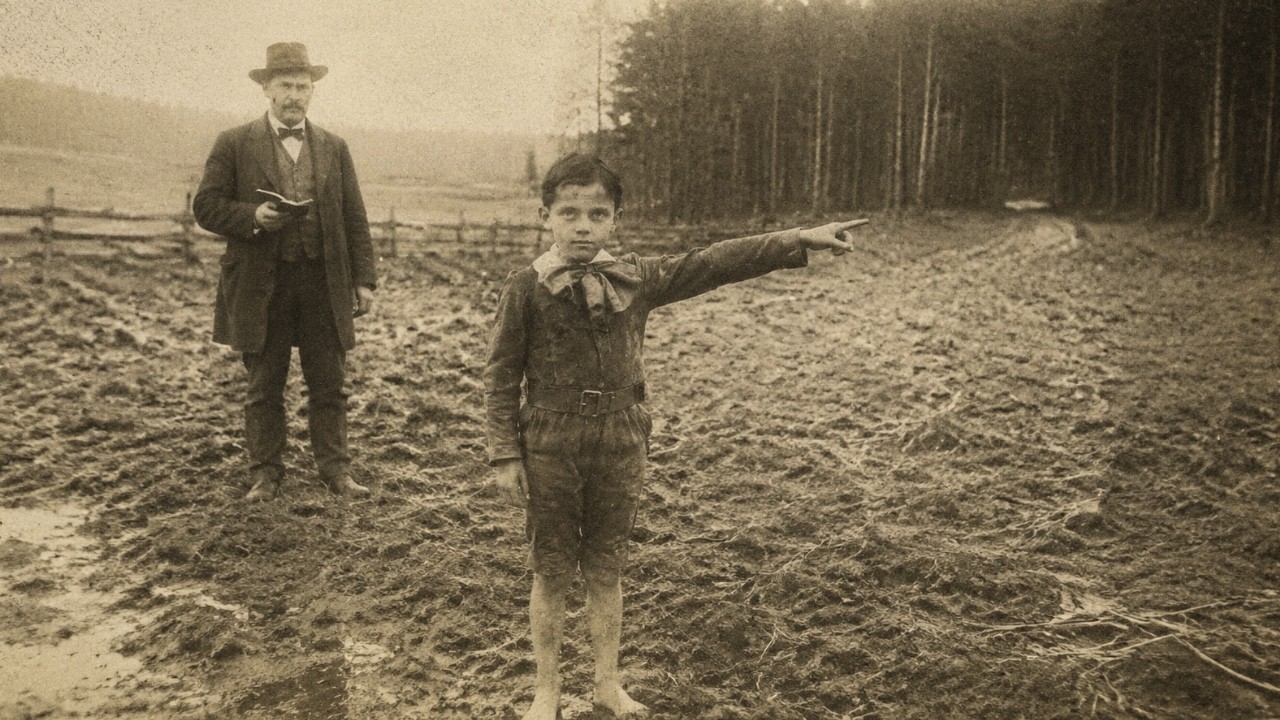
Not hunters. Not a lost family. The Others. And what he told the sheriff over the next four days was quietly removed from the county records, locked in a drawer, and left to rot for more than a hundred years.
The county was small and poor, connected by logging roads that turned to mud every October. The nearest real town was a full day’s walk away. People there lived and died within twenty miles of where they were born, and they knew every face within that distance. So when a farmer named Harlan found a child sitting in the middle of his eastern field at dawn, soaking wet and shivering, his first feeling was not pity.
It was confusion. He knew every child in that valley, and this child was not one of them. Harlan had lived in the valley his whole life. He had buried neighbors and birthed calves and dug wells by hand.
But a strange child appearing overnight in clothes no store within a hundred miles had ever sold, sitting in a field he had walked a thousand times, gave him a cold feeling he could not describe. The boy did not cry. He did not run. He watched Harlan the way a wild animal watches a man who has decided not to be afraid of him anymore.
When Harlan spoke to him, the boy answered in English, but slowly and carefully, like someone choosing words he had not used in a long time. He did not give his name. All he said was that he came from where the Others lived. When Harlan asked where that was, the boy looked at the ridge line to the north and said, Not there anymore.
They removed it. A hungry child says strange things. Harlan knew that. He wrapped the boy in a horse blanket, put him in the wagon, and took him to town to see Sheriff Quill, a heavyset man who had held the office for nineteen years and, by his own account, had heard every lie a frightened person could invent.
Quill expected a runaway, maybe a boy fleeing a beating, or the lone survivor of a family that had died quietly inside a cabin somewhere beyond the hills. That is not what he found. During the first day, the boy ate as if he had not tasted food in a week, and he began to talk. The more he talked, the quieter the room became.
He was not describing a cabin. He was not describing a farm. He was describing a place with straight stone streets, buildings taller than the county courthouse, taller than anything within two hundred miles. Lamps that burned without oil.
Walls, he said, that were already old when the old people were young. He described the light more than anything else. Not hand lamps, not fire. A steady glow, he said, that lived inside the walls and came on at dusk without anyone lighting it.
The same in every building, never flickering, never smoking. Quill stopped him and asked how a child could invent something like that. The boy did not understand the question. For him, it was not remarkable.
It was simply how the room worked. And that certainty, more than the story itself, was what troubled the men listening. Quill asked where this place was. The boy said it was right here, all around them, under the trees.
That most of it had been torn down and carried away before he was born, but some of the people remained, hiding, living in what was left of it. He and the Others. To understand why a seasoned lawman would take a barefoot child seriously, you have to understand what that part of the country looked like in 1915. The official story of the Ozarks is simple.
Poor hill folk. Log cabins. Nothing before the settlers but forest and rock. But the settlers who arrived in the nineteenth century left letters, and those letters kept repeating the same strange thing.
They described structures they had not built and could not explain. Carved stone foundations in the heart of virgin forest. Straight raised roads running for miles under the tree cover, wider and flatter than wagon trails. Low stone walls arranged in patterns that made no agricultural sense, following no property lines and enclosing nothing.
One surveyor in the 1890s wrote that he measured a raised stone road as straight as an arrow for nearly four miles, then it disappeared under the base of a hill as if the hill had been poured over it. He noted he knew of no crew capable of building it, and the local families had no memory of who built it. It was simply older than memory. He wrote the word old in his notebook, then added in the margin a second word: deliberate.
People who came west were told the land was empty. Then they arrived and found features of something that had not been empty at all. The answer they were given again and again was that it was natural. Just rocks.
Just the way the hills formed. The boy in Quill’s office had a different answer. He said people built it a long time ago. Then, in his words, other men came and deliberately dismantled it.
Not looters, not treasure hunters, but organized crews. They tore down the tall buildings, broke the stone, hauled it away along the raised roads, and buried what they could not carry under soil and new trees, so that those who came after would think the forest had always been there. Quill wrote some of this down. We know that because the pages exist.
Then, on the second day, the boy said the thing that made Quill stop writing. He said the men who dismantled it were still working. That it was not finished. That the demolition had been going on his entire life.
And that the Others, the people who remained, were also being removed. Quietly. Taken a few at a time, loaded into covered wagons at night, driven north, and never seen again. The boy said he watched it happen to his own people.
And he said he was the only one who escaped. A modern person might stop here and say this was a frightened child inventing a story. Perhaps. But Quill did something in the following week that tells us he did not think it was just that.
He began asking around, and he found that more than one traveler and more than one preacher in the past decade had reported the same thing in that region. Covered wagons on the old roads at night moving people no one was meant to see. Strange-speaking children who were not registered anywhere, never enrolled in school, never listed in church records, then simply vanished. One preacher wrote that he tried to follow a wagon convoy north to see where these people were being taken.
After two days, the road he was following simply ended in fresh forest, with no camp, no footprints, no sign that anyone had passed. As if the road itself had been removed behind them. Quill gathered what records he could, and here he hit his first real obstacle. For part of the northern county, the records did not show empty land.
They showed erasure. Survey pages with entries crossed out. A census that counted forty families one year, and a few years later counted nothing at all, with no recorded fire, flood, or epidemic to explain it. Just a clean, quiet deletion.
Someone had taken those books and made the record match the emptiness, as if no one had ever lived there. The boy had a name for the men who did it. He called them the gray coats. He said they wore long gray coats, did not act like farmers or soldiers, and came with papers, always papers.
They would arrive, present the papers, and everything they had come for would stop existing. A building, a family, a name on a page. Quill asked the boy how a piece of paper could make a whole building disappear. The boy said the paper did not make it disappear.
The paper made it allowed. Once the gray coats had their paper, the crews came to do the rest, and afterward the paper was the only evidence the place had ever stood. And the gray coats kept the paper. So there was nothing left to point to.
No building, no people, no record except the one they took with them. He said his own settlement was removed over three nights. On the third night, when the gray coats came to take the people who remained, an old woman told him to run south and not stop. And not to talk about the tall buildings to anyone, ever, because the gray men followed talk.
He ran until he came out of the trees into Harlan’s field. And the first thing he did when a grown man found him was break the old woman’s only rule. He talked. The boy in the Ozarks was not alone.
Once you know what to look for, the same pattern appears across the country in those years, hiding in plain sight under a name everyone heard and almost no one questioned. The orphan trains. Between the 1850s and the 1920s, hundreds of thousands of children, allegedly mostly from crowded eastern cities, were loaded onto trains and shipped west and south to be distributed to strangers on station platforms. That is the official history, taught as charity, as rescue.
The numbers alone should give you pause. At least a quarter of a million children moved across a single generation, distributed on train platforms to almost anyone who would sign for a child, with little paperwork following them and very little effort made to record where each child actually came from. In an era that documented livestock and land deeds to the last acre, the origins of hundreds of thousands of human children were left blank. That is not an accident of bad record keeping.
Blank spaces of that size are intentional. But read the testimonies left by the children themselves when they grew up, and you find that something is off. Many of them did not know where they came from. Many had no birth record anywhere.
Some of them remembered a home that did not match any city they were told they came from. They remembered open country, and stone, and large, quiet buildings. Then a gap, and a blank, and a train. The boy in Quill’s office described covered wagons heading north.
The orphan trains ran on rails, a different method, the same result. Children without paper records, separated from their true origins, scattered to places so distant that no two of them could compare stories and realize they were describing the same vanished place. There is a wider pattern people began to notice, and once you see it, you cannot unsee it. Across the country, in photographs from the late nineteenth century, there are towns that look more fully built than they should be.
Massive stone buildings, ornate and grand, standing in towns supposedly home to a few thousand people who owned no machinery capable of raising them. Streets where ground-floor windows sit half-buried below sidewalk level, as if the whole town had been excavated out of something or buried beneath it. Official explanations exist for all of this. They are thin.
And the boy in the Ozarks, decades before this became public conversation, described the mechanism precisely. Someone builds, and someone else arrives with papers and tears it down. And the earth swallows what remains. The same people who ask about the buried windows ask about the forts.
Across America and much of the world, there are earthworks shaped like perfect stars, geometrically precise, far larger and far older than the frontier posts later built inside them. History books call them simple military engineering and move on. But no frontier militia designed flawless eight-pointed stars stretching for miles, and the settlers who found them did not build them either. They occupied what was already there and gave it a new name.
Which is exactly what the boy said about the gray coats and what they did to everything. They were not always destroying. Sometimes they were only renaming and re-assigning, letting the new story grow over the old one like moss. That is the part that should stick with you.
It is not that a settlement disappeared. Settlements fail all the time. It is that the disappearance was administrative. It came with survey adjustments and crossed-out census lines and men carrying papers.
Someone was keeping the record. Someone decided what stayed in the ledger and what was struck from it. And nothing is erased with that much care unless someone decided you were never supposed to know it existed in the first place. Think about what the boy actually claimed.
Straight stone streets. Buildings taller than anything the settlers could have raised. Light without flame. Walls already old when the elderly were young.
In 1915, a barefoot child who had never seen a city, where would that image come from? He could not have read about it. He could not have been taught it by hill people who had never seen anything like it themselves. He was describing in simple child’s words an advanced settlement that official history says never existed anywhere near him.
And note what he did not describe. He did not describe magic. He did not describe monsters. He described construction and demolition.
Builders and work crews and wagons and papers. The horror of his account is not that the Others were supernatural. It is that they were ordinary people living in a real place, and that a quiet, organized, well-documented effort erased them and their town the way a clerk strikes a line he no longer wants on the page. And he was describing that demolition as ongoing.
Here is what happened to the boy. Quill kept him for a little over a week. He fed him, tried to place him with a local family, and kept writing down what he said. Then, according to the surviving fragments, two men arrived in the county whom Quill did not know.
They were not from there. They had papers. And they left with the boy. Quill wrote that the men were polite, that they thanked him, and that they presented documents identifying them as officials come to take a displaced minor for relocation.
The papers looked entirely proper. That, somehow, was the worst part. There was nothing to refuse. Everything was in order.
The papers said the boy belonged to them, and before an apparently valid document, a county sheriff in 1915 had nothing. Quill never wrote their names. What he wrote in the last surviving line of his notes was a single sentence. They were dressed in gray, and I did not stop them, and I have not slept well since.
The boy was never recorded in any school, church record, or census, just like the children he described, just like the families that faded from the northern pages. He walked out of a place that was being erased. He told one man the truth about it. Then he was folded back into that erasure as if he had never walked out of those trees.
You can decide this is a legend, a ghost story told by hill people to explain the stones in their forests. That is the comfortable version, and you are free to take it. But before you do, consider three facts the comfortable version must justify. The stone foundations and straight raised roads in the Ozark forest are real.
Travelers and settlers described them for a century, and some of them are still there under the leaves. The census gaps are real. There are places in the records where households are counted, then, with no catastrophe, vanish from existence. And the pattern of children without origin, moved in groups, their paper traces erased, is real.
It even has a name that sounds respectable in a museum, which prevents anyone from looking too closely at it. Quill resigned his office within a year. He had held it for nearly two decades. He had faced armed men, floods, and killers.
But a barefoot child drove him out of the only job he had known his whole life. He moved his family east and never spoke about the boy in public. The notes survived only because a relative kept the drawer they were locked in and did not read them until long after Quill’s death. If you want to erase a civilization and impose your own history over it, the buildings are the easy part.
Stone can be torn down in a single season. The hard part is the people, because people remember and people talk, and one old man describing his childhood’s lit streets is enough to unravel your entire fabricated story. So you do not just take the city. You take the children before their memories set.
You scatter them across a continent under a pleasant name, and you make sure no two of them stand in the same room long enough to say the one sentence that would reveal the truth. The old woman told him the gray coats followed talk. So he talked once, to a sheriff who believed him enough to write it down, and enough to live in fear for the rest of his life. The question the boy leaves you with is not whether the Others were real.
The stone in the forest answers that. The question is simpler and worse. If a place of that size, with people living in it, could be dismantled and struck from the records within a single man’s lifetime, and the only witness who escaped was quietly collected by two men in gray, then how much of the world handed to you is merely the version that was permitted to remain in the record? Think about that, then go find the stone yourself.
It is still there, waiting for someone to ask the same question the boy asked. Who brought them down, and where did they take everyone?