In the stifling stillness of an Arizona summer in 1886, Isabel Perico Enjadi, a Chiricahua Apache woman, was photographed as a prisoner of war. The image captures her in the shadow of the final campaigns of the American Southwest, a moment defined by the surrender of Geronimo and the collapse of Apache resistance. The camera did not document a victory so much as an ending, framing a woman whose people had been hunted, cornered, and now held under military authority. The photograph, like many taken in that era, froze a face while the world around it continued to close in.
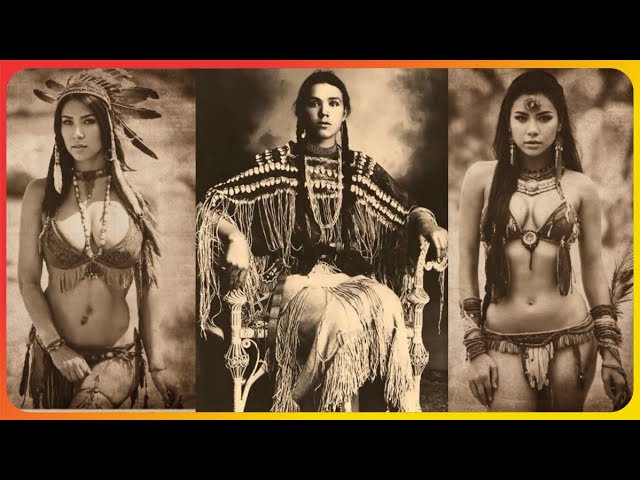
That same year, far from the deserts of the Southwest, Lizzie Longwolf stepped into the glare of another kind of spotlight, performing in Buffalo Bill’s Wild West show. The spectacle, part of the international touring exhibitions that packaged the frontier for mass audiences, featured equestrian feats, exhibition shooting, and choreographed battle scenes. For the public, it was entertainment; for Longwolf and other Native performers, it was a livelihood that came with the burden of playing a role in someone else’s story. The show sold a narrative of the vanishing West even as the real West was being remade by railroads, settlers, and federal policy, and her presence on that stage was a negotiation between survival and representation.
These photographs, taken across the turn of the twentieth century, document a people in motion, not because they were moving forward in any progressive sense, but because the ground beneath them was shifting. The images scattered throughout the era, attributed to photographers like Carl Moon, Frank Reinhardt, Roland Reed, and others, capture Native women at the precise moment when their communities were being absorbed, displaced, and redefined by an expanding nation. In 1878, at Fort Keogh in the Montana Territory, a Cheyenne woman was photographed within the walls of an army post established just two years after the Battle of the Little Bighorn. The fort anchored the military presence on the northern plains under Colonel Nelson Miles, and in that setting, the Cheyenne and other Algonquian-speaking peoples, allied with the Lakota and Arapaho, faced the blunt reality of displacement.
The photograph does not show a battlefield; it shows the quiet aftermath, a woman standing in a place built to control her people, holding to traditions that the fort’s existence was meant to extinguish. A decade earlier, in 1868, the Cheyenne had been promised the land around Fort Keogh by treaty, yet by the time the photograph was taken, that promise had already frayed. The buffalo were thinning, the alliances of the plains were fracturing, and the seasonal mobility that had defined Cheyenne life was being replaced by confinement. The woman in the image, like the others documented in this era, sits at the intersection of a violent history and a resilient present.
Out west, in the pueblos of New Mexico, the transition was quieter but no less profound. Around 1905, Liy Ki Yates, the daughter of a Laguna Pueblo chief, was photographed wearing ceremonial attire marked by belts and bead necklaces. The image was taken in the semi-arid country near Albuquerque, where railroads were beginning to stitch isolated communities into the national economy. The railroad brought goods, tourists, and photographers, but it also brought pressure to conform to new markets and new expectations.
Yates’s ceremonial dress was not a costume; it was an assertion of identity in a time when identity itself was under negotiation. The Pueblo peoples had inhabited the upper Rio Grande for centuries, living in multi-story communal houses that anchored their villages. Taos Pueblo, photographed in the 1890s, stood as a crossroads of trade routes that predated European contact. The adobe walls in these images frame daily tasks, agricultural work, and community gatherings, all of which persisted even as New Mexico moved from territory to statehood in 1912.
The women photographed at Taos, Isleta, and the Hopi mesas of Arizona wore dark wool clothing, turquoise necklaces, and traditional hairstyles, markers of kinship and life stage. Their expressions, captured in the glass plates of the era, suggest neither defiance nor despair, but a steady continuity. On the Colorado Plateau, Hopi villages like Sichomovi on First Mesa were visited by artists, traders, and scholars who came to document what they believed was a vanishing way of life. The photographers were often wrong about the vanishing, but they were right about the change.
Railroads, merchants, and anthropologists arrived with growing frequency, and the ceremonial cycles tied to the agricultural calendar continued, but now they were observed, cataloged, and commodified. The young women photographed in ceremonial dress were not passive subjects; they were participants in a cultural encounter that required them to perform their identity for outsiders while preserving its meaning for themselves. The plains told a different story. In 1894, a Kiowa woman lived in what had become the Indian Territory, present-day Oklahoma.
After the plains wars and the imposition of boundaries, her community faced economic and spiritual strain. Ceremonies, language, and family roles, once reinforced by regional alliances and the mobility of buffalo hunting, were being reorganized by federal agents who saw the reservation as a civilizing project. The beads and textiles in the photographs of this period show evidence of trade with settlers and plains peoples, a reminder that even in confinement, the Kiowa adapted without abandoning their craft traditions. Amid this, individual lives emerge from the archival record with particular clarity.
Marcia Pascal, of Cherokee descent, was the daughter of George Pascal, an officer in the U. S. Army. Her trajectory crossed the post-Civil War phase of westward expansion, when railroads and new legal frontiers were altering life in the Indian Territory and in mixed communities.
To be a woman of Cherokee descent in that era was to navigate multiple worlds, those of her father’s military world, her mother’s Cherokee community, and the new settler society pressing in from all sides. In 1899, Hattie Tom, a Chiricahua Apache woman, was photographed by Frank Reinhardt. The image, made amid growing ethnographic interest in Native peoples, reveals the adornments, hairstyle, and textiles that marked her group’s techniques and identity. Her posture was calm, but the calm was hard-won.
The Chiricahua had been through the Apache Wars, through imprisonment, through displacement to Florida and Alabama, and finally to the arid lands of Oklahoma. By the time Reinhardt photographed Tom, the Apache clans had preserved kinship networks and subsistence routes against extraordinary odds, and the woman in the image carried that history in her clothing and in her stillness. A year earlier, in 1885, a young Comanche woman was photographed with the beads and textiles of the southern Great Plains. The period followed the decline of the bison and the settlement of tribes onto bounded territories, a shift that altered mobility, clothing, and modes of subsistence.
Comanche women had been central agents of collective life, responsible for preparing food, setting up and leading camps, working leather, and managing exchanges. They sustained the mobile economic networks tied to buffalo hunting and regional trade, and they transmitted the languages, songs, and rituals that articulated kinship and alliance. In the 1880s, those networks were collapsing, but the young women photographed in that decade were not merely relics of a lost order. They were shaping cultural continuities in a time of rapid change.
Farther north, on the Columbia Plateau, Spokane and Cayuse women were photographed in 1897 and around 1900, their clothing and accessories reflecting the practices of a region being transformed by railroads and new economies. Treaties, displacement, and territorial reconfigurations marked the Pacific Northwest, yet community life maintained its rituals, its beadwork, and its basketry. The women of the Plateau, like the women of the plains and the pueblos, were photographed at the edges of a national expansion that claimed to be inevitable. In the same period, away from the frontier narratives of the West, George A.
Addison painted Amy and Carrie Kiowa on Kiowa Island off the coast of South Carolina in 1895. The post-Reconstruction era had reshaped the barrier islands, where fishing and cotton connected local lives to tides and coastal commerce. The painting highlights clothing, posture, and objects, an attentive look at materiality and environment that stands apart from the documentary photographs of the West but shares their concern with how people were situated in a changing world. Across all these images, one figure recurs: the corn maiden.
In 1904, a photograph from present-day New Mexico presented this mythic figure among the Pueblo peoples. Corn was daily food, guide to the agricultural calendar, and ritual offering. The image illuminated the ties between myth, labor, and community life. It also captured a deeper truth about the era.
The Native women photographed at the turn of the century were not failures of progress; they were carriers of order. They held the crafts, the languages, the rituals, and the family structures that allowed their communities to endure the upheaval of conquest. By 1900, the frontier was officially closed, but the people who had lived on it were still there, photographed, cataloged, and often misrepresented. The camera had become a tool of documentation, but it also became a site of encounter.
Native women stood before it with composed faces, their dress arranged according to both tradition and circumstance, their gazes meeting the lens with a steadiness that the era’s rhetoric of extinction could not account for. These photographs, taken across the American West and its edges, did not capture a vanishing race. They captured a people who were refusing to vanish.