In the summer of 1840, a thousand Comanches rode four hundred miles toward a sea they had never seen. They crossed rivers, prairies, and settled land where no Comanche war party had ever operated, dragging their families and pack animals behind them. Their destination was the Texas coast. Their target was the port of Linnville, the second largest port of the Republic of Texas.
Behind them, they left burning farms. Ahead of them, the ocean waited. The raid did not come from nowhere. Five months earlier, on March 19, 1840, sixty-five Comanches walked into a small building in San Antonio known as the Council House.
Chiefs, warriors, wives, and children came in good faith under a flag of truce for a peace talk. They brought with them a captive, a girl between thirteen and sixteen named Matilda Lockhart, and promised she was only the first to be returned. The Texans had a different plan. The officer leading the meeting, twenty-six-year-old Colonel Hugh McLeod, carried orders that if all captives were not handed over immediately, the chiefs would be taken hostage.
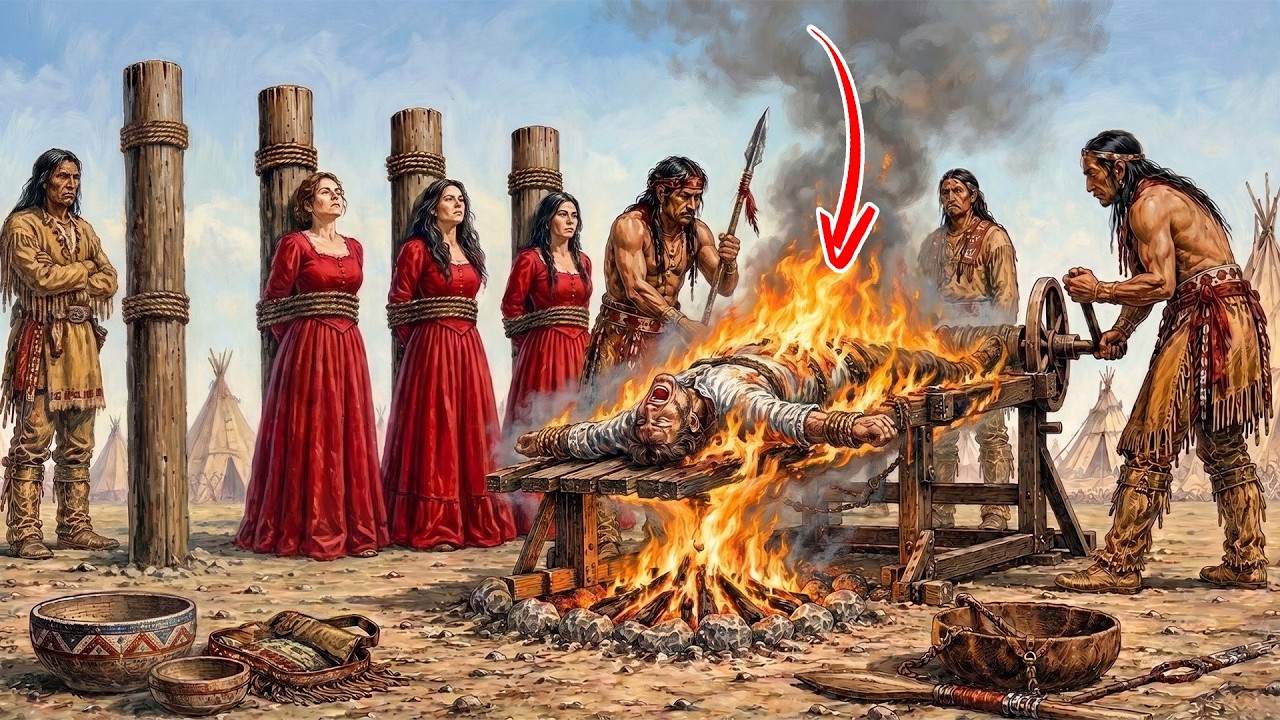
It was a trap, not a negotiation. When Matilda Lockhart was brought forward, the room saw the evidence of her captivity. Her head, face, and arms were covered in bruises and sores, and her nose had been burned almost to the bone. She spoke with difficulty, explaining that she had been tortured with hot coals.
The next day, McLeod wrote to President Mirabeau Lamar. Of the sixty-five Comanches in the city, thirty-five had been killed, including thirty adult men, three women, and two children. Twenty-nine were taken prisoner. One escaped.
Seven Texans lost their lives, and ten were wounded. The peace talk had turned into a massacre. Within days, the thirteen Anglo captives still held by the Comanches were also killed, most by torture. The man who would answer for the Council House was a war chief known in English as Buffalo Hump, named for the distinct fleshy lump on his back.
He was likely in his forties, a man who had been raiding settlements since he could ride a horse. He had watched his people’s lands shrink under wagon wheels and rifle fire. Now he devised a plan no Comanche war chief had ever attempted. He would not raid a farm or a village.
He would gather every band that would ride with him, cross four hundred miles of enemy territory, and strike the Republic where it felt safest, on the coast. He would ride until he saw the sea, then burn everything he found. To do it, he needed the families. A lone war party could ride ninety miles a day and vanish.
A column of women, children, pack animals, and loot could not. Buffalo Hump traded speed for symbolism. He wanted a demonstration the Anglo settlers could not misunderstand. The council fire made the case: they would strike a port, not a farm.
They would ride until they saw the ships with their own eyes. They would bring everyone, because the plunder would be more than warriors alone could carry. Toward late July, the war party gathered in the upper Colorado and Brazos region. Estimates placed Buffalo Hump’s force at four to five hundred warriors and up to six hundred women and children—at least a thousand people and nearly two thousand horses.
On August 1, 1840, they set out. The Republic of Texas had fewer than one hundred thousand Anglo settlers scattered across a thin strip of land. There were no forts between the raiders and the coast, no garrisons, no warning. The column advanced twenty-five to forty miles a day, hunting along the way.
Between August 3 and 5, small groups broke off and struck surrounding farms. Settlers found their horses gone. Some went looking and never returned. No one was watching.
A thousand people were moving through central Texas, and the Republic did not know it. On the morning of August 6, the column crossed the Guadalupe River and spread out around the town of Victoria, an established settlement twenty-five miles inland with a militia and armed civilians. The Comanches did not attempt to take the town. They did not need to.
They hit the surrounding farms. Enslaved people working in the fields and white settlers who could not reach Victoria were killed in the early hours. Families inside the town took shelter behind any wall they could find while smoke rose from the outbuildings and the sound of hundreds of hooves echoed along the perimeter. The main attack lasted until the afternoon, then the column turned south, driving hundreds of stolen horses and mules toward the coast.
At dawn on August 8, they emerged from the coastal prairie and saw the sea. For many of the young warriors, it was the first ocean they had ever seen. Small ships were anchored in the shallow bay. Warehouses, a custom house, stores, and private homes lined the shore.
There was no wall and no fort. They surrounded Linnville and moved in. Residents ran directly into the water. Rowboats and small sailboats were pushed off the shore.
Men, women, and children plunged into Lavaca Bay and swam toward the boats, clinging to the sides. From a few hundred yards out, they watched their town being systematically dismantled. Inside the town, three white people were killed. One of them was the customs officer, Hugh Orange Watts.
He had been married to his wife, Juliet Constance Watts, for exactly twenty-one days. As the warriors reached the town, Hugh turned back to get a gold watch. He was caught and killed. Juliet, along with a black woman and her child, was taken captive and dragged onto a horse.
Another captive taken that day was Mrs. Crosby, the granddaughter of Daniel Boone, the most legendary name in American frontier history. Texan propaganda would use her name for months. Then came the strangest scene of the raid.
The Comanches stayed in Linnville for hours, four, five, six. They broke into every warehouse and emptied every store. Bolts of cloth, barrels of whiskey, hats, umbrellas, gunpowder, lead—hundreds of thousands of dollars in manufactured goods in 1840 currency. And in front of the townspeople swimming in the bay, the warriors started trying the items on.
Silk sashes over buckskin. Top hats over braided hair. Women’s dresses over leggings. Umbrellas open to the sun.
They rode through the streets of the burning town wrapped in whatever fabrics they pleased, laughing and shouting war cries. Some rode their horses straight into the shallow water and screamed victory cries in the salty bay. It was not looting for value. It was Buffalo Hump’s answer to the Council House, written in a language the Anglos could not misunderstand.
By late afternoon on August 8, Linnville was turning to ashes. The column turned inland with its captives and a herd of horses estimated from a few hundred to a thousand head. Moving with heavy loads, the column’s speed dropped to ten to fifteen miles a day. The warriors who had crossed four hundred miles to the sea were now dragging themselves back at a quarter of the speed.
Behind them, Texas mobilized. Messengers had ridden out from Victoria and from the Linnville survivors floating in the bay. Every settlement between the Guadalupe and the Colorado rounded up armed men. Edward Burleson and Ben McCulloch rode toward the same rendezvous point.
With them came Tonkawa and Lipan Apache scouts, whose own villages had been raided and people taken by Comanches for generations. They read the column’s trail like a book. A thousand people cannot move quietly. The rendezvous point was a place called Plum Creek.
On the morning of August 12, roughly one hundred eighty to two hundred Texans waited in the oak clusters in the creek bed. The thousand-strong column was heading straight toward them. It started mid-morning. Texan scouts made contact with the Comanche vanguard.
The first volley erupted from the tree line. The Comanche horse herd, hundreds of stolen animals loaded with loot, panicked. Warriors broke off to keep their herds together. Others rode toward the tree line to draw the Texans out.
The clash turned into a running battle spread across miles of prairie. For two or three hours, charges and countercharges followed one another. The Texans kept hitting the flanks, diving into the middle of the column, spooking the pack animals. When the warriors realized they could not save the loot, could not protect the herd, and could not fight and flee at the same time, some turned on the people they carried.
Mrs. Crosby was killed on the trail. Daniel Boone’s granddaughter was killed by her captors during the running gun battle. Juliet Watts survived, but barely.
Different sources tell different pieces of the story. Some say a rescuer reached her. Some say she was ransomed. Others say she was found wounded on the trail.
The only indisputable fact is that at the end of the day, she was still alive. The column disintegrated. Warriors threw away bolts of cloth, dropped stolen furniture, released pack animals so their families could move faster. The prairie became a scattered debris field of items stolen from Linnville four days earlier.
Small groups of warriors fought to cover the retreat while others slipped away north-northwest toward the Balcones. By late afternoon, the fight became a pursuit. The final accounting was not neat. Texan casualties were astonishingly low: one account says one dead and seven wounded.
Comanche casualties were a massive unknown. Some reports claimed eighty warriors killed. Body counts on the field ranged from twelve to twenty-five. Every Texan officer claimed a number.
Every newspaper published one. But William B. DeWees, a settler who wrote meticulous private letters, admitted the truth the official reports would not: they never found out how many Comanches had been killed. No one would ever know.
Buffalo Hump escaped with what was left of his people. He rode north toward the escarpment country where he was born. The grand symbolic column that rode to the sea was shattered. The Texas State Historical Association records twenty-three settlers died in the entire Victoria–Linnville raid area.
Eight were black enslaved people killed in the fields or while cutting hay. One was a Mexican man working near Linnville. Three died inside Linnville, including Hugh Watts, who went back for a gold watch. Twenty-three names.
The Republic of Texas did not answer the Great Raid with a peace conference. Later that same year, Texan militias rode into a Comanche camp and killed nearly one hundred forty men, women, and children. A village, not warriors caught in the open. Mothers, children, the elderly mowed down in retaliation for a raid that killed twenty-three settlers.
One hundred forty to twenty-three. That was the arithmetic of the 1840 Texas frontier. Juliet Watts lived the rest of her life so quietly that history barely recorded it. She left no memoir, no letters.
On the twenty-first day of her marriage, she watched her husband die for a gold watch. She endured a mounted Comanche retreat, a situation where a captive’s chances of returning home alive were incredibly low. And she made it back. Buffalo Hump led raids for years more.
He saw the Republic of Texas join the United States. He saw the American army come after his people with a scale of force the Republic never possessed. He lived long enough to see the Penateka bands broken, driven onto reservations, forced to sign treaties written by men who had never faced him. In the 1860s, he died on a reservation.
Colonel Hugh McLeod, whose decisions at the Council House lit the fuse, led the ill-fated Santa Fe expedition in 1841. He was taken prisoner and jailed by Mexican forces. He died in 1847, still a prisoner. Two peoples looked at the same week in August and saw two completely different things.
In Comanche oral memory, an elder would later refer to it simply as the time we rode down to the great water where your ships were sitting on the land. In Texan memory, it was remembered as the Linnville Massacre. The pattern of raid and retaliation established in 1840 did not stop when Plum Creek was over. It did not stop when the Republic joined the United States.
It did not stop until the Comanches were broken as a free people. Only one of those memories was written into the textbooks.