On August 2, 1876, James Butler Hickok walked into a saloon in Deadwood, a ramshackle mining camp in the Dakota Territory. He joined a poker game, taking the only available chair, his back exposed to the room. Hours later, a drifter named Jack McCall approached from behind and shot him once in the head. He died instantly, still holding what would become the most famous hand in Western lore: two black aces and two black eights, a combination forever after known as the dead man’s hand.
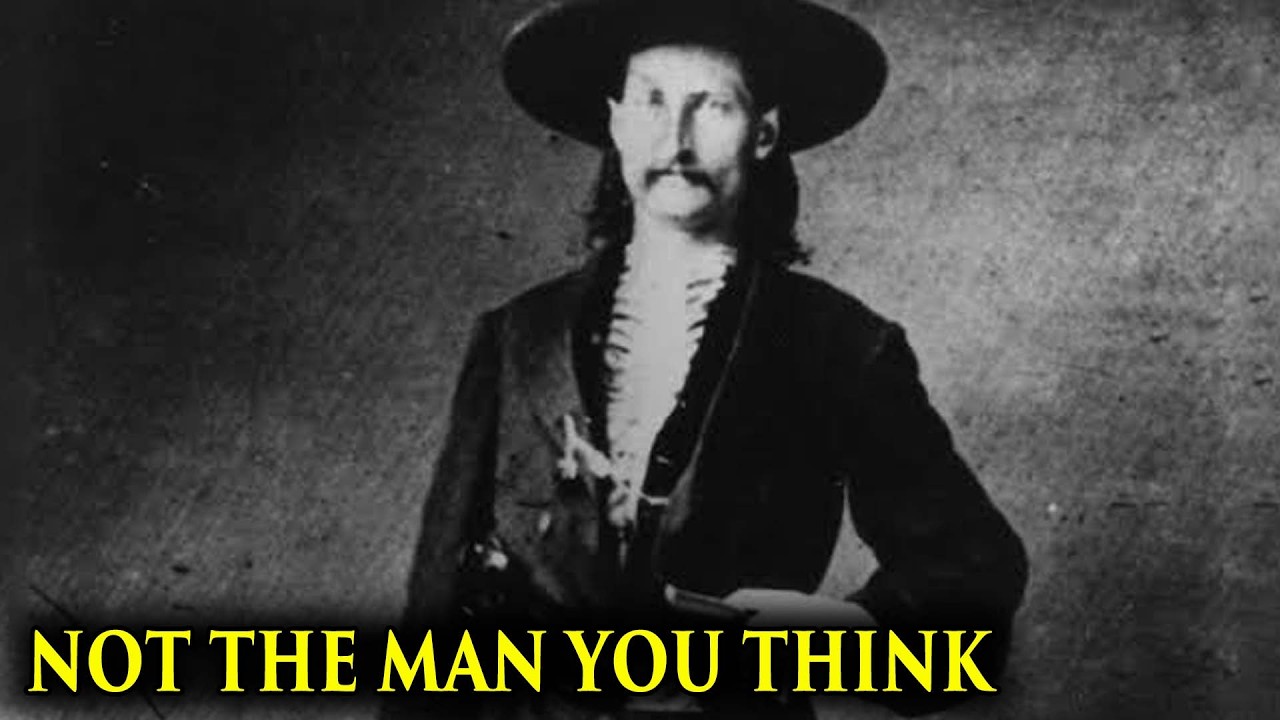
The man who died that afternoon was already a legend. But the legend of Wild Bill Hickok, as he had come to be known, was a carefully built construction, shaped as much by his own storytelling, newspaper embellishment, and later Hollywood fantasy as by his actual deeds. The real man who became Wild Bill was born James Butler Hickok. Before the name stuck, he was reportedly known by other titles, including Ducky Bill, a mocking reference to his appearance.
Historical records show he used the names William Hickok and William Hook, though his identity at birth was James Butler. The connection to the name Bill seems to have formed years before his national fame. A surviving notice for a dance in Monticello, Kansas Territory, in February 1858 lists a William Hickok on the invitation committee, demonstrating the name was in use long before his celebrated career as a lawman. In the spring of that same year, the young Hickok was living in Johnson County, Kansas Territory, trying to establish himself.
On March 22, 1858, he was chosen as constable of Monticello, his first documented job as a peace officer. He was barely twenty years old. Around this time, he also filed a preemption claim on nearly one hundred and sixty acres of land, hoping to secure a farm. The claim failed.
A man from the Wyandotte tribe named Samuel McColloch held a prior interest tied to treaty rights, and that claim took precedence. Without the land, Hickok relocated to Olathe, where his cousin had established a home, and soon found work with the major freighting firm of Russell, Majors and Waddell. In 1859, he was employed as a wagon driver along the Santa Fe Trail. The same year brought significant change to the broader economy.
On August 27, 1859, a commercially important oil well near Titusville, Pennsylvania began producing petroleum. The Drake Well did not mark the first time oil was discovered, but it launched the modern American petroleum industry. Hickok’s own life remained uncertain and mobile, moving from failed land claims and small-town policing to freighting on the frontier. The outbreak of the Civil War shifted the course of his life.
Hickok served the Union in several roles, including wagon master, scout, guide, and intelligence agent. By early 1862, he led wagon trains in Missouri, an essential and dangerous duty. One dramatic story claims Confederate forces intercepted his wagon train in early March, and that Hickok drove the wagons directly through enemy lines before riding to Independence for help. The broad outline fits wartime conditions, but the most dramatic details come from later biographical tradition rather than surviving military records.
Another tale from this period offers a possible origin for the name Wild Bill. According to the story, a bartender wounded a member of a victorious political or military faction during a dispute. As an angry crowd gathered outside the building where the bartender had taken refuge, Hickok reportedly stood between the man and the mob, fired his pistols into the air, and warned that anyone advancing would be stopped. The crowd dispersed.
Some biographies repeat this incident as the origin of the nickname, but historians have not precisely established when or why Hickok first acquired that name. Records show he used William or Bill before the Civil War, while later accounts attach the nickname to different events. Perhaps the most celebrated moment of his life, and the one that most shaped his legend, occurred in Springfield, Missouri, after the war. The trouble began on the evening of July 20, 1865, during a poker game at the Lyon House hotel.
Hickok and Davis K. Tutt argued over money, a gambling debt, and an unpaid balance connected to an earlier horse transaction. During the dispute, Tutt took Hickok’s valuable Waltham watch and announced he would keep it as collateral until the debt was settled. Hickok objected but did not escalate the confrontation immediately.
The watch became the central symbol of the quarrel. According to later accounts, Hickok was told that Tutt intended to wear the watch publicly across the Springfield town square the next day, which would humiliate Hickok and imply he could not pay his debts. Hickok warned that Tutt must not cross the square wearing it. The exact words cannot be verified, as detailed accounts were recorded later and influenced by the growing legend.
But witness testimony and subsequent court reports confirm both men understood the dispute had become dangerous. On July 21, 1865, the two men met across the public square. They drew their pistols, each fired a single shot. Tutt was mortally wounded.
Hickok was unharmed. The encounter became one of the best-documented face-to-face gunfights of the post-Civil War era and later a model for the classic Western showdown, even though the real event was far less theatrical than its cinematic versions. It was not the first such duel; such confrontations existed long before 1865. But the Hickok-Tutt fight became the archetype, the image of two opponents meeting in open space, each waiting for the decisive moment.
Hickok’s survival and subsequent acquittal boosted his growing reputation, and sensational accounts transformed a local dispute into national legend. Six days after the shooting, the Springfield Missouri Weekly Patriot identified the other participant as James B. Hickok, known in southwest Missouri as Wild Bill. The notice proves the nickname was already familiar locally before national magazines made him a frontier celebrity.
In February 1867, Harper’s New Monthly Magazine published a highly romanticized profile of Hickok by Colonel George Ward Nichols. The article portrayed him as a near-perfect frontier hero and introduced his famous horse, a black mare called Black Nell. Nichols described the animal as possessing intelligence approaching human levels and told remarkable stories, including one in which Hickok signaled the horse to lie down in the street, entered a saloon, and then whistled for the animal to follow him inside and climb onto a billiard table. A Missouri newspaper quickly challenged the story.
The Missouri Weekly Patriot responded on January 31, 1867, declaring these scenes fictional. The editor asserted the famous mare was actually a plain black horse, blind in one eye, known mainly for its speed. The paper denied the animal could perform such tricks. The dispute shows how quickly Hickok’s public image became contested: the national press offered a heroic ideal, while local papers accused writers of turning ordinary events into fiction.
Hickok’s appearance contributed as much to his fame as his actions. Elizabeth Custer, wife of General George Armstrong Custer, later recalled meeting him. She remembered him as tall, slim, and graceful, completely at ease whether walking or riding, with an easy movement and a physical presence that suited the landscape. She noted he carried two pistols but did not overload his belt with equipment, in contrast to the heavily armed figures later films would portray.
He understood the value of appearance. His long hair, carefully chosen clothes, confident bearing, and double pistols made him instantly recognizable. He looked like the frontier hero nineteenth-century journalists wanted him to be. He served as marshal in Hays City and later Abilene, becoming one of the first nationally recognized peace officers on the frontier.
Later figures like Wyatt Earp and Bat Masterson would become important parts of the Western legend, but Hickok helped establish the model before they achieved fame. Yet his reputation as an unrivalled gunslinger is overstated. Skilled marksmen existed before him, and the number of men he defeated cannot be confidently established. What can be said is that he became one of the first American gunfighters to achieve national fame and one of the most influential models of the Western hero.
By the end of his life, observers reported his eyesight was failing, likely from trachoma, an infectious eye disease causing severe vision loss. Biographer Joseph G. Rosa also discussed the possibility that syphilis contributed, but no surviving medical diagnosis confirms either theory. The safest conclusion is simply that he suffered from serious vision problems of uncertain cause.
On August 2, 1876, the final chapter of his life unfolded in Deadwood. Witness accounts differ on the exact form of poker played, but most agree Hickok joined a game with William R. Massie, Charles Henry Rich, and another man. Hickok was known for preferring a seat that allowed him to watch the room and its entrances.
On this occasion, Rich held that position. Hickok reportedly asked more than once to switch seats, but Rich refused. Hickok eventually accepted the only available chair, leaving his back exposed. McCall, a young drifter who had played poker with Hickok the previous night, entered the saloon.
He walked toward the bar, then moved to a position behind Hickok. He drew a pistol and fired from close range. The bullet struck Hickok in the head, killing him almost instantly, passing through his cheek and reportedly wounding Massie’s wrist. Tradition holds that Hickok was holding two black aces and two black eights.
The identity of the fifth card remains disputed, and even the exact cards were not consistently described in early reports. The hand became part of Western tradition rather than a fully documented arrangement. McCall was captured and held. On August 3, an improvised court of miners and merchants considered the case.
Deadwood lacked an established legal government, and the proceeding had no recognized federal authority. McCall claimed he acted in revenge for a brother he said Hickok had harmed. The committee accepted his explanation and acquitted him. No convincing evidence established that this brother ever existed.
McCall left Deadwood but reportedly began boasting about what he had done. Federal officials arrested him and transported him to Yankton, the territorial capital. Because the miners’ proceeding was not a legal court, federal prosecution was not barred as double jeopardy. The formal trial began on December 4, 1876.
Two days later, a jury convicted him. He was sentenced under territorial law and executed in Yankton on March 1, 1877. Hickok was initially buried in Deadwood’s Ingelside Cemetery before his remains were later moved to Mount Moriah Cemetery. His original wooden grave marker was repeatedly damaged by souvenir hunters.
It was eventually replaced by commemorative statues that suffered the same treatment. A life-size sandstone memorial was later surrounded by a protective metal fence. By the mid-1950s, souvenir hunters had so badly damaged the figure that it was removed and placed in storage. Today he lies in a plot enclosed by an iron fence.
The constant destruction of his memorials reveals something important about his legacy. His admirers were so eager to possess a physical piece of the Wild Bill story that their enthusiasm gradually destroyed the monuments erected to honor him. The real man was a skilled scout, a competent lawman, and a remarkably famous figure whose confidence and public image shaped how later generations imagined the American West.
His true significance lies not in an unverifiable kill count, but in the powerful combination of documented ability, personal display, and the legends that made him an enduring frontier icon.