On December 2, 1892, Jay Gould died, leaving behind an estate valued at 72 million dollars, a sum approaching 2. 5 billion in today’s money. He was the most feared financial figure of the Gilded Age, controlling 10,000 miles of American railroads, roughly a tenth of the entire national network, along with Western Union. He left it all in a trust for his six children, with his eldest son, George, placed in command of the operating empire.
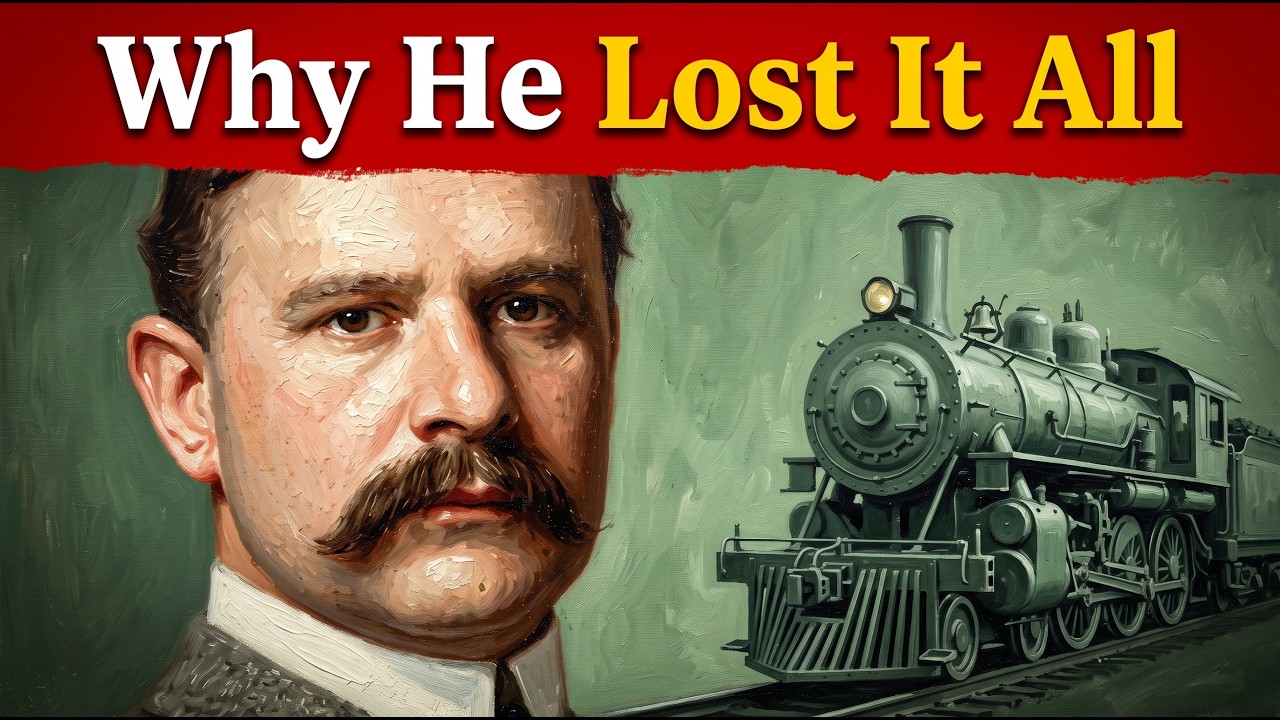
George would lose every mile of those railroads, and his siblings would sue him to find out where the fortune had gone. Jay Gould earned his reputation one Friday morning in September 1869, when his scheme to corner the entire US gold supply collapsed within an hour. He and his partner James Fisk had spent weeks driving gold prices upward, buying contracts on borrowed money until the price threatened to paralyze the American economy. President Grant ordered the Treasury to release its gold reserves.
The price collapsed within minutes, and the ensuing panic bankrupted thousands of investors in cities across the country. Gould had sold his positions before the crash, walking away unscathed while the men who trusted him lost everything. The papers called it Black Friday, and Jay Gould’s name became the most terrifying in American finance. Over the following two decades, Gould assembled one of the largest private railroad networks in the United States, doing it through acquisition.
He bought struggling railroads for fractions of their value, dissolved their boards, replaced their managers, cut costs until they became economical, and linked them into systems that no competitor could operate at comparable cost. At the height of his power, he controlled about a tenth of the nation’s railroads, Western Union, the telegraph monopoly, and Manhattan’s elevated railways. He had no formal education, inherited nothing, and had no patron. He cared nothing for charity or society.
Everything he owned he built himself, and he knew how every dollar had been made. That knowledge was the one thing he could not leave to his children. When his estate was finally inventoried, the value came in higher than the newspapers’ conservative estimate, making Gould’s fortune one of the largest estates ever recorded in the United States. On December 5, 1892, his coffin was placed in the parlor of his Fifth Avenue mansion, lit by electric lamps against walls of silk and velvet, decorated with paintings by the old masters.
A thousand people tried to enter the house that evening. Only about 150 were admitted. Outside on the sidewalk, hostile crowds pressed against the iron fence. The city had come for a look at what he had left behind.
On the other side of those walls, six children now owned everything Jay Gould had spent a lifetime building. Gould had chosen his heir years before his death. George Jay Gould, the eldest son, had been prepared to take over the empire since childhood, brought into his father’s office at an age when the sons of wealthy Manhattan families were learning to ride horses and attend social functions. On his twenty-first birthday, George received a seat on the New York Stock Exchange and a power of attorney from his father.
He could sign contracts in his father’s name. By the time Jay died, George was twenty-eight, having spent most of the past decade beside his father in board meetings, watching the old man read contracts, assess risk, and move entire railroad companies from one column to another in his ledger. The will made the arrangement formal. The fortune was divided into six equal trusts, one for each child, with George as the dominant trustee.
He controlled the empire, the railroads, the Western Union shares, and the holding structures that kept the machine running. His five siblings would receive income from their trusts in equal shares. The entire arrangement rested on one assumption: that George would run the empire the way Jay would have run it, with the caution of a man who knew the cost of building a fortune and would never risk what he could not replace. Jay had spent forty years learning caution.
George had spent ten watching it. No one at the family seemed to consider that observation and instinct might not be the same thing. George Gould wanted the one thing his father had never completed. Jay had assembled one of the largest private railroad systems in the western half of the United States, but the system had gaps, borrowed routes, and no single continuous line stretching from coast to coast.
George set out to close those gaps. His plan was a single railroad running from the port of San Francisco eastward through the Western Pacific, Denver and Rio Grande, and Missouri Pacific, through the Wabash to Pittsburgh, then down through Western Maryland to a coastal station on the Atlantic. It would have been the most ambitious private railroad project in the country since the original transcontinental. The men standing in George’s way were the most powerful figures in American finance, and they moved against him with coordination that left him no room.
In 1901, E. H. Harriman, who already controlled Union Pacific, seized the Southern Pacific and with it the Ogden gateway in Utah, the vital junction where western railroads exchanged freight between the Pacific coast and the interior. In 1906, Harriman’s Union Pacific abolished the joint shipping rates that had fed Gould’s system for years.
Without those rates, the western end of George’s transcontinental route became a dead end. Time magazine later delivered the verdict in a single sentence. George fought Harriman, Morgan, and Kuhn, Loeb and Company, and lost. Harriman controlled the routes.
J. P. Morgan controlled the banks that financed railroads. Kuhn, Loeb controlled the bond markets that kept them solvent.
Between them, these three interests decided no Gould railroad would reach the coast alone, and they had the financial power to enforce that decision. George’s response was the response of a man who believed he had learned his father’s lesson. If existing routes were blocked, he would build his own. The railroad George built to reach the coast was the Western Pacific, 924 miles of new track from Salt Lake City to Oakland, blasted through the Feather River canyon and carved through forty-three tunnels in the granite of the Sierra Nevada.
Work crews endured Sierra winters, building bridges across gorges and carving ledges into rock faces above the river. The original cost estimate was 39 million dollars. The final cost was nearly double, around 80 million, and most of it was loaded onto the Rio Grande, the Gould road least able to bear such weight. George was borrowing against one family line to build another, and the line bearing the cost was collapsing under debt it was never designed to carry.
While his crews were blasting tunnels through the California mountains, the eastern half of his transcontinental system was already falling apart. The Wabash Pittsburgh Terminal, the great eastern hub of the entire line, went into receivership in the spring of 1908. Western Maryland went bankrupt the same year. On November 1, 1909, a golden spike was driven at a junction called Keddie in the mountains of northern California.
George Gould’s coast-to-coast railroad was finally complete. The 150-mile gap at Connellsville remained open, meaning the transcontinental line could not operate as a single connected route, but the rails were there and the spike was in the ground. The ceremony was modest, far from the celebrations that had marked the original transcontinental meeting at Promontory Summit forty years earlier. No president stood on the platform.
No national media recorded the moment. By 1909, the Gould name carried more debt than glory, and the day passed without notice. It did not matter. The eastern end was already dead.
Years before the Western Pacific was completed, George had sought to give his transcontinental system a great eastern terminal. In 1901, his syndicate contributed 20 million dollars to build a station complex in Pittsburgh. The centerpiece was a Beaux-Arts passenger station, eleven stories of stone and glass rising above the Monongahela River with a train shed among the greatest in the country. It opened on April 13, 1904.
For a brief time, it was visual proof that the Gould transcontinental system was a reality. It operated as part of George Gould’s empire for four years and forty-six days. It fell into receivership on May 29, 1908. George had spent 20 million dollars to put the Gould name on a building that served his empire for less time than it took to construct.
When the Panic of 1907 froze American credit, the Gould system had no reserves. Every road in the system was pledged against every other road. When the banks stopped lending in the autumn of 1907, the entire structure collapsed. The men who had shut him out of the Pacific coast now held the loans that kept his system alive, and they had no desire to keep the Gould name on the railroad map of America.
The collapse came road by road. Western Maryland went bankrupt in 1908. The Wabash Pittsburgh Terminal entered receivership the same year. Control of Western Union was sold in 1909 to keep the railroad system alive a few more years.
Missouri Pacific, the road Jay had personally bought, rebuilt, and run for two decades, declared bankruptcy in 1915. George lost control. The Western Pacific, the railroad George had spent nearly 80 million dollars building across the California mountains, was foreclosed on in 1916. Denver and Rio Grande, the road that had carried the impossible debts of the Western Pacific on its back for seven years, went into receivership on January 25, 1918.
The last Gould railroad was gone. Twenty-six years after Jay Gould’s death, the operating empire he had spent a lifetime building was dismantled by the man he had chosen to protect it. Under George’s management, the family fortune estimated at over 84 million dollars shrank to about 50 million, and every mile of railroad that had produced that fortune was lost. The trusts designed to protect the family money had been raided to cover the debts of roads George controlled and over-leveraged.
His siblings turned on him. Frank and Anna Gould, the two youngest, sued the trustees for mismanaging the estate, in what contemporaries described as the most expensive private lawsuit of its time. It lasted more than ten years and drew cross-suits from about forty-five heirs of the extended Gould family. A referee named Edward Hatch was appointed by the New York Supreme Court to audit the accounts.
George’s testimony ran to 1,250 pages of depositions taken over nearly two years. The court ruled that George had mismanaged the estate. Time magazine reported a judgment of 50 million dollars against the four trustees, later settled for 20 million. George Gould did not live to see the end of the lawsuits.
In the winter of 1922, he traveled to Egypt and entered the newly discovered tomb of Tutankhamun. He fell ill with a fever there from which he never recovered. On May 16, 1923, George Jay Gould died in the south of France, far from the railroad maps, the courtrooms, and the Fifth Avenue mansions that had defined his family for thirty years. He was fifty-nine.
He died six weeks after Lord Carnarvon, the British aristocrat who financed the tomb’s excavation. The coincidence was enough for contemporaries to whisper about the curse of the pharaohs. The truth was simpler. George Gould had been deteriorating for years, and the fever in Egypt finished what the railroad wars and the family lawsuit had begun.
His final accounting was clear. He had inherited about 14 million dollars, his one-sixth share of Jay Gould’s fortune, along with operational control of the entire railroad empire. His own estate, after settling debts, amounted to about 5 million dollars. The brother who controlled everything died with 5 million in the French Riviera.
One member of the Gould family kept the money. Anna Gould, the youngest daughter, had her share of Jay’s fortune held in the same type of trust as her siblings, designed to protect the capital from her, from any husband, and from any business venture that might drain it. Anna could not control the money. She could not invest it, mortgage it, or offer it as collateral.
The trust managed itself. In 1895, Anna married a French count named Boni de Castellon, who put the trust’s defenses to the most direct test possible. Over eleven years of marriage, Castellon burned through roughly 10 million dollars of Gould income, building pink marble palaces in Paris and hosting parties that were the talk of European aristocracy. He spent like a man with a sea of money and was stunned to discover the sea had a bottom he could not reach.
The trust paid substantial income, but the bulk of the capital Jay Gould had placed in it remained beyond the count’s reach. Anna divorced Castellon in 1906 and married a duke. The structure Jay Gould built to protect his children’s money had held against a spendthrift husband, just as it had held against the railroad collapse, preserving most of its capital. Over 68 years, the trust paid Anna nearly 35 million dollars in income.
She outlived the railroad empire by four decades. When she died in 1961, she still owned her father’s Gothic castle on the Hudson River, a stone fortress called Lyndhurst she had kept her entire life. What remains of it all are the houses. Jay Gould’s castle on the Hudson became a museum and national historic landmark, open to visitors who walk the same grounds where the most feared man in American finance once lived.
George Gould’s marble estate in Lakewood, New Jersey, Georgian Court, became a university. Students walk its marble halls today. The railroad empire Jay built and George destroyed left behind no operating company, no seat in American finance, no existing business.
It left the stone, the glass, and the grounds where the wealth once lived.