America has fixed the Truman couple in a single photograph: two Sunday school children from Missouri who grew old together, thirteen hundred love letters, and a president who called his wife “the Boss. ” But in the days around Christmas in 1955, that wife stood before a fireplace in Independence and burned nearly thirteen hundred letters. Her husband asked her to think of history. She said she had thought about it, and she kept feeding the flames.
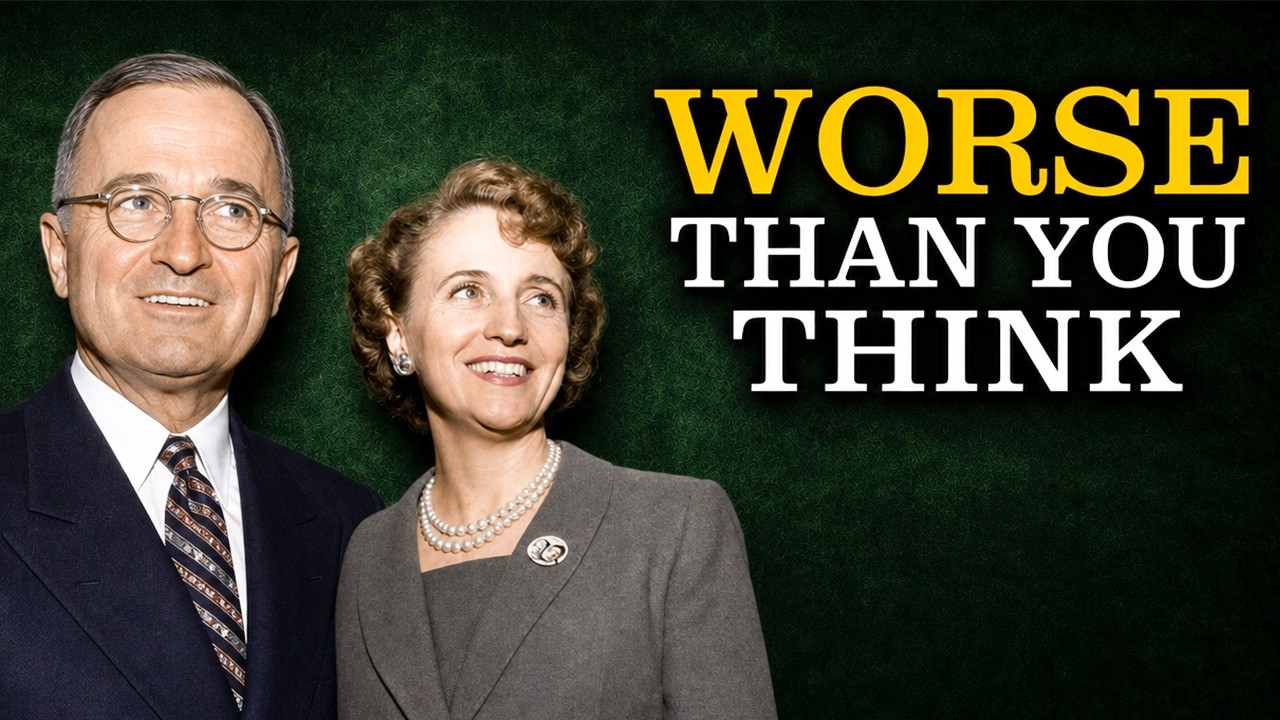
What she was trying to preserve was not merely decency. It was a revolver, a bathroom, June of 1903, and a secret she never told anyone—not even her only daughter. The marriage America so admired had taken everything from her. And it all began with her father.
Harry Truman saved everything: ticket stubs, receipts, memos, notes written at three in the morning and never sent. The Truman Library holds roughly 1,316 letters he wrote to Bess between 1910 and 1959. Of her letters to him, the record that contained her judgment, her voice, her wit, her grievances, and her assessment of the men her husband trusted, only 184 survive. And those 184 letters survived only because they slipped out of her hands.
Their grandson, Clifton Truman Daniel, tells the story this way. Near Christmas 1955, he says, his grandfather came home and found his grandmother throwing bundles of letters into the fire. He said, “Think of history. ” She said she had thought about it, and she continued.
The event took place in Independence after the presidency ended. Some accounts have moved the date, and Margaret Truman in her own memoir wrote that her father saw her mother burning papers but gave no year. Disagreement exists over when it happened, but not over what happened. She destroyed the evidence, deliberately, and she admitted it.
The historian Robert Ferrell, who later collected Harry’s letters in the book Dear Bess, found the surviving letters scattered around the house after her death—under sofa cushions, tucked inside books, even in the attic among pigeons and raccoons. That was the archive. One voice survived by accident and neglect. The other was almost erased on purpose.
So when you hear that the Trumans’ marriage was the last great romance in American political history, understand where that idea comes from. It comes from him. He was a magnificent writer and a devoted husband, but he was not an impartial witness to his own marriage. Go back now to 1903.
Her father was David Willock Wallace: handsome, popular, the kind of man in Independence everyone liked, the kind who never quite succeeded at anything. He held a series of patronage jobs—county treasurer, then deputy surveyor at the Kansas City customs office—jobs that depended entirely on whose friend you happened to be that year. The income was never enough. He drank.
The debts mounted. On the morning of June 17, 1903, at age forty-three, he shot himself in the family home. Bess was eighteen. She had graduated from Independence High School in 1901.
Her friend Mary Paxton later described walking into the yard, finding Bess pacing, and walking silently beside her because there was nothing to say. What matters for the next seventy-nine years of her life is this: the family did not grieve publicly. They left. Madge Gates Wallace took her daughter and three sons to Colorado Springs and stayed nearly a year—not for the mountains but for a place where no one knew.
When they returned, they did not go back to their own house. They moved into Madge’s father’s home at 219 North Delaware Street, a large Victorian owned by George Porterfield Gates, co-owner of the Waggoner-Gates Milling Company. Wealth on the mother’s side, shame on the father’s. And they never spoke of David Wallace again.
Bess never told her own daughter how her grandfather died. Margaret learned the news as an outsider. Bess’s nephew, who grew up in that same house, said plainly that his aunt created the silence around the family to protect her mother, and it worked. Two lessons came out of that summer, and she applied both for the rest of her life.
The first: silence is a technology. It is not weakness or modesty. It is a weapon that works. Say nothing, and the story simply disappears.
The second lesson is uglier, and it explains a decision she made forty-one years later that stunned everyone around her. Politics killed her father. Not literally—his debts and drinking did that. But the world that broke him was the world of county offices, patronage lists, and men whose income depended on the next election.
Bess Wallace grew up watching a political career consume a man from the inside, and then watching the town whisper over the wreckage. Remember that when Harry Truman began courting her. He had been in love with her since age six. That part of the legend is true, and he repeated it constantly.
His family moved to Independence in 1890, and he saw her at Sunday school at the First Presbyterian Church. He later said he noticed her blue eyes and golden curls and never stopped noticing. They attended school together and graduated in the same class. Occasionally he carried her books.
That was the extent of it. Then the Trumans left Independence, and Harry went to work: bank jobs in Kansas City, then the family farm in Grandview, where he stayed until he was thirty-three. An ordinary farmer with no degree and no money. According to family accounts, they reunited over a cake plate.
His aunt lived across the street from the Gates house, and there was a plate in her kitchen that needed returning. Harry volunteered to take it over. Bess opened the door. The plate story should be taken lightly—families polish such stories—but take the geography seriously.
Living across the street is what made it possible. From 1911 he wrote to her every week. On paper he was funny, self-deprecating, apologetic, and relentless. That June he proposed in a letter, saying he had been crazy about her since Sunday school.
She did not answer. He wrote again. Still no answer. After the third letter, she replied—with a no.
Her exact words are lost. The outcome is not in doubt. Harry took it as gracefully as possible, said he would ask again once he earned more than a farmer’s income, and kept writing. They stayed friends.
It took until November 13 for her to change her mind. Ask why she said no, and the usual answer is that she was not in love yet. Perhaps. But look at what Harry was offering in 1911: a farm in Grandview, minimal income, no certainty.
She had seen what happened to a family when the money stopped. By then the Gates household had become her responsibility. Her mother never fully recovered and never would, so Bess managed her mother, three brothers, and the family’s standing. Every hope of further education or a life of her own had ended in that yard in 1903.
And her mother’s opinion of Harry Truman was no secret. The Gates family was wealthy, established, served by servants. The Trumans were farmers from Lamar, and the town kept careful account of social rank. Madge Wallace never accepted him.
Not during the engagement, not at the wedding, not during the presidency. Until the day she died, she called him Mister Truman. The engagement stretched on. Then the war took him: France, artillery, Battery D, and letters flowing in both directions.
After the war they married on June 28, 1919, at Trinity Episcopal Church in Independence. He was thirty-five. She was thirty-four. They set off toward Chicago in a roadster.
Nine years of courtship, six of engagement. America saw fidelity, and it was. But it was also a long negotiation with a family that had decided Harry was not good enough. When the honeymoon ended, they returned to Independence and moved into her mother’s house.
The arrangement was supposed to be temporary. It lasted thirty-three years. Understand that arrangement, because everything else in this marriage grew from it. The house at 219 North Delaware belonged to Bess’s grandfather until his death in 1918, then to her grandmother, then to Madge, who bought out her siblings’ shares for ten thousand dollars.
From that point until December 1952, the roof over Harry Truman’s head legally belonged to his mother-in-law. At age sixty-eight, before his mother-in-law’s death, Harry Truman had never owned a home. This is not family gossip; it is in the Truman Library’s own records. It is a legal document.
Picture the household he married into. At the top sat a grandmother, and beneath her a mother who had not moved freely since 1903. The brothers came and went, one of them raising two children in that same house. Bess managed all of it.
She had been doing it since she was eighteen, and marriage added a husband to the ledger. Margaret later wrote that her grandmother sat at the head of the dinner table—not the son-in-law, not the future president. Margaret also wrote that her father must have loved her mother very much, because he accepted it all without complaint and never said one bad word about Madge Wallace, even though Harry Truman was a man who publicly and freely insulted nearly everyone else. He would tell a general exactly what he thought of him.
He would tell the whole country. He would not tell his wife what he thought of her mother, because on that one subject there was no agreement in their marriage. Family accounts say the Trumans nearly stopped inviting friends over, not from lack of sociability but because it was impossible to control what Madge might say to guests. These accounts come from relatives and from Margaret decades later, so treat them with care.
But the picture they draw matches the documentary evidence: a household consumed with managing one woman’s fragile nerves and a family’s shame. Money followed the same path as Margaret’s father. Harry opened a men’s haberdashery in Kansas City with his army friend Eddie Jacobson. The store did well for about two years, then collapsed under the postwar farm depression.
In 1922 it failed. He spent most of the next fifteen years paying off his debts without declaring bankruptcy—a credit to his character and a description of the household budget Bess managed. She also lost two pregnancies in those early years, and in the fall of 1923, pregnant again, she bought no clothes, no blankets in advance, because she had learned. Margaret was born at home on February 17, 1924, and laid in a bureau drawer.
That was the accounting of Bess Truman’s first five years of marriage: her mother’s house, her husband’s debts, two lost children, one daughter. And in 1922, the year the store failed, Harry Truman entered politics, supported by the Pendergast machine that controlled Jackson County and most of Missouri and that would follow him like a bad smell for the rest of his career. He won a seat as county judge—an administrative post, not a judicial one. He lost reelection in 1924, won again in 1926, and again in 1930.
Think about what that meant for the woman he had married. She watched her father hold a series of county offices, watched the income never be enough, watched what it did to him. Now her husband, after failing in business, had taken a county post dependent on a political boss. She kept his accounts, worked as his assistant through his judgeship, edited his speeches, and read every major address before he delivered it.
The hat comment was an act. She learned in 1903 how much the public should be told. In 1934 Pendergast backed him for the U. S.
Senate, and he won. The Trumans moved to Washington, and their life split in two—an arrangement almost no one remembers, yet one that defined the relationship for the rest of their lives. An apartment in Washington. A house in Independence.
Bess traveled constantly between them, and the Washington side of things fell on her alone. The inventory of her papers in the Truman Library shows exactly this. Her surviving letters from 1936 to 1943 are full of the strain of running two households: money, schedules, her mother’s health, Independence politics, and her assessments of whom in Washington could be trusted. He was reelected in 1940 in a fight he was supposed to lose, because Pendergast was in federal prison and the machine had collapsed.
In 1941 he received the chairmanship of the special committee investigating waste in the defense program—the Truman Committee. It was genuinely excellent work, saved enormous sums, and by 1944 Washington journalists called him one of the most valuable officials in the capital, the only congressman on the list. He had become famous. That was the problem.
By then he had put his wife on the Senate office payroll at $2,400 a year. David McCullough found a detail that makes this ugly: during his first Senate campaign, Truman had publicly attacked the opponent for doing exactly that. Staffers who made less than she did questioned how much she actually worked. Truman himself worried in writing about what would happen if it became known.
Robert Ferrell argued that the payroll was one of the main reasons Harry Truman did not want the vice presidency. When it finally came out, an opponent named her “Payroll Bess. ” Harry defended the salary as payment for real competence, which was partly true. It faded in time.
But in the summer of 1944, the fear was not the checks. Franklin Roosevelt was visibly dying, and the party leaders were choosing his successor, which meant choosing the next president. Everyone in that room knew it. The scrutiny that comes with a national ticket is different from anything a Missouri senator faces.
Reporters would go to Independence. They would dig through county records. They would ask about the family. They would find the date June 17, 1903.
She had spent forty-one years making sure no one said it out loud. She had not even told her own child. Now they were handing her husband a job that would bring professional investigators to her hometown. She did not want it.
Everyone around them understood she did not want it. One observer at the convention described her as worn out, looking as if she had been crying. Family accounts say that as she pushed through a crowd of reporters and Secret Service agents, she asked Harry whether the rest of their lives would be like this. On the afternoon of July 19, the decision left both their hands.
Truman was summoned to a hotel room where the leaders were on the phone with Roosevelt. Roosevelt effectively said that if Truman wanted to break the Democratic Party in the middle of a war, the responsibility was his. Truman said yes. Notice what happened in that room.
Their marriage had an unwritten, absolute rule: her father’s death stayed secret. The rule held because nothing more important had ever tested it. Then a president on the other end of the line made it impossible to keep, and Harry Truman—the man who never defied his mother-in-law, who accepted everything, who wrote her thirteen hundred letters—said yes. The suicide never came out.
That is the strange part. Reporters either did not look or did not print, and the secret held through the entire campaign. The day after the nomination, Bess Truman did something almost unbelievable for her: she held a press conference. She spent the rest of the summer in Missouri, reading his speeches before he gave them.
When he took the oath in January, she had, by most accounts, somewhat adjusted. Being Second Lady was a survival-level job: parties, little scrutiny. She held it for eighty-two days. On the afternoon of April 12, 1945, she was with a neighbor in the next apartment when the call came.
Harry wanted her and Margaret to come to the White House. On the way, he was crying. She spoke first with Eleanor Roosevelt, then stood beside her husband as he took the oath. Her later comment about that day: she could never be like Mrs.
Roosevelt, and she was not going down any coal mines. She meant it as modesty. It functioned as a policy. Eleanor Roosevelt held hundreds of press conferences and wrote a daily newspaper column.
Bess Truman almost immediately canceled the weekly press conference, replacing it with occasional off-the-record chats. The Washington women’s press corps was furious. In 1947 she finally agreed to answer a written questionnaire. Her pencil answers were so brief that two White House secretaries read them in minutes.
Yes. No. No comment. Asked whether she wanted her daughter to come to the White House in the future, she declined in one sentence and said nothing more.
Asked why she would not speak to the public, her position was that she had not been elected and therefore had nothing to say. America accepted the version: a plain Missouri housewife who never wanted the job. It was not a lie. It was not the whole truth.
The same private woman read his speeches, argued over his wording, and told him which cabinet members were fools. J. B. West, who worked in the White House, said she guarded her privacy like a jewel and behind it played a role almost no one knew.
Harry publicly called her his chief adviser and full partner in politics and everything else. But in the summer of 1945, he developed and used a weapon without telling her. She learned about Hiroshima the same way the rest of the country did. The Truman Library’s own records state it directly: she was extremely angry that he had not consulted her before the atomic bombing.
Margaret’s assessment in her mother’s biography was that Bess became a spectator rather than a partner in her husband’s presidency, and it made her very angry. This was the real betrayal in the Truman marriage, and it was not by the woman. At sixty years old, she discovered what she had tolerated for twenty-six years—the mother’s house, the debts, the payroll, the county machine, two households, and the secret she carried alone—had placed her in a position that could be set aside when the stakes grew too high for her. She did not leave.
That was not an option, and they both knew it. Instead, she reclaimed the one ground she controlled. She went home. Not once, but year after year, until it became a habit.
Her own appointment books in the Truman Library divide in two, and the folders marked “personal” are the Independence ones. During her absences, the President of the United States wrote to her exactly as he had in 1911, 1918, and 1937. She answered, and in June 1946 she assured him that no one else opened her family mail. She called the White House “the Great White Jail.
” When she was too lonely, she flew her Independence bridge club members to Washington so she could play cards with people who had known her before. She drove herself around the capital until the Secret Service complained they could not keep track of her. She went to the same beauty shop and paid three dollars for her weekly appointment because she saw no reason to change. And when the public tried to recruit her into a moral position, she rejected it with the same weapon she had used since 1903.
In 1945, the Daughters of the American Revolution barred the pianist Hazel Scott from performing at Constitution Hall—the same organization, the same hall that had barred Marian Anderson six years earlier and driven Eleanor Roosevelt to resign in protest. Scott’s husband was Adam Clayton Powell Jr. , newly elected from Harlem, and he asked the First Lady to boycott the DAR event in Scott’s honor. She attended.
Powell called her “the last lady” in the country. Harry Truman refused to let Powell into the White House for the rest of his presidency, years of fury over the insult to his wife. Bess herself answered in a single sentence condemning any denial of artistic merit and opportunity because of prejudice, and then never spoke of it again. Her stated policy: a First Lady’s personal time is not a political matter.
The result was that she would spend nothing that was not her own, and when her name appeared on the same list as racists, she was genuinely hurt. Her response was to retreat further from public view, exactly as she had done at eighteen and would do at ninety. See what this reveals. Silence had become a system.
In 1903 it protected her mother. In 1944 it protected the family secret. In 1945 it protected her from having to take any position at all. The same weapon, different targets.
No one says this about Bess Truman: her restraint was not a lack of strategy. It was the strategy. Then, on December 5, 1952, M. Gates Wallace died in the White House six weeks before her son-in-law’s term ended.
She had lived with them for thirty-three years. The funeral was held in the music room at 219 North Delaware. After the property was divided, Harry and Bess Truman bought the house. He was sixty-eight.
She was sixty-seven. It was the first home either of them had ever owned. It was the house she had moved into in 1904 as a shamed eighteen-year-old. Three years later, she began to burn the letters.
That is the sequence of events, and the sequence is the whole story. She took ownership of the record and then cleaned it. Her letters—not his. She kept every one of his, scattered so carelessly that raccoons ate some of them.
But she kept them. Only hers. Only her own voice. Ask what was in them, and no one can answer.
The honest version of this story must say that. Maybe domestic chatter. Maybe forty years of sharp political opinions she was not willing to publish under her own name. Maybe arguments.
What we can say is that she spent a lifetime watching what happens when the personal becomes public property. She outlived the woman she spent her life protecting, and there was no one left to protect but herself. Harry died in December 1972. She lived on in that house another ten years, greeting visitors, refusing interviews, and died in 1982 at age ninety-seven, the longest-lived First Lady in American history.
Afterward, Ferrell searched the house and recovered 1,200 of Harry’s letters, published in 1983; they are wonderful, and they are why everyone thinks they know this marriage. In the 1980s, archive officials cataloguing the house found 184 of her letters that had escaped her notice. Her grandson published them in 2011 and called the woman inside them surprising, funny, sharp, and warm—utterly different from the quiet figure the country remembered. This is what she left us: less than one percent of one side of the correspondence, preserved by accident.
She thought about history more carefully than anyone else in that house, because she had spent her entire life understanding that it would not be fair to her, and she had spent her entire life preparing for it. The marriage America remembers is real. It was also thirty-three years in another woman’s house, built on a secret she carried alone, and the record that makes it look like a love story is a record she edited down to nearly nothing. Harry Truman saved every piece of paper he ever wrote and is quoted forever.
Bess Truman saved nothing, and she had the last word.