On the evening of November 22, 1985, two young mechanics from the Detroit area walked into a rural bar in northern Michigan and never came out. David Tyll, twenty-seven, had married just weeks earlier and worked for his father-in-law. Brian Ognjan, also twenty-seven, was saving every dollar for an engagement ring. They had been best friends since Boy Scouts, the kind of friends who stand up at each other’s weddings.
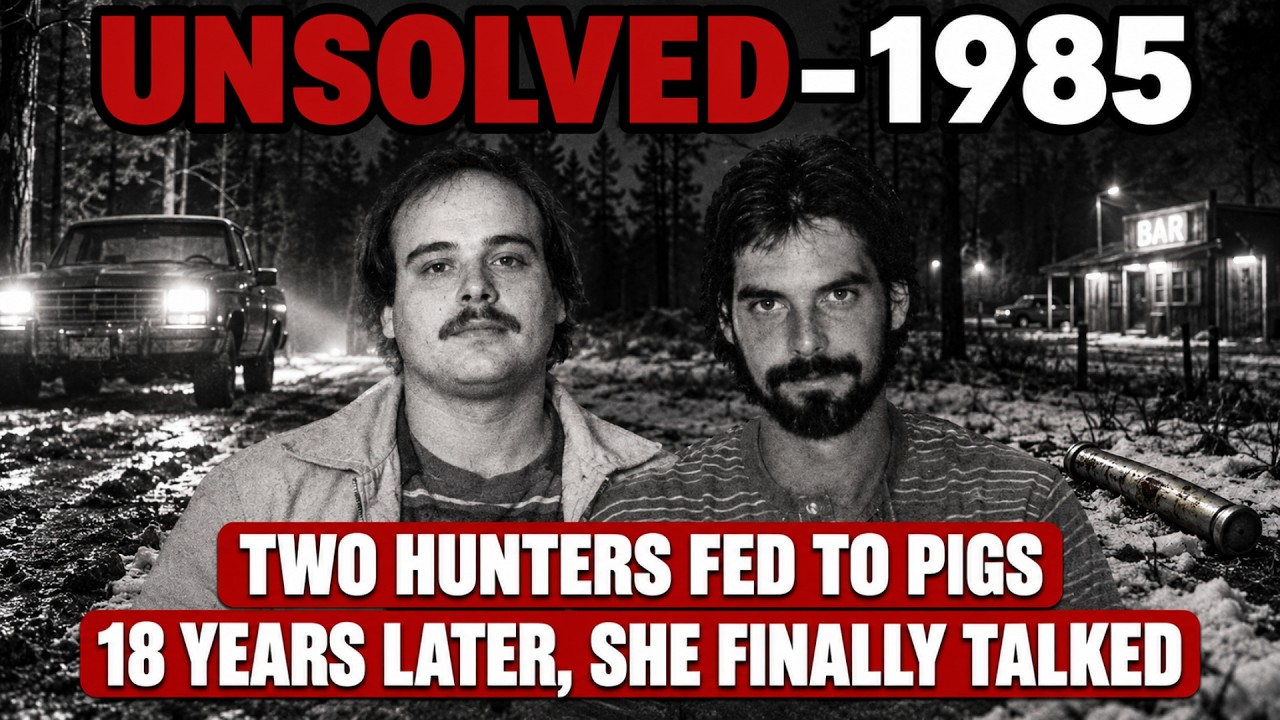
In a photo the families later gave investigators, Ognjan is seen adjusting Tyll’s tie on his wedding day, both of them smiling. It was the last image anyone had of them. The two men had planned a weekend of deer hunting at the Tyll family cabin in White Cloud, about two hundred miles northwest of Detroit. They loaded a black 1980 Ford Bronco with hunting rifles and set out on the Friday before Thanksgiving.
But instead of heading straight to the cabin, they decided to stop in the small town of Mio, about 185 miles north of Detroit, to see friends. That decision changed everything. They never bought hunting licenses. They never reached the cabin.
Tyll’s father and brother waited there, but the two men never arrived. When Monday came and neither man showed up for work or called, their families knew something was terribly wrong. They were not the kind of men to disappear without explanation. The families called the police, and the search began.
At first, authorities treated it as a routine disappearance. Two young men on a trip, drinking, perhaps crashed on a back road or lost in the woods. But as days passed with no trace of Tyll, Ognjan, or the Ford Bronco, the search expanded dramatically. Michigan State Police became involved, then federal agencies.
Divers searched lakes and rivers. Air teams scanned the forests from above. Ground-penetrating radar was brought in. Cadaver dogs were deployed.
Psychics were consulted. The Alcona County Sheriff’s Office, with its fifteen-person staff, participated. Even Interpol was notified. Thousands of posters with the men’s faces were printed and hung across the state.
As deer hunting season returned each November, authorities renewed appeals to the 700,000 hunters heading into the woods, asking them to watch for anything suspicious, a piece of metal, a scrap of cloth, a bone. Tips poured in from across the country. Someone claimed to have seen the men in Florida. Another said they fled to Mexico.
One person said the Bronco was at the bottom of a deep lake. Another blamed drugs. Another blamed a woman. One even claimed Bigfoot was responsible.
Police investigated every tip, chased every rumor, and hit dead end after dead end. The Bronco with license plate 447 HRZ seemed to have vanished from the face of the earth. The men were gone without a trace, no blood, no clothing, nothing. The case became an urban legend.
The disappearance was featured on Unsolved Mysteries, placing the men’s faces in millions of homes across the country. Each time it aired, a new wave of tips came in, and each time police followed every lead only to return empty-handed. Theories grew more outlandish. Were they at the bottom of a lake?
Did they flee the country? Were aliens involved? No theory had any evidence behind it. For years, investigators kept hearing the same name from multiple sources: the Duvall brothers.
Not vague rumors, but outright boasts. Raymond “J. R. ” Duvall Jr.
and Donald “Coco” Duvall had talked many times, in many places, to many people, about killing the two hunters. They hinted the bodies had been fed to pigs. They hinted the Bronco had been dismantled. But hints and boasts are not evidence.
There were no eyewitnesses willing to testify, no bodies, no physical evidence. To understand why an entire town stayed silent for eighteen years, one must understand who the Duvalls were. Seven brothers, not two or three, but seven men of the same blood, raised in the Michigan woods, living by their own rules. They divided their time between Monroe in southern Michigan and the pine forests around Mio.
Their reputation preceded them everywhere. Locals often compared them to the hill people from Deliverance, multiplied by three. They drank until they passed out, fought viciously, and recognized no law or social standard as applying to them. There was an unwritten rule: if you fought one Duvall today, you would face all seven tonight.
Local farmers blamed them for killing livestock. Police effectively avoided dealing with the Duvalls unless absolutely necessary, and when they did, they always went in large groups with backup. J. R.
and Coco, the two oldest, already had long criminal records. They ran a chop shop for stolen cars, poached trout and deer, tapped into the power grid illegally, and lived in small cabins and trailers in the woods, shooting wildlife and holding annual barbecues with friends and rough characters. One journalist later described them as living proof of criminal evolution, born and raised in crime, each generation more sophisticated than the last. What made the Duvalls truly dangerous was not just violence but their ability to silence everyone around them.
For eighteen years, rumors spread through Mio, through the bars, through whispers by winter heating stoves. Everyone knew. Everyone heard. Everyone stayed silent.
The brothers boasted of killing the two hunters for years, telling drinking companions and relatives that they had killed the men and fed them to the pigs. But no one called the police. No one filed a complaint. Everyone knew the price of opening their mouths.
A dog shot. Another dog run over in the front yard. A car deliberately swerving to hit an animal. A reminder about a pretty niece, or a knock on the door at midnight.
These were not empty threats. This was the language the Duvalls used to keep the secret, and it worked for eighteen years. On the night of November 22, 1985, Tyll and Ognjan stopped at Linkner’s Lounge, a small bar about five miles west of Mio in the remote area of Luzerne. Dark forest roads, homes separated by hundreds of yards, a place where a scream in the night might not be heard, or those who heard it might pretend they hadn’t.
The two men from the city drank, played pool, and flirted with the bartenders. They were louder than they should have been, more confident than was safe. They did not fit in with Mio, and Mio noticed. Also in the bar that night were two of the seven Duvall brothers, Raymond Jr.
and Donald “Coco. ” An argument broke out. No one knows exactly who said what first, but the exchange between the city hunters and the Duvalls escalated quickly. Perhaps it was a minor scuffle, perhaps just words.
But the Duvalls were not the type to let an insult pass. They began making phone calls. Friends, other brothers, and associates began arriving at the bar. Also present that night was a woman named Barbara Boudreau and her boyfriend, Ronnie Emery.
Boudreau lived in a home very close to the bar, just a few hundred yards down a dirt road. She saw the Duvalls summoning more people. She noticed the atmosphere in the bar change. She realized what was about to happen.
The Duvalls bought a six-pack of beer for Tyll and Ognjan and told them it would be best if they went home, because something was about to start. It was not advice. It was a final warning. Boudreau and Emery also left at the Duvalls’ word, returned to Boudreau’s nearby home, and sat down to watch Scarface on video.
Outside, in the darkness of the November Michigan pine forest, temperatures were near freezing, light snow covered the ground, and everything was still. Then screams tore through the quiet of the night. Boudreau and Emery heard shouting, cries for help, and the sound of beating coming from the road across the way. They knew what was happening.
The Duvalls had intercepted the hunters. When they looked outside, a strange pickup truck was parked at the entrance to Boudreau’s driveway. They did not dare go out the front door. Instead, they climbed out the bathroom window and crept through the woods to get closer to the noise.
What they saw would haunt Barbara Boudreau for the rest of her life. In the half-circle of light cast by the truck’s headlights on the ground, the Duvall brothers and their companions were beating David Tyll. It was not a fight. It was a brutal assault, with feet, fists, and an aluminum baseball bat.
Tyll lay on the ground, curled up, begging them to stop, begging them to let him live. They kept hitting him. The sound of the bat striking his skull was like dropping a pumpkin on concrete, blood splattering everywhere. They beat him until he stopped moving.
Then they kept beating him. They kicked his lifeless body. They laughed. Brian Ognjan watched all of it.
Two men held him while the Duvall brothers killed his best friend before his eyes. Ognjan broke free. He slipped from the hands holding him and ran, toward the darkness, toward the woods, running for his life. But they caught him.
They dragged him back into the light. When he was pulled back, he completely collapsed. The Duvalls began laughing because Ognjan was so terrified he had urinated on himself. A twenty-seven-year-old man saving money to propose to his girlfriend was so frightened he lost control of his body.
The killers laughed in his face. Then they beat him to death with the same bat, the same fists, the same feet, until both bodies lay still on the cold ground. Minutes after Boudreau and Emery returned home through the bathroom window, there was a knock on the door. Boudreau opened it.
Coco Duvall stood there. He said one sentence that echoed in Boudreau’s head for the next eighteen years: “You didn’t see anything. The pigs have to eat too. ” The Duvalls later told many people on various occasions that they had cut up the two bodies, put them through a wood chipper, and fed them to their hogs.
The Bronco was taken to junkyards the Duvalls owned or frequented, dismantled piece by piece, disappearing forever. The bodies were never found. The vehicle was never found. Not a bone fragment, not a drop of blood, not a piece of metal.
Time passed. Months became years. Years became a decade. The Duvalls lived free, moving through the community, drinking in the bars where they had killed.
Once a year or more, they would stop by Boudreau’s house to remind her to keep her mouth shut. They mentioned her pretty niece in a calm tone, but the meaning was not calm at all. One of her dogs was shot. Another was run over in the front yard, the car deliberately swerving off the road to hit it.
By the mid-1990s, the case of the missing hunters was effectively dead. The file sat in a cabinet, covered in dust. Investigators had retired or been transferred. Leads had run out.
Every November, the families appeared before cameras, making appeals, asking the same question. And every November, the answer was still silence. Then came Robert Lesneski, a Michigan State Police investigator nicknamed “Bronco. ” He inherited the cold case in the late 1990s, more than fifteen years after the disappearance.
It was assigned to him not because anyone thought it could be solved, but because it had to sit on someone’s desk. Lesneski began reading thousands of pages of files, hundreds of reports, dozens of statements. He read every page, reorganized the entire chaotic pile into a system he could work through. The case haunted his dreams.
He worked hundreds of hours off the clock, unpaid. He re-interviewed old witnesses, people who had spoken to investigators ten, twelve, or fifteen years earlier. He always carried a shovel in his trunk. Whenever he drove the forest roads around Mio and saw a piece of metal sticking out of the ground, he would stop and dig.
It might be garbage. It might be scrap from an old car. But it might also be part of the black Bronco that had vanished fifteen years earlier. He never found it, but he never stopped looking.
Then one tip changed everything. A woman called Lesneski and said she knew another woman who might know something about the disappearance. That woman lived near the bar in Luzerne where Tyll and Ognjan had last been seen. Her name was Barb Boudreau.
Lesneski had no address or phone number, just a name and a general area. So he started knocking on doors. Every day after his shift, after dark, he drove without his badge to the area around Linkner’s Lounge and knocked on every door. Day after day, door after door.
Finally, a wary woman opened her door a crack. When he identified himself as a state police investigator, she began trembling violently, her whole body shaking. “You’ll be the death of me,” she said, and pushed the door shut. Lesneski put his foot in the door to stop it from closing.
He had found Barb Boudreau, and her reaction told him more than any statement could. A woman with no connection to the case, living hundreds of miles from the city, trembling at the word “police” so violently she nearly fainted. She knew something, and what she knew was dangerous enough to make her fear death even after fifteen years. Boudreau said little in that first encounter.
She closed the door. But Lesneski returned the next day, the next week, the next month. He came not with a subpoena or a threat, but as a neighbor. He helped her fix things around the house.
He installed a security camera so she could feel safer. He always drove without his badge, always came alone, careful that no one saw a police car parked outside her home, knowing that if the Duvalls discovered police were talking to her, her life would be in genuine danger. Over many months, slowly, gradually, Boudreau began to talk. But she told the story in a very specific way, a way Lesneski immediately recognized as deliberate.
She said her boyfriend Ronnie Emery had been with her at the bar that night. She said Ronnie had gone outside to check when he heard the noise. She said Ronnie had returned and told her what he had seen. The screams, the beating, the truck lights, the baseball bat, the blood, two hunters begging for their lives, the Duvall brothers laughing as they beat them, the sound of metal hitting skull, lifeless bodies still being kicked.
Vivid details, but all through Ronnie’s account, not her own eyes. And Ronnie Emery had died years earlier. Lesneski realized immediately what this meant. Boudreau was telling the story through the eyes of a dead man to protect herself.
If she said Ronnie saw it, not her, then her statement was hearsay and could not be used as evidence in court. She was giving Lesneski enough information to know the truth, but not enough to drag her into a courtroom where she would have to point directly at the Duvall brothers and say, “I saw you kill these men. ”
By 2002, Lesneski was nearly certain what had happened to David Tyll and Brian Ognjan. He knew who killed them.
He knew where. He knew how. But he lacked sufficient evidence to arrest anyone. The breakthrough came from the Michigan Attorney General’s office.
Working with Attorney General Mike Cox, Lesneski and the investigative team issued subpoenas for Barbara Boudreau and several other witnesses, compelling them to come to Lansing and testify under oath before a formal hearing. Cox called this tactic the “poor man’s grand jury,” a streamlined way of using legal authority to force people who knew the truth to tell it. It was a last-ditch attempt. If it failed, the case would die forever.
Boudreau was the first to testify. She sat before investigators, raised her hand, swore the oath, and began telling the same story, the same details, the same narrative method, through Ronnie’s eyes. The screams in the night, the truck headlights, the baseball bat, blood on the snow, Ognjan running and being dragged back, the Duvalls laughing, lifeless bodies still being beaten. Every detail was accurate.
Every detail was vivid. And every detail was legally useless because it came from the account of a dead man. The room grew heavy. Investigators exchanged glances.
They all knew what she was hiding. They all knew she was protecting herself. And they all knew that if she left that room still telling the story through Ronnie’s eyes, the Duvalls would never face court. Lesneski turned off the recorder.
He leaned forward, his face inches from hers, and begged her, not commanded, not threatened, but begged. “Tell me what you know, Barb. Tell me the truth. ” Something changed in her eyes, a slight, barely noticeable shift, as if a wall inside her had finally crumbled after seventeen years.
“Lesneski, you know I saw it, don’t you? ” she said. “Yes, I know,” he said. “But I need to hear it from you.
” There was silence. Then Boudreau said four words Lesneski had waited years to hear: “I’m a dead woman. ” She said it, and then she told the story. This time not through Ronnie’s eyes, but through her own.
She had been there. She had climbed out the bathroom window. She had crept through the woods. She had stood in the darkness and watched the Duvall brothers beat two young men to death under the truck lights.
She had heard the sound of the baseball bat striking skull. She had heard the pleas. She had heard the laughter. She had seen all of it.
And she had stayed silent for seventeen years because she believed that if she opened her mouth, she would be next. They now had an eyewitness. In May 2003, nearly eighteen years after the night David Tyll and Brian Ognjan were beaten to death outside a bar in Luzerne, Raymond “J. R.
” Duvall Jr. , fifty-two, and Donald “Coco” Duvall, fifty-one, were arrested and charged with two counts of first-degree murder. For the first time in eighteen years, someone would face justice for the deaths of the two hunters. The trial was set for October 2003.
Due to extensive media coverage in the Mio area, the case was moved to Arenac County court in Standish, about sixty miles south of Mio. A jury of six men and six women was selected. The lead prosecutor was Donna Pendergast, an assistant Michigan attorney general with a formidable record. Pendergast, the daughter of a Detroit police officer, had put dozens of killers in prison.
But this case was unlike any she had handled. No bodies, no physical evidence, no murder weapon, no fingerprints, no DNA, no confession. Nothing but witness testimony, and the most important witness was a recovering alcoholic who had drunk nine drinks on the night she witnessed the murders and had stayed silent for nearly eighteen years because she feared for her life. If Pendergast could not convince the jury to believe Boudreau, the Duvalls would be free again, this time perhaps forever.
When Boudreau took the stand, the courtroom was so quiet you could hear people breathing. She sat there, facing the Duvall brothers for the first time since the night they had knocked on her door and told her she had seen nothing. And she began to tell what happened. She described the night at Linkner’s Lounge, seeing the Duvalls summoning more people, leaving with Ronnie Emery when she sensed danger approaching, the screams tearing through the darkness, climbing out the bathroom window, creeping through the woods, standing in the dark watching the scene she had carried in her head for eighteen years.
She described the half-circle of truck headlights, the Duvalls beating David Tyll with feet, fists, and an aluminum baseball bat while he lay on the ground begging for his life, the sound of the bat hitting his head like a pumpkin dropping on concrete, blood splattering everywhere. She described Brian Ognjan being held by two men, breaking free, running toward the darkness, being dragged back, collapsing, and the Duvalls laughing when they saw he had urinated on himself from fear. She described them beating Ognjan to death immediately after. And she described Coco Duvall appearing at her door minutes later to tell her she had seen nothing.
“The pigs have to eat too. ”
The defense attacked Boudreau from every angle. They pointed out she had drunk nine drinks that night. They pointed out that eighteen years had passed and human memory was unreliable.
They noted she had told the story from Ronnie’s perspective for years before changing her story. They tried to break her will on the witness stand. But Boudreau did not break. She answered firmly, directly, in a way that left the defense attorneys baffled.
She admitted she had drunk a lot, but said she was a longtime alcoholic and knew how to keep her mind clear. She admitted she had stayed silent for eighteen years, but explained she had stayed silent because she believed opening her mouth meant death. The details she provided, the sound of metal hitting skull, the laughter when Ognjan lost control of his bladder, were not details someone fabricates. They were sensory details no one could invent without having stood there in the darkness watching two people beaten to death.
The defense chose a different strategy: presenting alternative stories, no matter how bizarre. The first defense witness was a slow-talking, heavy alcoholic with a metal plate in his skull from a crane accident. He claimed Tyll and Ognjan had told him they intended to leave the country together. No one in the courtroom believed a word.
The second witness was Ken Duvall, one of the seven brothers. He testified that he remembered nothing, attributing this to years of cocaine use, a stroke, and Alzheimer’s disease. The third witness was pure absurdity. A man claimed he had once lost his memory but recently regained it, and now remembered that his friends had killed Tyll and Ognjan with an axe in downtown Grayling, undressed them, kept their mouths open, and drowned them in the Au Sable River.
He also claimed a personal connection to Leslie Williams, the notorious serial killer of southeastern Michigan. Pendergast seized the opportunity. In cross-examination, she asked him a single question in a calm voice: “Do you know who prosecuted Leslie Williams? ” He said, “No.
” Pendergast said, “You’re looking at her. ” No one understood why the defense had called that man to testify. The Duvall brothers themselves did not take the stand. Defense attorney Seymour Schwartz argued that the prosecution had not proven the case beyond a reasonable doubt, that the entire case rested on the testimony of an alcoholic telling a ridiculous story eighteen years after the fact.
Then Donna Pendergast stood before the jury for her closing argument. She looked directly into the eyes of the twelve jurors and said the defendants had escaped justice for eighteen years through lies and intimidation. “Do not reward the defendants for eighteen years of lies and intimidation,” she said. Then she turned and looked directly at Raymond and Donald Duvall, the men sitting at the defense table, and said the words the entire courtroom would remember: “Those faces are just masks of monsters.
” She said their crime was an evil so dark that your worst nightmares seem mild in comparison. The jury left the courtroom to deliberate. Twelve people, six men and six women, carrying the weight of eighteen years of secrecy, eighteen years of family pain, eighteen years of a town living in fear. No bodies, no physical evidence, no weapon.
Just words. The words of Barbara Boudreau, and the boasts of the Duvalls themselves. They deliberated for about two hours. When the jury returned, Judge Ronald Bergeron read the verdict: guilty.
Both Raymond “J. R. ” Duvall and Donald “Coco” Duvall were convicted of first-degree murder in the deaths of David Tyll and Brian Ognjan. Raymond Duvall dropped his head onto the defense table.
In the victims’ family section, Helen Ognjan, Brian’s seventy-seven-year-old mother, had waited eighteen years for this moment. She said, “God has answered my prayers. ” David Tyll’s father stood before reporters with bloodshot eyes and said one sentence he had carried inside him for nearly two decades. “They took my son.
” The judge imposed the mandatory sentence under Michigan law for first-degree murder: life in prison without the possibility of parole. Both Duvall brothers would die in prison. Schwartz said he would appeal, claiming disappointment with the verdict and that his clients were innocent. The appeal was later denied.
The conviction of the Duvall brothers without any physical evidence, no bodies, no weapon, no blood, no DNA, is considered one of the most extraordinary convictions in Michigan judicial history. It proved that reliable witness testimony, combined with circumstantial evidence and the killers’ own boasts, could be enough to put murderers in prison, even when no physical trace of the victims remained. Lesneski and Pendergast both believed others were involved in the murders that night, at least three other people who witnessed or aided the crime, but no one else was ever charged. Pendergast and Lesneski both retired.
Barbara Boudreau, the woman who lived with the secret for eighteen years and finally found the courage to tell the truth, died in 2007, four years after the trial. The violence did not end with the Duvall brothers. In 2005, Dawn Duvall, J. R.
’s daughter, was convicted of second-degree murder for stabbing a man named William Gilbreth to death and sentenced to thirty-one to forty-six years in prison. She had grown up being physically and sexually abused by the very men in the family who were supposed to protect her. Violence breeds violence. That was the true legacy of the Duvall family.
The entire case was documented by author Tom Henderson in his book Darker Than Night. The case was also featured on Unsolved Mysteries, Cold Case Files, and other programs. The bodies of David Tyll and Brian Ognjan were never found. The black 1980 Ford Bronco with license plate 447 HRZ was never found.
If the story about the wood chipper and the pigs is true, there was nothing left to find, and perhaps there never will be. Every November, when deer hunting season returns, hunters still flock to Mio, still drive the road where Linkner’s Lounge once stood, still stop at the bars where two twenty-seven-year-old men drank beer and laughed on the last night of their lives. The story was never forgotten. Pendergast, when asked about the motive, said she had no answer.
She said there was no way to understand why Brian and David died, because it was pure evil, and there is no way to understand pure evil. You can only recognize it for what it is. David Tyll, a recently married mechanic, got in his car to go deer hunting on November 22, 1985. Brian Ognjan, a mechanic saving money to propose to his girlfriend, sat in the passenger seat next to his best friend.
They never came home. But after eighteen years, someone refused to let them be forgotten. An investigator knocking on every door in the dark. A trembling woman who finally told the truth.
A prosecutor who looked into the eyes of monsters and called them by their names. And twelve people in a courtroom in Standish, Michigan, who said what should have been said in 1985. Guilty.