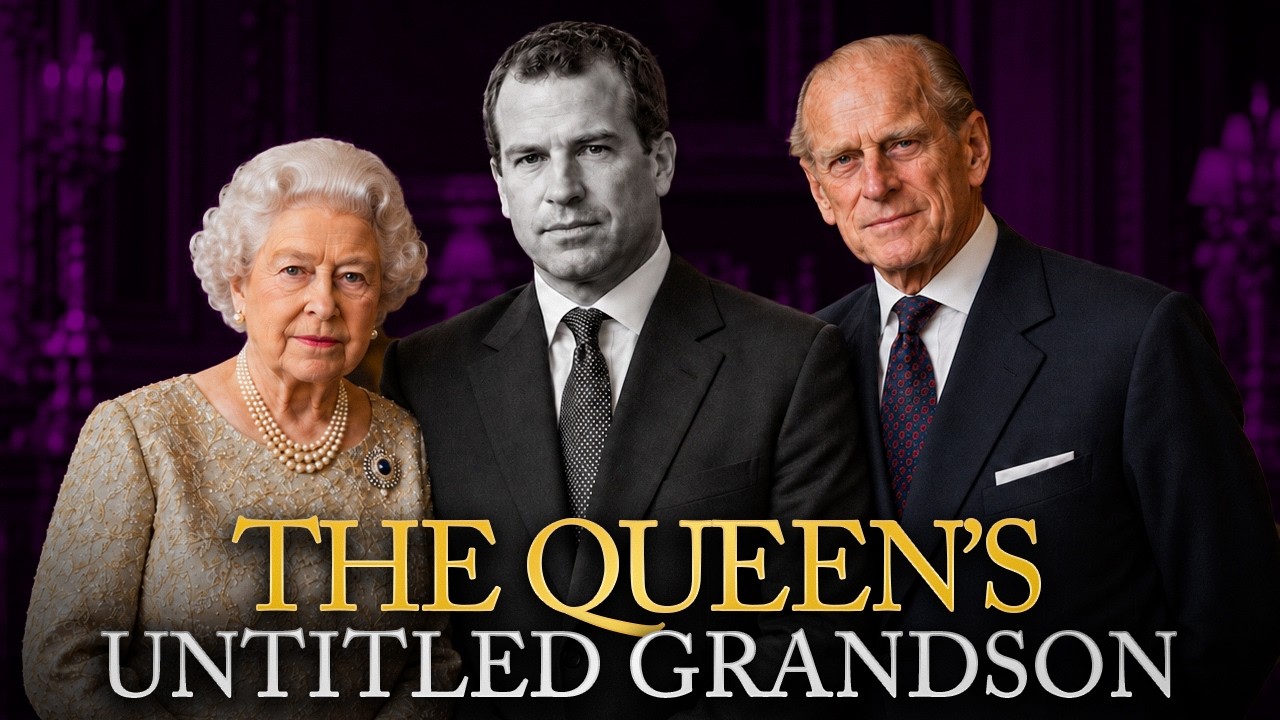
Peter Phillips was born on November 15, 1977, at St. Mary’s Hospital in Paddington, the first grandchild of Queen Elizabeth II. He weighed 7 lb 9 oz and stood fifth in line to the throne.
The Washington Post described him the next day as a “commoner,” a legal description, not an insult. He was Master Peter Phillips, with no royal highness style and no courtesy title.
The popular story has long held that his mother, Princess Anne, refused to give her son a royal title. His sister Zara has praised her for it, and Anne herself has said it was probably the right thing to do. But the title was never Anne’s to give.
British princesses cannot pass their rank to their children. For Peter to have been born a prince, someone would have had to ask the sovereign for new letters patent naming the children of Princess Anne. No such document exists.
The rules that shaped Peter’s status were set decades before he was born. In 1917, King George V issued letters patent declaring that only the children of a sovereign, the children of the sons of a sovereign, and the eldest living son of the eldest son of the Prince of Wales would hold the style of royal highness. A king’s daughter could not pass it on.
Her children took their rank from their father.
That rule would have caught Queen Elizabeth’s own children. In 1948, she was still a princess, married to Philip, Duke of Edinburgh. Under the 1917 rule, her children would have been the children of a duke and nothing more.
So King George VI signed a second paper on October 22, 1948, declaring that the children of Princess Elizabeth and the Duke of Edinburgh would hold the style of royal highness and the title of prince or princess. It arrived 23 days before Charles was born. Anne was born a princess because of a document drawn up for her brother before either of them existed.
That document covered only Elizabeth’s children. It did not reach forward to Anne’s.
There was another path to a title, and the family had used it 16 years before Peter was born. Princess Margaret married photographer Anthony Armstrong-Jones in 1960. In October 1961, the Queen made him Earl of Snowdon.
Their first child, David, was born 28 days later. Because his father was now an earl, the baby was born with the courtesy title Viscount Linley. He was never a prince, but he was a lord from his first day.
That door was open to Anne. She married Captain Mark Phillips of the Queen’s Dragoon Guards in November 1973. He was a cavalry officer and one of the best event riders in the world, an Olympic gold medalist from Munich in 1972.
Royal watchers expected him to come out of the abbey with a title as Armstrong-Jones had. He did not. He came out as Captain Mark Phillips and stayed that way.
What happened behind that is the least documented part of the story. The version most often repeated is that the Queen offered Mark Phillips an earldom and he turned it down. But according to royal genealogist Marlene Koenig, Mark said in a pre-wedding interview that he had not been offered a peerage at all.
No letter of refusal has ever been published. What exists is the result: no earldom was created, and no courtesy title waited for the children. Even if one had been created, it would not have made Peter royal.
The style of royal highness was never on the table for Anne’s children.
Four months into the marriage, the country saw what the letters in front of Anne’s own name could attract. In March 1974, a man called Ian Ball forced her car to stop along the Mall. He wounded four men who tried to protect her and was carrying a letter demanding £2 million in ransom.
Anne stayed in the back seat and refused to get out. Ball was arrested and sent to Broadmoor. A royal highness, the night showed, was worth a ransom note.
Three years later, Peter arrived with nothing in front of his name. His parents had a captain’s pay, an Olympic reputation, and a large house the Queen had bought them at Gatcombe Park in Gloucestershire. Somebody in that household was going to have to earn a living.
Mark Phillips ran the estate and kept earning from his sport, backed by sponsors and later working with the American eventing team. He rode for Britain once more at the Seoul Olympics in 1988 and came home with team silver.
The couple’s second child, Zara, was born on May 15, 1981. Like her brother, she had no title. Thirteen months later, the Princess of Wales gave birth to Prince William.
The 1917 rule that had passed over Peter now worked the other way. William was the son of the Queen’s son, so he was a royal highness from his first breath. He went straight in ahead of Peter in the line.
Peter dropped to sixth. Two years later, Harry pushed him to seventh.
Peter later described how his mother prepared them for balcony appearances at Buckingham Palace. She would give them a clip round the ear and say, “Right, behave yourself. We’re going out on the balcony.
Don’t pick your nose and don’t yawn.” It was one of the few glimpses of the household from inside. The children would appear, behave, and then go back to Gloucestershire and be nobody in particular.
At the end of the 1980s, the household split. In August 1989, Buckingham Palace read out a two-sentence statement: the Princess Royal and Captain Mark Phillips had decided to separate. There were no plans for divorce proceedings.
Anne kept Gatcombe, Mark kept the farm. The children stayed with their mother and saw their father.
The divorce came in April 1992. It took about four minutes at Somerset House. Peter and Zara, then at boarding school, would live with their mother.
Their father would have unlimited access. In December of that year, Anne married Commander Timothy Lawrence in a private service at Crathie Kirk near Balmoral.
There is a detail the famous story never mentions. When a royal marriage ends, officials have to decide what everyone is now called. For the children of Anne and Mark Phillips, none of that applied.
There was nothing to lose. Nothing changed. They had been Master Peter and Miss Zara Phillips before, and they were exactly that afterwards.
Peter went to Gordonstoun, his grandfather’s old school, where he became head boy. From there he went to the University of Exeter to study sports science. The first jobs came through motor racing.
He worked with Jackie Stewart’s Formula 1 team, then Jaguar Racing, then Williams. In 2005, he moved to the Royal Bank of Scotland, which had a Formula 1 sponsorship of its own. His work took him to Hong Kong.
In 2012, he set up a sports and entertainment management company in London.
That same summer, his sister showed what the untitled life could look like at its best. At the London Olympics, Zara rode in the British eventing team and won silver. The medals were presented by her mother.
In 2020, for Anne’s 70th birthday, ITV made a documentary. Peter explained on camera what that upbringing had meant. “We were always brought up on the understanding that we were going to have to go to work,” he said.

“We were going to have to go out and earn our living regardless of the fact of who our grandmother was or who our mother was.” His sister went further. “I think it made us fight harder as well,” Zara said, “to try and be as successful as we could be, so we’re very grateful to her not giving us a title.”
The family’s own words credit a decision, and more and more they credit her. The documents say the choice was narrower than that. What she could choose was whether to ask for more, and she never asked.
Being plain Mr. Phillips did not take Peter out of the line of succession. In 2003, at the Canadian Grand Prix, he met Autumn Kelly, a Roman Catholic from Montreal.
A law passed in 1700 removed from the succession anyone who married a Roman Catholic. It did not care about titles. By 2008, Peter was 11th in line.
Before the wedding, Autumn Kelly was received into the Church of England. A source close to the couple told reporters she had not been asked to do it and had done it of her own accord.
There was a second old law in the way. Under the Royal Marriages Act of 1772, every descendant of King George II needed the sovereign’s formal consent to marry, whether prince or plain mister. So on April 9, 2008, at a meeting of the Privy Council, the Queen’s consent to the marriage of her grandson was declared.
His birth had needed no document from the crown. His wedding did.
They married on May 17, 2008, at St. George’s Chapel in Windsor Castle. The Queen attended.
The couple had sold the rights to their wedding pictures and interview to Hello Magazine for a sum put at around £500,000. Reports said the palace had not known the pictures were part of a commercial deal and that officials later described it as a serious error of judgment.
On December 29, 2010, Autumn gave birth to their daughter Savannah, the Queen’s first great-grandchild. A second daughter, Isla, followed in March 2012. Then the law Autumn had changed churches for was changed itself.
The Succession to the Crown Act of 2013 ended the rule that removed anyone who married a Catholic. The same act repealed the Royal Marriages Act. From then on, only the six people nearest the throne would need the sovereign’s consent to marry.
In January 2020, in a single week, the difference between having a title and having only the name was tested in public twice. On January 8, Prince Harry and Meghan announced they would step back as senior members of the royal family. On January 18, Buckingham Palace set out the terms: the Sussexes would not use their HR titles as they were no longer working members.
Three days later, British newspapers picked up an advertisement running in China. It was for Bright Dairy, part of a state-owned food group in Shanghai. The man in it was Peter Phillips.
He drank a glass of milk. The caption introduced him as “British royal family member Peter Phillips.” In a behind-the-scenes video, he told a story from his childhood about a herd of Jersey cattle at Windsor.
The Queen’s former chef publicly disputed the memory.
In the same week, one grandson agreed to stop using his title in order to earn money. The other grandson had never had one. He was earning money with the only royal label he possessed.
On February 11, three weeks after the advertisement, Peter and Autumn announced their separation. The divorce was finalized the following year. That spring, Anne was asked about the decision directly in Vanity Fair.
“I think it was probably easier for them,” she said, “and I think most people would argue that there are downsides to having titles. So, I think that was probably the right thing to do.” It is the fullest public explanation she has given.

She does not say she refused anything. She says the result was probably right.
In April 2021, the family buried Prince Philip. His children walked behind the coffin: Charles, Anne, Andrew, and Edward. Behind them came three grandsons.
The palace had published the order in advance. William and Harry did not walk side by side. Between them in the published order was Peter Phillips.
Further back walked Sir Timothy Lawrence. Beside him was David Armstrong-Jones, now the second Earl of Snowdon, the baby born a viscount in 1961 because his father accepted a title. Two men whose titles had been settled by the same question 16 years apart followed the same coffin down the same short road.
Seventeen months later, the Queen died. On the evening of September 17, 2022, her eight grandchildren stood around her coffin in Westminster Hall for a vigil. Four of them were princes or princesses.
Two, Louise and James, had the right to be and had been raised not to use it. Two had never had any right at all. From the floor of the hall, the eight looked exactly the same.
The difference is kept on paper.
The royal family’s official website publishes the line of succession. At number 19 is the Princess Royal. At number 20, one line below his mother, is Mr.
Peter Phillips. In 1977, he was fifth. The births of his cousins and then of his cousins’ children have moved him down one place at a time.
What has not moved is the word in front of his name.
The accession changed other names instantly. The rule of 1917, the one that had passed over Peter at birth, now reached Harry’s children because their grandfather was the king. Archie had been announced in 2019 with no title at all.
By March 2023, the royal website was listing him as Prince Archie. That same month, Edward was made Duke of Edinburgh, and his son James began using the courtesy title Earl of Wessex. Paper had moved again for other people’s children.
For Anne’s son, there was still nothing to move.
On June 6, 2026, Peter Phillips married again. His bride was Harriet Sperling, a pediatric nurse in the National Health Service. They married at All Saints Church in the village of Kemble in Gloucestershire.
The reception was at Gatcombe, the estate the Queen bought the year before he was born. This time the Privy Council had no part in it. At number 20 in the line, he was far outside the six who still need the sovereign’s consent.
He married as any other man in the parish could.
The Washington Post called him a commoner on his second day of life, and it was right. It meant that no paper had been signed. George VI had signed one for his daughter’s children, 23 days before the first of them arrived.
For the children of his granddaughter, nobody signed anything, and no request was ever made public. What Anne chose, by every account her family has given, was not to ask for more. And what Peter did with the answer is a life that looks from the outside almost ordinary: a school, a degree, a job in motor racing, a bank, a company, a marriage sold to a magazine, a milk advertisement, a divorce, a second wedding in a village church.
Every one of those was possible because there were no letters in front of his name. Every one of them was noticed because of whose grandson he was.
The Queen’s first grandchild never had a title to lose, and so he never lost one. His mother has only ever said it was probably the right thing to do.