For most people, Wyatt Earp’s life is defined by those chaotic thirty seconds at the O. K. Corral. But the famous gunfight in Tombstone may not have been the deadliest confrontation of his life.
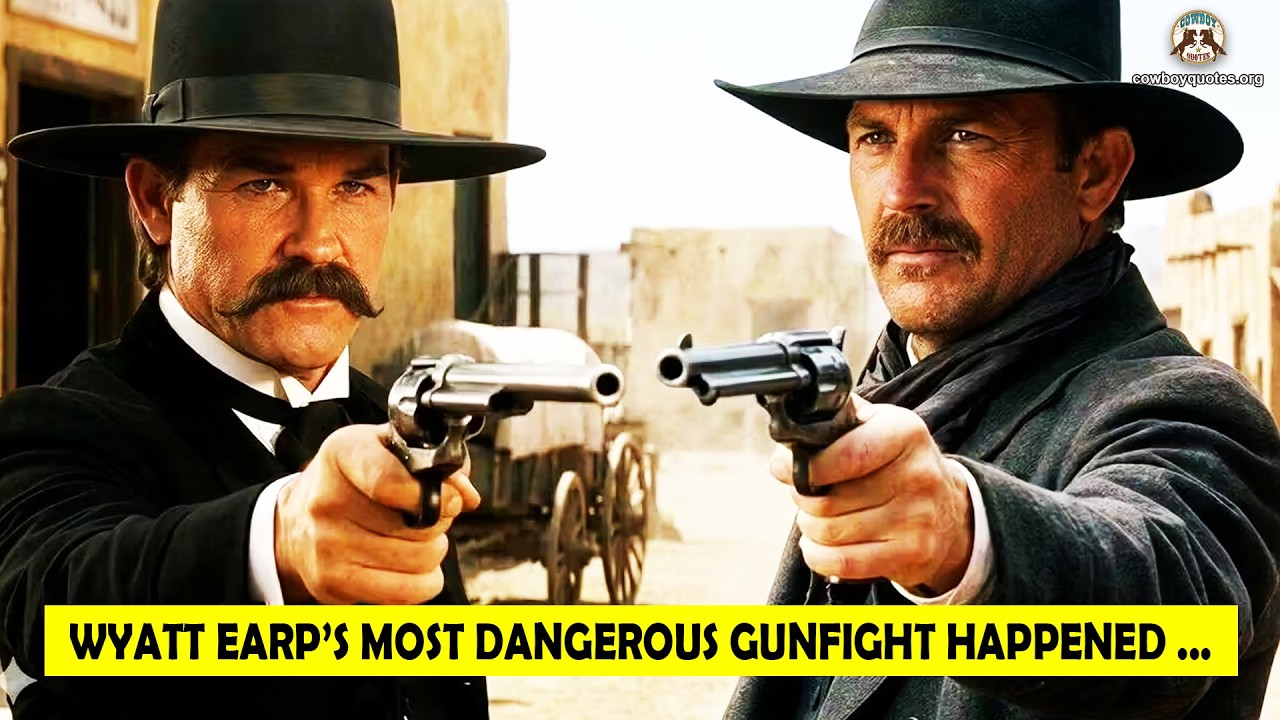
Years later, far from the dusty streets of that boomtown, Earp found himself in another lethal encounter, one that placed his life in far greater danger. Yet popular history has largely overlooked it. The shootout at the Iron Springs in the Whetstone Mountains, which took place on March 24, 1882, tested Earp in ways the Tombstone fight never did. To understand why Iron Springs was so dangerous, it helps to strip away decades of cinematic polish from the O.
K. Corral story. That October afternoon in 1881 has been portrayed as a classic western showdown: two lines of steely gunmen facing off in a wide, sunlit street. The reality was far messier.
The fight took place in a narrow lot beside Fly’s photography studio on Fremont Street, a strip of ground barely fifteen feet wide. When Wyatt, Virgil, and Morgan Earp, accompanied by the consumptive Doc Holliday, confronted Frank and Tom McLaury and the Clanton brothers, the two sides were close enough to smell each other’s alcohol. Once the first shot rang out, confusion and thick gunsmoke took over. The heavy single-action revolvers produced clouds of white smoke, and after the initial exchange, visibility vanished.
Men fired through the haze, their hearing dulled by the sharp reports echoing off nearby buildings. Billy Clanton was hit while backing toward a fence. Tom McLaury was shot while trying to hide behind a panicked horse. The fight was disorderly and brief, over in roughly thirty seconds.
When the dust cleared, three men lay dead, and the Earps emerged as apparent victors. But the real danger of that day did not come in those thirty seconds. It came in the drawn-out legal aftermath that nearly sent the Earps to the gallows. Tombstone was a town split in two.
The Tombstone Epitaph, run by the Earp-supporting John Clum, portrayed the brothers as guardians of civic order. The rival Tombstone Nugget told a different story, describing the Earps as lawmen who used their badges to attack men trying to surrender. The clash of narratives culminated in the lengthy Spicer hearing in November 1881. For weeks, Wyatt and Doc Holliday endured tense legal proceedings as Judge Wells Spicer weighed whether to send them to trial for murder.
Although Spicer ultimately ruled that the lawmen had acted within their duties, the decision brought no real closure. It only deepened the town’s divisions. Driving the Earps toward prosecution, the Cowboys faction, backed by influential cattle ranchers and rural sympathizers, realized the courts would not hold the brothers accountable. On the frontier’s informal code, when formal justice fails, vengeance often follows.
The shootout at the O. K. Corral was not the climax of the story. It was the opening chapter of a longer, escalating conflict.
In Tombstone, allies were close, and the jail cell offered some protection. But out in the open desert under Arizona’s harsh sun, there would be no walls to hide behind, no court to appeal to, and no thick smoke to obscure what awaited. The first blow came on the night of December 28, 1881. Virgil Earp, Tombstone’s city marshal, was crossing the intersection of Fifth and Allen Streets when a volley of gunfire erupted from the shadows of a nearby unfinished building.
Virgil was gravely wounded, his arm permanently crippled. Doctors had to remove several inches of damaged bone. He survived, but the message was clear: the Earp family was no longer safe even inside the town they had come to police. If the attack on Virgil was meant as a warning, what happened three months later was far more decisive.
The evening of March 18, 1882 began as an ordinary Saturday. Seeking relief from the surrounding tension, Wyatt and his younger brother Morgan visited the Campbell and Hatch billiard parlor on Allen Street. Morgan, thirty-one years old and known as the quietest of the brothers, joined a game while Wyatt watched from a nearby chair. Around 10:50 p.
m. , a shot rang out through the back door window, striking Morgan and causing a severe spinal injury. A second bullet passed near Wyatt and lodged in the wall. Morgan was carried to a couch in a back room, where his brothers and friends gathered.
Accounts describe Wyatt staying by his brother’s side in his final moments. Morgan spoke quietly to Wyatt, recalling a promise the two had made about what might happen after death, before dying about forty minutes later. The impact of this loss on Wyatt Earp was profound. He had spent months working within the boundaries of territorial law, wearing the badge, appearing before the court, following legal procedure.
But Morgan’s death, combined with Virgil’s permanent injury, convinced him the legal system could no longer protect his family. From his perspective, the courts had proven ineffective against the network of cattle rustlers and hired gunmen operating in the region. Morgan’s killing became the catalyst for one of the most significant shifts in Wyatt Earp’s story. He decided to step entirely outside formal legal proceedings.
Instead of seeking arrest warrants and judicial processes, he chose to handle matters directly, on his own terms. When Wyatt accompanied Morgan’s body and the wounded Virgil out of the territory by train, he was making a clear break with his previous approach. The Cowboys may have expected the Earps to withdraw entirely. Instead, Wyatt was moving his family to safety so he could return to Cochise County unburdened by that concern.
No longer serving as a city marshal, he began organizing a small group of trusted, determined men loyal to him personally. This set the stage for the pursuit that would eventually lead to the showdown at Iron Springs. By late March 1882, Wyatt had secured a federal commission as a deputy U. S.
marshal from Crawley Dake, the territorial marshal increasingly concerned about instability in Cochise County. Several Tombstone mining investors, eager to end the rustling problem and stabilize commerce, contributed funding. Wyatt chose his companions carefully, selecting men known for loyalty, skill with firearms, and steady nerves. They included Doc Holliday, sick but fiercely devoted; Sherman McMaster, a former Texas ranger familiar with Cowboy methods; Texas Jack Vermillion; Turkey Creek Jack Johnson; and Charlie Smith.
Together they formed a small, heavily armed, highly mobile unit. The posse’s first major confrontation came on March 20, 1882, at the Tucson train station. Wyatt and his men were escorting the wounded Virgil and his wife Allie to a train bound for California. While the train was stopped in the Tucson rail yard after dark, McMaster spotted two familiar figures near the passenger cars: Frank Stilwell and Ike Clanton, both linked to the earlier attack on Morgan.
Once the two men realized they had been spotted, they fled. Wyatt chased Stilwell across the rail yard, and a confrontation followed near a row of freight cars. According to historical records, Stilwell was killed in that encounter. The coroner’s report documented multiple gunshot wounds consistent with close-range fire.
Ike Clanton managed to escape in the darkness. Two days later, on March 22, the group rode to Pete Spence’s wood camp in the southern pass of the Dragoon Mountains. There they encountered Florentino Cruz, believed to have served as a lookout on the night Morgan was killed. Historical accounts indicate Cruz was questioned about the others involved and did not survive the encounter.
Following the deaths of Stilwell and Cruz, the legal situation shifted dramatically. Officials in Pima County, many sympathetic to the Cowboys, issued murder warrants for Wyatt Earp, Doc Holliday, and the rest of the group. Almost overnight, men who had recently held federal law enforcement authority became fugitives sought across the Arizona Territory. Cochise County Sheriff Johnny Behan organized his own posse, drawing heavily on Cowboy sympathizers.
Wyatt and his men now faced pressure from two directions: hunted by the legal system they once represented, and pursued by those seeking vengeance for Stilwell’s death. They retreated to remote areas, intensified their movement, and relied on their horses and instincts to stay ahead. By late March, the desert sun had turned the high country into a place of intense, brutal heat. Wyatt and his five remaining companions were exhausted, having had little rest.
Behind them, Sheriff Behan’s posse closed in with warrants in hand. Ahead stretched a vast, unforgiving wilderness. Most of all, they needed water. Wyatt led his group toward the Whetstone Mountains, a rugged limestone range west of Tombstone.
Within one of its canyons lay an important water source known as Iron Springs, later called Mescal Springs. It was a popular stopping point for travelers, lawmen, and outlaws alike across Cochise County. What Wyatt did not know was that the Whetstone Mountains were already under the control of a significant threat. A large party of Cowboys, numbering between nine and twelve men, had left Tombstone and established camp right at the springs.
This was not a disorganized bunch. They were led by William “Curly Bill” Brocius, a capable and cunning outlaw leader known for his shooting skill and intense hostility toward the Earp family. He was accompanied by experienced gunmen, including Johnny Barnes, Milt Hicks, and Pony Diehl. The terrain at Iron Springs gave this group a major tactical advantage.
The spring lay in a low area concealed by a dry gulch, surrounded by desert willow, cottonwood trees, and eroded banks. Approaching from the east, the direction Wyatt’s party was traveling, riders had to cross a small exposed hill before descending into the gulch below. This created a natural blind spot. Those waiting below could remain hidden in the shadow of the banks, while anyone approaching would be clearly silhouetted against the open sky.
Historians who have studied the site’s terrain in detail note that geography gave a significant advantage to whoever controlled the low ground. Curly Bill and his men reportedly heard the riders approaching on the rocky trail long before they appeared. They extinguished their fires, loaded their rifles, and took positions using the natural cover. On March 24, 1882, around 1:00 p.
m. , the Earp party reached the area near the springs. The heat was intense. Wyatt rode at the front, exhausted from days of travel.
He wore a long canvas coat and carried his rifle on his saddle. Focused on finding water for the horses, he had unfastened his ammunition belt and placed it across the saddle. A moment of diminished readiness. As Wyatt’s horse reached the top of the hill and began descending into the gulch, gunfire erupted at close range.
The Cowboys opened fire from less than thirty yards away. The sound of rifles echoed through the canyon. What had been a quiet desert site turned into a sudden, chaotic ambush. The Earp party found itself trapped in open ground, facing a well-concealed attack.
The initial exchange was sudden and overwhelming. Texas Jack Vermillion’s horse was hit and fell, pinning him briefly. Doc Holliday, Sherman McMaster, and Turkey Creek Jack Johnson worked to calm their panicked horses amid the noise and dust. Realizing they were exposed, the group fell back down the gulch, seeking whatever cover the desert brush could provide.
But Wyatt Earp did not retreat. In the first moments of the fight, he dismounted to face the situation directly, but the noise spooked his horse, which bolted into the brush, taking with it the ammunition belt he had set aside moments earlier. This left Wyatt separated from the rest of his group, standing alone and uncovered in the open gulch while gunfire continued around him. Without his horse and with his companions positioned behind him, he remained a solitary figure in his dark coat amid the noise and smoke of the ongoing exchange.
Drawing on Wyatt’s later account, preserved in the John H. Flood manuscript, historians have pieced together the details of those tense minutes. The Cowboys realized Wyatt had become separated from the others. Sensing an opportunity, several rose from their positions along the gulch to get a better view of him, believing the confrontation was nearing its end.
With his companions scattered and the opposing group nearby, Wyatt stayed put. Holding his rifle, outnumbered and without cover, he began moving forward, advancing toward the hidden group rather than retreating. According to Wyatt’s later account, Curly Bill Brocius emerged from his hiding place, believing the fight was essentially over. Wyatt fired both barrels of his shotgun, and by his account, this ended the confrontation with Curly Bill at close range.
It must be noted that this particular claim is among the most controversial details in Earp history. The fate of Curly Bill at Iron Springs rests primarily on Wyatt’s own testimony. No body was ever found, and some contemporaries and later researchers have questioned whether Curly Bill was killed there, with a few accounts suggesting he may have survived and left the area. Historians remain divided on this point.
Regardless of Curly Bill’s fate, the fight continued. The remaining Cowboys, including Johnny Barnes and Milt Hicks, kept firing toward Wyatt’s position. Wyatt set down his empty shotgun, drew his pistol, and returned fire while moving back toward cover. Johnny Barnes was wounded in a manner that, according to historical accounts, contributed to his death a few weeks later, while Milt Hicks was hit in the arm.
During his retreat, Wyatt tried to remount his horse, but his loose ammunition belt shifted and tangled around his legs, hindering his movement. Despite the continued gunfire, he managed to mount his horse and return to where the rest of his group had regrouped. When Wyatt rejoined Doc Holliday and the others, his condition reportedly stunned them. His long canvas coat was riddled with bullet holes.
A rifle bullet had struck and damaged his saddle horn. Another bullet had hit the heel of one of his boots. The pocket of his coat had been torn by a passing round. Despite being a primary target throughout the exchange, Wyatt Earp emerged from Iron Springs without injury.
This outcome, whether attributed to skill, luck, or a combination of both, became part of what solidified his reputation on the frontier and reportedly left the surviving Cowboys in disarray. The aftermath of Iron Springs dealt a severe blow to the organization of the Cowboys faction in Cochise County. From a historical perspective, the loss of Curly Bill Brocius, according to Wyatt’s account, is often seen as a pivotal turning point. The group lost a key coordinator and one of its most influential leaders.
In the following months, the network that had caused persistent problems in southeastern Arizona became noticeably less cohesive. For Wyatt Earp and his group, the outcome carried real consequences. They had avenged Morgan’s death and disrupted their opponents’ operations, but they had done so outside formal legal procedures. Arizona Governor Frederick Tritle, under pressure from rural residents sympathetic to the cattle rustlers, issued arrest warrants for Wyatt, Doc Holliday, and the rest of the group, offering rewards for their capture.
The men who had recently held law enforcement authority were now wanted by the same government they had served. Recognizing that remaining in Arizona carried grave legal risks, Wyatt made a strategic decision. In mid-April 1882, the group left Arizona, traveled through New Mexico, and finally settled in Colorado, where local officials refused to extradite them. Even as he was officially classified as a fugitive, public perception of Wyatt Earp began to shift in a different direction.
The extraordinary circumstances of his survival at Iron Springs, the torn coat, the damaged boot heel, the shattered saddle horn, became an essential part of his growing reputation. If the O. K. Corral had proven his ability to handle chaos and close-quarters combat, Iron Springs contributed to a broader image: a calm, seemingly untouchable figure associated with frontier justice.
Historians studying the larger arc of Wyatt Earp’s story often suggest the most significant moment may not have been the famous gunfight in the Tombstone alley. Instead, it may have been the events in the Whetstone Mountains, where he found himself isolated during an ambush, at the center of the ensuing exchange, and walked away without physical injury. While the O. K.
Corral remains the most widely remembered event, the Iron Springs incident played a significant role in shaping the enduring legend of Wyatt Earp. It is worth noting that the key details of the Iron Springs confrontation, especially regarding the fate of Curly Bill Brocius, rely heavily on Wyatt Earp’s own account rather than independent evidence, and remain a subject of historical debate. In the end, the gunfight most people remember may not be the one that truly defined Wyatt Earp.
The thirty seconds on Fremont Street made for good headlines, but the isolation, the odds, and the razor-thin margin of survival at Iron Springs were what built the legend history remembers today.