The man who took command of the Reich Security Main Office in January 1943 looked nothing like the men who had built it. He was six-foot-seven and roughly 250 pounds, with deep dueling scars carved across the right side of his face from his student years in Graz, a jaw broken in a car accident that never healed properly, stained teeth, and a reputation for arriving at his own headquarters drunk in the morning. He was an Austrian provincial lawyer, the son and grandson of small-town attorneys, and he inherited the most lethal bureaucracy in human history because the man who had designed it was already dead. He was also, of all the chiefs of Nazi terror, the one who actually walked into the concentration camps and watched what they did.
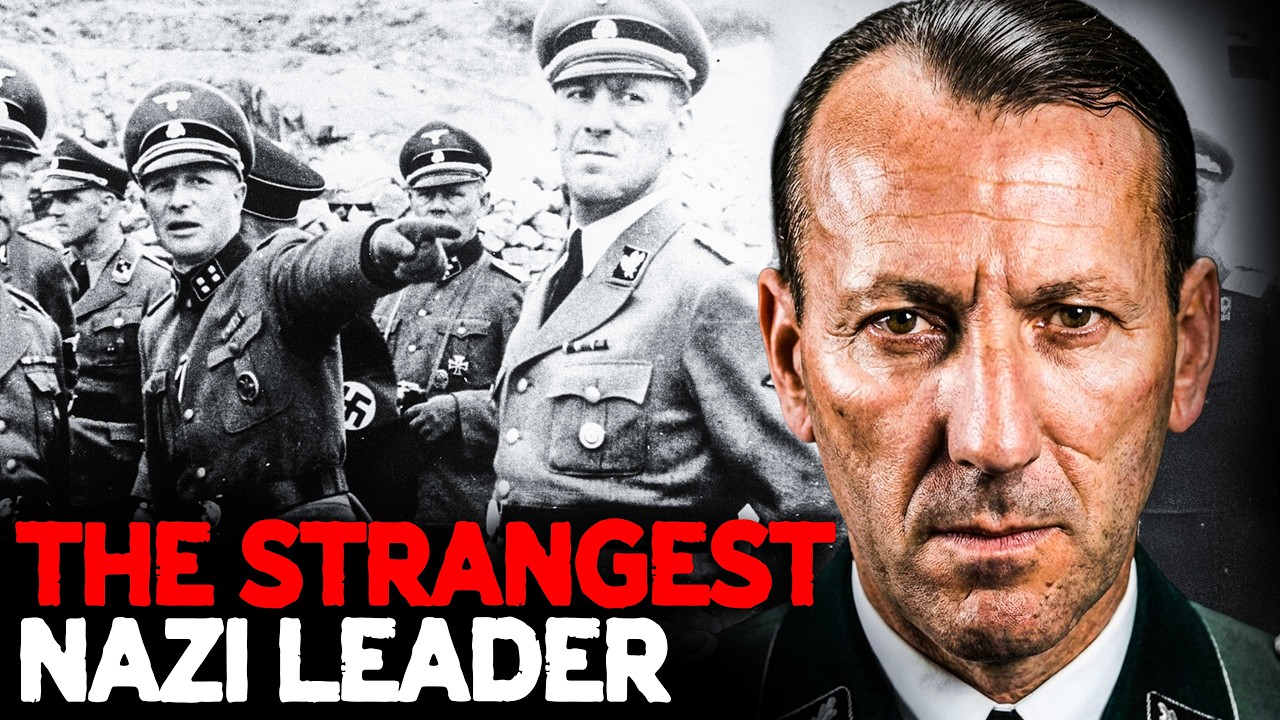
Ernst Kaltenbrunner was born on October 4, 1903, in Ried im Innkreis, a small Upper Austrian town near the Bavarian border. His family moved to Linz when he was a child, and he grew up in a household that was politically pan-German, anti-Catholic, and casually anti-Semitic in the way common among Austrian small-town professional circles before the First World War. He studied chemistry briefly at Graz, then switched to law and earned his doctorate in jurisprudence from the University of Graz in 1926. While there, he joined a dueling fraternity of the pan-German nationalist type that still practiced ritualized saber combat, in which young men stood face-to-face and accepted controlled cuts to the head as marks of honor.
The scars on his face for the rest of his life were not war wounds. They were the deliberate badges of a student culture that prized physical disfigurement as a sign of character. By the late 1920s he was practicing as a junior advocate in Linz, the same Austrian city where a failed schoolboy named Adolf Hitler had spent part of his youth. Kaltenbrunner joined the Austrian Nazi Party in October 1930 and the SS in August 1931, when both organizations were politically marginal and would soon become illegal in Austria, association with them carrying real professional risk for a young lawyer.
He was arrested twice by Austrian authorities in the mid-1930s, once on suspicion of high treason in connection with the failed July Putsch of 1934 that killed Chancellor Engelbert Dollfuss, and again in May 1935 for conspiracy. The treason charge collapsed for lack of evidence. The second arrest cost him a six-month prison sentence and the temporary suspension of his right to practice law. By the time of the Anschluss in March 1938, he was the senior SS officer in Austria, holding the rank of Brigadeführer.
Within days of Germany’s annexation of his homeland, he was promoted to Higher SS and Police Leader for the Austrian region, the senior security position in his home country, a post he held until his appointment to the Reich Security Main Office five years later. That origin mattered. Every other man who ran the RSHA had been a Reich German pulled from the cultural and bureaucratic core of the Nazi movement. Kaltenbrunner was Austrian, provincial, and trained in a legal system the Reich had only just absorbed.
The contrast with his predecessors was impossible to ignore. Heinrich Himmler had built the SS from a few hundred bodyguards into a state within a state, embodying the regime’s racial mysticism, the pseudo-medieval rituals at Wewelsburg Castle, the obsession with breeding registries and runic insignia. He was a vegetarian fanatic who agonized over the moral cost of mass shootings on the men doing the shooting and nearly fainted when he watched a single execution at Minsk in August 1941. Reinhard Heydrich, the man Kaltenbrunner replaced, was a former naval officer cashiered for breaking a marriage promise, a competitive fencer, an amateur violinist, a man so aligned with the racial ideal the SS was selling that Hitler reportedly called him the man with the iron heart.
Heydrich designed the architecture of the Holocaust at the Wannsee Conference on January 20, 1942, and gave his name to the operation that murdered roughly 1. 7 million Polish Jews. Adolf Eichmann, the desk officer who ran the deportation timetables, was a meticulous mid-level bureaucrat who never personally pulled a trigger and made his career out of the efficiency of paperwork. Each of those men fit a recognizable type: the mystic fanatic, the polished predator, the gray functionary.
None of them looked like Ernst Kaltenbrunner. Heydrich was assassinated by Czech and Slovak commandos in Prague on May 27, 1942, and died of his wounds on June 4. The RSHA, the most powerful single security apparatus on earth at that moment, sat without a permanent chief for almost seven months. Himmler ran it himself in the interim and quickly discovered he had neither the time nor the temperament to keep doing so.
The job description was unambiguous. It required a man who would not threaten Himmler personally, who would not be too clever or too charismatic, who would not develop a power base inside Berlin, and who would do what he was told. On January 30, 1943, the tenth anniversary of Hitler’s appointment as Chancellor, Himmler named Ernst Kaltenbrunner chief of the RSHA. At 39 years old, the Austrian lawyer now controlled the Gestapo, the criminal police, the security service, the foreign intelligence service, and the entire administrative spine of Nazi mass murder.
He had built none of it. He inherited all of it. The SS had spent twelve years marketing an aesthetic so successfully that it survived the regime itself. The poster SS man was tall, blond, Nordic, athletically built, his uniform tailored, his bearing rigid.
Heydrich was that man almost on purpose. Kaltenbrunner was the precise opposite. He was unusually tall, but enormous rather than elegant, with a heavy frame, narrow shoulders for his height, and a face contemporary witnesses described as menacing in a way that had nothing to do with intelligence. American journalists who saw him in custody after the war described his face as brutal and sinister, the kind of face the propaganda machinery would never have used.
Robert Jackson, the chief American prosecutor at Nuremberg, would later describe him in court as the man who looked the part of an executioner. In 1943, that face became the SS. The drinking was the next contradiction. Himmler was a notorious Puritan about alcohol among senior SS officers, a teetotaler who promoted abstinence and physical discipline as part of the order’s pseudo-monastic self-image.
Heydrich had been a controlled, calculating drinker who used alcohol socially and never sloppily. Kaltenbrunner drank like a man trying to fall down. Multiple postwar testimonies from junior officers and visitors to the RSHA building on Prinz-Albrecht-Straße described him arriving at work already drunk, conducting meetings with cognac on his desk, and being physically supported by aides at official functions. For the chief of the most important security apparatus in the most ideologically self-disciplined regime in modern Europe to be a visible alcoholic was a structural absurdity.
It made sense only if one understood that Himmler had appointed him precisely because he was not going to outshine anyone. The darkest part of the story is where the picture stops being merely strange and becomes actively damning. Every previous chief of the SS terror apparatus had built himself a layer of professional and physical distance from the killing. Himmler issued the orders but, after the fainting incident at Minsk, almost never returned to a site of mass murder if he could avoid it.
He preferred maps, reports, and statistics. Heydrich coordinated the Wannsee Conference and drew up the timetables, but the physical work of extermination was done by Einsatzgruppen commanders and camp commandants. Eichmann’s distance was even more elaborate. He arranged the trains and could later argue with a straight face at his trial in Jerusalem that he had never personally murdered anyone.
Kaltenbrunner did not construct that distance. He traveled to the camps. He went to Mauthausen in his native Upper Austria on multiple documented occasions during his tenure as RSHA chief. Mauthausen and its subcamp Gusen were classified by the SS itself as the harshest camps in the entire system, the only ones assigned to stage three, reserved for prisoners deemed beyond rehabilitation.
They killed roughly half of the more than 190,000 prisoners who passed through them, somewhere between 90,000 and 120,000 deaths. Witness testimony introduced at Nuremberg, including statements from survivor Alois Holleriegel and from Mauthausen prisoner functionaries, placed Kaltenbrunner inside the camp watching executions. The most disturbing of these accounts described him personally observing demonstrations of three different methods of killing in the same visit: a hanging, a shooting, and gassing. The historian Peter Black, whose 1984 study of Kaltenbrunner remains the standard scholarly biography, concluded that the Austrian was directly responsible through signature, instruction, or knowing oversight for the murder of hundreds of thousands of people during his two years and four months as chief of the RSHA.
That was the shortest tenure of any of the men who ran the inner apparatus of Nazi terror, and one of the deadliest. Every other senior Nazi who was vetted for a job at the top of the SS had come with some claim to internal legitimacy. They had been old fighters before 1933, had been seen at Nuremberg rallies in the early years, had built personal followings inside the party. Kaltenbrunner had almost none of that.
His pre-1938 work had been confined to Austria, where the Nazi party was an illegal organization that mainstream Reich figures regarded as provincial and slightly disreputable. He had no Berlin power base, no patrons inside the old guard. He owed his entire career to Himmler, and Himmler knew it. The historian Richard Breitman has noted that Kaltenbrunner’s appointment was less a promotion than a containment, a way for Himmler to retain real control of the RSHA through a chief who lacked the standing to challenge him.
The provincial lawyer with the broken jaw was useful precisely because he could not become Heydrich. Except that within a year of his appointment, Kaltenbrunner had developed a direct line to Hitler that Himmler had not anticipated. From 1943 onward, he was authorized to deliver intelligence briefings personally to the Führer at the Wolfsschanze, the Eastern Field Headquarters in Rastenburg. Those briefings gave him a privileged channel into Hitler’s daily decision-making that bypassed Himmler entirely.
The careerist chosen for his harmlessness was quietly accumulating influence by being the person who walked into the bunker with the latest cables. After the failed bomb plot of July 20, 1944, when Colonel Claus von Stauffenberg’s attempt on Hitler’s life nearly succeeded, it was the RSHA under Kaltenbrunner that ran the investigation. Roughly 7,000 people were arrested. Almost 5,000 were executed.
Kaltenbrunner personally interrogated several of the conspirators and wrote daily reports to Hitler summarizing what was being extracted. Those reports, recovered by the Allies after the war and known to historians as the Kaltenbrunner reports, are one of the primary documentary sources for what the Reich Security Apparatus did to the families and associates of the men who tried to kill Hitler. From late 1944 onward, as the Eastern Front collapsed and the Allies broke into Germany from the west, Kaltenbrunner ran his own quiet back-channel attempts at negotiation with the Western powers, largely independent of Himmler’s similar efforts. He used Wilhelm Höttl, the SD officer who headed Austrian foreign intelligence within RSHA Section 6, as an intermediary to American intelligence contacts in Switzerland.
His people probed the Hungarian channel through which Eichmann’s deputy had been negotiating with Jewish organizations, and they trailed behind SS General Karl Wolff’s negotiations with Allen Dulles under what became known as Operation Sunrise. None of these approaches succeeded. The Western Allies had already committed at Casablanca in January 1943 to a policy of unconditional surrender. But the fact that he tried, and that he did so behind Himmler’s back, was its own evidence of what kind of man he had become.
The instrument had developed independent motion. It did him no good. Kaltenbrunner did not kill himself. He did not negotiate.
He fled to the Austrian Alps, where he had spent his childhood, and was captured on May 12, 1945, by an American patrol from the 80th Infantry Division at a remote hut on the Wildensee, high in the Totesgebirge range above Altaussee. He was carrying false papers identifying him as a doctor. He was thoroughly drunk at the time of capture and denied his own identity until a former concierge from Vienna walked into the room and recognized him on sight. At Nuremberg, where he was the highest-ranking surviving member of the SS, he denied everything.
Not the existence of the camps, not the death tolls, not the broad outlines of the Holocaust. Those were established by the prosecution and documentation he could not contest. What he denied was his own personal authority. He claimed the RSHA had been a foreign intelligence operation, that the camps had been under Himmler’s personal command and outside his jurisdiction, that the deportations had been Eichmann’s responsibility, that the Bullet Decree had not crossed his desk, that the visits to Mauthausen had been routine inspections.
He claimed not to remember signing documents that bore his unmistakable signature. He was the only major defendant who attempted a flat denial of his own role, and he attempted it on a record that included his own signed correspondence with Eichmann, with the camp inspectorate, and with Himmler himself. On October 1, 1946, the International Military Tribunal found Kaltenbrunner guilty of war crimes and crimes against humanity. He was acquitted on the conspiracy and crimes against peace charges on the technical grounds that he had taken office too late to be part of the original planning.
The sentence was death by hanging. He was the only chief of the entire Nazi security apparatus across the twelve years of the regime to receive that verdict from a court. Himmler was dead. Heydrich was dead.
Müller was missing. Eichmann was still hiding in Austria and would not be brought to trial in Jerusalem until 1961. Kaltenbrunner, the late arrival, the careerist, the provincial Austrian who had never been the symbol of anything, was the face the world finally got to convict. He was hanged at Nuremberg in the early hours of October 16, 1946, alongside nine other defendants.
His last recorded words were a complaint that he had served his people loyally. He was the eighth man on the gallows that night. The trapdoor dropped at 1:12 in the morning. He was 43 years old.
His body, like those of the other executed defendants, was cremated at the cemetery in East Munich that same morning, and the ashes scattered in the Isar River to prevent the creation of any memorial. The propaganda image of the SS had been a marketing exercise from the beginning. The actual machinery of Nazi terror did not need a fanatic at its head to keep functioning. It did not need a polished aristocrat.
It did not need a true believer at all. What it needed, by 1943, was someone willing to absorb the close-range work and produce the daily output. The organization did not collapse when Heydrich was killed. It did not lose efficiency when his replacement turned out to be a drunken provincial lawyer with a face the posters would not have used.
It kept killing at scale until it was physically dismantled by the armies of three other countries. Kaltenbrunner was the proof of that. He was not the architect. He was not the visionary.
He was not the iron heart. He was the man Himmler picked precisely because none of those things were necessary for the work to continue. And the work did continue, and the work killed somewhere between two and three hundred thousand additional people during his short tenure at the top of it.