On the evening of June 19, 1944, an officer on the Japanese carrier Zuikaku sat at a small desk under a bare light. He opened the operations log and wrote a single number: 35 serviceable aircraft. That morning, Vice Admiral Jisaburo Ozawa’s First Mobile Fleet had launched with 430 planes. The officer closed the log.
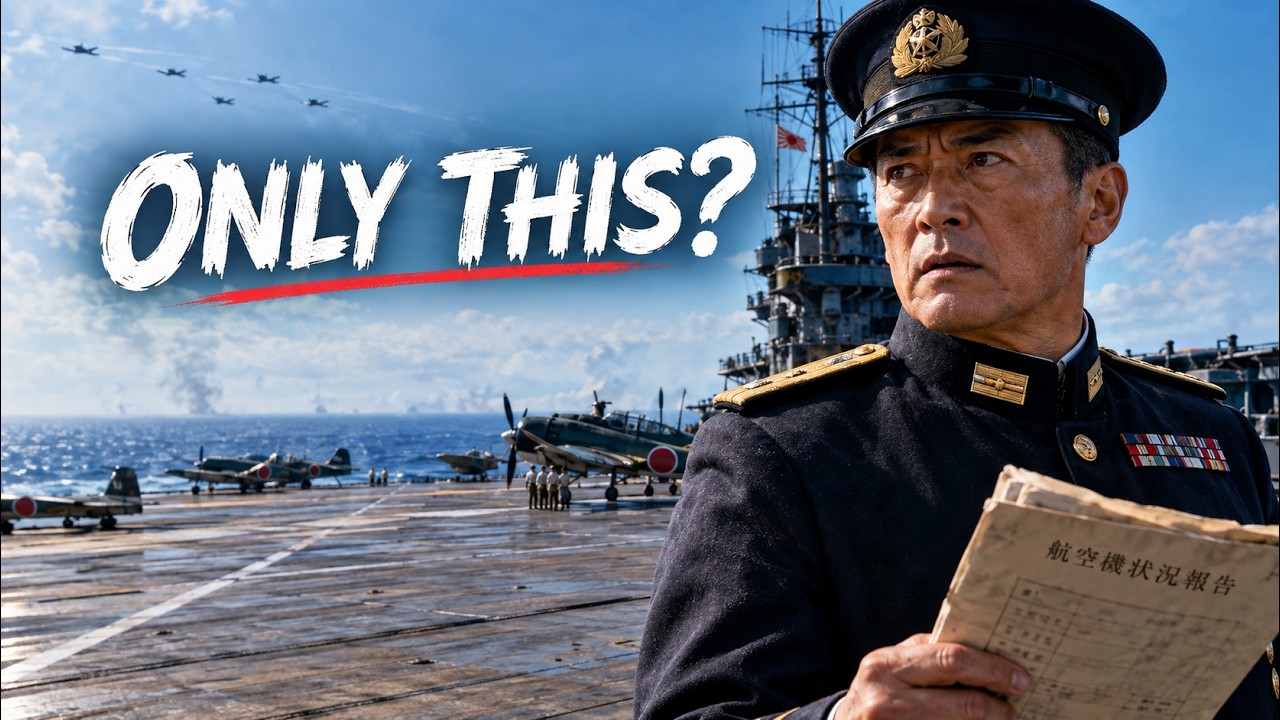
He did not know that his flagship, the new carrier Taiho, was already at the bottom of the Philippine Sea. He did not know that Shokaku, the veteran that had struck Pearl Harbor, lay beside her. He did not know that his pilots’ triumphant reports of sinking American carriers were utterly false. He knew only the number in his hand.
The story of how a fleet sails into battle with 430 aircraft and returns with 35 does not begin in the Philippine Sea. It begins three months earlier, on the night of March 31, 1944, when two four-engine Kawanishi flying boats lifted off from the black waters of Palau. They climbed west into the darkness toward Davao. American carrier strikes had just ravaged the anchorage, and the order to evacuate had come in haste.
In the lead aircraft sat Admiral Mineichi Koga, commander-in-chief of the Imperial Japanese Navy’s Combined Fleet. His predecessor, Isoroku Yamamoto, architect of Pearl Harbor, had been shot down over Bougainville in April 1943. On the runway at Palau, Koga told his chief of staff that Yamamoto had died at the right time. Then he added: “Let us die together.
” They shook hands and boarded separate planes, as protocol demanded. An hour into the flight, the aircraft entered a violent storm. Koga’s plane vanished without a trace into the South China Sea. Tokyo kept the disappearance secret for weeks.
The second plane, carrying Chief of Staff Shigeru Fukudome, went off course. Its engines failing, it crashed into the sea a mile off the coast of Cebu shortly after two in the morning on April 1. Ten men, including Fukudome, escaped the wreckage. The plane sank.
The red leather briefcase on his lap floated away on the current. Inside it was Combined Fleet Secret Operations Order No. 73: the entire strategic framework for Japan’s decisive battle. Philippine guerrilla fighters captured Fukudome on the beach.
At dawn, a fisherman named Pedro Gantiongco saw something red bobbing in the shallows. He waded in and took it. He could not read Japanese, but he knew the empire would be searching for it. Within days, Japanese occupation forces were burning villages and executing civilians in desperation to recover it.
Gantiongco dried the pages on clean cotton cloth, wrapped them in oilcloth, buried them beside his home, and sent word through the resistance to Lieutenant Colonel James Cushing, a 36-year-old American mining engineer who had spent two and a half years in the Cebu jungle leading Filipino irregulars. Cushing faced an impossible dilemma. He could not keep the admiral without provoking more massacres, and he could not risk the briefcase. He separated them.
He returned Fukudome to the Japanese in exchange for a promise to stop the killings. He sent the documents by submarine to MacArthur’s translation unit in Brisbane. Within days, the pages were copied, translated, and distributed. Admiral Chester Nimitz read them in Honolulu.
Admiral Ernest King read them in Washington. Every fleet commander in the Pacific read them. The Nisei translators, second-generation Japanese-Americans whose families sat in internment camps at that very moment, translated the plan that would decide the Pacific war for the nation that had imprisoned their fathers. The new commander of the Combined Fleet, Admiral Soemu Toyoda, issued Operation A-Go in early May.
His signal read: “The fate of the empire rests on this battle. ” He was right, but he was wrong about almost everything else. The man who would actually fight the battle stood on the bridge of the Taiho, watching his fleet assemble in the anchorage at Tawitawi. Vice Admiral Jisaburo Ozawa, at 57, was the most respected carrier commander in the Imperial Navy.
He had pioneered the doctrine of concentrating carrier air power. He had made Pearl Harbor possible. He now commanded nine carriers and roughly 450 aircraft. On paper, a formidable force.
But his pilots were boys. The veterans of Midway, Santa Cruz, and the Solomon Islands were gone. The new pilots had, in many cases, fewer than 200 flying hours. Some had flown their assigned aircraft only a few times.
American submarine surveillance of Tawitawi made even basic training impossible. Ozawa canceled all further exercises. His pilots would fight the largest carrier battle in history without any training. The American pilots they faced had at least 300 hours.
Many had 500. Their squadron leaders had a thousand. They were hardened by Midway, the Coral Sea, Guadalcanal, and Truk. Ozawa had one ace in the hole.
He believed nearly 500 land-based aircraft waited at airfields on Saipan, Tinian, Guam, and Rota. He planned to strike the American fleet from beyond the range of their fighters, his planes hitting after the land-based waves softened the defenses. It was a sound plan, except the land-based aircraft did not exist. American carrier raids had destroyed nearly 200 of them.
The airfields were rubble. The commander in the Marianas, Vice Admiral Kakuji Kakuta, did not tell Ozawa the truth. Honest reports would end careers. He sent signals describing aircraft that were no longer there.
On June 6, 1944, as the greatest naval invasion in history crawled toward the beaches of Normandy, Vice Admiral Marc Mitscher gave the order. Task Force 58 sortied from Majuro: 15 carriers, 7 battleships, 21 cruisers, 69 destroyers, and roughly a thousand aircraft. The men aboard knew what was coming. Mitscher, a 57-year-old with sun-cracked skin and a crumpled cap, wanted this battle.
He had wanted it for two years. But Admiral Raymond Spruance, commanding the Fifth Fleet, had different priorities. The Marines were landing on Saipan on June 15. The beaches had to be protected.
Spruance refused to chase the Japanese fleet west. His pilots were furious. They privately accused him of squandering the greatest opportunity of the Pacific war. Some would accuse him openly for the rest of their lives.
Spruance, reading intelligence summaries like a chess player studying a mid-game position, knew something his pilots did not. The Japanese had a doctrine of divided forces. If he rushed west, a second Japanese group could circle around and strike the invasion beaches. The Marines on Saipan would be slaughtered.
So he held his position. On the afternoon of June 18, Ozawa’s search planes found Task Force 58. Ozawa had the range advantage. He could strike from farther out than the American Hellcats could.
But his pilots could not land on carriers at night. They had not trained for it. To launch at dusk would condemn most of them to the sea. So he waited for dawn.
Every hour he waited, American fighter directors refined their plans. American radar operators watched their screens. At dawn on June 19, the sky over the Philippine Sea was clear to the horizon. Ozawa gave the order.
The first planes of the largest carrier battle in human history began their takeoff runs into a war already lost, a battle whose plan their enemy had already read. At 8:30 a. m. , on the deck of the USS Lexington, the radar operators saw a blip, then another, then a cluster.
One hundred fifty miles west, approaching. Throughout the task force, Hellcats moved into position on the flight decks. The F6F Hellcat was a massive machine: armored, self-sealing fuel tanks, six . 50-caliber guns in the wings.
More than 400 were already airborne or launching. The first strike from Ozawa’s second wave was lifting off the Taiho when a young petty officer named Sakio Komatsu, 22 years old, took off and looked down. He saw a wake, a straight white line cutting across the blue water, heading directly for the ship he had just left. A torpedo.
He pushed his stick forward, rolled his wings, and dived his Zero toward it. The torpedo exploded on his plane. He died in that instant. The torpedo had been aimed by the submarine USS Albacore, whose fire-control computer had failed.
Another torpedo from the same spread hit the Taiho directly. The forward elevator jammed half-open. Avgas began leaking from a torn tank into the elevator well. The damage appeared manageable.
The ship still made 26 knots. The flight deck still worked. The remaining aircraft launched without incident. Ozawa was told the ship was not in immediate danger.
He returned to the battle. Below decks, a young lieutenant faced a problem he had never trained for. Fuel vapors were accumulating in the hangar. The Japanese fleet was being supplied with unrefined crude oil from Tarakan in Borneo, which vaporized explosively at room temperature.
He ordered the ventilation system opened fully. It did its job perfectly. It drew the explosive vapors out of the tight space near the elevator and distributed them evenly throughout the entire ship. Every compartment on the Taiho was now saturated with flammable gas.
The ship was a bomb waiting for a spark. Far to the east, the second strike of 128 aircraft, the largest coordinated air strike Japan would ever launch in the Pacific war, flew toward an American picket line. A catastrophic error occurred. The anti-aircraft gunners on the Japanese cruisers and battleships had not been informed of the timing of their own strikes.
They fired on their own aircraft. Two planes exploded. Eight more were so badly damaged they turned back. Ten aircraft gone before ever reaching the enemy.
At 11:07 a. m. , the strike met the American combat air patrol. The pattern repeated across the sky.
Formations of Japanese planes arrived to find hundreds of Hellcats waiting at altitude. The fighter direction was near-perfect. Every incoming raid was tracked, plotted, and directed long before it came within 100 miles. The planes that broke through the fighters flew into anti-aircraft fire from ships using a new weapon, the VT proximity fuse, which detonated a shell when it passed within 70 feet of a solid object.
It had been classified above top secret. Planes exploded without being directly hit. Formations dissolved. By early afternoon, the third and fourth strikes launched.
The third, 47 planes, never found the American fleet. The fourth, 82 planes, got lost, scattered, and drifted south. Some tried to land at Guam. Hellcats were waiting.
Sixty of 82 were shot down before touching a runway. Beneath the surface, the submarine USS Cavalla, on her first war patrol, had been tracking Japanese carriers by propeller noise all morning. Just before noon, Commander Herman Kossler raised his periscope and found himself looking at the Shokaku. He fired six torpedoes.
Four hit. Shokaku, veteran of Pearl Harbor, the Coral Sea, and Santa Cruz, burst into flames immediately. The fire reached the avgas stores, then the bomb magazines. At a little after two in the afternoon, the magazine exploded with enough force to tear off the forward third of the ship.
She slid beneath the surface. Twelve hundred seventy-two men died with her. Ozawa continued to receive reports. His surviving pilots told him he had won.
They reported multiple American carriers hit. Explosions on flight decks. Enemy ships burning, stopped, sinking. They believed it.
They had seen fires. They had seen planes falling. The two American carriers that had actually been damaged that day, Wasp and Bunker Hill, had suffered near-misses and minor damage. Both returned to full operation by evening.
At 2:32 p. m. , aboard the Taiho, a spark from an electric generator on the hangar deck touched the fuel vapors. She did not explode all at once but in a rolling wave, each compartment igniting the next.
The armored flight deck turned the ship into a pressure cooker. Ozawa himself was thrown against a bulkhead. The captain begged him to transfer his flag. Ozawa refused at first, then was convinced.
He was transferred to the heavy cruiser Haguro, and later to the Zuikaku. The Taiho sank at 4:28 p. m. with 1,650 men.
Sakio Komatsu, whose sacrifice was meant to save her, lay in the wreckage, his plane dust, the torpedo he stopped having killed him without saving anything. Ozawa, transferring his flag through the smoke, still did not know what kind of day it had been. He planned to refuel and attack again in the morning. He believed his missing planes were in Guam.
They were mostly in the water. On the Zuikaku, an officer opened the operations log and made the count. Thirty-five serviceable aircraft from the 430 that had launched at dawn. He wrote the number without thinking of history.
He was thinking of fuel and ammunition and pilot rest schedules. The carrier air arm of the Imperial Japanese Navy, the force that struck Pearl Harbor, had ceased to exist as a fighting instrument in a matter of hours. Ozawa on the Zuikaku’s bridge was planning pursuit. He was planning a counterattack.
He was convinced he still had a fleet. The truth came with the dawn: 226 American aircraft from the east, with Marc Mitscher, the man who had waited three years for this moment, leading them. At 3:40 p. m.
on June 20, a search plane found Ozawa’s fleet. Mitscher looked at the chart. He looked at the clock. The Japanese fleet was very far away, 275 miles.
His planes could reach them. Some would not make it back. The sun would set in 75 minutes. The moon would not rise until midnight.
Recovery would be in total darkness over open ocean. Mitscher turned to his chief of staff, Captain Arleigh Burke, and said two words: “Launch them. ”
The order went out at 4:10 p. m.
The pilots knew exactly what they were flying into. They launched anyway, 226 planes of the afternoon Pacific light, climbing west over wakes they might never see again. The strike arrived just before sunset. In the twenty-minute battle, 65 Japanese planes were shot down.
Avengers from Belleau Wood found the carrier Hiyo. Two torpedoes hit her starboard side. The avgas leaked, the vapors accumulated and ignited, and the pattern that had killed the Taiho repeated. Hiyo burned for two hours, then capsized and sank.
Two hundred fifty men died. The American strike turned east into the night. The moon was gone. The horizon vanished.
The sea and sky became one black wall. Radio discipline began to break. Voices came over the emergency channel from every direction. Some were calm.
Some were not. On the Lexington’s bridge, Marc Mitscher listened. Then he turned to Burke. “Turn on the lights.
” The order went out to every ship in the task force. Navigation lights. Flight deck lights. Searchlights.
Everything. Destroyers fired star shells into the sky. The fleet lit itself up in the middle of the Philippine Sea, exposing itself to any Japanese submarine within 30 miles. It violated every principle of naval self-preservation.
Marc Mitscher, at the end of a long day, decided he would rather lose a ship than lose his pilots. The pilots above saw it happen. The ocean went from pitch black to blazing light. Ships looked like small burning cities on the sea.
One pilot said later it was the most beautiful thing he had ever seen. The planes began to land. Some landed on the wrong carriers. Some tried to land on cruisers.
One pilot ran out of fuel on final approach and glided his last quarter mile onto a carrier that was not his. Eighty planes were lost that night, not to Japanese guns, not to the darkness, but to the choice Mitscher had made when he gave the order at 4:10 p. m. By dawn of June 21, all but 49 of the downed crews had been recovered.
The Japanese fleet was gone. Ozawa had ordered the night withdrawal. He had finally accepted that there would be no counterattack. He offered his resignation.
It was refused. The navy could not spare its most experienced carrier commander. The final tallies took weeks. The Imperial Japanese Navy lost three carriers.
Roughly 3,000 sailors and pilots died. Between 550 and 600 aircraft were lost, by whatever method of counting. American losses were 125 aircraft and 109 men, more than half lost on that dark night. The kill ratio on June 19 alone was roughly 12 to 1.
Commander Masatake Okumiya, the staff officer who had been recording reports on the bridge, would later write that the Japanese pilots never had a chance to survive. Undertrained men in fragile aircraft, executing a plan whose foundation had collapsed and whose strategy their enemy had already read, against radar-directed defenses and proximity-fused anti-aircraft fire. They were not defeated in combat. They were outbuilt, outtrained, and outmaneuvered before they ever left the ground.
The political consequences came quickly. Saipan fell on July 9. Prime Minister Hideki Tojo’s government fell on July 18. He was later tried as a war criminal and executed.
B-29 Superfortresses began arriving in the Marianas in late November. They flew north over Japan for seven months. Tokyo was firebombed on the night of March 9, 1945. One hundred thousand people died in a single night.
Nagoya, Osaka, Kobe, and Yokohama burned. On August 6, 1945, a B-29 named Enola Gay took off from a runway on Tinian, built on the site of a former Japanese airfield defended so fiercely in June 1944. At 8:15 a. m.
, she dropped a single bomb on Hiroshima. On September 2, aboard the USS Missouri in Tokyo Bay, Japan formally surrendered. The number 35 was never engraved on any monument. But the line from the operations log of June 19 to the suicide platforms off Samar on October 25 was straight.
When a carrier air arm can no longer face the American fleet on equal terms, and when a trained pilot in a good plane can no longer survive the engagement, the pilot does not have to survive. The plane becomes the weapon. The word for what they had become is known to every child in America: kamikaze. The dead are not recorded in the logbook.
They appear elsewhere. In the cemeteries of Hawaii and Manila. In the small stone gardens of Japanese villages that lost their sons. In the memories of men who carried that day with them for the rest of their lives.
After the war, someone asked Ozawa what he remembered. He answered only: “I remember the sound of the plane that never returned. ” Then he never spoke of it again.