Otto Carius was born on May 27, 1922, in Zweibrücken, in the Palatinate region of southwestern Germany. His father was a school teacher, a disciplined man who regarded the new armored branch of the Wehrmacht with open suspicion, dismissing tanks as metal death traps. His mother kept the household, and young Otto grew up in a modest, orderly middle-class home. He was drawn not to soldiering but to music, an accomplished cellist and pianist who might have pursued a career in the arts.
World War II broke out in September 1939, just as Carius was finishing his schooling. He tried to enlist twice, and twice he was turned away for being underweight, rejected as physically unfit for service. Finally, in May 1940, as German forces were smashing through France, Carius was accepted into the 104th Infantry Replacement Battalion. In the autumn of 1940, he volunteered for the Panzer branch, the armored core his father had so distrusted.
It was a decision that would define the rest of his life. By June 1941, Carius’s regiment was moved to East Prussia as part of the enormous build-up that culminated on June 22nd in Operation Barbarossa, the largest land invasion in human history. He went into Russia as a loader on a Panzer 38t, a light Czech-designed tank serving with Panzer Regiment 21, part of the 20th Panzer Division. On July 8th, 1941, in the fighting near Vitebsk, Carius was wounded, the first of a long litany of injuries.
Around the same time, his radio operator lost an arm in combat, a stark reminder that the men who fought inside these steel boxes were never as protected as their armor suggested. On August 1st, 1941, Carius was promoted to Unteroffizier and selected as an officer candidate. He was sent back to Germany to attend officer training. He failed the course on February 2nd, 1942, a setback that could have ended any hope of advancement.
He returned to the front near Gzhatsk and found his division nearly decimated by the ferocious fighting that followed the failure of the German advance on Moscow. For a time, he served in unglamorous roles, including managing an officers’ club in Paderborn. There, fortune intervened. He struck up a friendship with an officer who would go on to command the second company of the 502nd Heavy Tank Battalion, a unit being equipped with a revolutionary new weapon, the Tiger.
Armed with the devastating 88-mm gun and protected by frontal armor that could shrug off hits from most Soviet tank guns, the Tiger was slow and mechanically finicky, but nearly unstoppable when used correctly. For Carius, the chance to join a Tiger battalion was, in his own recollection, nothing short of a gift from heaven. The 502nd was one of the first units to receive the new Tiger tanks, deployed to the northern sector of the Eastern Front around Leningrad. By June 1943, Carius, now a lieutenant, had been given command of the second company.
The terrain around Leningrad was treacherous for tanks, a war of ambush and counter-ambush that demanded a very different kind of skill. By late 1943, the German position around Leningrad was crumbling. A Soviet offensive in January 1944 broke the siege and sent German forces reeling backward toward the pre-war Estonian border. Carius and his Tigers were thrown into the fighting along the Narva River, a stretch of front that German propaganda called the gateway to the Reich.
Field Marshal Walter Model personally arrived at the front in early February 1944 and gave Carius a blunt and almost impossible order: stop the Russian tanks without losing a single Tiger. On February 12th, Carius destroyed four Soviet tanks defending the bridgehead. Four days later, commanding just two Tigers, he moved to support a hard-pressed infantry commander whose positions were being overrun. It was exactly the kind of engagement the Tiger had been designed for: a small number of heavily armored vehicles used to blunt a much larger attacking force.
On March 17th, 1944, a massive Soviet artillery bombardment signaled a new offensive. Within two days, the headquarters area where Carius was stationed came under direct attack from six T-34 tanks. Carius and his crews fought off the assault. On March 19th, near a position called Lembitu, Soviet forces attempted to encircle German troops, and Carius’s Tigers knocked out several more T-34s.
On May 4th, 1944, at Pskov, Carius was awarded the Knight’s Cross of the Iron Cross in recognition of his actions in the Narva sector. A little over a month later, he received a personal letter of congratulation from General Heinz Guderian, the father of German armored warfare doctrine. By late June 1944, Carius was back with his unit. On July 2nd, the battalion was transported by rail to Daugavpils, a critical rail and road junction in Eastern Latvia.
The Tigers assembled on the southern bank of the Daugava River, bracing for a major confrontation as the Soviet summer offensive, Operation Bagration, threatened to unhinge the entire German position in the East. On July 20th, Carius reached the supply zone near a small village called Malinava. Two days later, as Carius and his close friend Albert Kerscher drove ahead of their company in a Kübelwagen, they found a mob of panicked German troops fleeing before the Soviet onslaught. From a ridge overlooking the village, Carius could make out Soviet T-34 tanks near the entrance, with more armor entering from the north.
Malinava was held by a substantial force, likely the advance guard of a full Soviet tank brigade, possibly numbering close to 20 armored vehicles, including some of the new IS-2 heavy tanks. Carius returned to his company and made a decision that would define his reputation as a tactician. He would attack with just two Tigers, his own and Kerscher’s, while the remaining six tanks held back in reserve. Speed, surprise, and the devastating accuracy of the 88-mm gun at close range would have to substitute for numbers.
What happened next unfolded, by Carius’s own account, in less than 20 minutes. The two Tigers drove directly into the village, catching the Soviet crews completely by surprise. The narrow streets became a killing ground, with engagements at ranges sometimes as short as a few dozen yards. Carius radioed that he had personally destroyed 17 Stalins and five T-34s.
Not a single German tank was lost in the fighting, though two Tigers were rendered temporarily inoperable. The after-action report filed by the battalion commander credits the Second Company with destroying 17 tanks in total, of which 10 were attributed to Carius and four to Kerscher. Soviet archival records suggest a similar overall figure, around 15 tanks lost near Malinava that day. The essential core of the story appears corroborated by evidence from both sides, though more embellished elements of Carius’s later telling proved far more difficult to substantiate, particularly his claim of a follow-on ambush east of the village in which he described destroying an entire column of 28 Soviet tanks.
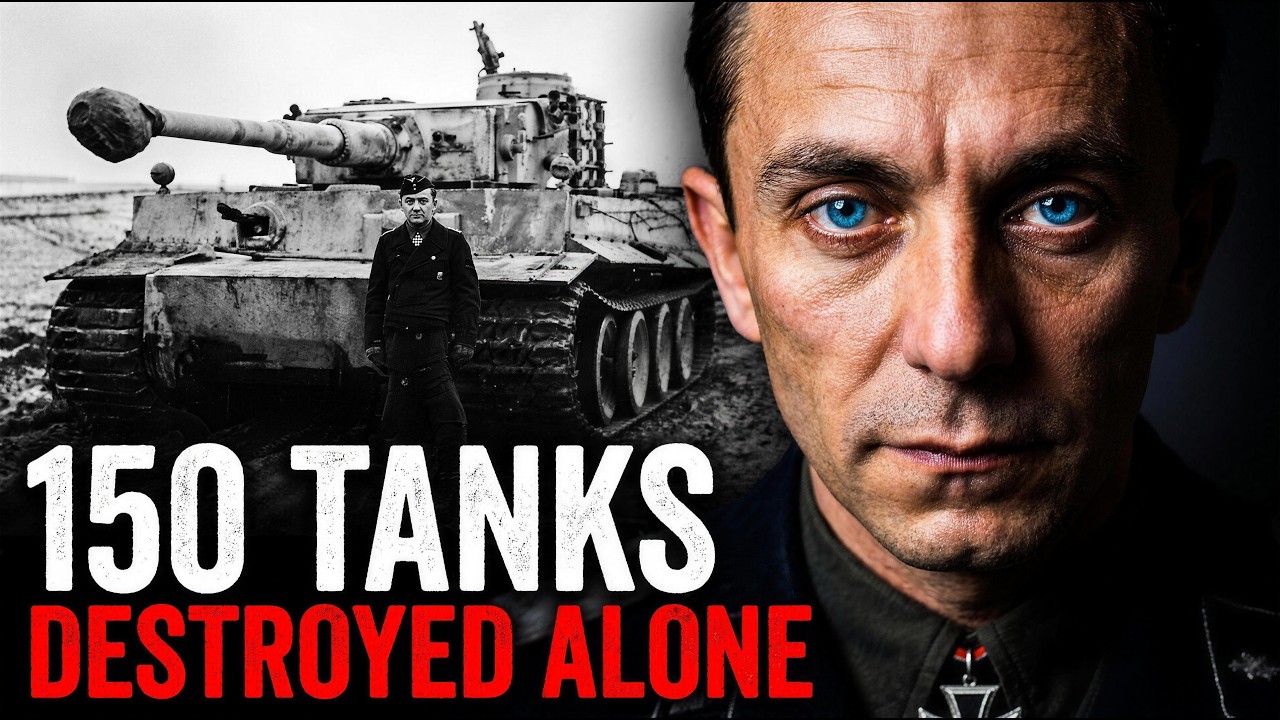
No German unit records beyond Carius’s own recollection appear to corroborate an ambush of that scale, and no Soviet tank unit seems to have recorded losing a formation of that size in a single engagement that day. Carius himself, in a later interview, revised his personal claim of over 150 destroyed tanks down to a figure closer to 100 or even fewer, explaining that he had never personally kept a precise count. On July 24th, 1944, just two days after Malinava, Carius set out ahead of his company on a motorcycle with sidecar to scout the road toward Daugavpils. He was ambushed by Soviet troops lying in wait along the roadside.
Carius was hit almost immediately, shot through the thigh, then struck again in the arm, and then four more times in the back as he lay exposed on the open ground. Three Soviet soldiers reached him, and one, an officer, drew his pistol and aimed it directly at Carius’s head. In that instant, Carius managed to turn his head, and the bullet meant to kill him struck him through the neck instead. He survived, conscious and feeling almost no pain in the shock flooding through his body.
Just as the soldiers prepared to finish him, the Tiger tanks of his own company, alerted to the ambush, came thundering onto the scene and scattered the Soviet troops, saving his life with only seconds to spare. He was rushed to a field hospital where, against considerable odds, he made a full recovery. On that very day, he was officially confirmed as company commander. While recovering aboard a ship crossing the Baltic, he received word of the Oak Leaves to his Knight’s Cross, awarded on July 27th, 1944.
While Carius convalesced through the late summer and autumn of 1944, the war continued its catastrophic collapse. Early in 1945, following his recovery, Carius was assigned as commander of a company within the newly formed 512th Heavy Anti-Tank Battalion, equipped with the Jagdtiger, the heaviest armored fighting vehicle to see service in the war. Carius was distinctly unimpressed. The Jagdtiger was extremely slow, mechanically unreliable, and lacked a rotating turret, a serious tactical limitation for a machine that size.
Carius later wrote candidly about his disappointment. His company was called into action in March 1945 without having completed its training. By early April, his unit had become trapped within the Ruhr Pocket, a massive encirclement in which some 300,000 German troops were surrounded by advancing American forces. On April 15th, 1945, the order came to cease all combat operations.
The following day, in the district of Iserlohn, Otto Carius was taken prisoner by the United States Army just three weeks before the war in Europe formally ended. He was released from captivity on May 21st, 1945, thirteen days after Germany’s formal surrender. Germany in the summer of 1945 was a landscape of ruins. At 23 years old, Carius had to reinvent himself from nothing.
He chose pharmacy. He completed preparatory examinations in the years immediately following the war, then enrolled to study pharmacy formally at the University of Freiburg. In 1956, Carius took over an existing pharmacy in the small village of Hirschweiler-Petersheim and renamed it the Tiger-Apotheke, a direct tribute to the tank that had defined the most consequential years of his life. He ran it for the next 55 years, retiring in 2011 at the age of 89.
In 1960, Carius published Tigers in the Mud, his memoir of wartime service. It became one of the most successful and widely read individual memoirs to emerge from the German side of the Second World War, eventually published in six editions across 17 languages. Among its more unexpected adaptations was a watercolor manga created by Hayao Miyazaki, later celebrated worldwide as the creative force behind Studio Ghibli. The reach of Carius’s legend extended into model kits, video games, and tabletop wargames.
The broader question of Carius’s legacy remains complicated. There is no evidence that he personally participated in war crimes, and his documented combat record consists overwhelmingly of tank battles against Soviet armored forces. But he fought for a regime responsible for the systematic murder of millions, and his units fought in direct cooperation with Waffen SS formations at Narva as a matter of routine tactical necessity. Carius himself generally avoided unrepentant nostalgia for the Nazi regime and offered his own deflationary reassessment of his tank kill count, a rare example of a celebrated wartime figure working to moderate his own legend rather than inflate it.
Otto Carius died on January 24th, 2015, in the same small village where he had spent nearly 60 years of his civilian life, at the age of 92. He was buried in the local cemetery, surrounded by his family and those closest to him from both his wartime and civilian lives. A quiet, dignified end for a man whose youth had been defined by some of the most violent combat of the entire Second World War, and whose far longer afterlife was defined by steady, unglamorous service to a small community.