For thirty-four years, the killer was a ghost. He committed what he believed was the perfect murder in 1988, then vanished into an ordinary life, working, building relationships, and hiding in plain sight. He was so confident his secret would never surface that he did the unthinkable: he taunted the police in writing, boasting of his crime. That single act of arrogance would unravel everything.
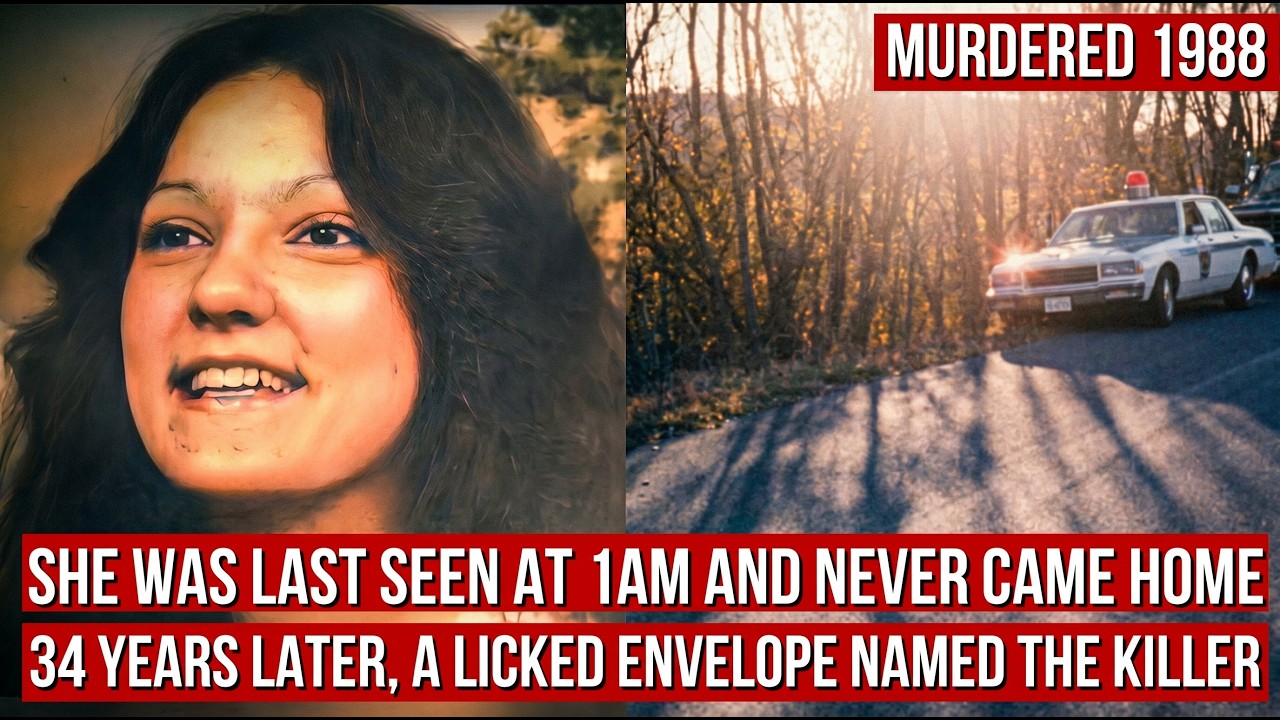
The story began on a cold autumn day, October 23, 1988, in the quiet rural community of Perry Township, Pennsylvania. Along a lonely stretch of Ontelaunee Trail Road, a passerby discovered the body of a young woman lying by the roadside. It was a brutal scene that would haunt the first investigators on the scene and shake the small town. The victim was identified as 26-year-old Anna Jean Kane, a young mother of three sons and a daughter who had been facing financial problems and had worked as a prostitute in nearby Reading.
Her lifestyle made her an easy target in the eyes of some, but the police treated her murder with the same seriousness as any other. To her family, she was not a headline. She was a beloved mother, daughter, and sister. The autopsy, conducted by forensic pathologist Dr.
Neil A. Hoffman, revealed that Anna had been savagely beaten and strangled to death. The killer had used a piece of baling twine, the thick rough cord used on farms for hay, tied so tightly around her neck that it left deep marks. The choice of weapon was a clue: it suggested someone familiar with rural life, farm equipment, or manual labor.
She had last been seen alive around 1:00 a. m. near the corner of Franklin and South 6th Streets in Reading. Her body was found about twelve hours later, meaning she had been killed overnight.
That window of time was all the killer needed to disappear. The Pennsylvania State Police immediately hit a wall. Anna’s transient life and high-risk work created a murky pool of potential suspects. There was a victim, a cause of death, and a crime scene, but no witnesses to the murder itself.
Days turned into weeks, and the trail went cold. The only hope lay in forensic science. In 1988, DNA technology was in its infancy, but the investigators had the foresight to meticulously collect and preserve Anna’s clothing. They bagged each item, logged it, and stored it in a climate-controlled evidence room, unaware that they were saving the key to a mystery that would take decades to solve.
From her clothing, analysts managed to pull a trace amount of DNA from an unknown man, a genetic fingerprint linking directly to the man who was with Anna in her final moments. When the FBI launched its CODIS database of convicted offenders in the 1990s, investigators ran the unknown profile through the system, hoping for a match. The result was crushing: no match. The suspect had never been arrested or convicted of a serious crime.
He was living off the grid of the very system designed to catch men like him. As the years passed, the case went cold. Investigators retired, new cases took priority, and the file collected dust. For Anna’s children, the silence was deafening.
They grew up under the shadow of their mother’s unsolved murder, unable to fully mourn because they had no closure. Then, in February of 1990, the local newspaper, the Reading Eagle, published a front-page story about the case, asking for any new information. A letter arrived at the newspaper’s office, written by someone claiming to be a concerned citizen who just wanted to help. But as the staff, and soon the police, read it, they realized this was no ordinary tip.
The letter was filled with intimate, disturbing details about the murder that had never been made public. The writer described the position of the body, the type of cord used, and the condition of her clothing, facts that had been deliberately withheld from the press. The tone was not guilty or remorseful. It was arrogant.
The writer was taunting the police, flaunting his freedom and intelligence. He had seen the newspaper article, and his ego could not resist injecting himself back into the story. For investigators, the letter was a bombshell. And in his arrogance, the writer made a fatal mistake: he had licked the envelope to seal it.
Investigators swabbed the flap and sent it off for DNA analysis. The question was whether the DNA on the envelope would match the DNA found on Anna’s clothing. The answer came back: a perfect match. The man who licked that envelope was, without a doubt, the same man who killed Anna Kane.
They had his words, his DNA, his psychological profile. But they still did not have his name. The new DNA profile was run through CODIS again, and again there was nothing. The ghost had reached out, only to vanish back into the darkness.
The letter sat in a box for over three decades, waiting for technology to catch up. As the 1990s turned into the 2000s, the case remained stubbornly frozen in time. The evidence was safe, but the link connecting it to a person was missing. The killer lived his life, grew older, worked, had neighbors, and maybe even a family of his own.
He must have felt completely safe, believing his secret was buried forever. Then came 2022. Forensic science had a revolutionary new tool: investigative genetic genealogy. Instead of looking for a direct match to the killer, it looks for a match to any of his relatives who have voluntarily uploaded their DNA to public genealogy websites.
It can find second, third, even fourth cousins, anyone who shares a piece of DNA with the suspect. The Pennsylvania State Police, using a new grant for cold cases, partnered with Parabon NanoLabs. Parabon’s genealogists took the killer’s DNA and uploaded it to public genealogy sites. For the first time in 34 years, they got a hit, not on the killer, but on his relatives.
From there, genealogists started building a massive family tree in reverse. Starting with distant cousins, they traced ancestry backwards for generations to find a common ancestor. Using census records, obituaries, birth certificates, and old newspaper clippings, they built the tree forward, identifying every single descendant. Slowly but surely, they narrowed down the possibilities, focusing on one family line with deep roots in the Berks County area, the same area where Anna was killed.
The tree finally funneled down to one name that had never once appeared in the case file: Scott Grimm. At the time of Anna’s murder, Scott Grimm was 26 years old, the same age as his victim. He was from the Hamburg area and lived around Reading, putting him in the same geographical area as Anna. Yet his name never came up.
Neighbors described him as quiet, maybe a little odd, but nothing that raised alarm. He worked regular jobs, paid his taxes, and kept to himself. But there was a major twist: Scott Grimm had died in 2018 of natural causes at the age of 58. The ghost they had been hunting for over three decades was already dead.
There would be no courtroom, no trial, and no jury. Police still needed to be certain. They obtained a direct sample of Grimm’s DNA and dug into his past, where they found one final damning piece of the puzzle. In 2002, twelve years after he sent the taunting letter about Anna’s murder, Grimm had been arrested for harassing a former business partner.
How did he harass them? By mailing threatening letters. Police in that case had collected the envelopes Grimm had licked shut. That case file had sat in a different evidence room for twenty years, unconnected to the Anna Kane investigation until now.
The Pennsylvania State Police lab compared four sources of DNA: the DNA from Anna’s clothing in 1988, the saliva from the taunting letter in 1990, the direct sample of Scott Grimm’s DNA, and the saliva from the 2002 harassment letters. The results came back: a perfect match across all four samples. Scott Grimm was the killer. After 34 years, the ghost had a name, and the case was finally closed.
The chain of evidence was unbreakable, forged by a killer’s own arrogance and solidified by a science he could never have seen coming. For Anna’s family, the news in 2022 was a flood of emotions. Relief, yes, but also grief renewed. They had spent decades imagining the man who took their mother, wondering if he was still out there.
To learn his name and see his face brought a strange kind of peace. They held a private memorial, finally able to say they knew who did this. While they could not confront him in court, they took solace in the fact that he died knowing what he had done, even if the world did not. As one family member put it, the truth was always going to come out.
It just took longer than they hoped. As Berks County District Attorney John Adams said, the solution brought a measure of closure, even if a trial was impossible. It was not the day in court the family hoped for, but it was an answer, an end to the not knowing. He reminded everyone that no case is truly cold as long as the evidence is preserved.
For Anna’s three children, identifying Scott Grimm finally allowed them to close a deeply painful chapter of their lives. They could now remember her for who she was, a mother who loved them, a young woman whose life had value and was tragically cut short. Scott Grimm thought he had committed the perfect murder, but he made one mistake. He underestimated the persistence of a family’s love, the dedication of law enforcement, and the relentless march of science.
It was his own arrogant words and the DNA he left on an envelope that made sure that even after three decades, the truth would finally come out.