In the winter of 1887, the town of Haraford, Kentucky, buried three men in a single week. The influenza had been hard that year, but even the undertaker admitted it was unusual to lose them so close together, especially since two of them were regular patients of Dr. Elias Harrow. By all accounts, Harrow was a respected figure in the county, tall, broad-shouldered, precise in speech, and known for keeping meticulous records in his patient ledger.
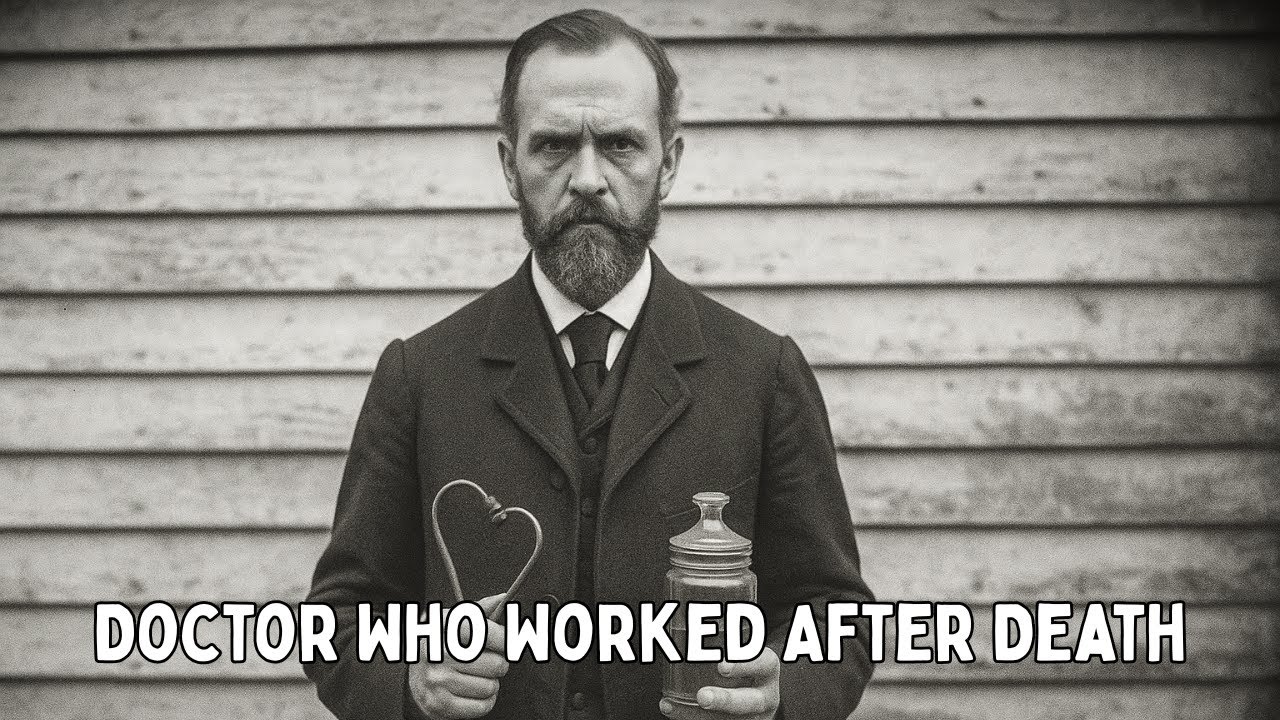
It was in that ledger, weeks later, that the first contradiction appeared. Beside the name of one of the deceased, William A. Cobb, Harrow had written in his neat, slanted hand, “Next appointment, February 14th. ” Cobb had been in the ground since January 28th.
The ledger was not a rough draft. It was a bound volume kept in Harrow’s locked desk, its pages numbered in the same ink as the entries. Other names followed, all with notes about ongoing treatments, ointments to be applied, diets to be monitored, as though the men and women listed were still walking into his office. In a few cases, the next appointment was scheduled months into the future.
Harrow’s handwriting never wavered, and there were no erasures or smudges to suggest correction. When the ledger was cross-referenced with the county death registry, the dissonance became undeniable. Cobb’s death was listed as January 28th, certified by coroner Amos Fletcher. The burial took place the next day in St.
Luke’s cemetery, confirmed by the undertaker’s receipt. Yet Harrow’s ledger, dated after these events, calmly anticipated a follow-up appointment more than two weeks later. There was no mark to indicate that the appointment was cancelled. Two pages later, the pattern repeated.
A patient named Margaret Price was recorded as suffering from rheumatic fever, her next appointment set for March 3rd. Price’s death certificate was dated February 19th. And again, the words appeared in Harrow’s precise script: treatment ongoing. Archivists who handled the ledger noted there was no evidence of tampering.
The ink was consistent with the period. The handwriting matched Harrow’s authenticated letters, and there were no breaks in pagination. These entries were not forgeries inserted later; they were part of the book’s original sequence. Haraford in the late nineteenth century was a narrow vein of brick storefronts and clapboard houses strung along the Kentucky River, its prosperity tied to the timber yards and the narrow gauge rail line that cut through the valley.
In such a town, a physician was more than a dispenser of remedies; he was part confidant, part arbiter, part confessor. Dr. Elias Harrow stepped into that role with an ease that made him, within a few years of his arrival in 1878, one of the most trusted men in Haraford. Born in Virginia, trained in Philadelphia, he carried himself with the formal bearing of an academic but had the plain-spoken manners the locals appreciated.
He never missed a house call even in the worst weather, and he treated the mill hands with the same care he gave the mill owner’s wife. His office occupied the second floor above a hardware store, with polished oak cabinets and the faint smell of camphor and alcohol. Patients remarked on his handwriting, tight, slanted, and neat enough to read without squinting. Every diagnosis, every dosage, every instruction, was committed to his ledger.
Harrow’s reputation was not only for precision but for discretion. Families trusted him with matters they wouldn’t take to the preacher. Perhaps it was this comfort with death, this willingness to face it plainly, that kept the townsfolk from asking questions when his records began to contradict the cemetery. The first time the dates truly collided in a way that could not be excused as oversight was in the spring of 1884, three years before the Cobb and Price entries.
The patient was Thomas L. Merrick, a riverboat deckhand. Merrick had been seen in Harrow’s office in early April for what was described as severe congestion of the lungs. Harrow’s notes were thorough: pulse rate, respiration count, and a sketch of the inflamed chest area.
The page ended with the recommendation of bed rest and a review in six days, set for April 14th. The county death registry placed Merrick’s death on April 12th, the result of acute pneumonia. The burial occurred the very next afternoon. Yet, when Harrow’s ledger is examined, the appointment for April 14th is still there, in the same ink and hand as the rest of the entry, and beneath it, the same phrase that would appear again and again in the years to come: treatment ongoing.
In the summer of 1885, Harrow took on a young apprentice, a twenty-year-old named Samuel Ore. For the first few months, Ore’s duties were menial, cleaning instruments, mixing simple tonics, and carrying messages to patients’ homes. But among the papers left in Ore’s estate decades later was a thin journal bound in cracked calfskin that suggests he saw far more than the public ever suspected. On October 3rd, 1885, Ore wrote of visiting a patient, Mr.
Hanley, per Dr. Harrow’s instruction. The patient was stiff and silent, no pulse Ore could find, eyes half shut. Still, Harrow had prepared the usual powders and applied them to the tongue, telling Ore to keep the mouth moist and replace the dressing tomorrow.
When Ore asked if they should inform the coroner, Harrow only looked at him as if he’d spoken out of turn. Two days later, another entry. Mrs. Hanley wept, saying her husband had been gone three nights past, but Harrow insisted upon continuing the regimen until the conclusion of the course.
Ore wrote that it felt wrong to walk into their home and speak as though the man were merely abed with fever. The journal offered no outright accusation, but it confirmed that Harrow was sending his apprentice into homes where death had already occurred, armed with instructions to proceed as if nothing had changed. By the winter of 1886, the contradictions had begun to form a pattern so broad it could no longer be dismissed as coincidence. In one striking example, Mary Lou Carter, age 41, was recorded in the registry as having died on July 6th, 1886, of complications from childbed fever.
The burial occurred on July 8th. Yet Harrow’s ledger listed her next appointment for July 10th, with instructions for a new tonic. Another case was Robert Stokes, a blacksmith who succumbed to a crushed rib cage after a wagon accident. The death registry listed him as deceased on September 3rd, 1886.
Harrow’s ledger recorded a follow-up visit on September 5th for further compression wrapping and bloodletting. By 1887, treatment ongoing had become less an update than a signature, a quiet insistence that the work had not ended, regardless of what the coroner’s report or the cemetery plot might claim. In one instance, the phrase was written twice, once beside the last appointment date and again on the payment page where it had no accounting function whatsoever. The ink was slightly darker on the second, suggesting it was added later, perhaps during one of Harrow’s periodic reviews of the book.
In late March of 1887, a folded sheet of cream laid paper arrived at the Haraford post office addressed to Dr. Elias Harrow. The postmark was from Miller’s Ferry, a hamlet fifteen miles up river. The letter was unsigned, though the contents made the writer’s identity all but certain.
It began, “Doctor, I am compelled to write though my grief is yet fresh. You have tended to my husband Samuel R. for the past four years through sicknesses both light and grave. I was present when you declared him taken from us on the night of February 26th.
” The next paragraph shifted, growing troubled. The writer described how a young man had arrived at her door with a parcel of powders and a note in Harrow’s hand, bidding her to mix them into broth and see that Samuel took them thrice daily. “Sir, my husband has been in the churchyard these many days, and I do not understand for whom this medicine is intended. Is it meant for me, or do you believe he yet requires it?
”
There was no record of Harrow replying, but a notation in his ledger beside Samuel’s name read simply, “Delivery confirmed. ”
Testimony later came from a woman named Clara Whitlow, a nurse who worked under Harrow for nearly six years before leaving abruptly in the summer of 1888. She was called to speak at a closed-door session of the county medical board. Her words paint a picture of a space few in Haraford ever knew existed.
She described attending patients in the main examination room until dusk, after which Harrow would dismiss her. But on several occasions, when she returned unexpectedly, she found him in the rear chamber. It had no windows, only a single gas lamp and a long table draped in oilcloth. Whitlow described seeing bodies in the room, people she recognized from recent funerals, laid out as if for surgery.
They were not prepared for burial, she insisted, but neither were they breathing. The doctor would be at work with his instruments, checking the eyes with his lens, tapping the chest as if to summon an answer. Sometimes he would speak to them softly, like a man coaxing a child awake. The board took no formal action after hearing her testimony, noting only that further inquiry may be warranted.
In the autumn of 1888, word of Harrow’s peculiar recordkeeping reached the Lexington branch of the Kentucky Medical Society. On October 17th, two physicians from Lexington arrived unannounced and walked up the narrow staircase to Harrow’s rooms. The inspection report is an odd document, measured in tone, precise in detail, yet leaving gaps large enough to cast a shadow. “Premises clean and in good repair,” the first line reads.
But further down, the language begins to strain against what it describes: “In rear chamber was observed a male subject. Age indeterminate, recumbent upon table, pupils fixed, respiration not observed, skin cool to the touch. Attending physician stated that subject was under sedation for purposes of muscular examination. We were not invited to remain for conclusion of said examination.
”
In another section, the inspectors remark upon the ledgers, calling them exemplary in neatness, yet containing certain incongruities when compared with the town registry. They record Harrow’s explanation in a single sentence: “Dr. Harrow affirms that the work of medicine may continue beyond the moment others term death and that to withhold care before all avenues are exhausted would be dereliction. ” The inspectors did not censure him.
Their closing remark read that while some practices observed may diverge from prevailing opinion, they were conducted with evident care, and in the absence of public complaint, they recommended no immediate disciplinary action. The first record of Harrow ordering supplies under a dead patient’s name appeared in the spring ledger of 1889. The entry was for twelve ounces of digitalis and assorted suturing silk charged to the account of one Edward Laam. Laam’s death certificate was dated March 14th of that same year.
Yet the order was placed on March 29th, and the invoice listed Laam as both the purchaser and recipient. Over the next eighteen months, at least seven similar orders were placed with regional apothecaries and surgical suppliers. The items varied, but the names remained consistent. All belonged to individuals already buried in St.
Luke’s or the smaller hillside churchyard to the west. In the late summer of 1889, Harrow began commissioning photographic sittings for patients who, by all other accounts, were already dead. The local photographer, Ephraim Stokes, kept a meticulous daybook. Among the entries for that year were three names that stand out: William A.
Cobb, Margaret Price, and Edward Laam, each followed by the notation “special sitting after hours. ” In the daybook’s margin beside Cobb’s name, Stokes wrote, “Subject unable to hold pose, Dr. Present. ” Price’s entry reads, “Hands arranged upon lap, eyes closed, doctor present.
” Laam’s reads simply, “Very still, cabinet print delivered to Dr. H, not family. ” In none of these cases were the families informed. The photographs themselves have not survived.
The most direct account of Harrow attempting to rouse the dead comes from a letter written by Samuel Ore to a cousin in Louisville, dated May 1890. Ore described an evening visit to the rear chamber after being summoned unexpectedly by Harrow. On the table lay a woman who had been buried in St. Luke’s not a fortnight past.
Harrow had placed a handkerchief at her throat, damp with some tincture of his devising, and a metronome ticked on the shelf beside her head. “The body remembers rhythm,” he said. Harrow then instructed Ore to open a jar of camphor and hold it near the woman’s nose. Ore wrote, “Her eyes were open, and though they did not turn toward me, I thought I saw the pupils shrink.
I cannot say for certain if it was the lamplight shifting. ” Harrow leaned close and spoke to her, not in the way one speaks to the bereaved, but as though she might truly answer. He asked if she could hear the ticking. He asked if she could smell the camphor.
After several minutes, Harrow straightened and made a note in his ledger: “Condition unchanged. ” He then dismissed Ore, adding only, “We must not speak of this to others. Not yet. ”
By the autumn of 1890, whispers about Harrow had begun to circulate beyond the walls of his practice.
Several accounts describe a tall figure in a dark overcoat moving along the gravel path of St. Luke’s Cemetery well after the gas lamps along Main Street had been extinguished. In each telling, the figure carried something long and narrow wrapped in black cloth. A gravedigger named Amos Flannery told his brother-in-law that he once saw Harrow kneeling at the foot of a grave just before dawn.
“It was not the act of a mourner,” he insisted, but of a man working, his hands busy with tools in the soft earth. On more than one occasion, these nocturnal excursions seemed to coincide with fresh treatment ongoing entries in the ledger, entries for patients who had been buried days earlier. In January of 1891, the landlord of the building housing Harrow’s rooms hired a carpenter to repair a warped floorboard in the rear office. While prying up the board, the carpenter uncovered a shallow cavity lined with scraps of linen.
Inside, wrapped in a strip of dark oil-stained cloth, was a shard of mirror, its backing dull with lead corrosion, its surface clouded to the point of opacity. The carpenter brought it to Harrow, who was in the front room with a patient. Witnesses later recalled that the doctor’s reaction was uncharacteristically sharp. He took the shard without a word, rewrapped it, and stepped into the rear chamber, locking the door behind him.
A sworn statement given in 1903 by Thomas Ellery provides the only firsthand account of Harrow using the shard in the presence of others. Thomas recalled that on the night of his aunt Ruth’s passing, Harrow arrived not long after the family had gathered at her bedside. Instead of closing her eyes right away, Harrow reached into his bag and took out the broken piece of mirror. He held the shard just above Ruth’s face, tilting it so whatever lamplight was in the room caught her open eyes.
He leaned in close, his gaze fixed not on her, but on the cloudy reflection. When Ruth’s sister asked what he was doing, Harrow replied without looking up, “Sometimes there’s a glimmer left, and it will show itself to the glass. ” After a minute or two, he lowered the shard, wrapped it again, and placed it back in his bag. Only then did he close Ruth’s eyes, murmur a brief benediction, and pronounce her gone.
Beginning in late May of 1891, Harrow’s handwriting on death certificates introduced an odd variation. Beside the formal cause of death, he added a small secondary note enclosed in parentheses. The first example appears in the record for a minor named Daniel Burch: “Pneumonia condition unclosed. ” In July, a similar phrasing appears for the widow Harriet Cole: “Heart failure not yet complete.
” By autumn, the wording became even stranger: “Unknown fever process ongoing. ” County clerk Eliza Fenton later remarked to her granddaughter that Harrow was the only doctor who ever caused her to pause over her pen. “It was as though he didn’t believe the end had truly happened,” she said. In the winter of 1892, Harrow’s predictable rhythms were interrupted by stretches of unexplained absence, often lasting two or three days.
In each of these absences, rumors from neighboring counties reached Haraford, carrying a disturbing similarity. In Garrard County, a farmhand reported finding the earth atop his employer’s grave freshly turned less than a week after burial. The coffin remained, but its lid had been unlatched and propped open. No valuables were missing, but the hands had been moved, crossed differently than when the body was laid out.
In Rock Castle County, the caretaker of a small churchyard noticed long, narrow footprints in the frost leading to a grave dug the previous autumn. In late February, a Madison County sexton found a burial mound collapsed inward, a lantern, still faintly warm, sitting on the disturbed earth. Whether Harrow was in those counties is impossible to confirm, but the pattern of absence paired with the timing of the grave disturbances formed a shape in the minds of those inclined to suspicion. In December of 1892, an inquest was called concerning the sudden death of a traveling merchant who had collapsed in the street outside the Haraford depot.
Harrow was the primary witness. When asked to state the cause of death, Harrow said, “Cardiac seizure, possibly incomplete. ” The coroner, taken aback, pressed him. Harrow leaned forward, speaking with the precision of a lecturer.
“There are deaths that, though they appear decisive, may not be so in their first hours. We ought to distinguish between cessation of motion and cessation of process. ” The coroner reminded Harrow that the law recognized no such distinction. Harrow smiled faintly.
“The law is written for the living,” he said. “It does not account for the edge cases. ” When asked whether any further examination of the body had been made, Harrow replied, “Yes, by my own method, which need not be detailed here. ”
In the spring of 1893, a local amateur photographer was showing a series of glass plate prints at the general store.
Among them was a dim interior shot of Harrow’s surgery taken through the front window. At the far end of the room, seated in a high-backed chair, was a small figure in a white gown. Several townspeople who saw the print swore the figure was Anna Doyle, a six-year-old girl who had died of scarlet fever in early February. The photographer insisted the image had not been staged.
When word reached the Doyle family, Anna’s father confronted Harrow, demanding to know if the image was genuine. Harrow reportedly examined the print for several moments before handing it back without expression. “Light is a trickster,” he said. “It can make the absent appear present, and the present appear absent.
” He offered no direct denial. Within a week, the plate was reported missing from the photographer’s studio. By the summer of 1893, a new term began appearing in Harrow’s precise handwriting, always in the margins, and always in connection with cases that were already concluded by any conventional measure. The word was interval, sometimes preceded by a number, sometimes alone.
The first example came after the burial of John Matz, a blacksmith who succumbed to tetanus. In the margin, in smaller script: “interval 36H. ” Weeks later, following the burial of a seamstress, the note read simply “interval 52H, negative. ” As the year progressed, the numbers climbed higher.
A farm wife named Margaret Ellis: “interval 72H diminished. ” One particularly cryptic entry following the burial of a man named Isaac Green read “interval indefinite glass. ” Local historian Charles Merrow, who studied the surviving ledgers in the 1950s, believed interval referred to a period of post-mortem observation, time measured not from the moment of death, but from the moment Harrow stopped expecting change. By the spring of 1894, Harrow’s once brisk gait had slowed to a measured, deliberate pace.
Neighbors remarked on the sallowness of his skin, the deeper hollows beneath his eyes, and the slight tremor in his hands. Yet, despite his obvious fatigue, his nocturnal habits intensified. Lantern light was spotted more often in the churchyards, always in the hours before dawn, and always moving slowly from grave to grave. One account described Harrow kneeling at the grave of a child buried only a week earlier, holding the mirror shard in both hands, angled toward the mound as though trying to catch a reflection from beneath the earth.
In late August of 1894, Harrow received an unexpected summons from the nearby town of Weatherby. Dr. Josiah Klene, once a respected physician and long Harrow’s professional rival, was in the last stages of a wasting illness and requested his presence. When Harrow arrived, Klene was already deep in the final hours.
What passed between them survives only in fragments from secondhand accounts. Klene’s sister later said she heard Klene speaking of “cases unfinished and names you have yet to reckon with. ” Harrow’s replies were quieter, but she caught the words “intervals extended” and “glass confirmed. ” Klene died within the hour.
Harrow did not sign the death certificate. Before leaving, he told the sister only, “Your brother’s ledger is not closed. It will pass to someone who can read it. ”
The winter of 1894 into 1895 was bitter.
Harrow’s health was visibly failing. His once crisp handwriting in the ledger began to wobble. Yet his nightly walks to the outskirts continued. On the night of February 17th, Harrow was seen by the Cooper brothers, who were cutting across the lower field near the north burial ground.
He stood at the far end of the cemetery, not at any particular grave, but at a point where no stone marked the earth. The brothers called out, but he didn’t seem to hear. After a minute, he knelt, set the lantern down, and bent over so in the snow. By the time they reached the fence, the light was gone.
Morning brought no sign of him. His surgery was locked, the key still in his coat hanging by the door. The ledger lay open on his desk. The last entry was nothing more than a date and a single word: Interval.
A search party combed the surrounding fields, the churchyards, and the frozen riverbank. No tracks were found beyond the cemetery fence, as if he had walked there and vanished in place. In the weeks that followed, townspeople entered his surgery under the sheriff’s order. They found no will, no instructions, and no trace of the mirror shard.
An entire drawer of patient ledgers was missing. Only the current year’s book remained, ending with that incomplete entry. Speculation filled the void. Some claimed he’d gone to join a clandestine network of like-minded physicians.
Others believed he had finally crossed some threshold he’d spent years approaching, stepping into the interval he’d been measuring all along. The more pragmatic concluded he’d succumbed to the cold and been carried off by the river’s spring thaw, his body never recovered. In Haraford, his absence took on the weight of presence. In the cemetery, the spot where the Cooper brothers saw him last became a quiet point of pilgrimage.
No one marked it with a stone, but the ground there seemed, to those who noticed, a fraction softer than the rest, as if something below still waited for its own interval to end. The last official trace of Dr. Harrow in the county records is that single word, interval, in his open ledger. Yet in the spring of 1897, more than two years after his disappearance, a report surfaced from a small hamlet fifty miles to the east.
A tinsmith named Albert Roke claimed he had been called to repair a stove pipe in a tenant cabin. The cabin’s occupant was a thin, gray-bearded man who spoke in a low, deliberate tone and paid for the work in silver coins so worn that the dates were barely legible. When Roke asked for a name to note on his work order, the man hesitated, then simply said, “Doctor. ” Noticing an object on the table, wrapped in dark cloth, a fragment of glass, the man’s hand moved quickly to cover it when he saw Roke looking.
“Not for seeing,” the man said. “For knowing. ” When Roke returned to the cabin a month later, it was empty. On the floor near the hearth lay a small scrap of yellowed paper bearing a faint penciled phrase: interval complete.
Whether the man Roke met was truly Dr. Harrow or a coincidence shaped by rumor is impossible to say. But in Harford, the story became one more layer to the legend, a quiet suggestion that the doctor had simply moved his work beyond the reach of those who would question it.