A British prisoner of war stood before a room filled with Nazi SS officers, dressed in the black uniform of the German armored forces. He was no longer a prisoner. He was volunteering. He told them that Britain was about to go to war with the Soviet Union, and that the men in that room would not be punished for changing their allegiance.
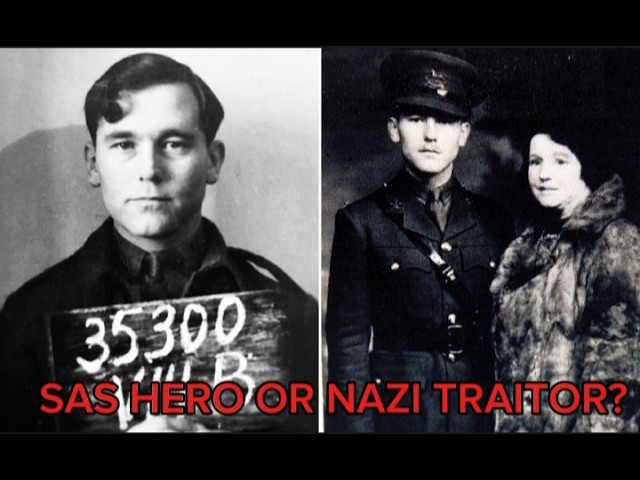
They would be rewarded. Now imagine the same man thirty years later, standing before a class of Australian schoolchildren, medals pinned to his chest, telling stories of his heroic service in the SAS. The same man. Both things were true.
And somehow, he almost got away with it completely. This is the story of Douglas Berneville Clay, a bigamist, a fraud, a Nazi collaborator, and one of the strangest men ever to wear the beret of the Special Air Service. This is not a story about courage. It is the story of a traitor who spent his entire life pretending to be someone else, and nearly succeeded.
Douglas Bernardville Clay was born in Plumstead, London, on November 26, 1917. There was nothing glamorous about it. His father, Frederick, had served in the Royal Army Service Corps and had been awarded an MBE. But the family was thoroughly working class, tied to industrial London, not to any aristocracy.
This detail matters because everything Berneville Clay built as an adult, the accent, the titles, the elite manner, was fabricated. None of it was real. Not a single word of it. As a teenager, he enrolled at the Army Technical School in Chepstow in 1933, but was expelled within a year and returned to his parents, who ran a pub near York.
There he began the pattern that would define his entire life. He met a young woman named Ada Metcalfe. They had a daughter, Margaret, born in 1935. Then, simply, he left.
He walked away from both of them. Margaret grew up believing her father was a war hero. She would not learn the true story until very late in her life. Neither would anyone else, for decades.
What followed was a decade of repeating the same story under different names. In 1934, he joined the 16th Queen’s Lancers, a period that taught him to ride and handle horses, skills that later helped him convincingly play the role of a country gentleman. He was discharged in 1936. In 1937, he married again, this time to Irene Palmer.
While she was pregnant with their daughter Yvonne, he abandoned her as well. Later that same year, he joined the 12th Royal Lancers. He was discharged again in 1938, this time simply because the army no longer wanted him. Then in 1938, he met Nina Paine in Torquay.
In March 1940, while Nina was in the final stages of her pregnancy, he married her. There was only one problem. He was still legally married to Irene. This was not an honest mistake.
It was bigamy, committed openly, and their son Graham was born shortly afterward. By the outbreak of the Second World War, Berneville Clay had already abandoned two women, fathered children with two of them, and married two at the same time. The war had not even properly begun for him yet. He tried to join the Royal Air Force and trained as aircrew at Cardington and Cambridge.
In March 1940, he was rejected, deemed unlikely to become a competent pilot. He moved into factory work and joined the Home Guard. And here things escalated from unreliable husband to something closer to compulsive fraud. He retrieved his father’s old uniform, attached RAF pilot badges he had no right to wear, and walked around publicly pretending to be a decorated pilot.
After a traffic accident put him in an officers’ convalescent home, he stole another patient’s cheque book. In January 1941, he appeared before magistrates and was fined for impersonating an officer. At that exact moment, Douglas Berneville Clay effectively disappeared, replaced by a new man. He began calling himself the Venerable Douglas Aubrey Webster Berneville Clay, claiming the title of Lord Charlesworth, and adopting an aristocratic accent to match.
When he enlisted as a soldier in the West Yorkshire Regiment that same month, he told his superiors he had been educated at Charterhouse, then Magdalen College, Oxford, then Emmanuel College, Cambridge. And the bluff worked. Thanks to a wholly fabricated education, he was fast-tracked into officer training at Sandhurst, and by October 1941, he held an emergency commission as a second lieutenant. Four months later, he was placed under house arrest and court-martialled for forging cheques.
He defended himself in the proceedings by falsely claiming to be a barrister. Remarkably, the court accepted that the bounced cheques were the result of carelessness rather than deception. But his immediate commanding officer was clearly not fooled and transferred him elsewhere. By June 1942, he arrived in Egypt at a time when the war in North Africa was reaching a critical point.
Tobruk had just fallen. British command was rushing to respond with raids on Axis targets, including the port of Benghazi. That raid, ironically codenamed Operation Bigamy, was assigned to Major David Stirling’s L Detachment of the Special Air Service. The unit was small and needed men.
Berneville Clay volunteered, and in August 1942, he was among their ranks. Here is the part that makes this story so unsettling. His SAS service was not fake. He actually fought with them.
He took part in Operation Bigamy that September. The raid collapsed after their security was compromised and Axis forces were waiting for them, forcing a brutal withdrawal across the desert. Most of the temporary volunteers were returned to their original units afterward. But Berneville Clay was not.
He stayed with A Squadron, and by late September he was promoted to substantive war lieutenant. On September 28, 1942, the SAS was formally elevated to full regiment status. Three days later, Berneville Clay was officially enrolled in the 1st Special Air Service Regiment, a genuine member of one of the most elite units Britain ever created. He continued fighting in operations linked to the Second Battle of El Alamein, striking Axis supply lines and airfields deep in enemy territory.
Then, on December 23, 1942, the regiment’s war diary recorded him as missing in the Western Desert. He had been captured near Tripoli. What followed was the usual grim round of prisoner-of-war camps. After the Italian armistice of 1943, he was among the prisoners shipped north to Germany.
By April 1944, he was at Oflag 79 near Braunschweig. And here something changed among the other British prisoners. They began to believe there was an informer in the camp. Suspicion fell directly on Berneville Clay.
It became so serious that the senior British officer in the camp warned the Germans in February 1945 that the other prisoners intended to try him themselves and possibly execute him. The Germans removed him from the camp for his own safety. A formal summary of evidence was compiled and sent directly to the War Office and MI5. That alone should have been the end of the story.
But it was not. It was the beginning of the worst part. In March 1945, on orders connected to Gottlob Berger of the SS, Berneville Clay was transferred between camps. This time, he was not wearing British khaki.
Witnesses saw him in the uniform of a German captain, carrying German identification papers. He made his way to Berlin, where he was attached to SS headquarters before being sent to the Eastern Front under General Felix Steiner. At Steiner’s headquarters, Berneville Clay appeared in full German field grey, with the rank of SS-Hauptsturmführer. During dinner, he spun a complete fictional identity for Steiner.
A captain in the Coldstream Guards, a member of the British aristocracy, and most importantly for his hosts, a fervent anti-communist eager to fight the Soviets. Steiner believed every word. Steiner then arranged a meeting between Berneville Clay and the British Free Corps, a small, grim unit of British prisoners and turncoats who had agreed to fight for Germany. On April 19, 1945, weeks before the end of the war, Berneville Clay stood before them in SS panzer uniform and tried to persuade them to join him in seizing armored vehicles and turning them against the Soviets.
He told them Britain would soon be at war with Moscow, and that none of them would face punishment at home for what they had done. Nearly every man in that room refused his offer. Only one man followed him. As the Third Reich collapsed around him, Berneville Clay headed west.
On May 2, 1945, with the Allies approaching, he stripped off his SS uniform and discarded it, putting his British battledress back on. When American troops found him, he and his single remaining follower simply presented themselves as escaped British POWs. No one stopped to scrutinize the story amid the chaos of Germany’s collapse. Within days, he was back in British hands.
On May 7, 1945, just one day before Victory in Europe Day, Douglas Berneville Clay was returned to Britain as a repatriated prisoner of war. MI5 opened an investigation. Former prisoners from Oflag 79 gave statements against him. The summary of evidence from the camp finally reached the people capable of acting on it.
Berneville Clay’s defence was audacious. He claimed that everything, the SS uniform, the speech to the British Free Corps, was part of an elaborate escape plan. The investigators did not believe him for a moment. But the case faced real problems.
Key German witnesses could not be found. The only remaining British witnesses were members of the British Free Corps themselves. Men whose credibility in a courtroom was worthless given what they had done. And since high treason carried the death penalty, the authorities were not prepared to risk a weak case on a man’s life.
He walked free and was never charged with treason. But his military career did not survive the peacetime reckoning. He faced a court-martial for stealing fuel, more cheque fraud, unauthorized use of a vehicle, and an improper relationship with a female recruit under his command, who later bore his child and received no support from him at all. That same year, the truth of his illegal second marriage to Nina came out.
He was legally obliged that July. By September, he was back before another court-martial, this time for stealing coal, fuel, a typewriter, and misusing a War Department vehicle. This time there was no escape. Dishonourable discharge, and six months in prison.
Civilian life gave him no additional discipline. More fraud convictions followed. Links emerged to a Paris-based gang smuggling guns to Palestine and cars to Britain. Another bigamous marriage, to a woman named Margaret Murdoch, led to a stretch in Pentonville Prison.
Somehow, after all that, he married again. A woman named Gisela, with whom he had four children, and briefly lived the fantasy he had been performing his whole life. A country gentleman in Hertfordshire, riding to hounds, chairing village committees, wearing medals he never earned at commemoration ceremonies. It could not last.
In 1957, he ran off to the Mediterranean with a neighbour’s wife, spent her money, abandoned her, lost his job, and declared bankruptcy. He moved to Australia and built his most successful lie yet. A decorated wartime intelligence agent, a former SAS major, holder of the Military Cross and the War Medal. None of it was real, but it held for a time.
In 1967, a routine check with Scotland Yard exposed him. He was fined for falsely claiming entitlement to bravery medals, and the press dug up everything. The convictions, the courts-martial, the bigamy, the dishonourable discharge. He simply moved again, this time to Campbelltown in New South Wales, and became, of all things, a respected teacher at St Gregory’s College.
Douglas Berneville Clay died of cancer on June 26, 1975. The school even established a memorial trophy in his name. It remained in use until 2008, when his true history surfaced one last time, and the trophy quietly disappeared. Here is what makes this story so deeply unsettling.
Berneville Clay was not a criminal who got lucky with a wartime disguise. He was a fraud who happened to fight genuinely with one of the most elite units in the British Army. Then he came back and wore the SS uniform to save his own skin. Both things are true.
And that is what makes him so hard to classify and so hard to forget. Sometimes history does not need embellishment. It only needs to be told honestly.
And this story barely needed any help at all to be unbelievable.