The Greenbrier Resort in White Sulphur Springs, West Virginia, had long been a symbol of American luxury, a playground for the wealthy where guests dined on fine China and strolled manicured grounds. But in the early days of 1942, its doors opened to a new kind of clientele. The guests were not vacationers. They were the diplomats of America’s newest enemies, and their arrival was not a matter of hospitality, but of strategy.
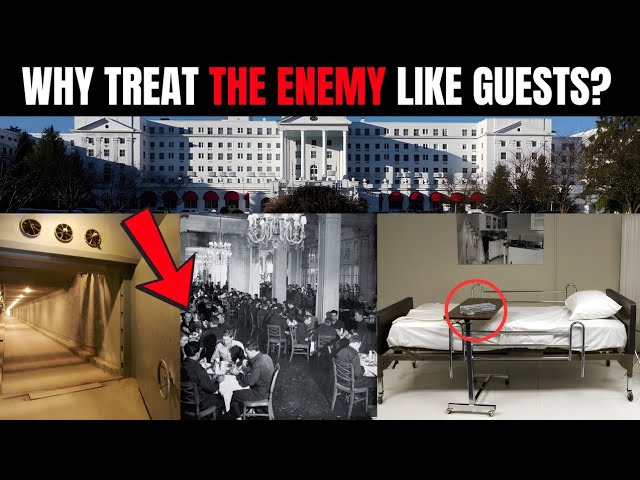
The attack on Pearl Harbor had shattered the peacetime order overnight. Foreign diplomats from Germany, Italy, and Japan were suddenly stranded in Washington, D. C. , operating embassies that had functioned normally just hours before.
Federal authorities knew they could not remain in the capital, yet their treatment required careful calculation. International law and diplomatic precedent demanded reciprocity: how America treated these envoys would directly determine how American diplomats held overseas would be treated in return. A conventional prison would invite retaliation. A luxury resort offered a different solution.
The Greenbrier was selected for strategic reasons. It sat along a major rail line, allowing discreet transportation from Washington within hours. Its geographic isolation simplified security. And its reputation for quality ensured that foreign governments could not credibly claim their personnel were being mistreated.
This was not a matter of comfort; it was a calculated move to protect American interests abroad. Within days, the resort closed to civilian guests. Nearly 1,700 diplomats from Germany, Italy, Japan, and several allied states passed through the property under federal supervision. Movement was restricted and security personnel monitored activity, but daily life inside maintained a structured normality.
Dining rooms remained active, shops operated, and recreational spaces were accessible under supervision. The balance served a purpose: it preserved the legal status of these individuals as diplomats rather than prisoners of war. Tensions simmered beneath the polished surface. National rivalries did not disappear within the resort’s walls.
German and Italian officials maintained strained relations, reflecting broader political divisions, while the later arrival of Japanese diplomats added further complexity. These interactions required constant oversight to prevent escalation. Managing this delicate environment fell to General Manager Loren Johnston, whose role extended far beyond hospitality. He functioned as a mediator between federal authorities and staff, ensuring compliance with government directives while maintaining operational discipline.
His internal communications emphasized duty, reinforcing that the quality of service carried strategic weight. The internment phase lasted several months. Behind the scenes, negotiations progressed through neutral countries, including Portugal and Sweden, aimed at arranging exchanges of diplomatic personnel between opposing nations. The controlled environment at the Greenbrier contributed directly to the success of these talks by demonstrating that the United States adhered to international expectations.
By mid-1942, the diplomatic mission concluded. The final group departed as part of an organized exchange. The Greenbrier could have reopened its doors to the civilian elite. Instead, a second transformation began almost immediately.
The US Army faced a growing need for large-scale medical facilities to treat casualties arriving from multiple theaters of war. The Greenbrier’s size, infrastructure, and accessibility made it an ideal candidate. The federal government acquired the property at a price below its estimated market value, reflecting wartime priorities. Conversion was rapid.
Guest rooms were reconfigured to accommodate hospital beds. Corridors were adapted for medical transport. Surgical facilities were installed, requiring structural modifications in selected areas. The objective was not temporary use but sustained medical operation.
The facility became Ashford General Hospital. Between 1942 and 1946, more than 24,000 service members received treatment at the location. Over 11,000 surgical procedures were performed, including advanced operations in vascular and neurological care. These figures reflect a significant contribution to wartime medical capacity, often overlooked in broader historical narratives.
A logistical challenge soon emerged. Staffing such a large facility during a national labor shortage required alternative solutions. The Army established a nearby camp housing prisoners of war captured overseas. These individuals performed support roles, including maintenance, food preparation, and logistical assistance.
The arrangement allowed medical personnel to focus on treatment rather than operational tasks. Without this use of prisoner labor, the hospital would have required a larger domestic workforce at a time when manpower was already strained, potentially reducing efficiency or limiting patient capacity and delaying recovery timelines for injured soldiers. The hospital environment itself produced a psychological effect on patients. Many soldiers arrived expecting the austere conditions typical of military facilities.
Instead, they encountered an environment with preserved architectural elements, landscaped grounds, and access to recreational spaces. This contrast supported recovery by improving morale, an outcome recognized by military medical planners. The hospital also contributed to rehabilitation innovation. Physical therapy programs incorporated outdoor movement across varied terrain, including walking paths and open fields.
This approach differed from the more confined rehabilitation methods used elsewhere and helped shape evolving treatment practices. The Greenbrier’s wartime service did not end with the conclusion of hostilities. A decade later, during the early Cold War period, the US government again selected the site, this time for a covert continuity of government facility designed to house members of Congress in the event of a nuclear emergency. The decision reflected the enduring strategic value of the location.
The broader significance of the Greenbrier’s wartime transformation lies in its demonstration of adaptive infrastructure. A single property fulfilled diplomatic, medical, and later strategic defense roles within a relatively short time frame. Each function addressed a distinct national priority, yet all relied on the same foundational asset. The case also illustrates how non-military institutions can become integral to wartime operations.
Hotels, rail systems, and civilian facilities formed part of a larger logistical network supporting national objectives, their contributions often overshadowed by battlefield narratives. War extends beyond combat zones. It reshapes economic systems, repurposes civilian spaces, and demands flexibility from institutions never designed for conflict. The Greenbrier stands as a precise example of that capability.
A resort built for leisure became a controlled diplomatic environment, then a critical medical facility, and later a strategic contingency site. Each transformation addressed a different phase of national need. The underlying question remains relevant.
When future crises emerge, which existing institutions will be called upon to serve roles they were never designed to fulfill, and how prepared will they be to adapt?