In the summer of 1951, four men stood on the gallows inside Landsberg Prison, condemned for crimes that had claimed the lives of hundreds of thousands. They were not ordinary soldiers who had lost a war. They were generals and commanders of the Einsatzgruppen, the mobile killing squads that followed the German army into the Soviet Union. Their executions by hanging, rather than by firing squad, carried a deliberate meaning.
These men were being treated as common criminals, convicted after full legal proceedings, not as enemy officers captured in battle. They had been arrested, indicted, represented by defense counsel, tried before a military court, found guilty, and sentenced to death. The manner of their deaths reflected the nature of their crimes. They had organized the mass murder of civilians, and the Allied authorities intended to make clear that such acts carried the ultimate penalty.
The story of these men began with Operation Barbarossa, the German invasion of the Soviet Union in June 1941. As the Wehrmacht pushed eastward, it was followed by four main Einsatzgruppen, designated A, B, C, and D. These units belonged to the SS Security Police and the Security Service, and they were divided into smaller sub-units known as Einsatzkommandos. Initially, their official task was to deal with enemies of the new German occupation, such as partisans and resistance fighters.
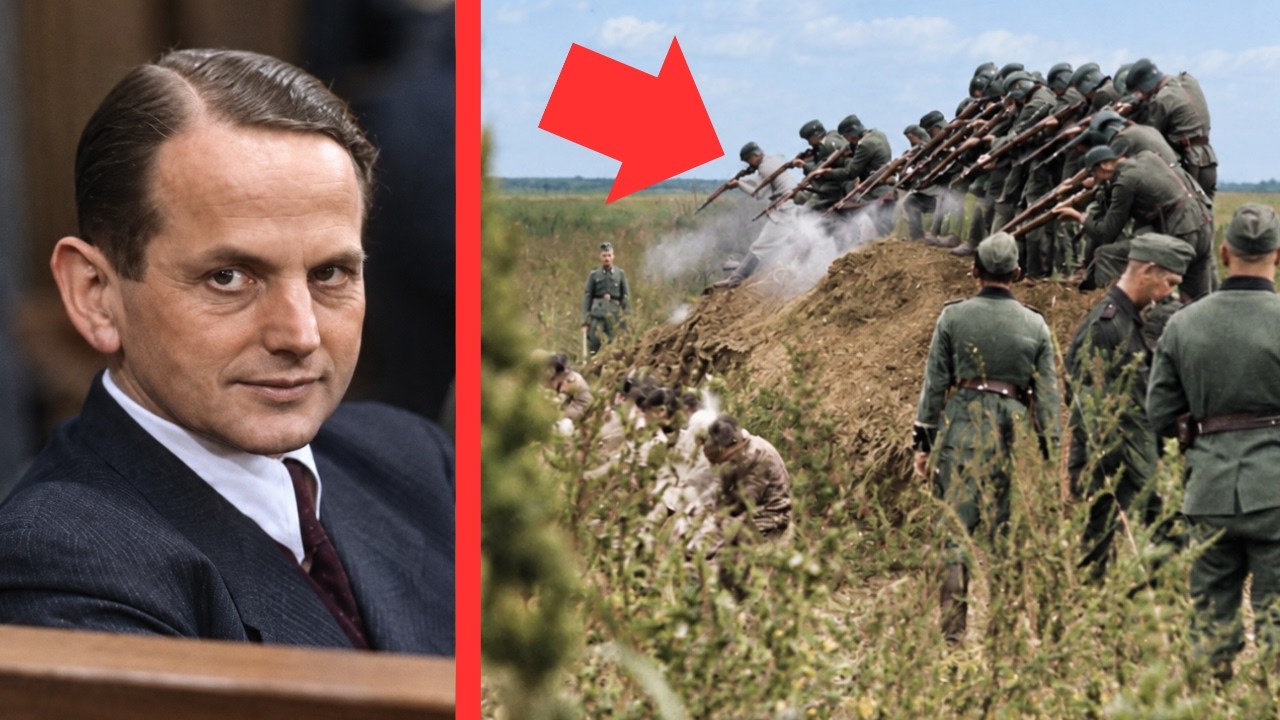
That mission quickly transformed into something far more terrible. The Einsatzgruppen, along with regular police units, the army, and local auxiliary groups, began systematically rounding up civilians. They gathered men, women, and children, marched them to prepared killing sites, forced them to surrender their belongings and clothing, and shot them into mass graves. Entire communities were erased within hours.
At Babi Yar, a ravine near Kyiv, SS and German police units killed approximately 34,000 people in just two days. The scale of the killing was staggering. The men who commanded these operations were not military leaders fighting a conventional war. They were administrators of murder.
By the end of the war, the official indictment against the Einsatzgruppen leadership charged them with the deaths of no fewer than 723,000 people. The prosecution argued that the true figure exceeded one million. Modern estimates place the number of victims killed by the Einsatzgruppen in the east at no fewer than one and a half million. Many of the dead were buried in mass graves that remain undiscovered beneath the ground to this day.
The evidence against these commanders was overwhelming, and much of it came from the perpetrators themselves. The Einsatzgruppen maintained detailed operational reports that recorded the number of victims, the categories of people killed, and the locations of their burial sites. These documents made it nearly impossible for senior leaders to claim ignorance of what their units were doing. The paper trail was so extensive that the defense of following orders carried little weight before the court.
One of the most prominent figures in the postwar trial was Otto Ohlendorf, commander of Einsatzgruppe D. His forces operated in southern Ukraine, the Crimean Peninsula, and the Caucasus region. Ohlendorf did not deny the killings. He admitted that his group had slaughtered around 90,000 people, most of them civilians, during his time in command.
Instead, he attempted to justify his actions by claiming he was merely carrying out orders received from his superiors, including Heinrich Himmler, the head of the SS. He argued that these orders were tied to the Reich’s struggle for supremacy against the Soviet communists. The court rejected this reasoning. It ruled that an order to deliberately kill unarmed civilian populations did not become legal simply because it came from higher up the chain of command.
A soldier is normally expected to obey legitimate military orders, but an order to murder civilians is not a legitimate military order. The nature of the victims was central to the prosecution’s case. These were not battlefield casualties or enemy soldiers. The victims were women, children, and the elderly, all of them unarmed.
Communities were often assembled through deception before being led to their deaths. Sometimes victims were shot while lying on top of the bodies of those who had been killed before them. If the Nazis had singled out a particular group of people, those captured were usually executed with a single shot to the back of the head. The prosecution did not need to prove that the commanders personally fired the shots.
It was enough to show that they had ordered the killings, organized the operations, supplied the personnel, received the reports, and overseen the organizations responsible for the massacres. A commander could bear criminal responsibility without ever pulling a trigger himself. The trial of the Einsatzgruppen leadership indicted 24 senior officers, of whom 22 ultimately stood trial. They faced charges of crimes against humanity, including the murder and persecution of civilian populations, and war crimes involving killings committed in occupied territories in violation of the laws and customs of war.
They were also charged with membership in criminal organizations such as the Security Service, the SS, and the Gestapo. All 22 defendants faced at least one charge. Among the accused, few were more notorious than Paul Blobel. He had commanded a unit involved in the Babi Yar massacre, and he was later given responsibility for Action 1005, a plan designed to destroy the evidence of Nazi crimes.
Under his supervision, prisoners were forced to exhume mass graves, remove the decomposing bodies, and burn the remains. Those prisoners were then routinely killed themselves so they could never testify about the original crimes. Blobel was among those sentenced to death. On April 10, 1948, the court issued its verdicts.
Fourteen men received death sentences, two were sentenced to life imprisonment, and five received prison terms ranging from ten to twenty years. But the outcome of the trial was not the final word. In the years that followed, politics intervened. The Cold War was intensifying, and West Germany had become increasingly important to the Western Allies.
Pressure grew to reconsider the death sentences imposed on German war criminals. As a result, many of the sentences were commuted to prison terms. Only four of the senior Einsatzgruppen generals were ultimately executed. Those four men were Otto Ohlendorf, Paul Blobel, Erich Naumann, commander of Einsatzgruppe B, and Werner Braune, commander of Einsatzkommando 11b.
They were hanged in June 1951, shortly before Landsberg Prison was handed back to German authorities. Photographs taken in their final moments show the men on the execution platform just before the trapdoor opened. The reasons for their executions were clear. They had been directly involved in organizing the mass murder of hundreds of thousands of innocent people.
They did not merely belong to the SS, and they were not executed simply because Germany lost the war. They were tried in fair proceedings and held responsible for crimes against humanity and war crimes. The court established that giving the order, organizing a massacre, and leading the organization that carried it out carried the same weight of guilt as the men who actually pressed the triggers. These four commanders went to the gallows because they had collected entire communities and killed them, and because the evidence against them was overwhelming.
The trial demonstrated that command responsibility for mass murder could not be evaded by claiming to be a small cog in a large machine. The men who ordered the killings were just as guilty as the men who fired the shots.