The war that followed the surrender of Fort Sumter would cost more than 600,000 lives, a toll almost no one had foreseen. The men who fell on both sides did so under the direction of generals whose abilities varied enormously, from the genuinely gifted to the dangerously incompetent. Among the most accomplished were Ulysses S. Grant, William Tecumseh Sherman, Robert E.
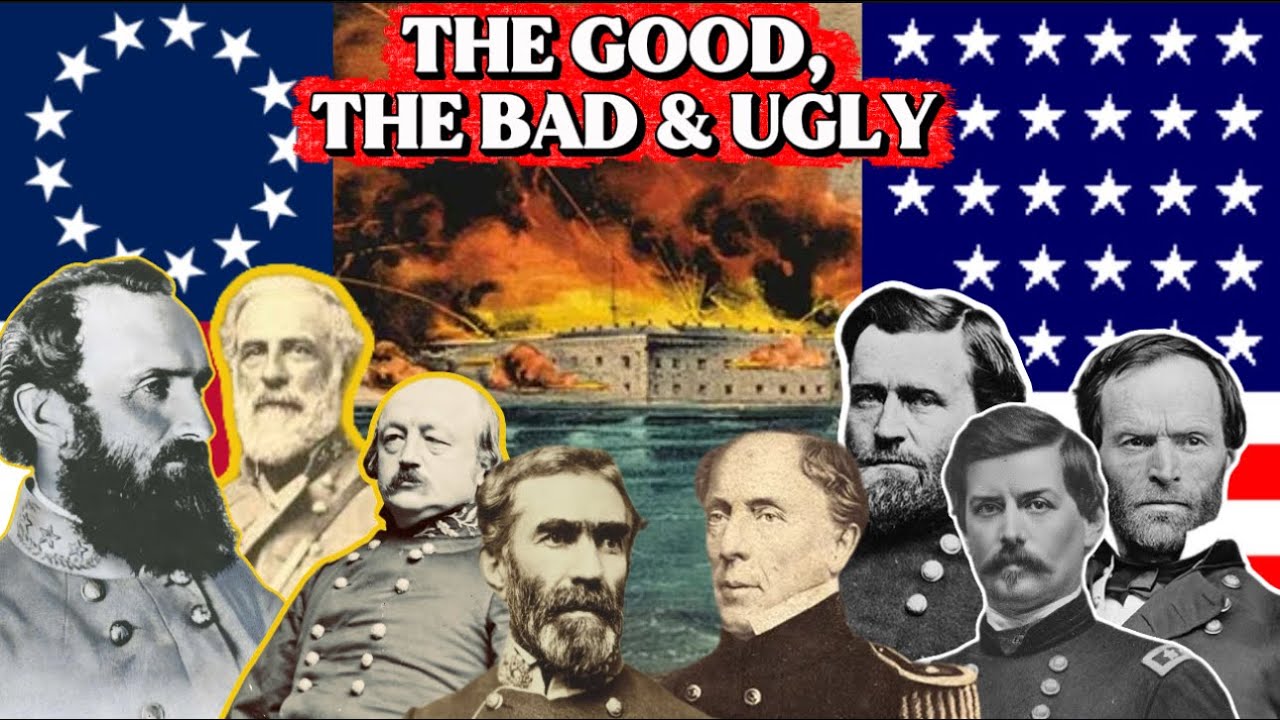
Lee, and Stonewall Jackson. By contrast, George McClellan, Braxton Bragg, Benjamin Butler, and John B. Floyd represented the failures—commanders whose flaws cost thousands of lives and, in some cases, helped doom the very cause they served. Ulysses S.
Grant was the Union’s most compelling military leader. Before the war, his career had been marked by disappointment, culminating in a resignation compelled by his drinking. When hostilities began, he returned to the army, and despite a personal aversion to bloodshed and a dislike of military dress, he persevered longer and proved superior to his peers. At Shiloh in April 1862, he led the Union Army to a costly victory, but the carnage—more than 10,000 combined casualties—stunned the nation.
Critical reports followed, and his commanding officer, General Henry Halleck, relegated him to a deputy role. Grant seriously considered resigning, but his friend William Tecumseh Sherman persuaded him to stay. President Lincoln eventually restored him to command, and Grant would go on to guide the Union to its final triumph. Grant understood that the war was one of attrition.
The North possessed greater manpower, financial resources, and supplies, making victory inevitable if the Union pressed forward relentlessly. Lincoln, who had cycled through timid, politically ambitious, or outright insubordinate generals, finally found in Grant a commander who fought and made no excuses. Lincoln famously said, “I cannot spare this man. He fights.
” Grant was known for his quiet, unflappable demeanor, but privately he was deeply sensitive. While Lee is often studied for tactical brilliance, Grant’s strategic vision was revolutionary. He understood the Civil War as a total war requiring the destruction of the enemy’s ability and will to fight. He also pioneered the use of combined arms, coordinating infantry, cavalry, and artillery, and he was a master of military logistics—arguably his greatest talent.
Grant was also a flawed but sincere civil rights pioneer. As commanding general, he broke the Union Army’s color barrier by creating the Bureau of Colored Troops. As president, he used federal power forcefully to crush the first iteration of the Ku Klux Klan, signing the Enforcement Acts and suspending habeas corpus in parts of the South. He advocated for the rights of freed Black Americans and Native Americans, though his Native American policies were deeply contradictory and often harmful.
Years later, knowing he was dying, Grant fought his last battle with illness. Having lost his wealth in a fraudulent investment scheme, he raced against death to write his memoirs and provide for his family. With the help of his publisher, Samuel Clemens—Mark Twain—he produced one of the best-selling books in the United States, The Personal Memoirs of U. S.
Grant. Completed days before his death, it was a literary masterpiece. Twain called it the most remarkable work of its kind since the commentaries of Julius Caesar. The memoirs earned Grant’s family about $450,000, the equivalent of over $12 million today.
William Tecumseh Sherman was Grant’s friend and loyal subordinate. When Grant was called east to fight Lee, Sherman led his army of rough westerners through the heartland of Georgia and up through the Carolinas. Famous for the phrase “War is hell,” Sherman brought the hell of war to the South. His march to the sea destroyed the infrastructure and public morale of the Confederacy, and the fall of Atlanta helped secure Lincoln’s reelection.
Before the war, Sherman had been a multifaceted failure. He resigned from the army in 1853, floundered in banking in San Francisco during the gold rush, and later failed as a lawyer in Kansas. In 1859, he briefly served as the first superintendent of what would become Louisiana State University. He was deeply fond of the South, making his later role in its devastation a personal tragedy.
These failures, combined with the immense pressure at the start of the war, led to a public nervous breakdown in 1861, with newspapers calling him insane. Sherman was not an abolitionist. He held typical nineteenth-century racial prejudices and disliked slavery more for its social and economic effects on whites than out of sympathy for the enslaved. Yet his military policies unintentionally became a massive emancipation tool, as his armies attracted tens of thousands of freedom seekers.
His famous Special Field Orders No. 15—the origin of “forty acres and a mule”—was a pragmatic military measure to handle refugees, not a visionary program for racial justice, and he was dismayed when it was later reversed. His deeper innovation was psychological warfare. The march was designed to break the Southern will to fight by making civilians feel the war’s cost directly.
This concept of targeting the enemy society’s center of gravity made him a foundational, if controversial, figure in modern military strategy. Ironically, after the war Sherman became a leading voice for peace and reconciliation with the South. But this stance did not extend westward. As commanding general of the army from 1869 to 1883, he was a chief architect of the brutal campaigns against Native American tribes, applying his hard-war philosophy to the Plains Wars.
He famously said, “The more Indians we can kill this year, the less will have to be killed the next. ” He also loathed politicians and reporters, and when urged to run for president, he bluntly replied, “If nominated, I will not run. If elected, I will not serve. ”
Robert E.
Lee served for three decades in the United States Army, earning distinction during the Mexican-American War. Lincoln offered him command of the Union armies, an offer Lee refused. Following the example of many fellow Southern officers, he left his federal commission to defend his native state. His early Confederate campaigns in western Virginia were unsuccessful, but Jefferson Davis nevertheless appointed him to lead the Army of Northern Virginia.
There, Lee’s tactical ingenuity enabled him to overcome larger Union forces and extended the Confederacy’s existence. Lee eventually concluded that a decisive victory on Northern soil might secure foreign support for the South. That hope was shattered at Gettysburg, where the infamous assault on Cemetery Ridge—Pickett’s Charge—cost the Confederacy 15,000 men, a third of his army, and forced a retreat. Thereafter, Lee could only wage a masterful yet ultimately futile defensive campaign in Virginia, prolonging the war for two more years and adding countless names to the casualty lists.
Lee personally disliked slavery, calling it a moral and political evil, but he believed it was a greater evil for the white race than for the Black race, and he thought emancipation should happen gradually. His aggressive offensive strategy caused catastrophic Confederate casualties the South could not afford. He showed little interest in the Confederacy’s industrial and railroad weaknesses, focusing solely on the army in Virginia, which contributed to his men being chronically undersupplied. After the war, Lee accepted the outcome, took an oath of allegiance to the United States, and, as president of Washington College, advised Southerners to avoid controversy and work to restore harmony.
He reportedly declined invitations to build monuments on battlefields, saying it was wiser not to keep open the sores of war. Thomas “Stonewall” Jackson earned his nickname at the First Battle of Bull Run, when he rapidly advanced his forces to seal a breach in the Confederate line under heavy Union assault, prompting a fellow officer to remark that Jackson stood like a stone wall. A devout Presbyterian, Jackson’s Calvinist faith gave him unshakable confidence in battle, though it also manifested in strict, even legalistic ways; he refused to send or open military correspondence on Sundays. In Lexington, Virginia, where he taught at VMI, he started a Sunday school for enslaved and free Black children, teaching them to read so they could study the Bible.
His motives were paternalistic and evangelistic, not abolitionist—he fully supported slavery as ordained by God. At Chancellorsville in May 1863, Jackson was accidentally shot by his own men. His left arm was amputated, and the surgeon noted the wound was not necessarily fatal. The true cause of his death eight days later was pneumonia, likely resulting from an infection that the doctors failed to properly drain.
His famous last words, “Let us cross over the river and rest under the shade of the trees,” are poetic but likely apocryphal. His death was a severe setback for the Confederacy, and military scholars often link Lee’s defeat at Gettysburg to the loss of his most dependable corps commander. Among the bad and the ugly, George B. McClellan stands out.
Known as “Little Mac,” he excelled as an organizer and administrator, building the Army of the Potomac into a professional, modern fighting force. He instituted crucial reforms in supply, medical care, drill, and officer training, and he pioneered the use of the balloon corps for aerial reconnaissance. But he consistently hesitated to engage in battle. Even after Union soldiers discovered a copy of Lee’s detailed plans at Antietam, McClellan, contradicting the evidence, persisted in believing he was outnumbered.
This caution prevented him from exploiting his opportunity and allowed Lee’s army to escape. His intelligence gathering was led by Allan Pinkerton, whose notoriously inflated enemy troop estimates fed McClellan’s innate caution. Lincoln removed him after Antietam. McClellan was a conservative Democrat who believed in restoring the Union but not in abolishing slavery as a war aim, putting him at odds with the Republican administration.
His letters to his wife revealed staggering grandiosity, including the belief that he alone bore the nation’s fate. Braxton Bragg was arguably the worst general the Confederacy produced. In command of its western armies, he was responsible for several costly Southern defeats and the loss of thousands of men. His subordinates described him as vindictive, contrary, and deceitful, and his personality was likened to that of a cornered animal.
Jefferson Davis repeatedly saved Bragg’s career, not just out of friendship, but because he valued Bragg’s strict discipline and organizational skills. While a terrible field commander, Bragg was arguably the best administrative organizer in the Confederacy. After being relieved from field command, he served as Davis’s chief of staff and functioned as the Confederacy’s de facto first chief of the general staff, working to centralize the war effort and manage the army’s desperate manpower crisis. Many historians believe he was far more effective in this bureaucratic role than in the field.
Union General Benjamin Butler was a lawyer and Massachusetts politician whose war record included a series of failures. Early in the war, when three enslaved men fled to Union-held Fort Monroe, Butler refused to return them to their owner, inventing the legal category of “contraband of war. ” He argued that if the South considered enslaved people property, and that property was used to support the rebellion, he could seize them as he would any enemy cannon or wagon. He was hated in the South for his occupation of New Orleans and for enlisting Black troops, and his General Order No.
28—stating that any woman who insulted a Union soldier would be treated as a woman of the town—earned him the epithet “Beast Butler. ” He was a disastrous field commander, and Grant called his campaign at Bermuda Hundred as helpless as a child on a battlefield. Yet he was simultaneously a corrupt opportunist and a radical progressive on race. Finally, Confederate Brigadier General John B.
Floyd tangled with Grant and lost Fort Donelson. A Virginia politician, he served as U. S. Secretary of War under President Buchanan, where his tenure was spectacularly corrupt.
He was accused of issuing fraudulent bonds and suspected of systematically transferring over 105,000 muskets and rifles from federal arsenals in the North to arsenals in the South, a move contemporaries and historians view as a deliberate act to arm the future rebellion. At Fort Donelson, when Union forces arrived, Floyd escaped, leaving his command behind. His flight is usually attributed to cowardice or political calculation, fearing capture and trial for treason. His career ended not with a court-martial, though many demanded one, but with a quiet removal from field command.
He died in August 1863 in relative obscurity. As one account put it, he may have done more to militarily prepare the Confederacy while a U. S.
cabinet secretary than he ever did as a Confederate general.