In November 1947, an old man sat painting in his studio at Chartwell, copying a torn portrait of his father. He was 72 years old. As he worked, he became aware that someone was sitting in the chair beside him. It was his father, the ghost of Lord Randolph Churchill, who had died more than half a century before.
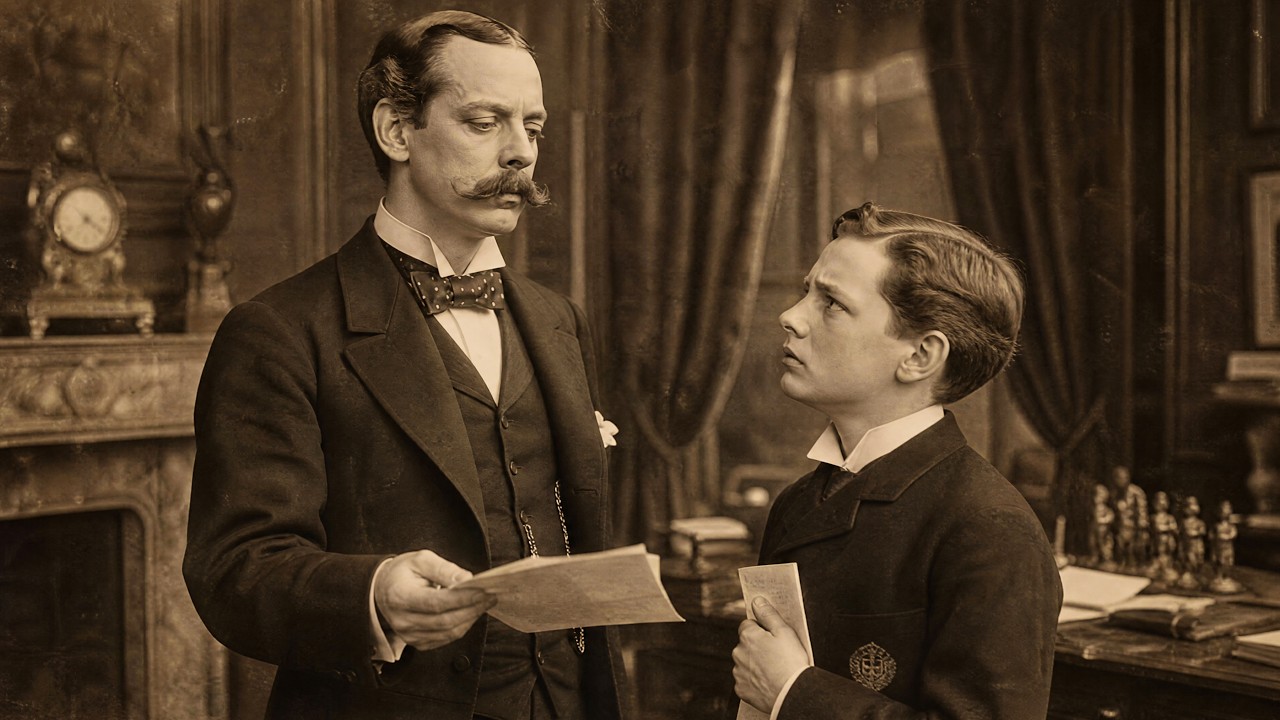
The ghost asked what year it was, and when told, said it remembered nothing after 1894, the year of his final illness. The old contempt was still there. The ghost reminded him that he had been bottom of the school and had never passed any examinations except into the cavalry. Then the ghost paid him the only compliment he could imagine: “When I hear you talk, I really wonder you didn’t go into politics.
You might even have made a name for yourself. ” Then the ghost vanished. The old man was Winston Churchill. The recognition he had waited for as a boy never came, not even in a dream.
The boy had been born in a palace that would never be his. In the last week of November 1874, a young American wife went walking with the shooting party at Blenheim Palace and fell. She was 20 years old, married a little over seven months, and expecting her first child. The couple had not meant to be at Blenheim for the birth.
Their own house in Mayfair was being made ready. The child arrived in the wrong house at the wrong time, attended by a country doctor, because the London physician reached the palace after it was over. The baby was safely born at one in the morning on Monday, the 30th of November. He was named Winston Leonard Spencer Churchill.
His mother was Jennie Jerome, born in Brooklyn, the daughter of a New York financier. His father was Lord Randolph Churchill, 25 years old, the younger son of the Duke of Marlborough, elected to the House of Commons that same year. A duke stands at the very top of the British peerage, but a younger son carries only a courtesy title, and the courtesy did not pass down to his son. The palace, the land, and the title would all pass to his elder brother.
So the child born in the little room off the great hall was the grandson of a duke and heir to a name, and nothing else. The marriage had been a hurry and a negotiation. The couple met at Cowes in August 1873 and were engaged within three days. The two families argued over the marriage settlement for months.
The young couple had the equivalent of a present-day income of a little more than £150,000 a year, a sum which guaranteed they would live constantly above their income and be always in debt. They were married in Paris on the 15th of April 1874. Their first son was born seven and a half months later. Some biographers have suggested the child was carried to full term and that the story of the fall was a way of covering a pregnancy that began before the wedding.
Nobody knows. Neither parent raised the child. That was not unusual in their world. A boy of his class was handed to a nurse, then a governess, then at seven or eight to a boarding school.
But even by the standards of that world, the Churchill household was a distant one. The official biography judged the neglect remarkable, even judged by the standards of late Victorian and Edwardian days. Within two years of the boy’s birth, a scandal carried the whole family out of England. Randolph’s elder brother was caught up in a society scandal, and Randolph in the middle of it threatened the Prince of Wales himself.
The Duke found a solution: he accepted the post of Viceroy of Ireland and took his younger son with him as private secretary. It was a polite exile. Randolph and Jennie took a small house in Dublin, and the little boy went with them. He was two years old.
The one person who stayed with him through Ireland and everything that came after was his nurse, Elizabeth Anne Everest. She had been born in Chatham in Kent, which she told him was the garden of England. She had never married. She came to the Churchills early in 1875 when the baby was only weeks or months old, and she stayed for the best part of two decades.
The boy could not manage the word “woman. ” The nearest he could get was “Woom,” and Woom she became. In his memoir, My Early Life, published in 1930, he left no doubt who had brought him up. “My nurse was my confidant,” he wrote.
“Mrs. Everest it was who looked after me and tended all my wants. It was to her I poured out my many troubles. ” It was Mrs.
Everest who taught him to read. He remembered being frightened of the Fenians because his nurse was nervous of them. He remembered the day a governess was announced and he ran and hid in the shrubberies. His brother Jack was born in Dublin in 1880.
His parents were something else. He described his mother as a fairy princess, a radiant being possessed of limitless riches and power. Then he wrote the sentence every biographer since has quoted: “She shone for me like the evening star. I loved her dearly, but at a distance.
” The nurse was near. The parents were lights in the sky, beautiful and unreachable. In the autumn of 1882, when he was nearly eight, his parents decided the time had come for school. He was not asked.
His mother took him to the station in a handsome cab and pressed three half crowns into his hand. He dropped them, and mother and son had to scramble about in the straw to find them. A school had been chosen for him near Ascot, one of the most expensive and fashionable in the country. Its real name was St.
George’s. It modeled itself upon Eton. The routine told the boys what they were buying: seven or eight hours of lessons every day except half holidays, with football or cricket in addition. On his first day, the form gave him a Latin word to learn.
He asked what it meant, and pressed on to one of its odder forms. “Oh, table,” the master explained, “you would use that in addressing a table, in invoking a table. ” “But I never do,” the boy blurted out in honest amazement. “If you are impertinent,” came the reply, “you will be punished, and punished very severely.
”
He was by his own description a troublesome boy, stubborn, unwilling to learn what did not interest him. At home those qualities had been managed by Mrs. Everest with affection and patience. At St.
George’s they met the birch. Churchill described it plainly. “Flogging with the birch in accordance with the Eton fashion was a great feature in its curriculum. ” Two or three times a month the whole school was marshaled in the library, and one or more delinquents were hauled off to an adjoining apartment and flogged until they bled freely while the rest sat quaking, listening to their screams.
He judged the punishments to exceed in severity anything tolerated in the reformatories under the Home Office. Another boy who passed through the same school, Roger Fry, described the headmaster and the same room. As head boy, Fry was made to hold the victims down. It took only two or three strokes for drops of blood to form everywhere, and it continued for fifteen or twenty strokes until the boy’s bottom was a mass of blood.
The young Winston was exactly the kind of boy who ended up in that room. His school reports survive. His first placed him last in his class. By the summer of 1883, his composition was very feeble, his spelling about as bad as it well can be.
He had been late nineteen times in a single month. By spring 1884: “He is a constant trouble to everybody and is always in some scrape or other. He cannot be trusted to behave himself anywhere. ” His letters home give almost no sign of any of it.
In February 1884, a nine-year-old boy wrote to his mother: “I am wondering when you are coming to see me. I hope you are coming to see me soon. You must send someone to see me. You must send someone.
”
How the family learned what was happening is told in more than one way. The most often repeated account is that Mrs. Everest saw the marks of the birch on the boy’s body and raised the alarm. Churchill himself said only that he fell into a low state of health and that after a serious illness his parents took him away.
He left at the end of the summer term of 1884. That autumn he arrived at a very different place, a small school kept by two sisters in Hove beside Brighton. “There was an element of kindness and of sympathy there,” he wrote, “which I had found conspicuously lacking in my first experiences. ”
His parents’ visits did not become more frequent.
The letters of that autumn show the pattern plainly. On the 29th of September 1885 he wrote, “When do you think Papa will come and see me? ” Three weeks later he wrote to his father directly. Lord Randolph had been in Brighton and had not called.
“I cannot think why you did not come to see me while you were in Brighton. I was very disappointed, but I suppose you were too busy to come. ” In November the plea came again, and then a line that says more than all the rest: “I am not very happy, but quite well. I want you to come and see me when the elections are over.
” He was ten years old. His father was too busy. Lord Randolph was on his way to the top of British politics. He had built his name by attacking everyone, including the leaders of his own party.
In 1885 he became Secretary of State for India. On the 17th of March 1886, the boy in Brighton fell ill with pneumonia and his temperature climbed to 104. 3 degrees. In the days before antibiotics, everything depended on the crisis.
The prime minister asked after him. So did the Prince of Wales. And this time his parents came. The father and mother who had declined so many invitations rushed to his bedside.
He came through in April, and his father came down to Brighton and gave him a toy steam locomotive. It took a fever of 104 to bring it. The rest of that year belonged to his father’s career. In 1886 Lord Randolph became Chancellor of the Exchequer and Leader of the House of Commons.
He was 37 years old. Before the year was out he had thrown it all away. In December he picked a fight with the War Office over the army budget and sent his resignation, meaning it as a threat. The prime minister called his bluff, accepted the resignation, and appointed George Goschen in his place.
Lord Randolph never held office again. He battled on in the political wilderness for another eight years. His son, back at school, grew up in the shadow of that moment. One could not grow up in his father’s house, he wrote, without understanding that there had been a great political disaster.
In March 1888, a 13-year-old boy sat down to the Latin paper of the Harrow entrance examination and wrote his name at the top of the page. That was very nearly the only thing he wrote. He wrote the number of the question, put a bracket around it, and then nothing came. “There arrived from nowhere in particular a blot and several smudges.
I gazed for two whole hours at this sad spectacle. ” The headmaster, J. E. C.
Welldon, let him in. He entered Harrow on the 17th of April 1888. He was placed in the lowest division of the bottom form, only two from the bottom of the whole school, and those two disappeared almost immediately through illness or some other cause. There was one piece of luck.
Because he was in the lowest form, he was taught English by a master named Robert Somerville, whose job it was to teach the stupidest boys to write mere English. Churchill never forgot him. The boy who could not construe Latin learned how an English sentence is built. Half a century later the whole world would hear the result.
The record of his father’s attention is precise because a scholar has counted the letters. During his Harrow years, the boy wrote to his father nine times before he received a single reply. When the first reply finally came, it was dated June 1891, from Johannesburg, after he had been at Harrow for more than three years. His father visited Harrow only once.
His mother seldom visited despite his entreaties, though she wrote regularly. One visitor he could count on. Mrs. Everest came to Harrow, and according to one account, the boy kissed her in the high street.
The toy soldiers turned the current of his life. By now his collection had grown enormous, nearly 1,500. The day came when his father paid a formal visit of inspection, spending twenty minutes studying the scene. At the end he asked if the boy would like to go into the army.
The boy said yes at once. For years he thought his father had discerned in him the qualities of military genius, but he was told later his father had only concluded he was not clever enough for the bar. The examinations did not agree. In July 1892, at his first attempt at the Sandhurst entrance examination, he placed 390th out of 693 candidates.
He tried a second time and failed again. On the 10th of January 1893, on his aunt’s estate at Bournemouth, a boy of 18 ran onto a rustic bridge with his brother and cousin chasing him. He jumped for a fir tree. The measured fall was 29 feet onto hard ground.
It was three days before he regained consciousness and more than three months before he crawled from his bed. He had ruptured a kidney; it emerged much later he had broken his thigh as well, an injury not discovered until 1963. When he recovered he was sent to a crammer. It did its work.
On the 28th of June 1893 he qualified in 95th place out of 389 candidates. But he had not passed well enough for the infantry, which was what his father had wanted. He passed only for the cavalry, which demanded lower marks and cost a good deal more. He was delighted anyway, and wrote to his father to say so.
His father’s answer arrived in August 1893. It is the most famous letter Lord Randolph Churchill ever wrote to his son. “I am rather surprised at your tone of exaltation over your inclusion in the Sandhurst list,” it began. “The first extremely discreditable feature of your performance was missing the infantry.
” He had come up, his father wrote, among the second-rate and third-rate class, and by accomplishing the prodigious effort of getting into the cavalry, he had imposed an extra charge of some £200 a year. He dismissed the boy’s whole school career as a slovenly, happy-go-lucky, harum-scarum style of work. Then came the sentence the boy carried for the rest of his life: “You will become a mere social wastrel, one of the hundreds of the public school failures, and you will degenerate into a shabby, unhappy, and futile existence. ”
The boy’s reply was humble.
He was very sorry indeed his father was displeased, and promised to try to modify his father’s opinion by his work and conduct at Sandhurst. He entered Sandhurst on the 1st of September 1893. Within weeks he was writing to his father again, trying to find a way to please him and finding none. The father who wrote that letter was a sick man and getting sicker.
The signs had been visible in Parliament for months. His speech grew slurred. His last speech in the Commons in June 1894 was, in one account, a painful failure. His old friend Lord Rosebery called it a waking nightmare.
Rosebery later wrote the epitaph that has stayed with Lord Randolph ever since: “He died by inches in public. ” That June, Lord Randolph set off on a journey around the world with Jennie and a doctor. His condition on the voyage was terrible. In December 1894, the boy passed out of Sandhurst 20th in a class of 130.
He had done well at last. His father was brought home that same month, no longer in a condition to be proud of anyone. Lord Randolph Churchill died on the 24th of January 1895 at his mother’s house. He was 45 years old.
The death certificate gave the cause as bronchial pneumonia from paralysis of the brain. Most of his biographers believed it to be the final stage of syphilis. On the day of his father’s death, the boy was 20. He wrote about it 35 years later in some of the plainest sentences he ever set down.
“All my dreams of comradeship with him, of entering Parliament at his side and in his support, were ended. There remained for me only to pursue his aims and vindicate his memory. ” Crowds lined the streets as the coffin passed through London. There was a memorial service at Westminster Abbey, and then the body was carried to the little churchyard of St.
Martin’s at Bladon, within sight of Blenheim Palace, and buried there. The telegram reached his barracks at Aldershot at the beginning of July 1895. It said that Mrs. Everest was critical.
He had been a soldier for only a few months, commissioned into the 4th Queen’s Own Hussars, a cavalry regiment on pay of £120 a year. He left and went to her. She was lying ill at a house in North London. She died at a quarter past two in the morning on the 3rd of July, 1895.
The cause was peritonitis. She had spent the better part of her working life raising other people’s children, first the clergyman’s daughter in Cumberland, and then the two Churchill boys. He wrote about her death in My Early Life, and his words are among the gentlest in the book. “Death came very easily to her.
She had lived such an innocent and loving life of service to others. ” Then he wrote the sentence that settled once and for all who had raised him: “She had been my dearest and most intimate friend during the whole of the 20 years I had lived. ” His grief at the time was less composed. Four days after her death he wrote a letter that is now in the Churchill archive.
“I feel very low,” he wrote, “and find that I never realized how much poor old Woom was to me. ” She was buried in the City of London Cemetery at Manor Park. The grave is marked by a white cross and a stone carrying an inscription he and his brother paid for. “Erected to the memory of Elizabeth Anne Everest.
” The parents who employed her for almost two decades do not appear on it. A small photograph of her in a red frame stood near his desk at Chartwell. In the summer of 1895 the two halves of his childhood were gone. The father he had spent 20 years trying to please was dead, and so was the woman who had loved him without being asked.
But there was one thing his father had left him, and he set to work on it. He learned his father’s speeches by heart, many of them. In his first speech to the House of Commons in 1901 he spoke of a certain splendid memory many honorable members still preserved. In January 1906, at 31, he published a two-volume biography, Lord Randolph Churchill.
It was a son’s defense of a father, and it was written with care about what it would not say. Of the illness that killed Lord Randolph, the book spoke only of strain, of vexations and disappointments, and described the end in a single delicate sentence: “The numbing fingers of paralysis laid that weary brain to rest. ”
The robe came nearly 20 years after that. In 1924, Stanley Baldwin offered him the office his father had held for those few months in 1886, Chancellor of the Exchequer.
His reply to Baldwin has survived. “This fulfills my ambition. I still have my father’s robe as Chancellor. I shall be proud to serve you in this splendid office.
” He had kept the robe for almost 40 years. In 1893, Lord Randolph had told his son he would degenerate into a shabby, unhappy, and futile existence. Thirty-one years later, the son held his father’s office in his father’s robe. In these same years, mother and son finally found each other.
With Lord Randolph gone, Jennie became her son’s most tireless ally. “She left no wire unpulled, no stone unturned, no cutlet uncooked. ” They worked together, in his words, more like brother and sister than mother and son. In January 1953, according to his private secretary, Churchill remarked that the date was the day his father died.
“It’s the day I shall die, too. ” Winston Churchill died on the morning of Sunday, the 24th of January 1965, 70 years to the day after his father. He was 90 years old. He was buried in the little churchyard at Bladon, near his parents and his brother, within sight of the palace where he was born.
After a whole life spent trying to reach them, he lies beside the mother and father he had loved so dearly, and for so long, at a distance.