The painting on the front of the box was never a photograph. It was a hand-painted illustration of a tank grinding through mud, or a race car drifting through a turn, or a fighter plane banking against a clouded sky—so detailed and alive that many boys cut the top off the box and pinned it above their desks. Throwing away a Tamiya box top felt like throwing away a piece of art. Inside, the sharp, slightly sweet smell of polystyrene hit immediately, the scent that meant model building the way fresh-cut grass meant summer.
The box held sprues of gray or olive drab plastic, dozens of numbered parts waiting for a hobby knife; an instruction sheet that ran twenty or thirty pages of step-by-step diagrams; and a sheet of delicate water transfer decals that wrinkled if breathed on wrong. Tamiya did not make easy kits. They made precise kits. The parts fit together with a tolerance that rival companies could not match.
Revell parts had gaps. Monogram parts had flash, thin ridges of excess plastic along the seam lines that had to be scraped off with a knife. Tamiya parts clicked together like they were made for each other, because they were. The molds were machined to a standard the model industry had never seen, and the result was a kit that built into something that looked real—not like a toy, but a miniature version of the actual machine, scaled down to 1/35 and accurate to the rivet.
The military models were the beginning. Tamiya started with a Panther tank in the early 1960s, and the reason they chose a tank was pure engineering. The linear shape made the molds simple to produce, and the body was just large enough to hold a small electric motor and two AA batteries. That first Panther could move.
You built it, dropped in the batteries, flipped the switch, and the tank crawled across the kitchen table with its rubber treads grinding and its turret fixed in place. You were no longer in a kitchen in Ohio or Texas or New Jersey. You were in Normandy, at Kursk, in the Ardennes—wherever the history section printed on the first page of the instructions said the tank had fought. The war was on the kitchen table, and you were in command.
They made Tigers and Shermans and Panzers and half-tracks and Jeeps, soldiers and medics and officers, barbed wire and sandbags and brick walls. Some boys spent months building entire battlefields on sheets of plywood, with hills made from plaster, trees from wire and lichen, roads from textured paint. It was not a hobby. It was a world.
Then, in 1976, Tamiya did something that changed everything. They released the radio-controlled Porsche 934, a kit you assembled yourself and then drove with a handheld transmitter. Not a slot car locked to a track, not a tethered car running in circles, but a free car that went where you pointed it—across grass, dirt, pavement, and your neighbor’s lawn if you were not careful with the steering trim. The RC car revolution had begun, and Tamiya was at the center of it.
The Rough Rider came in 1979, the first of Tamiya’s SRB series, and it changed the meaning of the word toy for an entire generation. It had a fiberglass chassis, oil-filled shock absorbers, a rear suspension with torsion bars, and a motor that screamed at 12,000 RPM, driving the rear wheels through a gear train you assembled yourself from parts that came in a bag and took four hours to get right. You did not buy a Rough Rider the way you bought a Hot Wheels car. You earned it—saving allowance for months, mowing lawns, washing cars, negotiating with parents—and when you finally carried the box home, you treated it like a religious artifact.
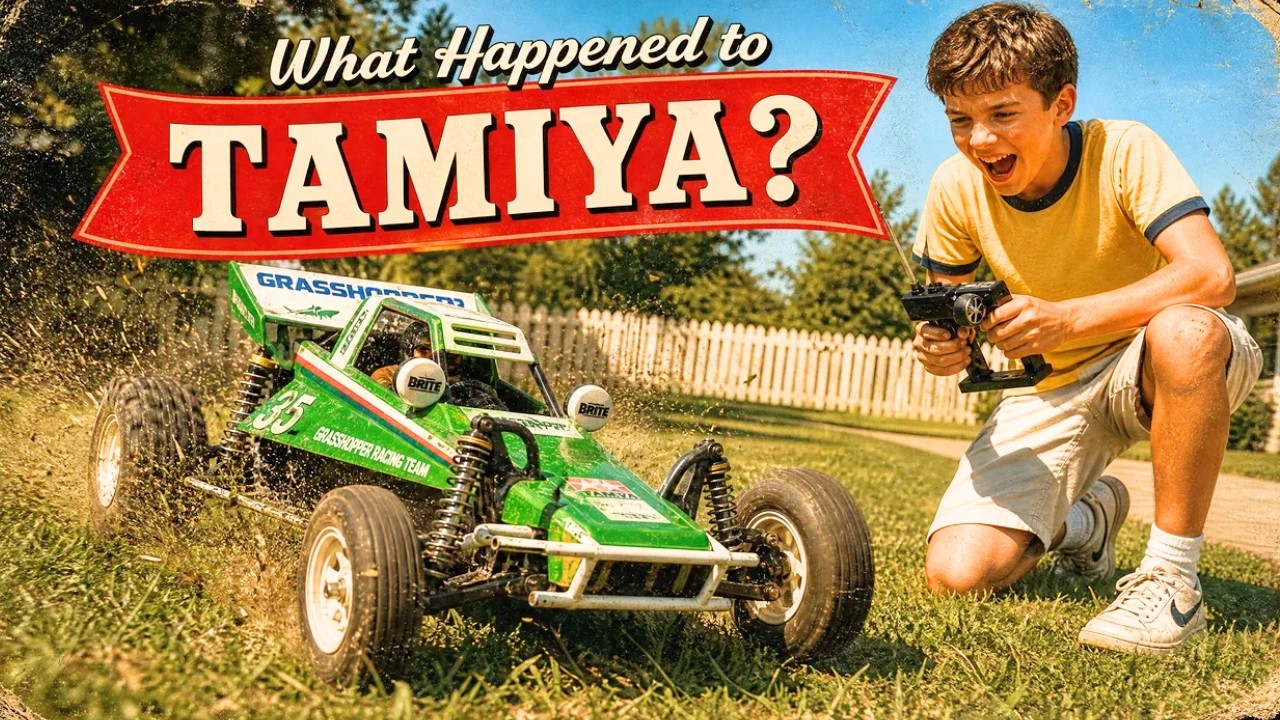
The Sand Scorcher followed, a Volkswagen Baja Bug with a body detailed enough to look shrunk from a real car. Then the Grasshopper, the entry-level buggy every kid could afford, which taught a generation how to build, drive, crash, fix, and build again. Then the Hornet, the Frog, the Fox, the Hot Shot, the first four-wheel-drive Tamiya, which made every other RC car on the track look like a toy. And the Avante, the pinnacle, now selling for $900 in the original box.
Every one of them was a kit, not a finished product. The construction process itself was an education. You mounted the motor, wired the speed controller, and soldered the connections; the first time you soldered a Tamiya kit, you burned your finger, and the second time too, and the third time you held the iron at the right angle long enough to make a clean joint, and the solder flowed like liquid silver into the connection, and you felt like an engineer. You assembled the gear train.
This was the part that separated the patient from the impatient. The gears had to mesh perfectly. Too tight and they would grind and strip; too loose and they would skip and lose power. You adjusted them by ear, listening for a hum that meant the gears were meshing correctly.
That hum was the sound of precision, the sound of getting it right, the sound of everything working the way the instruction book said it would if you followed the steps and did not skip ahead. You filled the oil-filled shocks with actual silicone oil from a tiny bottle; if you overfilled them, they leaked, and if you underfilled them, they bounced, and finding the right level was an art nobody could teach you. You painted the body, the part that took the longest and mattered the most. Three coats of white primer from a Tamiya spray can, each dried for 24 hours.
Then masking tape laid carefully along the lines between colors, pressed down with a fingernail to prevent bleed. Then two coats of blue or red or orange, dried overnight. Then a pinstripe done by hand with a brush that had three hairs on it, and the pinstripe wavered a little because your hand was not perfectly steady, and the waiver became part of the car’s character. Your car, your waiver, your imperfection that made it perfect because it was yours.
Paint got on your fingers, on your jeans, on the newspaper, on the garage floor. Thirty years later, the stain was still there if the house had not been sold. Then came the moment. Everything—the cutting, the gluing, the soldering, the painting, the waiting, the adjusting—was for this.
You carried the car outside and set it on the driveway. Your friend was there, the neighbor kid was there, everyone wanted to see if it worked, because it might not. You might have wired the motor backwards. You might have stripped a gear.
That possibility is exactly what made the moment you pressed the trigger, the wheels spun, and the car lurched forward and shot down the driveway feel like every Christmas morning compressed into one second. You drove it into the curb on the first run, into the mailbox on the second, through a puddle that shorted the electronics on the third, and you had to take it apart and dry everything with a hair dryer. You broke the front bumper on day one, stripped the spur gear on day two, and on day three you went back to the hobby shop for replacement parts, where the man behind the counter said, “Let me guess, the steering rod? ” because he had seen a thousand boys break the same part on the same car in the same week.
You went home, fixed it, drove it again, broke something else, and fixed that too. Build, drive, break, fix, build better, drive faster, break harder, fix smarter. It was not a hobby. It was an education, and every broken part taught you something no classroom ever could.
The hobby shop was where it happened, every Saturday morning—a physical store on a strip mall or a side street with a bell on the door and a man behind the counter who knew your name and what part you needed before you told him. The shelves were stacked with Tamiya boxes, motors, tires, shocks, bearings, pinion gears, body shells, paint, and tools. You could spend an hour in that store and buy one $9 part, and the man did not rush you because he understood that the hour was the point. Most of those shops are gone now.
The bell on the door is silent. The shelves hold nothing, or the strip mall is a nail salon or a vape shop. The man behind it all was Shunsaku Tamiya, son of the founder and chairman of the company. He personally photographed full-size tanks, aircraft, and automobiles, then demanded that his modelers reproduce every bolt, every weld seam, every scratch on the real machine in miniature.
He was so obsessed with accuracy that during the Cold War, the Japanese police placed him under surveillance, because he had been visiting the Soviet Embassy in Tokyo. He was not spying. He was photographing Warsaw Pact tanks—T-72s, BMPs, BTRs—because his model line needed to be accurate, and the only place in Japan where you could see a real Soviet tank was the Embassy parking lot. The police watched him for months before they understood that this man was not a threat to national security.
He was a model builder who refused to guess what a rivet looked like when he could photograph the real thing. Shunsaku Tamiya died on July 18, 2025, at the age of ninety. He had spent his life making kits that taught boys how to build, paint, read instructions, be patient, fail, fix, and hold something in their hands that they had made from nothing and feel pride no store-bought toy could deliver. And the thing he feared most has happened.
The company survived—it still makes the best 1/35-scale military models in the world—but the culture he built is dying. Today, you can buy an RC car ready to drive out of the box, ready to run. RTR. Three letters that killed a generation of builders.
No building, no soldering, no painting, no adjusting, no Saturday mornings at the hobby shop, no four-hour gear train assembly, no three-coat paint job, no listening for the hum, no burned fingers, no paint on the jeans, no waiver in the pinstripe, no pride. You open the box, charge the battery, and drive. It is faster, more durable, cheaper, and handles better on a track than anything Tamiya made in 1985, and it is worth exactly as much as the time you spent building it, which is zero, because you did not build it. Someone in a factory built it.
The thing that made a Tamiya yours—the hours, the patience, the mistakes, the fixes, the paint, the solder, the hum—is not in the box. The children of today will never know the feeling of spending four Saturdays building something that crashes on the first run and sends you back to the hobby shop for a $7 part and back to the kitchen table for two hours of repair work that teaches more about engineering than any classroom ever will. Ready to run is better, easier, faster, and it is the reason the hobby shops closed, the kitchen tables are clean, the garages have no paint stains, and the boys who built machines with their hands are men who buy machines from Amazon with their credit cards. A man on eBay bought a vintage Tamiya Falcon for $200.
He wrote a review: “One of the first RC cars growing up. I was about 15 years old and it was my cousin’s RC car. I was hooked from that point on. My family all have went on to become successful policemen, doctors, and engineers.
The funny thing is we all still remember our old RC cars. Money can’t buy time, but it can buy my old RC of my childhood. ” Money cannot buy time, but it can buy the box. The box with the painting on the front, the box that smells like polystyrene when you open it, the box that contains a hundred parts on gray sprues and an instruction book and a sheet of decals and the promise that if you are patient enough and careful enough and willing to spend four hours on a Saturday afternoon with a hobby knife and a soldering iron and a can of paint, you will build something that moves, something that is yours, something that nobody gave you and nobody can take away because you made it with your own hands.
Shunsaku Tamiya is gone. The hobby shops are closing. The ready-to-run cars are winning.
But the box is still on the shelf, and the boy who built his first Tamiya on a kitchen table in 1982 still remembers the hum of the gears, the smell of the paint, and the moment he set it on the ground and pressed the trigger, and it moved because he built it.