Dwight Eisenhower did not merely win the war. He lived long enough to define what winning had meant. By the time the guns fell silent in Europe, the public assumed that Eisenhower and his surviving generals had written a unified account of victory—coordinated leaders, shared preferences, and a clean narrative of alliance that matched the handshakes and ceremonies. But the memoirs suggested something more specific: a consistent hierarchy of competence and temperament, where each surviving general held a distinct role.
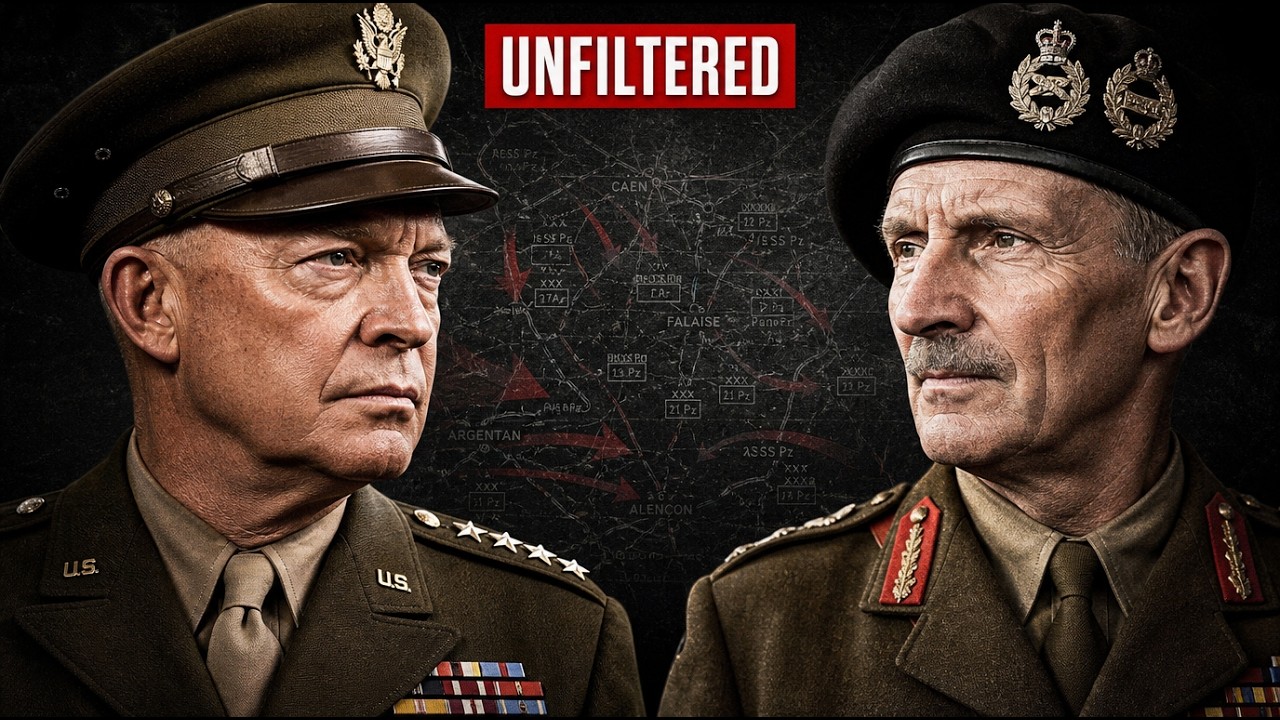
The strategist. The steady hand. The difficult ally. The volatile weapon.
George Patton’s private papers suggested something far less stable than either public version of the war. He died first, in December 1945, in Germany, in the aftermath of the conflict he had helped win. Everyone who outlived him gained a chance to shape the meaning of his death before he could respond. Eisenhower rose to become Supreme Allied Commander of NATO and then President of the United States.
Montgomery rose to field marshal and Deputy Supreme Allied Commander of NATO. Bradley became Chief of Staff of the Joint Chiefs of Staff. Each accumulated institutional authority, public platforms, and the publishing power that came with being a respected, surviving statesman rather than a controversial general who died young. History did not simply belong to the best general.
It belonged to the men who lived long enough to publish their version of events while the public was still listening. In his 1948 book, Crusade in Europe, Eisenhower placed Patton with deliberate, measured precision. He acknowledged Patton’s aggression in battle, the speed of the advance across France, and the operational brilliance of the turn toward Bastogne. He never diminished Patton’s tactical value.
What he did consistently was place that value within a larger structure of alliance discipline—the very discipline Eisenhower himself represented, and which Patton repeatedly threatened. The image emerging from Eisenhower’s own pen was not contempt. It was something more specific: Patton as a tactical weapon, highly effective within carefully managed limits, requiring constant institutional supervision to remain useful rather than dangerous. Eisenhower wrote about Patton the way a commander writes about an asset whose power and risk were matched equally.
Valued precisely for the qualities that also made him impossible to fully trust. This framing mattered enormously because Patton was no longer alive to challenge it. Within three years of Patton’s death, Eisenhower’s book had become part of the foundational public record of the war. The man described in it never had the chance to respond, correct, or contextualize anything Eisenhower chose to include or omit.
Eisenhower’s statements about Montgomery carried entirely different dimensions. While Montgomery was diplomatic in public, the relationship was tense in substance. Montgomery represented the prestige of the British Army and a competing leadership philosophy that Eisenhower had to manage as a coalition necessity throughout the campaign. Whatever his personal feelings, the image Montgomery crafted for himself—during the war and in his later memoirs—positioned him as the measured, rational, systematic counterweight to what he described as American operational recklessness.
That framing placed Patton specifically as the flamboyant, strategically limited commander. Eisenhower’s public language about Montgomery, read carefully in his postwar statements and memoirs, reveals a man who was diplomatically generous toward a colleague he found difficult, self-promoting, and politically impossible to bypass. Eisenhower needed Montgomery’s cooperation to maintain alliance cohesion. Based on the available evidence, he did not trust Montgomery’s judgment any more than he trusted Patton’s.
But he trusted Montgomery’s prudence and his ability to disagree through official channels rather than through the press. That distinction formed the basis of Eisenhower’s postwar hierarchy of the commanders who served under him. The question was not primarily who was the better tactician. It was who could be trusted to manage his public appearances without creating problems Eisenhower would have to absorb.
Omar Bradley occupied the most institutionally comfortable position in Eisenhower’s postwar vision, and the comparison with Patton makes this clear. In his 1951 book, A Soldier’s Story, Bradley presented himself with a more measured, restrained tone than either Patton’s reputation or Montgomery’s self-mythologizing memoirs. Bradley’s public persona—sober, methodical, institutionally reliable—matched exactly what Eisenhower valued in subordinates: competence without political cost requiring constant management. Eisenhower’s relationship with Bradley, according to the documented records, was the most institutionally stable of the three.
There was no crisis comparable to the soldier-slapping scandal in Sicily, no statements comparable to the denazification remarks that forced Patton’s removal from actual command. Bradley simply did not generate the kind of public controversy that required Eisenhower to spend political capital protecting him. Yet Bradley’s memoir, by presenting himself as the rational American counterweight to Patton’s instability, helped cement a specific hierarchy in the public record. Patton as the brilliant, unstable field weapon.
Bradley as the engineer of operations and the steady hand. Montgomery as the difficult but necessary coalition partner. Eisenhower above them all, the disciplined strategic center who managed this volatile arrangement toward victory. This was the structure the three memoirs reinforced independently and consistently in the years immediately following Patton’s death—while the man subjected to that classification no longer had a voice in how it was framed.
What gives this story its edge is what survived on the other side of the record, in papers no one outside the family was allowed to read for nearly two decades. Patton’s private correspondence and diaries, unavailable to historians until his papers were published, documented a far more hostile personal assessment of those same men who were simultaneously building their public record without him. He believed Eisenhower had repeatedly prioritized alliance politics and allied diplomacy over real military opportunity. He believed the campaign through France and Germany could have ended sooner under a more aggressive, less politically cautious command.
He considered Montgomery overrated and overly cautious, a commander whose reputation exceeded his actual battlefield contribution. He believed the Allied high command as a whole was institutionally willing to sacrifice operational momentum for political safety throughout the entire campaign. These were not passing grievances. They were documented, specific criticisms naming individual decisions and the officers responsible, by name.
Beatrice Patton, who managed her husband’s papers in the years after his death, made a deliberate decision to burn certain letters that mentioned Eisenhower directly—not to protect Eisenhower, but because she fully understood what those pages would have done to a man who, by the time she made that decision, was already preparing for the presidency of the United States. What remained eventually passed to George Patton IV, who inherited the broader archive. In 1963, in collaboration with historian Martin Blumenson, the Patton family authorized publication of The Patton Papers. Nearly two decades after Eisenhower, Bradley, and Montgomery had published their own accounts of the war, the historical record finally gained a documented account of just how hostile Patton’s private judgment of his surviving colleagues actually was.
By 1963, the postwar hierarchies were already entrenched in the public imagination. Eisenhower had been president. Bradley had served as Chief of Staff of the Joint Chiefs of Staff. Montgomery’s prestige had become institutionalized at the highest levels of NATO command.
The Patton Papers did not overturn that hierarchy. They complicated it, offering a documented counter-record that historians were forced to weigh against the narrative the survivors had spent eighteen years establishing as the approved version. What Eisenhower said about the generals who outlived him was not merely a matter of personal assessment or nostalgia for wartime. It was a strategic judgment, a political calculation, and an institutional positioning executed by a man who understood—consciously or not—that the historical record of the war would be written largely by whoever remained alive, trusted, and published at the time of writing.
He portrayed Patton as a weapon requiring management. He portrayed Montgomery as a difficult necessity requiring diplomacy. He portrayed Bradley, through implicit comparison, as the model of what a senior commander should actually look like: capable, controlled, and not politically prominent. All of those portrayals appeared in print while Patton, the man subjected to the most direct evaluation across all three categories, had been dead for years.
He never had the chance to publish his own account in his lifetime. What he left behind survived only because his widow chose selectively what to destroy, and because his son finally decided, eighteen years after the war ended, that the documented record deserved a counterbalance. Eisenhower did not simply win the war and then describe what had happened. Through the language of his own memoirs and the years of institutional authority that followed, he helped determine the permitted meaning of the other men’s contributions—while the one general best able to respond had already been buried in Luxembourg for nearly two decades.
That is what survival actually gave him. Not just the presidency or NATO command, but the first draft, uncontested, of how history would remember them all.