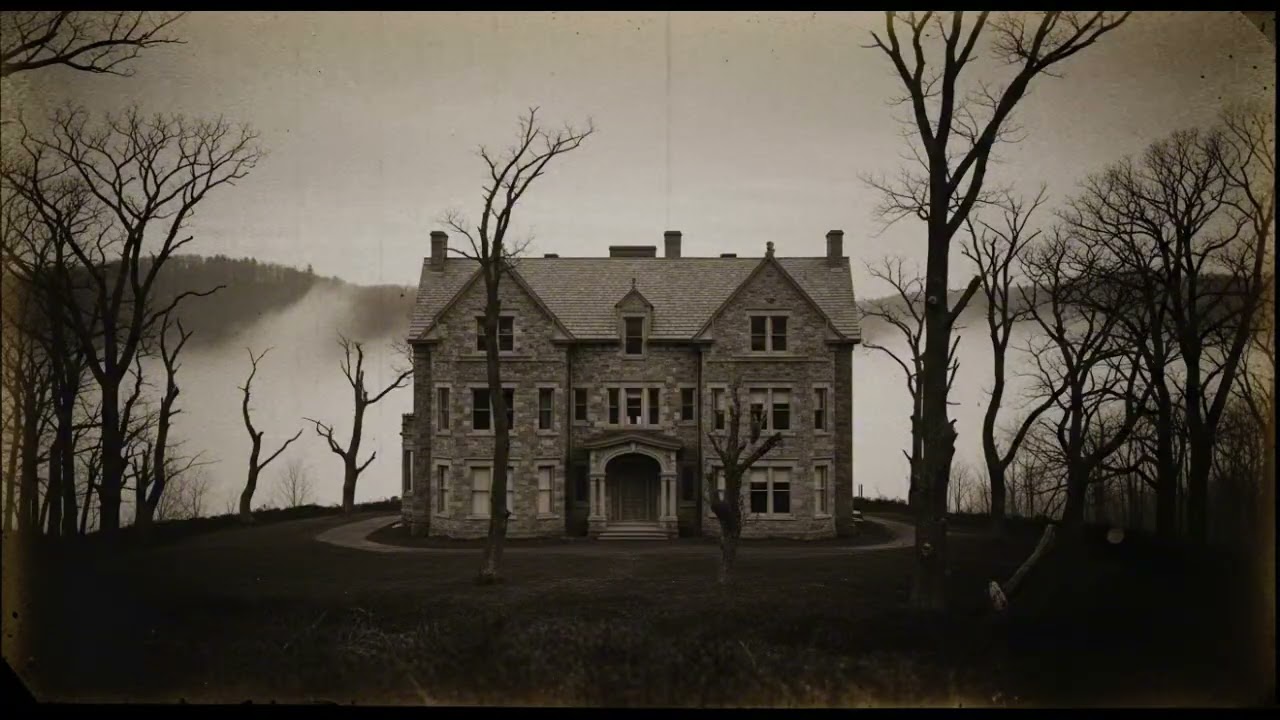
In the autumn of 1887, a surveyor named Cordell Acheson rode into Dresden Hollow, a coal settlement of roughly two hundred souls pressed into a narrow Appalachian valley where the Elk River bent sharply south. He had been sent by the Allegheny Land and Mineral Company to map mineral rights along the Elk River Basin, and his assignment included the ridge three miles north of town, where an old house stood on a rutted path winding through black oak and hemlock so thick it barely let in the sky. Nobody in Dresden Hollow called it Thornville Manor anymore. They called it the Lynedon Place, after the family that built it, or they did not call it anything at all.
When pressed, the older residents would look at a stranger with something that sat between anger and fear and say only this: Don’t go up there. The first person Cordell spoke to was Odessa Purdy, who ran the general store with her husband Harlan. When Cordell told her he would be surveying the ridge with the old house on it, her hands, which had been moving constantly since he walked in, went still. She warned him plainly that people who went up there came back wrong, and some did not come back at all.
She would say nothing more. That night, Cordell sought out the town preacher, Reverend Aion Cargill, who sat on the church steps smoking a pipe as the fog rolled in from the river. The reverend told him the history. Phineas Lynedon and his wife Jovetta had arrived in 1841, bought three hundred acres on the north ridge, and built a house of twenty-two rooms with a stone foundation and a slate roof.
For years things were fine. Phineas harvested timber, Jovetta kept the house, and they came to church on Sundays. Then, around 1853, they stopped coming to town altogether. A logger who worked for them reported hearing a hum at night, like the house itself was vibrating, as if it were alive.
By 1855, nobody in the valley would work for the Lynedons anymore. Supplies they ordered were never picked up. A boy sent to deliver flour made it to the gate and turned back, saying the front door stood wide open and something was watching him from inside, though he could not see it. In 1857, a county marshal went up to the house.
He came back three hours later and filed a report saying the house was empty, with no sign of the Lynedons, no sign of struggle. Personal effects remained in place. Clothes hung in the wardrobes. Food rotted in the pantry.
Beds were still made. It was as if the couple had simply stopped being there. The county tried to auction the property twice. No buyers.
A family from over the mountain moved in around 1870, lasted nine days, and left everything behind. The husband would not speak of what happened. The wife never spoke again for the rest of her life. Cordell went up anyway.
He left at dawn on the eighth of October, leading a mare whose disposition was as sour as his own. About two miles up the ridge, the forest changed. The trees twisted into corkscrews, their branches reaching inward toward each other, forming a canopy so dense the morning light could not penetrate. Then the sound stopped, not gradually but all at once, an absolute silence that had weight.
The mare refused to move. Cordell tied her to a tree and continued on foot. The house appeared suddenly, filling his vision as if it had always been waiting. It was enormous, two stories of gray stone with a slate roof gone green with lichen.
The windows defied counting. He tried three times and got three different numbers. The front door was closed, and from inside came a smell he had never encountered, sweet, almost floral, but underneath it acrid, like burned metal. It pulsed stronger, then weaker, as if the house were breathing it out.
Cordell crossed the clearing and opened the door. Inside, the house was dark but not completely. A faint luminescence seemed to come from the walls themselves. Furniture stood draped in white cloths.
In the parlor, a grandfather clock had its numbers arranged in the wrong order. In the dining room, plates were still set as if the diners had vanished between one bite and the next. In the kitchen, jars on the pantry shelves held dark, opaque contents, and one appeared to be moving. In the library, Cordell found hundreds of leather-bound books with titles on their spines, but when he opened them, every page was blank.
Except one. A plain black volume, worn soft with handling, filled with handwriting. It was Phineas Lynedon’s journal. The early entries were mundane, the ordinary concerns of a man building a life in a new place.
The tone shifted in 1849. Phineas wrote that Jovetta had found something in the cellar. His exact words were, “Jova found the door today. She says it was always there.
I have been in that cellar a hundred times, and I swear before God there was no door. ” After that, the entries became fragmented. Phineas wrote about the hum and the smell, which he called the breath. He wrote about rooms that he did not remember building, a hallway on the second floor that had not been there before, a window that looked out onto a landscape he could not identify.
“It is not the valley,” he wrote. “It is not the ridge. It is somewhere else entirely. ” He wrote that Jovetta spoke to someone he could not see.
He counted the rooms one day and found thirty-seven. There should have been twenty-two. The last readable entry was dated the third of March, 1853. It said only this: “We are not leaving.
We cannot leave. The house will not let us. It needs us here. It needs what we have.
It is patient. It has always been here, before the house, before the valley, before anything. We were foolish to think we built anything at all. We only gave it a shape.
” After that, the pages were filled with a single word written thousands of times, so small it was almost invisible: Below. Below. Below. Cordell closed the journal and went to the cellar.
There was a trap door set into the earthen floor, about four feet square, with a single iron ring for a handle. He reached for it, and something reached back. He felt, with absolute certainty, a presence on the other side of that door become aware of him. The lantern flame turned from warm yellow to a colder blue.
The shadows in the cellar did not correspond to the objects in the room. They were cast by things that were not there, tall shapes, still shapes, waiting. Then the hum started, exactly as the logger had described it thirty years earlier. It was less a sound than a pressure, and underneath it, just at the edge of hearing, there was something else, a current of meaning pulling in one direction.
Down. Cordell ran. He burst out of the house and into the clearing, where every window was now blazing with cold blue light. Then, one by one, the lights went out.
In the last window to go dark, he saw a figure, tall, thin, standing perfectly still, facing him. Back in Dresden Hollow, Odessa set a glass of whiskey in front of him without being asked. She told him what she knew. Her grandmother had been the Lynedons’ cook.
She had been there the night Jovetta opened the door. She described the air becoming heavier, the candle flame turning blue, the walls receding as if the cellar were expanding in real time. She ran and never went back. Over the years, others had gone up: a photographer in 1872, a mineralogist in 1879, the family that lasted nine days.
The mineralogist came back with notebooks full of diagrams, drawings of tunnels beneath the house. He said they were older than the mountains. He took a team of three men back with him in the spring of 1880, went down into the cellar, and opened the door. Nobody had seen any of them since.
Cordell left the next morning. That is what he should have done. Instead, he went back up the ridge. He gave only one explanation later: he had to see what was below the door.
He found the front door standing open, and the journal waiting on the foyer table, open to the last written page. He carried it down to the cellar. The trap door was gone entirely. In its place was a square opening in the earth with stone steps leading down into absolute darkness.
He lit his lantern and descended. The steps spiraled clockwise, 147 of them. The air grew warmer, which was wrong. The walls changed from rough hewn stone to something smoother, almost organic, like the inside of a throat.
Then the stairwell opened into a vast chamber. His light could not find the walls or the ceiling. The floor was smooth and polished, covered in thousands of glowing lines forming spirals, grids, and symbols that belonged to no language he knew. There were shapes rising from the floor, angles that did not connect, curves that bent in directions that should not exist.
They hurt to look at, not his eyes, but something deeper, the part of his brain that understood space. The chamber did not speak. It communicated in a way that bypassed language entirely. It wanted to be known.
It wanted to be mapped. Cordell was a surveyor. His entire life had been about mapping the unknown, reducing wild unexplored spaces to lines on paper. He opened his notebook and began to draw.
He drew for hours, maybe days. Time did not work correctly in the chamber. As he drew, the lines on the floor grew brighter, the hum grew louder, the shapes became more defined, as if his attention was giving them substance. He did not know when he stopped.
He did not know when he climbed back up the steps or walked out through the open front door. When he reached Dresden Hollow, stumbling down the ridge with his notebook clutched to his chest, Odessa looked at him and started crying. Twelve days had passed. Cordell opened his notebook, flipping through the dozens of pages he had filled with drawings and measurements, maps of something that existed in the deep dark places of the earth.
The pages were blank, every single one, as if nothing had ever been written on them. He could still feel the cramp in his hand. The graphite smudges were still on his fingers. The chamber had taken it back.
Cordell left that afternoon. He filed a report recommending abandonment of all claims to the property. He gave a statement to the county marshal in which he called going back the worst thing he had ever done in his life. Then he resigned from the company and never surveyed again.
In the years that followed, the house began to grow, visibly, measurably. Where it had been two stories, it became three, then four. New wings appeared in the same gray stone, but in styles that matched no architectural tradition. Windows were set at angles that made the eyes water.
Doors opened onto walls. The twisted trees crept closer, and the path up the ridge became harder to find. Within a few years, the house could not be seen from town at all. By 1900, nobody in Dresden Hollow went near the ridge.
The warning had become something unspoken. County records of the Lynedon property vanished. Maps showed nothing. A clerk in 1904 said there had never been a Lynedon Ridge, never been a Thornville Manor.
It was as if the house and everyone connected to it were being erased, not destroyed, erased like words wiped from a page. Odessa told one more person the story, a niece named Willa Jessimon Falls, who came to help in the store in 1912. Willa wrote everything down in a leather journal in a tin box under her bed and added to it over the years. The journal survived, and a copy eventually ended up in the archives of a small historical society in Charleston, where it was cataloged, filed, and forgotten.
Willa’s last entry was dated the fourteenth of November, 1947. Dresden Hollow had shrunk to fewer than fifty people. The coal was gone. She wrote that the ridge was quiet now, the house swallowed by trees, but that on some nights, very late, when the fog came up from the river, she could feel it, a hum, faint, distant, like a heartbeat underground.
She wondered if it was sleeping, or if it was finished, or if it was still waiting down there in the dark, patient as stone, patient as the mountains themselves, for the next person who came looking for something they could not name. Dresden Hollow is mostly gone now. The church collapsed in the 1960s. But the ridge is still there.
The trees on it are twisted and dense, darker than they should be. And if you pull over on the state road they built through the valley in 1952, and if you roll down your window, and if you listen, you might hear it. Not a sound, exactly, more like a feeling, a low steady vibration in the center of your chest. A hum.
And underneath the hum, very faintly, something breathing, something patient, something that has been here longer than the mountains, and it is not asleep.