On New Year’s Day 1953, the world learned that its greatest folk poet had died in the back of a powder blue Cadillac, his heart stopped by a lethal mix of alcohol and exhaustion. But the man who gave that voice its soul, the steel guitarist who translated that pain into a sound that shook the rafters of the Ryman Auditorium, was left behind in the crushing silence. His name was Don Helms, and for decades he was the architect of the cry, the high lonesome wail that defined American heartbreak. He spent his life mastering a machine to make it weep for the world, yet he ended his days as a forgotten footnote.
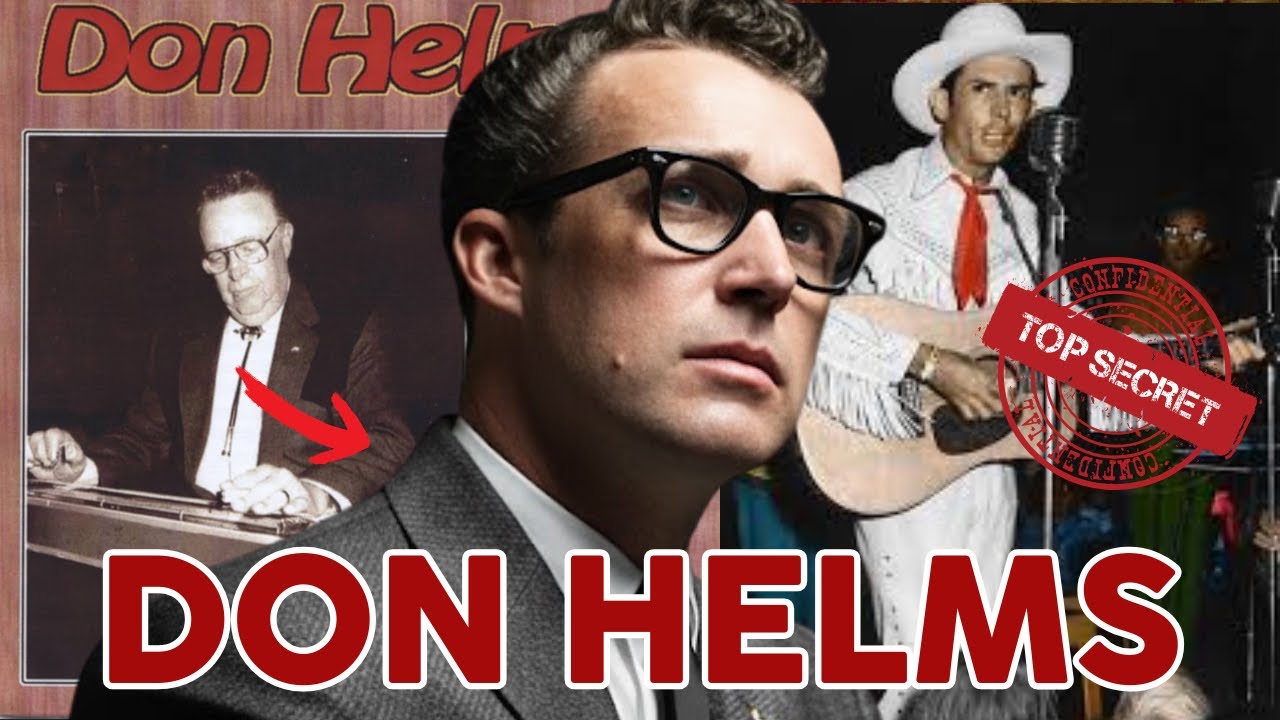
The sound was not born in the recording studios of Nashville or under the bright lights of the Opry. It was born in the dirt. Don Helms was born on February 28, 1927, in New Brockton, Alabama, in the era of the sharecropper, where families worked land they did not own for money they never saw. It was a world of physical exhaustion where children aged fast under the brutal southern sun.
In this world, silence was the enemy, so the people filled it with noise: the ecstatic shouting religion of Pentecostal churches and the string music of fiddles, banjos, and beaten acoustic guitars. Into this acoustic landscape, a new sound arrived through crackling radio static: the Hawaiian guitar. As it traveled into the American South, rural musicians with an instinct for tinkering raised the strings higher, electrified the instrument, and turned a sound of tropical relaxation into a sound of rural aggression and sorrow. Young Don Helms was listening.
He was not born into a musical dynasty, just a kid with big ears and an observant nature. When he finally got his hands on a steel guitar, it was a revelation. You do not hold it; you sit behind it. You wear metal picks and slide a chrome bar to the exact microscopic point on the string to find the pitch.
Off by a hair’s breadth, it sounds like a cat being strangled. Played perfectly, it sounds like an angel. Helms was a natural, but not flashy. He developed a dead thumb technique that muted the bass strings, creating a rhythmic, percussive thump while his fingers played the melody.
By his teens, he was playing honky tonks, rough roadside bars where fights were common and bands sometimes played behind chicken wire to catch flying bottles. In that environment, you played loud, and you played songs about cheating and drinking. Helms learned to be the anchor, sitting impassive while chaos erupted around him. The collision that changed history happened in 1943, when Helms crossed paths with a lanky, intense young man named Hyram King Williams, known to everyone as Hank.
Hank suffered from a congenital spinal condition that caused agonizing pain, and to manage it, he drank and took whatever pills he could find. But when he sang, something ancient came out. His voice was nasal and thin, but it had an undeniable authority. Hank had a band called the Drifting Cowboys, a revolving door of musicians because he was impossible to work for, moody, unreliable, often drunk, and demanding.
Yet when Helms met Hank, something clicked. Helms was steady; Hank was volatile. Helms was the mechanic; Hank was the mystic. Helms joined the band, but the draft board dismantled them during the war.
Helms joined the military, and Hank, classified 4-F due to his back, stayed behind. When the war ended, Hank called Helms back. The reformed Drifting Cowboys, with Helms on steel, Jerry Rivers on fiddle, Bob McNett on guitar, and Hillous Butrum on bass, were a finely tuned unit. Helms bought a Gibson Console Grande steel guitar, tuning one neck to E6 and the other to B11.
The B11 tuning produced thick, rich chords that sounded like a mournful organ; the E6 allowed high, stinging single notes. Because Hank’s voice occupied the middle frequencies, Helms played in the upper register, floating above the voice like a halo. Hank would sing a line, and in the pause, Helms would step in with a sliding, crying note that finished the sentence. They were having a conversation, Hank telling his troubles and the steel guitar nodding in sympathetic agreement.
Helms also knew when to lay out, letting the loneliness of the lyrics breathe. The big bang moment came on June 11, 1949, at the Ryman Auditorium. The Opry management was skeptical of Hank, a known drunk with a reputation as a loose cannon. But when they launched into Lovesick Blues, Hank attacked the song, yodeling and breaking his voice, and behind him the machine went to work.
When Hank went high, Helms went higher. The crowd went wild, and they played the song six times. The hillbilly had conquered the cathedral. Standing in the shadow of the spotlight, Helms realized their anonymous lives were over.
The defining moment of their collaboration came in 1951 during the recording of Cold, Cold Heart. The song felt like a dirge, and producer Fred Rose was unhappy. Helms placed his bar on the strings, picked a high note, and with a slow, deliberate motion slid the bar down. It was a simple melodic descent, played with heavy vibrato, and it sounded like a sigh, like the physical act of giving up.
Rose said, That’s it. Do that again. That intro became the most famous few seconds in country music. Before Hank sang a word, Helms had set the temperature of the room to freezing.
He developed a vocabulary of sounds: sharp staccato barks for fast, angry songs, wide swelling chords for spiritual songs, and notes that hung in the air forever for songs of pure loneliness. But the music was only thirty minutes of the day. The rest of the time was the road, two-lane blacktops and endless miles, five men crammed into a Packard or Cadillac, driving five hundred miles a night. Hank was in constant agonizing pain, and the medicine changed, from beer to whiskey to chloral hydrate and morphine and amphetamines.
Helms became the designated driver, literally and metaphorically, the one who made sure the gas tank was full, the one who woke Hank up when they arrived. He was the caretaker to an addict, a slow-burning trauma of love and fear. As 1951 turned into 1952, the wheels began to wobble. Hank’s marriage to Audrey was toxic, with furniture thrown and guns fired.
Concerts suffered; there were nights he was too drunk to stand and nights he simply did not show up. Helms stood on stage, catching Hank every time he fell. The breaking point came in August 1952. The Grand Ole Opry, the institution that had embraced Hank in 1949, fired him.
Devastated and feeling betrayed, Hank lashed out and disbanded the Drifting Cowboys. Helms was left in Nashville at twenty-five years old with a wife and bills to pay. Hank called a few times, asking Helms to come down, but Helms heard the slur in his voice and said no. He could not watch his friend die in slow motion.
He joined Ray Price and kept working, but every time he turned on the radio, he heard his own steel guitar playing behind Hank’s voice on records still topping the charts. He felt a phantom limb syndrome. His hands knew the notes, but the man was gone. On the morning of December 31, 1952, an ice storm moved across the American South.
In Montgomery, a powder blue Cadillac idled in a driveway, hired to drive Hank to a New Year’s Day gig in Canton, Ohio. Hank climbed into the back seat, frail, clutching a bottle. Helms was miles away, preparing to ring in the new year. He did not know the clock was ticking down to the final silence.
On January 1, 1953, the news traveled like a localized earthquake. Hank was dead in the back seat of the car, his heart stopped by a lethal cocktail of alcohol, morphine, and exhaustion. Helms did not scream or weep. He felt a coldness.
His entire identity had been wrapped up in preserving the fragile genius at the center of the stage, and now the genius was gone. The guilt of the survivor was terrible. Why was not I driving? The funeral on January 4, 1953, in Montgomery was a spectacle of grief.
Twenty-five thousand people descended on the city, crowding the streets and climbing onto roofs to glimpse the silver casket. In the middle of the hurricane, the four Drifting Cowboys stood on a small stage near the coffin. They were asked to play, and they chose I Saw the Light. Helms put on his picks, placed the bar on the strings, and began to play.
But there was a hole in the center of the sound, the place where Hank’s voice should have been. Helms played the melody with tears streaming down his face, the steel guitar crying out for its master. When the song ended, there was no applause, only the sound of people weeping. Helms packed up his guitar and realized the first chapter of his life was over.
What does a shadow do when the object casting it disappears? The months that followed were dark. The Drifting Cowboys were hired by Ray Price, who sounded eerily like Hank, but the telepathic connection was gone. Nashville was changing, moving toward the polished Nashville Sound, and the raw, piercing steel guitar was suddenly seen as too country.
Helms found himself fighting for relevance. But instead of quitting, he evolved. In 1957, he got a call from producer Owen Bradley to play on a Patsy Cline song called Walkin’ After Midnight. It was not a waltz; it had a swing, a bluesy, almost jazzy feel.
Helms realized his old tricks would not work. He smoothed it out, playing long sustaining chords that shimmered in the background. The song became a massive crossover hit, and Helms proved he was not just Hanks steel player. He was a musician of infinite adaptability.
But the past has a way of circling back. Hank Williams Jr. was three years old when his father died, and his mother Audrey was determined to turn him into a clone. He was dressed in his father’s old stage clothes and taught to mimic his father’s stance.
To complete the illusion, Audrey hired the Drifting Cowboys. For Helms, playing behind the boy was a disorienting nightmare, participating in a seance. He saw the same cracks forming, the drinking, the rebellion. But this time the ending was different.
Hank Jr. eventually broke free, falling off a mountain and being reborn as an outlaw rocker. When that happened, Helms quietly stepped away. He had carried the torch from father to son until the son was strong enough to build his own fire.
By the 1980s and 1990s, Helms was an elder statesman, but in the music business, statesman often means unemployed. He lived in a comfortable home in Nashville with his wife Hazel, the woman he had married in 1945. The phone had stopped ringing. He played nostalgia circuit reunions at small theaters and county fairs, where audiences remembered the songs and wept when he hit the Cold, Cold Heart intro.
He was a time traveler, giving them back their youth. In the twilight of his life, one final storm cloud gathered. Jett Williams, born five days after Hank died, the daughter of a woman Hank had a brief affair with, had been adopted, her identity erased by Hank’s mother. After decades of legal battles, she won recognition as Hanks daughter and wanted to connect with the father she never knew.
She called the man who had the sound. In his seventies, Don Helms sat down behind the steel guitar one more time to back the daughter of his dead friend. It was an act of quiet defiance, saying the music belongs to the blood and the truth. On August 11, 2008, Don Helms died in a Nashville hospital at eighty-one, surrounded by family.
There was no national day of mourning. The obituary in the New York Times was respectful but brief. The funeral was held, the surviving members of the country music community came, said he was a good man and a pro, the last of the Drifting Cowboys, and then went home. But the sound he created has detached itself from the man and become part of the atmosphere.
Every time a steel player in a dive bar plays a sad song, they are quoting Don Helms. He was the invisible man, the ghost in the machine, the man who stood in the shadow so that others could shine. He proved the one truth Hank spent his whole life trying to say but never quite could: words can lie, but the steel guitar tells the truth.