When the first Hopi ancestors climbed up out of the world below and stood in the light of this one, they were not alone. Someone was already here. A solitary figure had been walking this world before any human being set foot on it, tending small fires beside his fields in the dark. He owned the land.
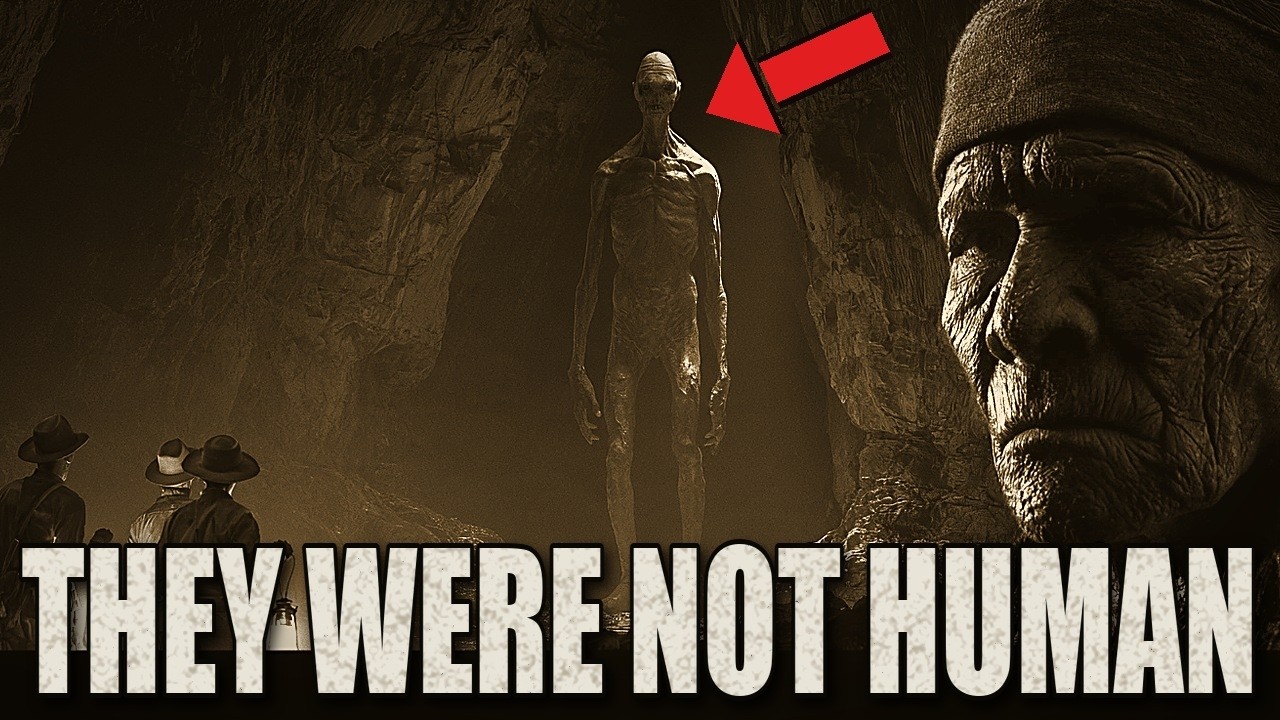
He owned the fire. He owned death. When the survivors of a drowned world emerged exhausted, carrying almost nothing, they had to ask his permission to stay. The Hopi say he gave it, but with conditions, and those conditions still govern life today.
His name is Masa, and in every recorded version, one detail never moves. He was not human. The journey out of the third world was not made by human beings alone. It was a migration shared with beings that ordinary categories cannot hold.
The accounts that missionaries, ethnographers, linguists, and Hopi authors set on paper between the 1880s and the 1990s tell one of the strangest and most complete origin traditions ever recorded in North America: a world before this one, a civilization that flew, a flood that ended everything, and beings who were already standing here when humanity arrived. The earliest detailed accounts were gathered in the 1880s and 1890s when Alexander Stephen and Jesse Walter Fewkes were living around the Hopi villages, writing down what people were willing to tell them. In 1905, a Mennonite missionary named Heinrich Voth published a large collection of traditions through the Field Columbian Museum in Chicago, most of it from Oraibi and Second Mesa. Voth was a complicated figure.
The anthropologist Peter Whiteley wrote that Voth is, in his words, universally reviled in contemporary Hopi discourse. He pushed his way into private ceremonies and was physically removed from at least one. He had ceremonial altars built for a museum display in Chicago; in 2001 two of them were listed in the Federal Register as sacred objects to be returned, and in 2015 around 2,200 of his photographs went back to the Hopi Tribal Council. His collection is used because it is the earliest full record of these stories that exists, and the history of how it was obtained must be told alongside the content.
In 1936, a Hopi man named Edmund Nequatewa published his own account, Truth of a Hopi, telling the story from inside the culture. The famous version came later. In 1963, Frank Waters published Book of the Hopi with the Hopi artist Oswald White Bear Fredericks of the Coyote Clan at Oraibi doing the recording and translating. The book made the four worlds famous far beyond Arizona, but scholars remain cautious about it.
One researcher wrote that a great deal of American and European misunderstanding of the Hopi comes out of that single volume. Albert Yava, a Hopi Tewa man from First Mesa, said of it that there is quite a bit of nonsense in it that no knowledgeable Hopi would accept. Three further sources matter deeply: Yava’s own book Big Falling Snow, published in 1978; the 1987 study Maasaw: Profile of a Hopi God by linguist Ekkehart Malotki and Hopi speaker Michael Lomatuway’ma, built from narratives recorded in the Hopi language; and the 1998 Hopi Dictionary compiled with elder speakers and the Hopi scholar Emory Sekaquaptewa on the editorial team. The idea that sits under everything else is this: the world now being lived in is not the first one.
Humanity has already lived through three complete worlds, each created, each filled, and each ended when the people in it lost their way. The one we occupy now is the fourth. The first is Tokpela, endless space. The people lived simply, understood the animals, and felt the earth as something alive under their feet.
Then they slowly forgot and began trading kindness for suspicion. The animals drew away from the people first, before the people had noticed anything was wrong. The first world ended in fire. Volcanoes opened and the land burned.
But before it burned, the people who had kept their hearts open were told to travel, following a cloud by day and a star by night, and they came to a great mound. Inside that mound lived a people who were not people. In English they have become known as the ant people. They are not insects; they are described as an underground race, intelligent, organized, and generous.
When the surface burned, they opened their tunnels and took the human survivors in. The tradition says they tightened their own belts rather than let their guests go hungry, which is offered as the reason an ant’s waist is so narrow. Two cautions are necessary here. The ant people do not appear in Voth’s 1905 collection under any name; the story everyone now tells comes from Waters in 1963.
And the phrase often repeated online, Anu Senom, appears in neither Waters nor Voth and seems to have entered circulation through a modern article arguing a connection to the Mesopotamian Anunnaki. The Hopi do have an old story about why ants are thin, recorded by Voth, and it has nothing to do with generosity: in it, an ant dresses one of the whipping spirits and lays into young initiates so hard their bodies are nearly cut through at the middle. The gentler explanation is the newer one, and that matters when building any interpretation on it. The humans stayed underground until the fire was finished, then came out into the second world, Tokpa or dark midnight.
It was colder and harder than the first, and the people did well anyway. They built villages, stored goods, began to trade, and then began to want more than they needed. Trade became greed, greed became conflict, and the second world was judged too corrupt. In the Waters account, the creator orders the twins who hold the poles of the earth to leave their stations.
The moment they do, the world loses its balance, spins wildly, rolls over, and freezes. Mountains of ice cover the land. However one reads it, it is a striking image for an oral tradition from the high desert to carry: the stability of an entire planet resting on its poles, and the poles failing so that the world tips and goes under ice. Once again the survivors waited it out below ground, sheltered by the ant people, and when the ice finally ended, they climbed out into the third world.
The third world is called Kuskurza. Waters places a bracket after the name and writes that it is an ancient word for which there is no modern meaning. The first, second, and fourth worlds all have translations attached—endless space, dark midnight, world complete—but the third, the one with the cities and the war, is the one whose name nobody can read anymore. Also worth noting: the four names themselves appear nowhere in the ethnographic literature before 1963.
The idea of four worlds is old—Frank Hamilton Cushing took a version down from a Hopi man in 1882 that plainly describes this world and three cave worlds before it—but the names came with Waters. In the third world, humanity became powerful. The people multiplied and built large cities. Separate nations formed, each with its own ambitions.
And then comes a detail that has launched a thousand videos: according to Book of the Hopi, the people made something called a puvot, which Waters translates as a shield made of hide, and the tradition says those shields flew. Men flew to other cities, raided them, and came home fast enough that nobody could be certain who had struck them. City after city armed itself the same way, and the third world went to war with itself. The remarkable element is not prehistoric technology but the fact that a desert farming people, centuries before powered flight existed anywhere on Earth, preserved a cautionary tale about what happens when human beings learn to fly and immediately turn it into a weapon.
Even the word itself is unsettled: in the body of Waters’s book, puvot is glossed as a shield made of hide, but in the glossary of the same volume, the same author defines it as water shield, flying shield. In Hopi, paa is water and tuvot is a shield; the famous flying shield carries the word for water inside it, and its own author could not decide across two hundred pages whether it was made of hide or made of water. The corruption of the third world went deeper than warfare. The accounts describe the rise of the powaka, usually translated as sorcerers or two-hearts, people who used hidden knowledge for their own benefit at everyone else’s expense.
In recorded stories, the women of one great city became so absorbed in ceremonies and dances that they neglected their homes and children. Husbands looked for wives who did not come back. Children were left to wander. The social fabric rotted quietly, one thread at a time, while the cities got richer and the flying shields multiplied.
This time the world could not be ended by fire, already used, or by ice. Sotuknang told Spider Woman the third world would end in water. And here the Hopi flood account does something almost no other flood tradition on Earth does: it does not give the survivors a boat. Spider Woman acted before the water came, sealing the people who were to be saved inside hollow reeds, great reeds cut and packed with a little water and a little white cornmeal, one person or one family to each.
Then the rain came. The seas rose. Waves taller than mountains rolled across the land. Continents broke apart and sank.
The people floated sealed in the dark inside reeds, rocking on an endless ocean for what the story calls a very long time. They could hear the water and feel the movement but see nothing. An ark is a vessel; a reed is a seed pod. This is not sailors riding out a storm but a world being replanted.
A common question follows: if the whole world was underwater, how could anyone have survived underground? The answer is that nobody did, not in this tradition. The first world ends in fire and the survivors go below ground with the ant people. The second ends in ice and they go below ground again.
The third ends in water and they do not go below ground at all; they go up, sealed in reeds on the surface. The confusion comes from the internet version, which mixes all three endings into one flooded underground rescue the sources never describe. The shelter that works against fire and ice is the shelter that drowns you in a flood, and this tradition knows it. When the water calmed, the people came out of the reeds onto a small piece of land with water in every direction.
They planted the reeds they had traveled in, built rafts, and moved from island to island, always pushing east and north, crossing islands that were the tops of drowned mountains, stepping stones between the old world and the new. Behind them, one at a time, those islands went under. Eventually they reached the shore of the fourth world, our world, and the land already had an owner. There is not one Hopi emergence story; there are at least two.
In the reed version Waters recorded, the people cross the sea. In the versions Voth took down at Oraibi, the ancestors climb up from the world below through an opening called the sipaapuni. Some accounts locate the place of emergence precisely in the gorge of the Little Colorado River, three and a half to four miles upstream from where it joins the Colorado, a real geological feature, a dome built up out of the mineral deposits of a spring. That spot is not inside Grand Canyon National Park but on Navajo Nation land, a restricted site closed to outsiders.
For the Hopi it is not a metaphor; it is a location. The climbing version reads less like a symbol and more like a rescue operation. The world below had gone dark and crowded, water was rising, and the corruption of the two-hearts had gotten into everything. The people heard footsteps above the sky of their own world, something walking on the other side of the ceiling.
They made birds out of clay and gave them life. One after another flew up, circled, and came back without a way through. Then the mockingbird found a crack of light, an opening in the dome of the world, and found the solitary figure tending fires beside his fields. The bird asked on behalf of the people below whether they might come up, and permission was given.
The problem of moving a nation through a hole in the sky was solved by growing their way out. The chiefs planted beneath the opening and sang over what they planted. A pine went up and fell short. A second kind of pine fell short.
A sunflower failed. Then they planted a reed, hollow and jointed and fast, and it went through the opening into the world above. Families, clans, and whole peoples climbed up through the inside of it, or up its outside, notch by notch, in the dark for days, with the sound of rising water somewhere underneath. Some accounts keep one indispensable detail: in Nequatewa’s telling and in Courlander’s, the one who plants and tends the growing shaft is a chipmunk.
Nobody makes up a chipmunk. Then the chiefs looked down and saw that people were still climbing, and among them, coming up in the crowd, were the two-hearts they had been trying to leave behind. In one version the village chief shouted to stop and pulled the reed up out of the opening, and a great many people still on it dropped back. In another the twins tore it out by the root and shook it, and the people fell away like seeds off ripe grass.
In Nequatewa’s telling they cut it down, and because there were still people inside it when they cut, that, he says, is why the cane is jointed. However it is told, the door closed. The third world was sealed along with everyone who had not made it out in time. Every major version agrees on what happened next.
The people met Masa, and the descriptions of him are unlike anything else recorded in the Southwest. He is the guardian of the fourth world, the deity of the surface of the earth, and at the same time the deity of fire and of death. Voth did not translate his name; he just called him skeleton over and over, ninety-five times across that collection. Nequatewa says his head was like the biggest squash and that there was no hair on it.
He walks at night carrying a flaming torch, and one account says he walks clear around the edge of the world every night. A detail constantly repeated online claims Masauwu never sleeps; Voth’s collection says the opposite in plain words. He hunts during the night and sleeps all day. And in one story the mask comes off to reveal a very handsome man wearing four strands of turquoise.
He is a figure of genuine terror and genuine reverence at the same time, a being who is death and also described as the greatest friend the people have. Skull and bloody mask, handsome man in turquoise: both are in the same body of stories. That contradiction is not a flaw in the tradition; it is the entire point of him. A whole book exists dedicated to him, Maasaw: Profile of a Hopi God, 273 pages assembled from narratives recorded in the Hopi language, and it is almost never mentioned in the videos about this subject.
The leaders approached the owner of the land and asked whether they could live in his world. Masa did not wave them through. He questioned them, asked what they had brought and what kind of life they intended to live. Then he laid out his terms.
He showed them a planting stick, a pouch of seed corn, a gourd of water. This, he told them, is my life. He owned everything they could see and he lived as the poorest of the poor, planting with a wooden stick, carrying his own water, walking his own land on foot. If they wanted to stay, they would live the way he lived, simply, as farmers and caretakers, not as conquerors.
The tradition dramatizes that choice. Just after the emergence, ears of corn are laid out in front of the gathered peoples: long, heavy, beautiful ears full of promise, and among them one short, stubby, unimpressive ear. Each people is invited to choose. The others move first and take the long ears.
The Hopi wait and take what is left. In Courlander’s version the Hopi took the stubby ear with blue kernels and became the people of the short blue corn. In Waters it is not Masa who lays the corn out but the creator. What is constant is the meaning: the long ears meant an easy life that would burn out fast; the short one meant a hard life, a humble life, and a long one.
Blue corn is still at the center of Hopi farming and Hopi ceremony today. The mockingbird that found the opening in one of Voth’s tellings comes back at the emergence in another. It sits where the people come up into the light, assigns them their places, and gives them their languages. To one it would say, You shall be a Hopi.
Courlander has the same scene; Albert Yava keeps it too. A songbird, the animal that can imitate every voice, standing in the doorway of the world, handing out languages. The price of admission to the new world was to give up permanently the power of the third world, sealed with the choice of the smallest ear of corn on the ground. The Hopi name for themselves, Hopitu, is usually translated as the peaceful people or the ones who follow the proper way.
The story of the third world is not an ancient technology mystery; it is a rejection. An entire people looked back at a memory of power and wrote into their deepest tradition the conclusion that it had not been worth it. Masa was not the only non-human being at the emergence. When the people came up from the world below, spirit beings came with them, the katsinam, living spirits who were never human.
They came up alongside the people and traveled with the clans through the migrations that followed, bringing rain and teaching ceremonies. In some tellings, when katsinam were killed in an attack, their spirits went back to the world below, and the people were left with the masks and the teachings, which is why Hopi dancers embody them to this day. They spent about half the year in the Hopi world, arriving near the winter solstice and going home in midsummer, the home most often named being the San Francisco Peaks near Flagstaff. One more passenger came up through the sipaapuni, one that nobody invited.
Several recorded versions describe a grim discovery in the days after the people reached the surface. A child sickened and died; in Voth’s telling it is the village chief’s own son, half grown. Death was not supposed to have followed them out of the drowned world. That was the entire point of leaving.
The leaders knew what it meant: a powaka, a two-heart, one of the sorcerers of the third world, had hidden among the people and climbed up with them. In Voth’s version the chief announces he will throw a ball of fine cornmeal into the air, and whoever it breaks on is the culprit. It breaks on the head of his own nephew, his sister’s son. But the accused calls out to the grieving father and tells him to look down through the sipaapuni.
When the father looks, he sees his child alive, playing happily in the world below. The dead, the tradition says, return to the world beneath. The underworld the ancestors escaped from becomes the afterlife their descendants go home to. The nephew is allowed to remain in the fourth world.
Voth attached a small footnote: according to others, he wrote, it was a maiden. Evil was never accidentally carried into our world. It walked in with us. It was recognized, and it was permitted to stay, because it is part of what human beings are.
The Hopi ancestors lived through genuine collapses: Chaco Canyon emptying out, the cliff dwellings at Mesa Verde abandoned by around 1285, a catastrophic drought at the end of the 1200s written into the tree rings, mass migration across the Colorado Plateau that ended with clans gathering on those mesas. A tradition that says we have survived the end of the world before, and here is how you live so it does not happen again, is not a strange thing for such a people to carry. It might be the most rational possession they had. The reading that turns flying shields into aircraft and the ant people into something out of science fiction keeps the spectacle and throws away the meaning.
The third world story is not proud of the puvot; the flight is the sin. Oral tradition is not a tape recording of the past. It compresses, it symbolizes, it teaches, but it also remembers. About 940 years ago a volcano erupted northeast of Flagstaff in country the ancestors of the Hopi were farming, what is now called Sunset Crater.
Malotki and Lomatuway’ma published a Hopi account of that eruption in 1987 under the title Earth Fire, and archaeologists have taken the correspondence seriously. A real event in the right place, held in a tradition for roughly a thousand years. The machinery works. The Hopi tradition answers not only where we came from but what we agreed to when we got here.
It says humanity arrived as refugees from our own worst instincts, that we were taken in more than once by beings who were nothing like us, and that we were allowed to stay on one condition: live simply, take care of the land, and remember what happened last time. Three worlds were lost because people forgot. The Hopi have kept their side of that agreement, planting corn with wooden sticks in one of the hardest farming environments in North America for something close to a thousand years on those mesas.