September 16, 1862. Morning fog lay over a creek in western Maryland. On the eastern bank stood 87,000 men, the largest army in America that month, equipped, armed, trained, and waiting, with strength nearly double everything across the water. On the western bank, behind a low ridge, a stone wall, and a sunken farm lane, stood between 18,000 and 40,000 men who had marched for six weeks on green corn and green apples, a fifth of them barefoot.
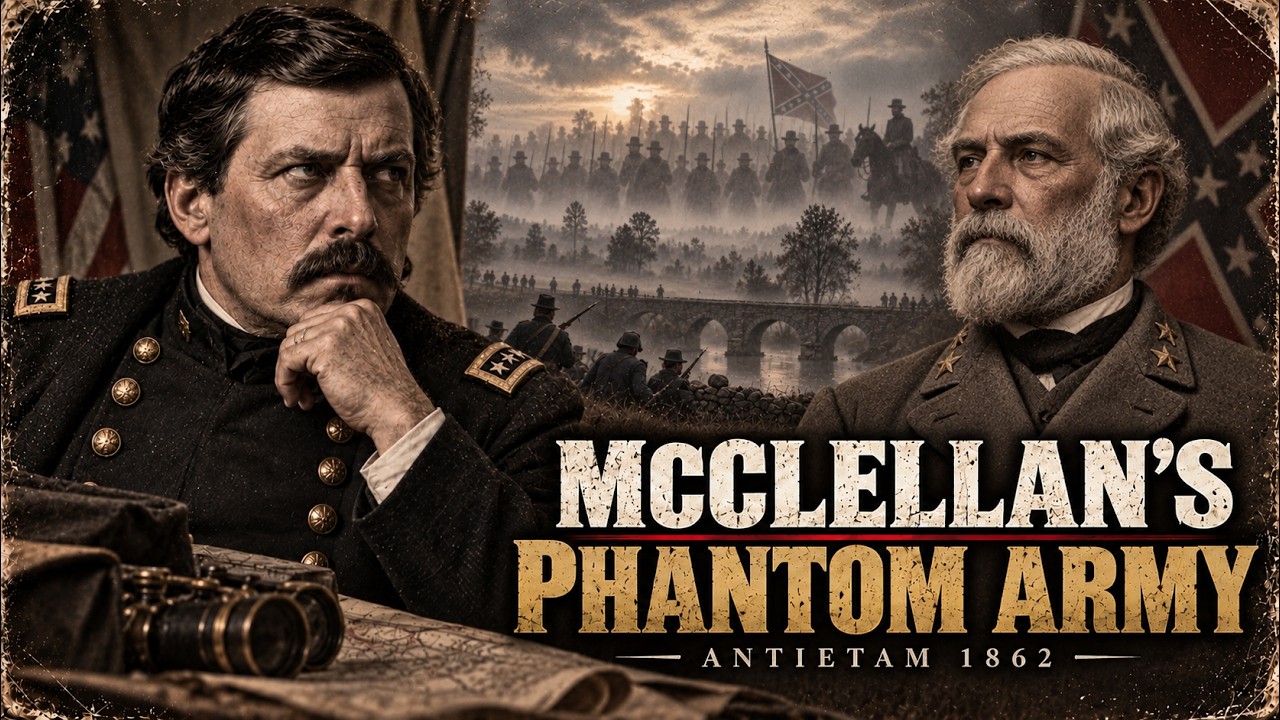
The general who could see both banks did not commit his army. He moved his men across the creek that day and probed Confederate positions until dark, but he did not attack because he did not believe what his eyes told him. He believed his intelligence chief, who reported 100,000 Confederates across the water. He believed there were more behind them, and more behind those.
He believed that if he committed everything he had, the portion no one had counted would arrive and destroy him. So the larger army stayed motionless for a day, and the smaller army stayed motionless beside it, at the smallest size it would ever reach. The battle happened anyway the next morning and became the bloodiest day in American history. But the battle is not this story.
This story is about the day before, the five weeks after, and the number that stood between them. The standard judgment of George McClellan is short. He was a coward, a fool, or a politician wearing a general’s coat. Some of that is fair, but this story deals in facts and receipts.
The receipts are unusual. They concern not what the general had, but what he was told he faced and what he did with the difference. Beneath the legend of McClellan’s caution lies something colder and more interesting. He was not afraid of Lee’s army.
He was afraid of a numerical estimate. And that estimate was not something that happened to him. He built the system that produced it, kept it after it had failed him once, and on September 16 he trusted the system more than the ground he saw through his field glass. McClellan was a professional soldier, second in his class at West Point, a veteran of the Mexican War, then survey work, then the Illinois Central, Ohio, and Mississippi railroads.
His mind was trained as an engineer’s. Before this war he had been a railroad executive, designing timetables for bridges, estimating the costs of cars, moving freight on paper long before he moved any regiment. The mind that built the Army of the Potomac was a mind that thought in schedules. That emerged after the disaster at Bull Run, when Washington needed an army and McClellan built one the way a railroad builds a system.
He trained it, clothed it, fed it, armed it, and organized it into brigades, divisions, and corps with staffs that actually worked. By the spring of 1862, the Army of the Potomac was the best-equipped force the United States had ever put into the field. An army that expensive is an army that is hard to risk spending. Every wagon, every pair of shoes, every artillery battery is a receipt, and a receipt is a reason not to risk what was bought.
McClellan did not take his intelligence from the War Department. He took it from a private detective agency that reported directly to him. Allan Pinkerton had built America’s first national detective network. He was not a soldier and had never counted an army before.
Pinkerton could often identify units correctly. His order of battle was close to right. The failure came when he turned those parts into a total. A prisoner guessed the army’s size.
A deserter repeated camp talk. A refugee estimated a column he had seen pass. A spy in Richmond gathered what he was told. Pinkerton collected all those aggregate guesses and settled on an average number.
Watch what that does. Every source was uncertain. The final number was not. Rumors went in.
Calculations came out. The result was precise enough to stop an entire army. That is not fraud. That is arithmetic performed on rumor.
The method had already been tested once. In the spring of 1862, McClellan did what no one thought possible. He put his army on ships. 121,000 men, 14,500 animals, 1,150 wagons, 44 artillery batteries, and 74 ambulances were moved by water from the docks of Alexandria to Fort Monroe within weeks.
It was the largest amphibious operation in American history to that date, and it worked. Then the army landed and marched up the Peninsula between the York and James Rivers, and stopped because at Yorktown they found John Bankhead Magruder with 11,000 or 12,000 men. Magruder had a talent for theater. His men called him Prince John, and at Yorktown he earned it.
He moved his troops conspicuously from point to point so that every observer counted the same small force multiple times. He placed painted black logs in the earthworks where his cannons should have been. McClellan looked at 11,000 men performing, and his command reported that the enemy was too strong to attack. He told Washington he needed a siege, requested heavy guns, and waited weeks for them to arrive by sea while Joseph Johnston brought reinforcements.
Thirty days at Yorktown. Then the Confederates slipped away at night, and the Union army entered trenches defended only by logs. McClellan had been deceived completely and deliberately. The estimate he made there was wrong, and the caution that followed cost him a full month.
But he learned something else. He learned that a Confederate commander would deliberately inflate his apparent strength, and that a general who assumed the enemy was larger than he looked had been right once already. Every system rewarded once repeats itself. Watch the numbers in Maryland.
In the first days of September, Lee marched his army into Maryland. Most reports reaching Washington estimated his strength at around 30,000. The truth on the road that week was closer to 50,000 and shrinking. On September 9, McClellan’s cavalry commander estimated 100,000.
McClellan forwarded the number. That evening his number was 110,000. On the 11th it became 120,000. On the 12th, the governor of Pennsylvania reported 190,000 Confederates in Maryland.
The estimates were not approaching the truth. They were moving away from it upward. Each estimate built on the previous one, and none was ever corrected downward. Then on September 13, two Union soldiers resting in a field outside Frederick found a copy of Lee’s Special Order 191 wrapped around three cigars.
It showed exactly what the Confederate army was doing, divided, with Jackson sent to Harpers Ferry, Longstreet advancing, the entire force scattered over twenty miles of ground. It was the greatest intelligence gift of the war. The order did not lower the estimate. McClellan read it, celebrated in a telegram, and moved faster than Lee expected, fast enough that the Confederates had to revise their plan on the march.
After receiving written proof of exactly how the enemy was positioned, headquarters numbers did not decline. The ghost stayed in place because the order told him where Lee’s divisions were, but not how many men were in them, and the system that turned men into numbers was programmed only to add. By September 15, the Army of Northern Virginia was positioned behind Antietam Creek with perhaps 18,000 men on hand, and Lee spent the night hoping McClellan would not attack before the rest of his army arrived. McClellan did not attack.
All through the 16th the Confederates kept arriving, Jackson’s men from Harpers Ferry, and Walker’s division right behind them. Late that evening McClellan sent Hooker’s corps across the creek to feel the enemy’s left, and the lines skirmished until dark. He believed there were up to 100,000 men in front of him. With every hour he waited, the real army approached the size of the ghost without ever reaching it.
On the 17th, the battle happened anyway. Dawn. Hooker’s corps struck the Confederate left through a cornfield that changed hands more than a dozen times before breakfast. Hooker was carried from the field wounded.
Mansfield brought up the 12th Corps and was killed deploying it. Sumner sent Sedgwick’s division into the West Woods in three long parallel lines, and it was shattered within fifteen minutes. Three separate attacks in sequence, hours apart, not one blow. At midday the center cracked.
French and Richardson drove the Confederates out of the sunken road that would be known as Bloody Lane. The line was pierced and nothing followed. In the afternoon Burnside spent hours storming a stone bridge while other crossings sat open upstream. He lost the ground he took to a counterattack, and the day ended with both armies roughly where they had started.
Here is the number the entire event turns on. Lee had committed almost everything, every division, no reserves at all. Behind him was the Potomac with a single crossing. If his line had broken decisively, the Army of Northern Virginia would have faced catastrophe with the river at its back.
McClellan committed less than three-quarters of his army. More than a quarter of the Union army, tens of thousands of men, never fired a shot on the bloodiest day in American history. Most were held in two corps. The Fifth Corps under Porter, about 13,000 men, and most of the Sixth Corps under Franklin.
When the question was raised, the answer was not cowardice. It was calculation. A later recollection put Porter’s warning into the words everyone remembers: General, I command the last reserve of the last army of the Republic. The reports written that evening were more direct: these are the only reserves of the army, and cannot be sacrificed.
The same meaning, fewer adjectives. If there were 100,000 Confederates across the creek, the Fifth Corps was not a reserve, it was the only barrier between the Confederacy and Washington, and committing it was not courage, it was suicide. If there were 40,000 across the creek, those reserves were thousands of ready men who could have turned a breakthrough into a rout, and possibly ended the war in Maryland in 1862. The same corps, the same ground, the same afternoon.
The entire difference lay in a number. September 18 passed with no attack. On the 19th, Lee crossed back at Boteler’s Ford with what remained of his army, and the Army of Northern Virginia escaped to fight at Fredericksburg, Chancellorsville, and Gettysburg. McClellan followed cautiously.
For more than five weeks he remained in Maryland, citing lack of equipment and the danger of overextending, while Lee rebuilt his force across the river. Serious movement did not begin until late October. His commanding general wrote the verdict in an official report: the long inactivity of so large an army in the face of a defeated enemy was a source of great disappointment and regret. Lincoln had already written to McClellan in the most polite phrasing in American correspondence: If you are not using the army, I should like to borrow it for a short time, provided you see that it is returned to me promptly.
On November 5, 1862, McClellan was relieved of command. He never led an army in the field again. Count what the account purchased and what it stole. 23,000 casualties in twelve hours.
12,400 Union, 10,300 Confederate, on the bloodiest day in American history. The Confederates lost a far greater share of the army they had brought. Days after the battle, Pinkerton told the president that the Confederate force was 140,000 and McClellan’s army about 90,000. The estimate had been 100,000 on the 16th.
After the bloodiest day of the war, it reached 140. The ghost grew while the real army across the creek bled and shrank. In his official report of the campaign, McClellan put the Confederate strength at 97,445, precise to the single man. For an army that fielded between 38,000 and 45,000 on the 17th, Lee’s own returns of September 30 listed more than 62,000 present, excluding cavalry, and nearly 140,000 present and absent.
The records say 60,000. The road says 40,000. Both are receipts. McClellan was counting a paper army that existed on paper.
What his system never produced was a reliable estimate of how many men Lee actually had in the field. A paper army can be counted. A field army must be tested against what scouts, cavalry, prisoners, deserters, and the battlefield itself tell you. The cost of the ghost, item by item.
The decision not to launch a general attack on the 16th while the scattered divisions were still arriving. More than a quarter of the Union army held out of decisive fighting on the 17th. More than five weeks of no pursuit. Command of the army itself handed over seven weeks after the battle to the general who spent that afternoon at the stone bridge.
And what that achieved. An army that came out of Antietam with large reserves intact because McClellan never committed to a decisive stroke. A result clear enough that Lincoln issued the preliminary Emancipation Proclamation on September 22, and the chance that Britain or France would recognize the Confederacy or intervene to mediate was badly damaged that autumn. That is not nothing.
The proclamation needed a victory to rest on, and Antietam was that victory. But the opportunity that McClellan chose not to risk his army to prevent was the destruction of the Army of Northern Virginia. The general was not fighting an army. He was fighting a number.
When the number is wrong, he fights the army he imagined while the army in front of him walks away. It is September 16, 1862. You command the largest army in America. Your men are fed.
Your guns are in position. The enemy across the creek has been marching barefoot for six weeks. Your intelligence chief says they are 100,000 with more coming. Your cavalry says the same.
A loyal governor says 190,000. The paper in your hand, written by the enemy himself, tells you exactly where his divisions are, but nothing about how many men are in them. Do you attack tonight before they concentrate, or do you not attack and let the estimates protect you until someone else takes your army? Or do you test the accuracy of the number before you trust it?
The debate has run for 160 years.