On the night of May 12, 2013, fifteen-year-old Nicole Cable walked to the end of her driveway in Glenburn, Maine, to meet a friend named Brian Butterfield. The person she had been messaging for weeks, the friend who had comforted her after a difficult breakup, was waiting for her in the darkness. But Brian Butterfield was not there. The real Brian, a nineteen-year-old from Bangor, had no idea his identity had been stolen.
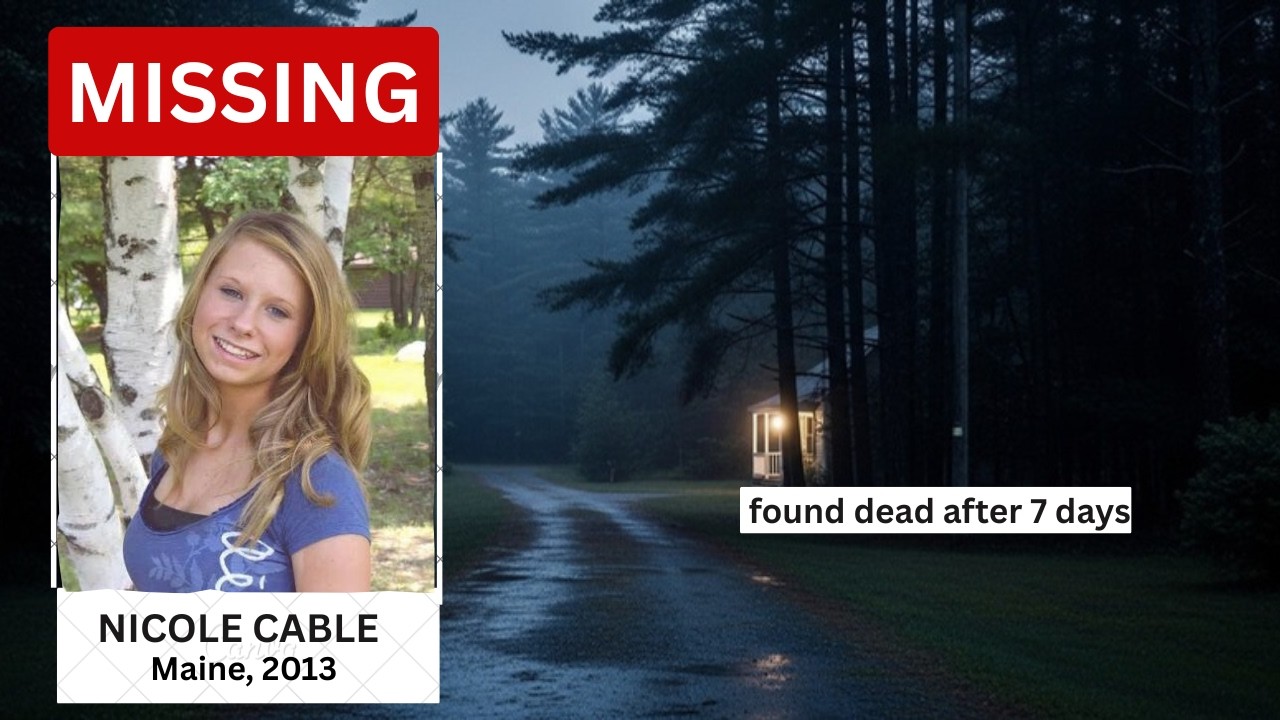
Nicole went to meet a mask cut from a dark blue knit hat, and she never came home. Nicole lived with her mother, Kristen Rye, and other family members in a quiet residential community not far from Bangor. She was energetic, sociable, and deeply connected to the people around her. She kept her phone with her constantly, responded to messages quickly, and always came home when she said she would.
Facebook was central to her world. It was where she stayed connected, shared moments from her life, and built relationships that felt real, even if they existed mostly on a screen. That evening, Kristen had spent Mother’s Day with her children, moved by a handmade card Nicole had given her. The weather was mild, with a light breeze and a brief shower before nine.
There was nothing unusual about the night. Shortly before nine, Nicole left her room and told her mother that Brian Butterfield was going to bring her a few items. She wanted to meet him at the end of the driveway. Kristen knew the name.
Nicole had mentioned Brian before, and the two had been friends in high school, but Kristen had never met him in person. She reminded Nicole not to leave with him, not to go anywhere, and to stay close to the house. Nicole agreed, stepped outside, and passed beyond the glow of the porch light. Kristen went to bed unaware that her daughter had walked into a carefully constructed trap.
Nicole never came back inside, and no one in the household noticed her absence until the following morning, when Kristen prepared to take her daughter to school. Nicole was not in her bedroom. She was not anywhere in the house. Kristen called out to her repeatedly and received no response.
She called Nicole’s phone, but every call went straight to voicemail. Text messages, normally answered within minutes, went unanswered. Nicole’s phone, which she carried constantly, was either off or dead. For a mother who knew her daughter’s habits, this silence was deeply alarming.
At approximately 8:27 on the morning of Monday, May 13, Kristen contacted the Penobscot County Sheriff’s Office. She was told that Nicole had not been gone long enough to be classified as a missing person. Authorities in Penobscot County chose to wait before initiating formal search efforts. Kristen refused to wait.
She gathered recent photos of Nicole and created missing person posters herself, printing them with the help of friends and family and posting them throughout Glenburn and the surrounding areas. She reached out to regional media, pleading publicly for anyone who had seen her daughter to come forward. She wanted Nicole to know she was not in trouble and just needed to come home. If someone had taken her, Kristen begged them to leave her somewhere safe and let her go.
By the following day, the sheriff’s office officially took over the case. Search efforts escalated rapidly. Local and state law enforcement mobilized to canvas residential areas, and investigators began interviewing Nicole’s friends and acquaintances. Notifications were issued to state-level authorities, and the number of volunteers swelled to approximately 500 people.
They searched wooded areas, roadways, and every conceivable location where a missing teenager might be found. Neighbors who had never met the Rye family joined the search. Strangers drove from surrounding towns to help comb the forests and fields. The disappearance of Nicole Cable had become a community crisis.
As investigators reconstructed Nicole’s final hours, two lines of inquiry emerged. The first involved verifying the identity of Brian Butterfield. The second involved analyzing the digital traces Nicole had left behind. On Tuesday morning, Detective Andy Whitehouse of the Penobscot County Sheriff’s Office interviewed Brian Butterfield.
Butterfield had attended the same high school as Nicole and had graduated from Oldtown High School the year prior. According to his statement, although the two had once been friends, several weeks had passed since he had last spoken to Nicole. The Brian Butterfield sitting in front of the detective looked nothing like the Brian Butterfield Nicole had been communicating with online. He knew nothing about the messages she had received.
He had not asked her to meet him, had not sent her any messages, and had not been anywhere near her home. Someone had stolen his identity. While Detective Whitehouse worked to determine who might have impersonated Butterfield, Detective Brent Bolu of the Bangor Police Department began reviewing Nicole’s electronic traces, including her social media activity, text messages, and phone call history. Investigators observed that Nicole had interacted with several individuals in the weeks before her disappearance, but the name Brian Butterfield stood out prominently.
According to message records, an account using that name had begun contacting Nicole shortly after she had gone through an unsuccessful relationship. The account offered attention, empathy, and emotional support. The messages were frequent, personal, and carefully designed to build trust. During the data analysis, Detective Bolu uncovered a pivotal detail.
The account named Brian Butterfield was fake. It had copied nearly all publicly available information from Butterfield’s real profile, including the profile picture, biographical details, and mutual friends. The underlying technical data pointed to a completely different individual. Investigators submitted an emergency request to Facebook to identify who had created the account.
At the same time, Detective Whitehouse asked Butterfield whether he knew anyone who might have impersonated him. Butterfield provided a name without hesitation: Kyle Dubet. Kyle Dubet was a former Oldtown High School student who had previously had a relationship with Nicole. Although that relationship had ended, Kyle had continued to show fixation on Nicole and had repeatedly engaged in boundary-crossing behavior she had rejected.
The age difference between them had also raised concerns. Facebook responded to the emergency request with critical data: the IP address used to create the fake account and the last four digits of the phone number used for verification. The data revealed that the account had been deleted early on the morning after Nicole disappeared, a deliberate act suggesting an attempt to cover tracks. Both the IP address and the phone information matched Kyle Dubet or members of his family.
The IP address was registered to Greg Dubet at the family residence at 5 Maplewood Street in Orono, Maine. Kyle had a history of minor prior offenses. In recent years, he had been living with his family, attending a community college, and working part-time jobs while helping care for his young daughter. When detectives approached the family, they learned that Kyle was preparing to report for a short-term sentence related to a prior traffic incident.
His relationship with Nicole was subjected to close scrutiny. The two had connected through social media during Nicole’s early high school years and later spent time together in person with the knowledge of her family. That relationship had ended not long before Nicole disappeared. Tensions had also emerged involving Kyle’s girlfriend, Sarah Maringer, who was living with him and his family.
In the days following the breakup, Sarah had sent Nicole multiple messages that were pressuring and threatening, warning her not to contact Kyle. After this period of tension, Nicole had cut off contact with Kyle entirely. That silence continued until the day after Nicole disappeared, when Kyle suddenly shared her missing person poster on his personal Facebook page and publicly offered to help care for his child so Kristen Rye could join the search. To the community, it looked like a gesture of kindness.
To investigators, it raised immediate suspicion. By Tuesday evening, May 14, the first physical evidence was discovered. Detective Bill Flagg conducted a search of a densely wooded area along Spruce Lane, below the Rye family home. He recovered a dark blue knit hat with holes deliberately cut into it, along with a sock and a black athletic shoe, all near the intersection with Route 221.
The knit hat appeared to have been modified with intent. The holes suggested it had been used as a makeshift mask, designed to conceal the wearer’s identity while allowing vision. It was a chilling discovery that strongly suggested premeditation. At approximately 9:10 the following morning, Kyle Dubet was taken in for questioning by Maine State Police major crimes unit detectives at a facility in Bangor.
Investigators presented him with the evidence linking him to the fake account. The account had been created from a computer in his home and accessed from his personal cell phone. One hundred twenty separate logins to the Brian Butterfield account had originated from his phone. Kyle denied everything.
He claimed he had never logged into the account, never created it, and never contacted Nicole under a false identity. Investigators then showed him the dark blue knit hat recovered from the woods near Nicole’s home and informed him that forensic testing had revealed it contained his DNA. Kyle offered no explanation. He became visibly uncomfortable but continued to deny involvement.
Detectives pressed him with direct questions. Was Nicole in the water? Was she in the woods? Was she buried underground?
Kyle provided no answers. The interview ended without a confession. Investigators knew Kyle was scheduled to report to jail within days to serve his prior sentence. They kept him under observation, but he displayed no unusual behavior.
On the scheduled date, Kyle was driven by his parents to the Penobscot County Jail. According to County Sheriff Glenn Ross, Kyle appeared visibly distressed throughout the intake process. He was separated from the general population and placed under special supervision out of concern for his mental well-being. Kyle’s behavior suggested he was carrying the weight of something far heavier than the sentence he was about to serve.
While Kyle was in custody, a major turning point emerged. Sarah Maringer came forward voluntarily. On Monday, May 20, 2013, Detective Jennifer Fisk conducted a formal interview with Sarah. During that interview, Sarah stated that Kyle had confessed to her that he was responsible for what had happened to Nicole and had attempted to conceal the evidence.
She recounted what Kyle had told her: he had taken Nicole out of town after restraining her, driven past the former Darts gas station in Oldtown, crossed a bridge, turned left, and traveled along the riverbank near a dam. He told Sarah he had left Nicole’s body in an open area near the water and covered her with branches and forest debris. On the drive back to Orono, he had discarded Nicole’s clothing out the window of the truck he had been using. Detective Pelletier conducted a separate interview with Kyle’s brother, who corroborated Sarah’s account and provided additional details that aligned with her report.
According to the statements gathered, Kyle had used the fake identity of Brian Butterfield to lure Nicole to the end of her driveway. His original intent had not been to kill her but to stage an ambush and abduct her. He concealed his identity with the knit hat. When Nicole appeared, believing she was meeting a trusted friend, Kyle approached her.
Nicole resisted immediately and fought back. While attempting to restrain her and render her unconscious, Kyle applied force to her neck. He used tape to restrict her movement and placed her in the bed of a pickup truck borrowed from his family. He drove her to a secluded area he had chosen in advance.
Investigators determined through the statements that Kyle had initially planned to hide Nicole and then return to participate in the search efforts, creating the appearance that he was helping. But Nicole fought back fiercely, leaving scratches on Kyle’s body that would later become evidence. During the prolonged struggle, Nicole lost consciousness and then lost all signs of life. Kyle panicked.
He abandoned her body near the riverbank, covered her with branches, and discarded her clothing along the roadway on the drive back. On May 20, 2013, while Kyle was already in custody, he was formally arrested and charged with kidnapping and murder. At approximately 9:30 that evening, acting on the information from Sarah and Kyle’s brother, a game warden and a K-9 unit located Nicole’s body in a wooded area near Oldtown, precisely where Sarah had described. Her body was concealed beneath branches and forest debris.
The days-long search that had mobilized hundreds of volunteers had come to a heartbreaking close. A memorial service was held with more than 300 people in attendance. Kristen Rye spoke, describing her daughter’s energy, warmth, and kindness. Friends shared memories of Nicole’s infectious smile and the way she made people feel seen and valued.
Forensic results confirmed what investigators had pieced together. The sock and athletic shoe contained DNA matching Nicole. The homemade mask contained DNA matching Kyle Dubet. The physical evidence, combined with the digital trail, the confessions relayed by Sarah and Kyle’s brother, and phone location data, formed an overwhelming case.
The defense attempted to introduce an alternative theory, suggesting Kyle may have been framed in a scenario involving relationship tension and jealousy involving Sarah. Kyle chose not to enter a guilty plea. While held awaiting trial, Kyle participated in a method of communication used by inmates to exchange messages between jail cells, writing notes on small pieces of paper and passing them through the facility’s plumbing. In these handwritten notes, Kyle documented what had occurred on the night Nicole left her home, described efforts to eliminate physical traces from her body, and discussed methods of concealment.
The notes were intercepted by jail staff and turned over to investigators. Forensic testing showed that microscopic traces still matched Kyle’s DNA despite his efforts. The defense attempted to have the notes excluded, but witnesses familiar with Kyle’s handwriting, including family members, teachers, and former co-workers, confirmed the handwriting belonged to him. The judge ruled the notes admissible.
Prosecutors offered a plea agreement that would have guaranteed a prison sentence without the trauma of a trial. Kyle declined. He chose to proceed to trial. The trial lasted ten days.
Prosecutors presented the digital evidence, the DNA, the handwritten jail notes, and the phone location data. The defense attempted to cast doubt, but the volume and consistency of the evidence made it nearly impossible to create reasonable doubt. After approximately one hour of deliberation, the jury returned a unanimous verdict, finding Kyle Dubet criminally responsible for unlawfully restraining Nicole Cable and causing her death. At the sentencing hearing, Kyle was given the opportunity to address the court and Nicole’s family.
He chose not to offer any admission of responsibility. He did not apologize. He did not express remorse. He made no statement related to the case whatsoever.
The judge imposed a sentence of 60 years for murder and 30 years for unlawful restraint, to be served concurrently, meaning Kyle would serve 60 years total. The court also ordered Kyle to cover the costs of Nicole’s burial. Kristen Rye spoke publicly after the sentencing. She described Kyle’s lack of remorse and his refusal to take responsibility.
She said he had shown himself to be focused entirely on his own situation, with no compassion for the life he had destroyed. She called him evil. Given the length of the sentence, Kyle Dubet will spend the vast majority of his remaining life behind bars, with any chance of release coming only when he is well into his 70s or beyond. Nicole Cable was 15 years old when she walked to the end of her driveway on a quiet Sunday evening.
She believed she was meeting a friend. Instead, she met someone who had been watching her, deceiving her, and waiting for the right moment to act. Her story is a permanent reminder that the people we trust online may not be who they claim to be, and that digital deception can have consequences that are permanent and irreversible.