For forty-three years, the man who killed nineteen-year-old Deborah Lynn Pask stood in the crowd at her memorial service. He signed the guest book at the Harlan United Methodist Church on the first Sunday of every October. He bowed his head when her name was read aloud. He drank coffee from the folding table afterward and made small talk with her family.
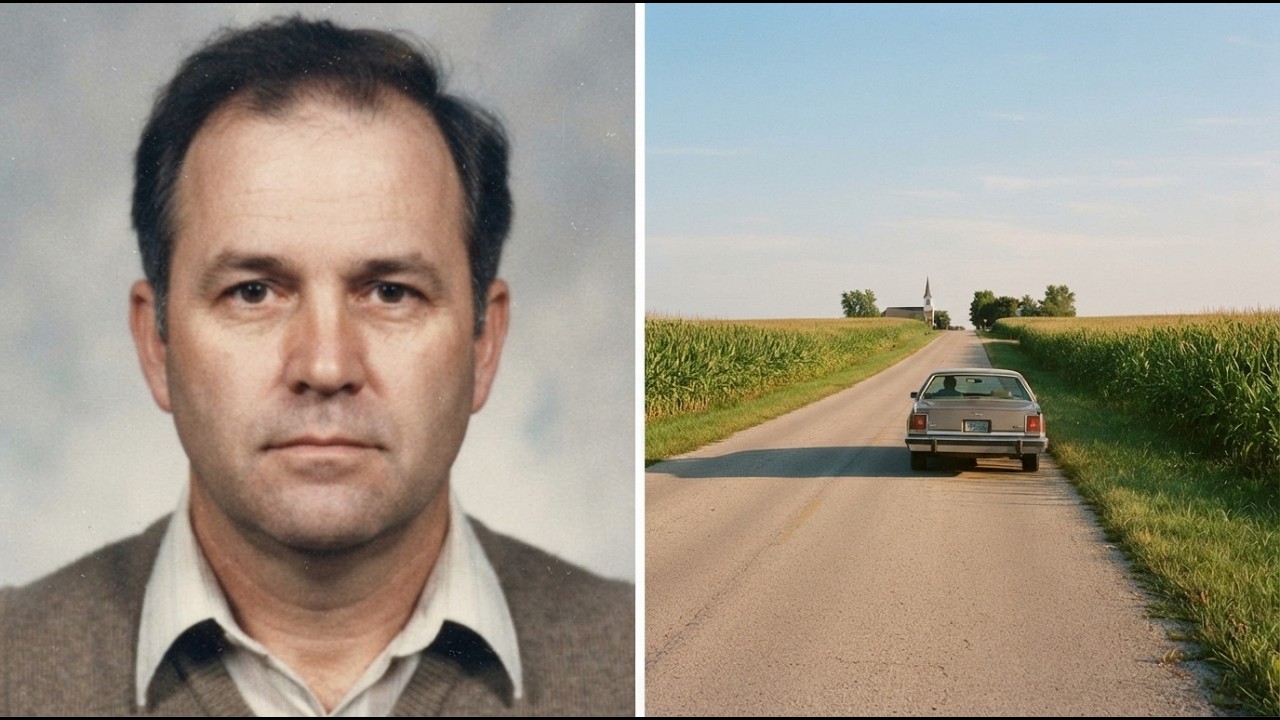
Her mother knew him by name. Her younger brother had shaken his hand on various occasions across the years. Every October, he drove back to his house through the cornfields of Shelby County, Iowa, and went to sleep. He did this for forty-three years.
His name was Raymond Earl Cutler. He was a retired school bus driver, a former deacon at the very church where those memorial services were held, and a man so embedded in the fabric of Harlan that no one ever suspected him, not the families who knew him, not the deputies who worked the original case, not even the cold case investigator who finally uncovered the truth. That changed in the spring of 2023, when a genealogy database returned a DNA match no one had expected. To understand the specific cruelty of this case, you have to understand who Deborah Lynn Pask was and what she meant to a town that never stopped mourning her.
Harlan, Iowa, sits in the heart of Shelby County amid the rolling farmland of western Iowa. In 1980, the town had just under five thousand residents. It had a Dairy Queen on Highway 59, a hardware store run by the same family for three generations, and a livestock auction barn that drew farmers from three counties on Wednesdays. It was a place with the kind of deep community trust that comes from generations of people who went to school together, buried one another, and brought food to help when crisis hit.
Deborah was nineteen that October. She grew up in Harlan as the oldest of four children of Robert and Vivian Pask, who ran a small appliance repair shop on the east side of town. Robert was a quiet, patient man who could fix anything mechanical, and his eldest daughter inherited that patience. Vivian was the kind of woman who served on three church committees at once yet still found time for her vegetable garden, kept the house clean, and had dinner on the table at exactly six.
Deborah, known to everyone as Debby, graduated from Harlan Community High School in the spring of 1980 and took a part-time job at the Harlan Savings Bank while she saved money for community college. She wanted to study early childhood education. She had a natural ease with children, the kind that drew young kids to her on the street without anyone asking. She babysat for three families in her neighborhood.
She sang in the church choir, just like her mother. She kept her dark hair short, held a library card she used every week, and since the age of twelve had kept a diary, a green cloth-covered notebook filled with her observations about the people around her, the books she read, and the world she thought about quietly and deeply. Her friend Janet Morrow, who had known her since second grade, described her this way: she noticed things other people missed. She cared about you in a way that made you feel worth caring about.
On the afternoon of October 14, 1980, Deborah left the Harlan Savings Bank at 5:15 and began walking home. She never arrived. The bank was six blocks from the Pask family home on Willow Street. She took that route every day, past every house, every barking dog, every shortcut through the alleys between Third and Fourth Streets.
It was a journey she had made hundreds of times. At 5:16, her coworker watched her leave through the front glass door. Deborah wore her coat and carried her purse on her shoulder. She turned left toward Court Street and disappeared from view in less than a minute.
At 6:30, Vivian Pask called the bank to ask if Deborah had stayed late. She had not. At 7:00, Robert Pask drove the six blocks between the bank and the house three times and found nothing. At 7:45, he called the Shelby County Sheriff’s Office.
Deputies arrived within the hour. By 9:00 that evening, a search had been organized along the route between the bank and the Pask home. By 10:30, one of the deputies found Deborah’s purse, intact and untouched, with her wallet and keys inside, in the alley between Third and Fourth Streets, the alley she always crossed. Deborah Lynn Pask was not found until the next morning, October 15.
A farmer named Earl Griggs, driving on a county road two miles east of town before dawn, spotted something in the edge of the ditch below the gravel shoulder and stopped his truck. She was nineteen years old. The cause of death, confirmed by the Shelby County medical examiner that evening, was strangulation. She had not been robbed.
She had not been carried far. The examiner’s report noted evidence consistent with a struggle, and samples were collected from beneath her fingernails, logged into evidence, placed in envelopes, and sealed. That sealed envelope remained in a storage room at the Shelby County Sheriff’s Office for forty-three years. The lead investigator assigned to the case was Deputy Sheriff Merle Arns, a twenty-year veteran of the Shelby County Sheriff’s Office.
He handled the murder of Deborah Pask the way he handled everything: methodically, without drama, with a precision that people who worked with him remembered long after he retired. Arns had three daughters of his own. In the weeks following the murder, he worked through a list of suspects that included a man recently released from a neighboring county with a prior assault conviction, a young man from Harlan High School who was said to have asked Deborah out and been rejected, and a farmer seen in the alley between Third and Fourth Streets on two occasions in the weeks before the crime. All three were investigated.
All three were cleared. The alley yielded little: a tire impression in the soft soil near the fence line consistent with a local midsize car, a partial shoe print near where Deborah’s purse had been dropped, and the samples from beneath her fingernails, carefully collected during the autopsy and sent to the Iowa Division of Criminal Investigation laboratory in Des Moines. Six months later, the lab returned the sample with a one-line note: insufficient for analysis under current testing methods. Arns requested a second review.
It went to the lab’s waiting list. When the response came three months later, it said the same thing. The science of 1981 could not do what the science of 2022 would take forty minutes to accomplish. That gap between what the evidence held and what technology could reach is where the case went quiet.
While Arns worked the official investigation, Robert and Vivian Pask conducted one of their own. They printed four hundred posters with Deborah’s picture and the words “Information Wanted,” dated October 14, 1980, and distributed them to every store within twenty miles. They organized a private, separate search of the neighborhood between the bank and the alley. They hired a lawyer to write to the Iowa Bureau of Criminal Investigation asking for the case to be elevated to a state-level investigation.
The letter was received. The case was not elevated. In the summer of 1981, an anonymous tip came into the sheriff’s office pointing to a man who had left Harlan and had been seen arguing with a young woman near the alley the previous October. Arns followed it for six weeks.
The man had moved to Council Bluffs. His wife confirmed his whereabouts on the night of October 14. The tip led nowhere. In December 1981, fourteen months after Deborah’s death, Merle Arns sat down with Robert and Vivian Pask in his office and told them, in the most precise and careful words possible, that the investigation would continue but that no viable suspects remained at that time.
He told them he was sorry. He told them he would not stop. Robert Pask shook his hand. Vivian thanked him for his time.
They drove home through the cornfields and sat at the kitchen table for a long time without saying anything. Deborah’s younger brother Dennis was fourteen that December. He kept her green diary on his bookshelf for the rest of his life. By 1987, seven years had passed without an arrest.
The leadership of the Shelby County Sheriff’s Office changed once. Merle Arns retired to a farm outside Kirkman and took with him a twenty-page file of personal notes he kept separate from the official record: names, impressions, things that never quite made sense no matter how many times he reviewed them. He went through those notes every October without fail, the way someone might hold a rosary. He kept doing it until the year he died in 2009, with the case still open and no name written in the margin.
By 1990, the Pask family organized an annual memorial at the Harlan United Methodist Church, held on the first Sunday of every October. It was a modest gathering: a reading of scripture, a few words from whoever wanted to speak. A photo of Deborah sat on a table near the door beside a candle and a small vase of marigolds, because someone once mentioned she loved them. Robert and Vivian attended every year.
They sat in the same pew. They shook the same hands. They drove home in the same silence that had settled over them since December 1981. Robert Pask died in 1997.
He had spent seventeen years shaking hands at that memorial and driving home without resolution. Vivian followed in 2008. She had spent twenty-eight years keeping the porch light on in a way that meant something different than it used to. Dennis Pask kept organizing the memorial after his parents were gone.
Attendance shrank from thirty people to fifteen in some recent years. Fewer than ten former classmates, now in their sixties. A handful of church members who had been children when it happened. A neighbor or two who no longer remembered exactly why they kept coming, only that it felt wrong to stop.
The marigolds were always there. Dennis made sure of it. And every year, at some point during the gathering afterward, Raymond Earl Cutler would find Dennis near the coffee table and say something quiet and decent about Debby. Dennis would nod and thank him for coming.
He had no reason to suspect anything. Cutler was a deacon at the church. He had known the Pask family for thirty years. By every measure, he was the man who always showed up, always remembered, always said the right thing.
The case had been dormant for forty-two years when a forensic analyst in Des Moines sat down at her computer and loaded a DNA profile into a genealogy database for the first time. The referral came from the Iowa Department of Public Safety’s cold case unit, expanded in 2021 as part of a statewide initiative to re-examine biological evidence from pre-DNA-era murder files using modern extraction techniques. A criminalist named Sarah Kovar was assigned the Pask case file in early 2022. She reviewed the evidence log, cross-referenced it with a 2020 storage audit, and found the sealed fingernail evidence collected during the October 1980 autopsy.
The package was intact. The chain-of-custody documentation was clear, unusual for evidence of that age and critical. Kovar submitted the sample to a private forensic genome laboratory in January 2022. The extraction alone took four months.
The profile that emerged was partial but usable. A male contributor had been recovered from beneath Deborah Pask’s fingernails, preserved by the dry conditions of the evidence storage room across four decades of Iowa winters and summers. Forensic genealogy, the science of uploading an unknown DNA profile to public genealogy databases and tracing family tree branches down to a single contributor, takes time. The lab began the process in the summer of 2022.
For nearly a year, the matches they found were distant: fourth and fifth cousins, people scattered across Iowa, Nebraska, and South Dakota, related without knowing exactly how. A genealogist contracted to work the case, a woman named Linda Fook who had worked seven cold cases in the previous three years, built the family tree by hand, branch by branch, testing each line against the geographic and age constraints of the original crime. In March 2023, the branches converged on a single family line rooted in Shelby County, Iowa. On a Thursday morning, Sarah Kovar called the Iowa Department of Public Safety and said four words into the phone: we have a name.
That name was Raymond Earl Cutler, a retiree from Harlan, Iowa, seventy-one years old. In 1980, he had been twenty-eight. He lived in Harlan. Court records later confirmed he had worked as a school bus driver for the Harlan Community School District, driving a route that passed within two blocks of the alley between Third and Fourth Streets.
He drove that route five days a week. Investigators moved with deliberate caution. The genealogy match was the starting point, not the endpoint. Iowa Division of Criminal Investigation agents worked alongside Shelby County sheriff’s investigators throughout the spring of 2023, building a supporting file before making any contact with Cutler.
A discarded coffee cup from a convenience store in Harlan, found in late April 2023, provided a direct DNA sample. The comparison result came back within a week. It was him. The probability was described in court documents as greater than one in a trillion.
Investigators then pulled Cutler’s 1980 work records and confirmed his bus route. They found a former coworker who remembered Cutler’s schedule during that October. They pulled vehicle records and confirmed he had owned a midsize local car, a 1977 Chevrolet Malibu, in 1980, consistent with the tire impression found in the alley. They discovered something else, something that, when the Shelby County Sheriff’s Office put it before the Pask family, made Dennis Pask sit down and cover his face with his hands.
Raymond Earl Cutler had attended Deborah’s memorial every year. Church records from the Harlan United Methodist Church, kept regularly since 1982, showed his name in the handwritten guest book for forty-one of the forty-two years the services were held. The only year he missed, confirmed by court records, was 2018, when he was recovering from knee surgery. He returned the following year.
On June 7, 2023, Shelby County deputies and Iowa Division of Criminal Investigation agents arrested Raymond Earl Cutler at his home in Harlan. He opened the door wearing a cardigan. He said nothing when they read him his rights. He looked at the arrest warrant in the deputy’s hand for a long moment.
Then he said, “I was wondering when this would happen. ” The charge was first-degree murder. Raymond Cutler pled not guilty at his arraignment in July 2023. He was held without bail.
His attorney filed motions challenging the admissibility of the genealogy evidence, which the Shelby County District Court rejected in October of that year. In February 2024, Raymond Earl Cutler changed his plea to guilty on a charge of second-degree murder as part of an agreement that spared the Pask family a trial. He was sentenced to thirty-five years in prison. Given his age and the terms of the agreement, it is unlikely he will ever leave prison.
Dennis Pask read a statement at the sentencing hearing. It consisted of only three sentences. He said, “My sister noticed things other people didn’t notice. She cared about you in a way that made you feel worth caring about.
She deserved more than forty-three years. ” There is a photograph of Deborah Lynn Pask taken at her high school graduation in May 1980, five months before she was killed. She is nineteen. She holds her diploma with both hands and laughs, not a posed smile but caught mid-laugh by whoever held the camera.
In her face you can see exactly the person her friend Janet described: someone who cared about the world, someone with good plans and the patience to carry them out. That photo is what her family wants people to see, not the alley, not the guest book with his name year after year. Deborah Pask kept a library card. She wanted to teach young children.
She had a green notebook full of careful thoughts about people and books she loved. She had a whole life that belonged to her alone, taken from her in an alley in Harlan, Iowa, by a man who spent forty-three years standing at her memorial and accepting coffee from the people who loved her. The forensic genealogy method that identified Raymond Cutler has now been used in dozens of cold cases across the country. But the detail that stays with most people who follow this case is not the science.
It is the guest book. Forty-one years of his handwriting in the church register, attending the memorial of the woman he killed, accepting condolences from her family. That detail will stay with Dennis Pask for the rest of his life as well. He said in a later interview that he had not yet decided what to make of it, whether to feel horror at it or something closer to a cold, dark clarity.
He said, “At least I know she was never forgotten. ” And that somewhere in every October, he knew exactly what he had done, and he had to live with that. Justice came for Deborah Lynn Pask after forty-three years.