On September 12, 2012, the man who had commanded one of Mexico’s most powerful criminal organizations for nearly a decade was running out of time and road alike. Burning blockades choked the highways of Tamaulipas as cartel operatives moved through cities in a desperate attempt to buy their leader another hour of freedom. Only hours earlier, Jorge Eduardo Costilla Sánchez—known as El Coss—had been the Gulf Cartel’s supreme leader, feared across northeastern Mexico, wanted by two governments, with a $5 million reward on his head. Now, somewhere inside a residential neighborhood in the coastal city of Tampico, he was about to discover that an empire built over two decades could not protect him from thirty Mexican Marines in a single afternoon.
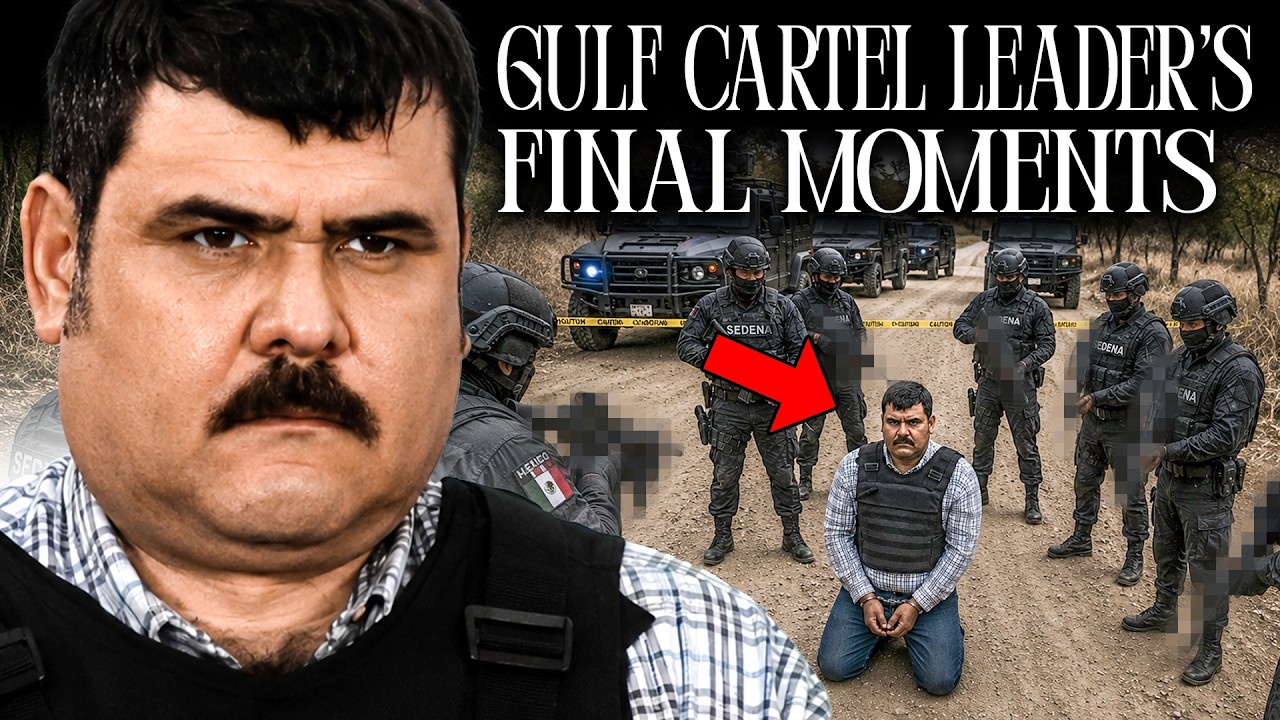
The roads of Tamaulipas were burning, authorities were mobilizing, and the organization was creating chaos across multiple cities in a desperate bid to shield its boss from what was coming. The ending, when it arrived, was not the violent last stand that cartel mythology promises. It was something far more unsettling. To understand the final hours, one must understand who El Coss was before the Marines found him.
He had begun his documented life as a young municipal police officer in Matamoros, Tamaulipas, a city directly across the Rio Grande from Brownsville, Texas. Matamoros sat at one of the primary commercial crossing points between Mexico and the United States, and the young officer understood from the inside how the city worked, how information moved through official channels, and how power connected local police to municipal government and the broader Mexican state. That knowledge, gained on the legitimate side of the law, would eventually serve a very different purpose. At some point in the 1990s, Costilla Sánchez crossed into the world of the Gulf Cartel.
The exact moment is not preserved in the historical record with precision, but the direction of travel is clear: he moved from law enforcement into one of the most powerful criminal organizations in Mexico. The Gulf Cartel was a mature enterprise with deep roots in Tamaulipas, built over decades by successive generations of traffickers who understood the same fundamental reality: northeastern Mexico was one of the most valuable pieces of real estate for organized crime in the Western Hemisphere. The region ran along the entire eastern edge of the U. S.
–Mexico border, with Matamoros, Reynosa, and Nuevo Laredo sitting across the river from Texas cities through which enormous volumes of commerce flowed daily. Whoever controlled these corridors sat at the center of something worth an almost incomprehensible amount of money. The cartel’s most powerful modern iteration was built under Osiel Cárdenas Guillén, who consolidated control through a combination of organizational sophistication and extraordinary violence. Cárdenas made one decision that would define Mexican organized crime for the next decade: he recruited a dedicated armed enforcement wing from former members of Mexico’s elite special forces units, particularly the Grupo Aeromóvil de Fuerzas Especiales.
These were not ordinary criminals. They were trained soldiers who brought paramilitary discipline and military-grade operational thinking into the criminal world. The wing became known as Los Zetas, named after the radio call sign of their original commander. For a period, the combination made the organization appear nearly invincible.
El Coss built his career inside this structure. By November 1999, he was part of an armed group that stopped and held several U. S. federal agents at gunpoint inside Mexico.
The agents were released, but the incident earned him his first indictment in an American federal court. Whatever anonymity he had maintained was gone; the United States government knew who he was. Then, in March 2003, Mexican authorities arrested Osiel Cárdenas Guillén, removing the Gulf Cartel’s most powerful leader in a single operation. El Coss emerged from the reorganization that followed as one of the cartel’s principal leaders, a position he would hold for nearly a decade.
According to contemporary authorities and analysts, he controlled the cartel’s daily drug trafficking activities while keeping so deliberately low a profile that only two photographs of him were ever made public before his arrest. But the organization he inherited was not the stable enterprise Cárdenas had built. Los Zetas had developed their own leadership structure, territorial ambitions, and revenue streams independent of their original employers. By 2010, the relationship had ruptured.
The Gulf Cartel and Los Zetas split, and northeastern Mexico descended into a new level of violence. Entire cities became contested terrain. Highways became danger zones where travelers could be stopped, robbed, kidnapped, or killed by either organization. Journalists faced death.
Local police forces were so deeply compromised that distinguishing between law enforcement and cartel affiliation became genuinely difficult. El Coss sat at the center of this, directing violent operations against the Zetas using, according to U. S. authorities who later prosecuted him, violence and the threat of violence as the primary tools of organizational control.
By 2012, the pressure had been building on multiple fronts. The U. S. State Department’s $5 million reward had been outstanding long enough that every person in his vicinity was a potential informant.
Mexican military and naval operations had been specifically targeting Gulf Cartel leadership. One week before September 12, Mexican forces captured Mario Cárdenas Guillén, the brother of the imprisoned Osiel. Days before that, Juan Gabriel Montes Sermeño, another major figure, had also been detained. Each arrest created new intelligence, and each new intelligence narrowed the circle around those who remained at large.
September 12, 2012, did not begin with El Coss in handcuffs. It began with chaos spreading across Tamaulipas. Armed operatives moved through cities, hijacking vehicles and seizing trucks and buses to create burning blockades on major avenues across three cities simultaneously. The disruption stretched security-force response across a wide geography and created uncertainty about where the primary threat lay.
Somewhere in Tampico that morning, El Coss was still free. The chaos playing out across the state was his organization’s attempt to buy him time and space. But the blockades could not stop what was already in motion. Mexican Marines received intelligence pointing to a vehicle carrying heavily armed men moving through Tampico’s streets.
The pursuit narrowed from an entire state to a specific vehicle in a specific city. The trail led through the Colonia Lomas de Rosales neighborhood and eventually stopped at a single residential property. At approximately 18:15 hours, with the day already filled with burning blockades and military movement, roughly thirty elements of the Mexican Navy’s Marine Infantry entered the property. Inside, they found Jorge Eduardo Costilla Sánchez.
He was caught by surprise. And the man who had directed the Gulf Cartel’s violent operations for nearly a decade did not reach for a weapon. He surrendered without firing a shot. The silence of that moment deserves reflection.
This was a man whose reputation had been built on fear, who had been present when federal agents were held at gunpoint in 1999, whose name had appeared on a $5 million reward notice. The myth around him was built on the idea that confrontation came at a price. Yet when thirty Marines entered the property, he offered no resistance. Mexican Navy officials later confirmed that he was arrested without any resistance whatsoever.
The exact reasons are not preserved in the historical record. No private account from inside that room has been documented. But the circumstances offer reasonable frameworks. El Coss would have understood what thirty Marine infantry personnel in a residential property meant for the odds of successful armed resistance.
He may have assessed the situation and concluded the calculation was clear, or he may simply have been overwhelmed by surprise before any calculation was possible. Five of his bodyguards were taken into custody with him. Five additional bodyguards were arrested after a separate confrontation elsewhere in Tampico. The circle of protection that had surrounded him had not protected him.
The following morning, September 13, a different spectacle unfolded in Mexico City. Mexican authorities presented El Coss to the press at the Navy Center for Advanced Naval Studies, handcuffed and wearing a bulletproof vest, standing before tables arranged with seized assault rifles, gold-plated handguns, and encrusted jewelry. A man who had maintained his invisibility as a primary tool of power was now displayed before the world. Admiral José Luis Vergara told reporters that Costilla Sánchez had headed the Gulf Cartel and had directed violent confrontations against the Zetas across Tamaulipas and Nuevo León.
President Calderón’s security strategy, which had attracted enormous criticism over the years, now had concrete evidence that the campaign was reaching the highest levels of criminal leadership. But analysts understood what the press conference could not fully address. George Grayson, professor of government at the College of William and Mary and an expert on Mexican organized crime, described the capture as a tremendous blow to the Gulf Cartel while immediately noting the complication: El Coss’s removal could open opportunities for the Sinaloa Cartel or the Zetas to move into the routes previously controlled by the Gulf organization. A power vacuum in criminal geography does not remain empty for long.
El Coss remained in Mexican custody for three years while prosecutors on both sides of the border assembled their cases. On September 30, 2015, alongside the trafficker Edgar Valdez Villarreal, known as La Barbie, he was extradited to the United States. The transfer severed him from the geography, relationships, and institutional environment in which his power had once operated. The federal case assembled against him was built around scale.
U. S. prosecutors established that his organization had trafficked more than 10,000 kilograms of cocaine and more than 140,000 kilograms of marijuana from Mexico into the United States over the course of his leadership. In September 2017, he entered a guilty plea in federal court to drug trafficking charges and two counts of assault, including his role in the 1999 incident with the federal agents.
On September 15, 2022, ten years after the Marines entered that house in Tampico, a federal judge in Brownsville, Texas, sentenced Jorge Eduardo Costilla Sánchez to life in federal prison. He was ordered to forfeit $5 million in criminal proceeds. Judge Fernando Rodriguez Jr. noted that Costilla Sánchez had led an organization that used guns and intimidation to maintain control.
U. S. Attorney Jennifer Lowry stated it simply: “The life sentence speaks for itself. ”
The federal courthouse in Brownsville sits across the Rio Grande from Matamoros, the same border city where a young police officer once wore a uniform.
The arc of Costilla Sánchez’s life closed in the same geographic space where it began—on the other side of a river and on the other side of every line he had crossed in the decades in between. The Gulf Cartel, as a broader entity, did not disappear with his arrest. It fragmented and evolved into something more decentralized and in some ways harder to target than its previous centralized form. The Metros faction that had been dominant during El Coss’s tenure became contested terrain, and different plaza bosses across Reynosa, Matamoros, and other cities began operating with greater independence.
New factions emerged from the organizational rubble. The underlying drug market continued to exist regardless of who was arrested and who remained free. This is the hardest truth about cartel kingpin arrests. They matter.
They disrupt organizations and remove capable people from the field. But they do not eliminate the underlying market, repair institutional corruption, or rebuild communities that bore the cost of the violence. What El Coss’s arrest did change was specific and real. It removed a capable organizational leader at a critical moment in the cartel’s conflict with the Zetas.
It disrupted the Gulf Cartel’s command structure and accelerated fragmentation that was already occurring. It generated intelligence that helped authorities map the organization’s structure. And eventually, it delivered a man who had trafficked industrial quantities of drugs into the hands of a federal judge where the law could reach him fully. For years, El Coss had lived as though the roads of Tamaulipas belonged to him.
On his final day of freedom, those same roads became the map that led authorities straight to his door. By the time the sun went down over Tampico on September 12, 2012, the Gulf Cartel still existed, but the man who had helped rule it was no longer free. The final 24 hours of Jorge Eduardo Costilla Sánchez had become the beginning of the rest of his life behind bars.