In the autumn of 1887, a young ethnologist from the Smithsonian Institution sat in a cabin on the edge of Qualla, in the mountains of North Carolina, and recorded a story he had not expected to hear. His hosts told him that long before the Cherokee settled in those valleys, another people had lived there. They had very large eyes, extremely sensitive to daylight, and could move safely only after darkness fell. The ethnologist was James Mooney.
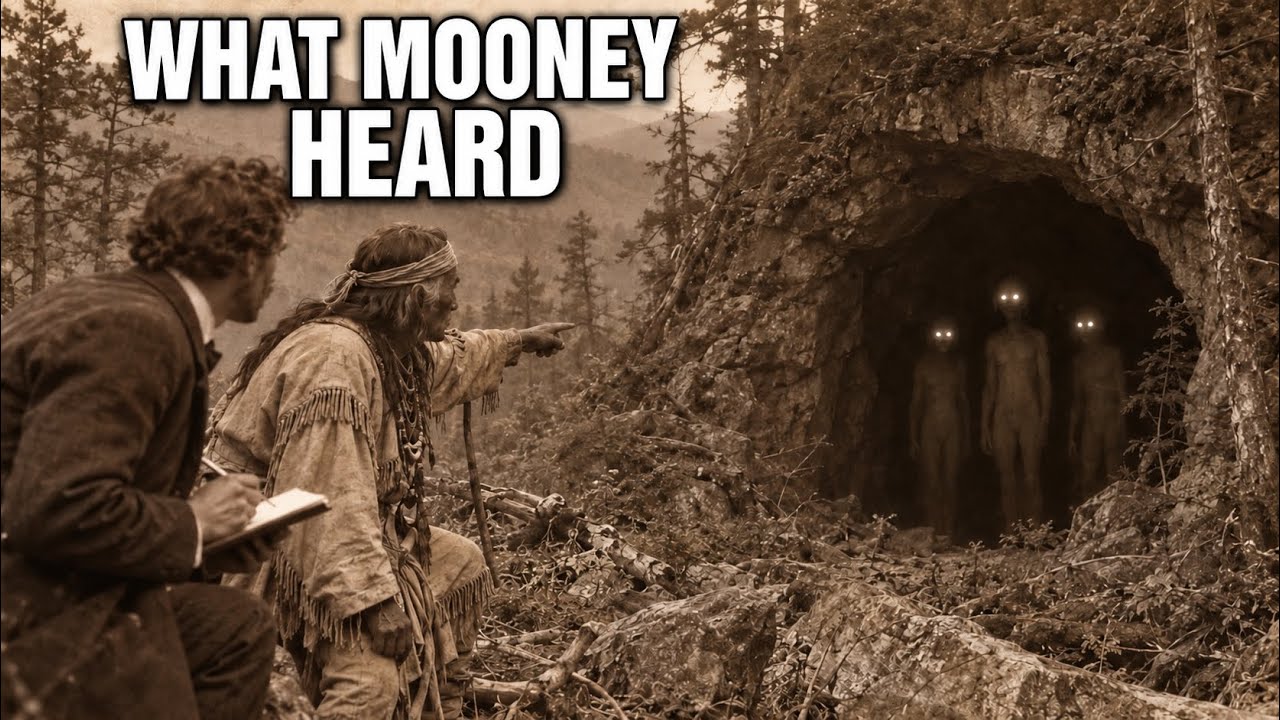
He had been sent south by the Bureau of American Ethnology in Washington with an urgent task. The Eastern Band of Cherokee, descendants of those who had refused or avoided removal to Indian Territory in the 1830s, still lived on their land in the Smoky Mountains. Many of their elders carried knowledge that had never been written down. Sacred formulas, medical practices, and origin stories were passed by memory from generation to generation.
Mooney understood that once those memory-keepers died, the precise wording, the details, and the order of events could be lost within a single lifetime. He set out to record everything he could, with as much accuracy as possible, working directly with Cherokee speakers rather than relying on the secondhand accounts of earlier travelers. In those early years, his principal source was a man called Ayunini, known in English as Swimmer, a respected healer and keeper of traditional knowledge among the Eastern Band. Mooney worked with Swimmer and with many other Cherokee men over the following years, comparing each man’s account against the others, noting where they agreed and where they differed.
It was slow, painstaking work conducted in both Cherokee and English. It produced far more material than Mooney had anticipated. Somewhere within that material, alongside stories about the origin of disease, the theft of fire, and the animals that shaped the world, was that fragment about the people who could not bear the sun. The tradition, as Mooney recorded it, was slight compared to the longer myths.
It held that when Cherokee ancestors arrived in the southern Appalachians, they found the land already occupied by a people who built with stone. These earlier inhabitants were said to have unusually large eyes and to see poorly, or not at all, in daylight, so they lived and moved mostly at night. Some Cherokee speakers connected these people to the ancient stone walls and fortifications scattered across the mountains, including a low, winding wall of piled rocks running along a ridge in what is now northern Georgia, a place later called Fort Mountain. No one who spoke with Mooney claimed to know who had actually built it.
The wall simply existed, older than living memory, and the story of the Moon-Eyed People was one way the Cherokee explained its presence. According to tradition, a conflict took place. The Cherokee, arriving as a new and growing people in the region, made war against those who were already there. At least one version of the story said they received help from the Creek, their neighbors to the south, in driving the earlier inhabitants out.
Mooney noted that the fighting was remembered as having occurred at the time of a full moon, which some Cherokee speakers considered the actual origin of the name, rather than poor eyesight alone. The defeated people were said to have withdrawn, although accounts did not agree on how far they went. Some said they crossed the mountains and continued on. Others placed their final departure west of the Mississippi River.
Mooney was honest about this ambiguity in his own notes. He did not try to smooth the story into something more complete than his informants had given him, and he did not present it with the same confidence he gave to the longer, more consistent myths in his collection. That honesty mattered because the Moon-Eyed People had already become useful to other people for other purposes decades before Mooney reached the Smokies. In 1823, a Tennessee judge and amateur historian named John Haywood published a book about the early history of the region.
He picked up that fragment about a pale people with wide eyes who once lived in the southern mountains and connected it to something entirely different: the old European legend of a Welsh prince named Madoc, said to have sailed to America centuries before Columbus and left descendants somewhere in the interior. Haywood was not alone. Through most of the eighteenth and nineteenth centuries, many American and British writers were already searching for so-called Welsh Indians, a lost tribe of light-skinned, blue-eyed natives supposedly descended from Madoc’s voyages. Reports of any group with unusual features were fitted into that search.
The Cherokee tradition of a people with sensitive eyes, driven out long ago, fit the shape of that old myth too comfortably, and writers who wanted to prove a Welsh discovery of America treated the Moon-Eyed People as their evidence. It was a genuine distortion, following a pattern that prevailed in much early American writing about native history. A community’s account of its own past, an account that existed to explain ruins on a ridge and to remember a conflict with an old neighbor, was torn from its context and attached to a European story that had nothing to do with the people who originally told it. The Moon-Eyed People ceased to be a Cherokee explanation for something in their own environment.
In the hands of non-native writers, they became proof of a white presence in America that no Cherokee narrative had ever claimed. By the time Mooney sat with Swimmer and his other informants, the Welsh theory had been circulating in print for more than sixty years, and Mooney was aware of it. He treated it with open skepticism in his own writings on the subject. He pointed out that the physical description given to him by Cherokee speakers, a people with large, weak eyes adapted to darkness, matched no known description of Welsh or other European settlers, and that the similarity to the Madoc legend existed only in the retellings of outside writers, not in the tradition itself.
Mooney’s approach was to record what his Cherokee sources told him in the terms they used, carefully separating that from what other writers had built on top of it. In doing so, he was not just collecting a myth. He was retrieving it from beneath more than half a century of someone else’s invented history. What Mooney could not do, because the tools did not yet exist, was answer the archaeological question underneath the story.
The stone wall at Fort Mountain is real. It still runs for hundreds of feet along the ridge today, built without mortar from piled field stones. Its age and purpose have never been firmly established by archaeologists. Later excavations and analysis linked such stonework in the region to native builders who worked long before European contact, probably for ceremonial rather than defensive purposes, although the responsible culture has not been attributed to a single group.
Nothing found at the site or anywhere else in the region produced evidence of a distinct population with large eyes. Nothing produced evidence of a Welsh presence either. The builders of the wall remain unknown. What can be said is that the structure long predates any reasonable connection to Wales, and that the Cherokee tradition recorded by Mooney was certainly an attempt by later generations to explain something already old and mysterious when their ancestors arrived, not a factual record of a Welsh colony.
That leaves the more interesting question, the one Mooney himself seemed cautious about. What did the story actually mean to the people who told it? Oral traditions in the Southeast often used accounts of displaced earlier peoples to explain natural features with no obvious origin, whether mounds, walls, or unusual artifacts turned up by the plow. Vanished peoples with strange traits, driven out in ancient conflicts, gave later generations a way to make sense of a landscape shaped by hands other than their own, without needing a name, a date, or a specific destination for those peoples.
The disagreement among Mooney’s informants over whether the Moon-Eyed People had crossed the mountains or crossed the Mississippi was not a flaw in the tradition. It reflected a story that performed a real explanatory function for the people who preserved it, not one built for the factual precision a later outside reader might demand. Mooney published the tradition, brief as it was, within his larger work, Myths of the Cherokee, issued by the Bureau of American Ethnology in 1900 as part of its nineteenth annual report. The book ran to hundreds of pages and represented more than a decade of fieldwork.
The Moon-Eyed People occupied only a short passage within it, overshadowed by the longer origin stories and the extensive sacred formulas Mooney also recorded. Yet that short passage traveled farther than almost anything else in the collection. Once it appeared in a government-published scholarly source, rather than confined to the speculative writings of men like Haywood, it gained a kind of authority that made it easy to cite and misuse again and again. During the twentieth century, the Moon-Eyed People kept appearing, usually stripped of Mooney’s careful framing.
Writers interested in ancient contact theories, lost civilizations, or alternative interpretations of pre-Columbian America picked up the story and ignored Mooney’s doubts, treating the documented Cherokee oral tradition as physical evidence for whatever theory they were promoting: Welsh explorers, an unrelated ancient race, or later, visitors from other planets linked to unexplained stonework. In almost every case, the pattern from Haywood’s era repeated itself. A specific, local interpretive tradition, preserved by a particular community for its own purpose, was stripped of its context and used to support a claim its original tellers never made and would not have recognized. Mooney did not live to see how far this would go.
He continued fieldwork among the Cherokee and other native nations for years afterward, becoming best known for his important and influential ethnographic documentation of the Ghost Dance movement in the 1890s, work that placed him at the edge of one of the most violent chapters in the government’s relationship with native nations. He died in 1921, having spent much of his career trying to record native accounts in the words of their owners, at a time when most published writing about American native history still treated those accounts as raw material for other people’s conclusions. The Moon-Eyed People were never the focus of Mooney’s work, nor are they the focus of Cherokee history. What this fragment leaves behind is something more limited and, in its own way, more enduring.
It is a record taken directly from Cherokee sources, about their arrival in these mountains and about a people already gone by the time their ancestors reached the place. Whether that earlier people existed as Mooney’s informants described them, whether the story explained a real conflict or a real older culture, or simply an ancient wall no one who lived there could explain, cannot be settled from the evidence that remains. What can be settled is what the story was not. It was not a Welsh colony.
It was not evidence of a hidden European history buried in the American interior. It was a Cherokee interpretation, preserved in their memory until an ethnographer from the Smithsonian wrote it down near its source, so that the inventions of later writers could be examined and compared against it, and shown to be false.