William T. Anderson, known to history as Bloody Bill, swore that he could kill men with as much skill and speed as anyone, and that he would ask no quarter and give none. Those who rode with him described a desperate man, a reckless fighter, and the worst devil in the bunch, someone who could shoot a kneeling man begging for mercy as easily as another man might kill a chicken. He claimed he did not care for his life and could not throw it away because he wanted to lose it.
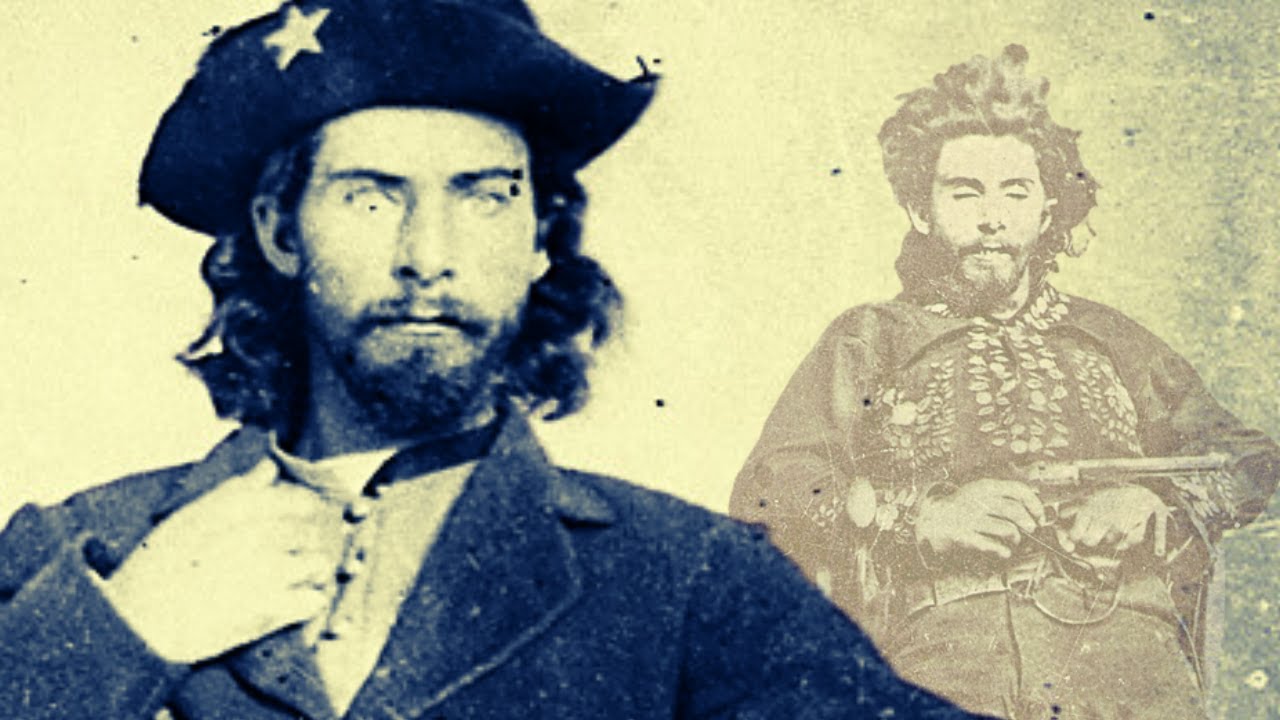
Whether he was a reluctant hero caught up in the passions of civil war or a bloodthirsty villain who used any excuse to terrorize the countryside is a question that has divided historians ever since. Anderson was born in Hopkins County, Kentucky, around 1829, one of at least seven children of William C. and Martha Jane Anderson. The family moved often, from Kentucky to Missouri, then Iowa, then back to Missouri, before settling in Kansas in 1857.
By 1860 they lived in Agnes City, about a hundred miles west of Kansas City, where Bill’s father had traded hat making for farming. Young Bill helped his father work more than three hundred acres, but the family may have had another source of income, as his father was suspected of horse thievery and was even arrested for it at least once. Bill and his brother Ellis both survived separate deadly shooting scrapes with Native Americans in Kansas in the late 1850s, with Bill claiming the man he killed had tried to rob him. He left Kansas with a freight load bound for New Mexico, only to return empty-handed, saying his cargo and horses had simply disappeared.
After that, he took to trading horses between Kansas and Missouri. In 1860, his mother was killed by a lightning strike in her front yard. The same year, the political storm that would consume him was building. The Kansas-Nebraska Act of 1854 had repealed the Missouri Compromise, allowing settlers in the new territories to decide for themselves whether they would be slave or free.
Kansas became a battleground. Pro-slavery and anti-slavery activists flooded in, and violence erupted in what became known as Bleeding Kansas. At least fifty-five people were killed between 1855 and 1859. Missouri, meanwhile, was a slave state with a deeply divided population, a hotly contested border state where union and Confederate sympathizers fought each other, and where jayhawkers, union-aligned guerrillas from Kansas, raided across the border.
Anderson did not immediately rush to join the fight. When he finally took up arms against the Union, he told his neighbors he did so for financial reasons, not loyalty. He once said he did not care for the South, but there was a lot of money in the business. Accounts of what drove him to guerrilla warfare differ sharply.
In one version, he and his brother Jim, along with a respected local judge named Arthur Ingram Baker, were attacked by Union cavalry in 1861. Bill and Jim escaped, but Baker was taken prisoner. When released, Baker ended his association with the Anderson family entirely. Some say he had always been an abolitionist; others claim he had impregnated and then abandoned Bill’s fifteen-year-old sister.
Whatever the truth, Baker filed a warrant for Bill’s arrest after horses were stolen from his property. In May 1862, Bill’s father confronted Baker with a shotgun and was shot dead. Bill buried his father, fled the state, and returned a month later. With his brother and two other men, he ambushed Baker at his store, forced him into the cellar, locked him in, and set the building on fire.
Baker took his own life rather than burn to death. A very different version claims that union-aligned jayhawkers lynched Bill’s father, stole the family’s possessions, and burned their farm. In this telling, Anderson joined William Quantrill’s guerrillas explicitly for revenge, saying the Yankees had murdered his father and destroyed his property. The end result was the same: judge Baker was dead, and Bill Anderson was in Missouri.
At first, he did not join Quantrill. He started his own gang, and after robbing some southern sympathizers, Quantrill took his horses and warned him that further trouble would mean his execution. Anderson kept his distance until early 1863, when he finally joined Quantrill’s Raiders. He rose quickly in the ranks, commanding his own fighters, including a seventeen-year-old killer named Archie Clements and a nineteen-year-old named Frank James.
The guerrillas did not fight like regular soldiers. They avoided pitched battles, striking swiftly, ambushing patrols, raiding supply depots, and disappearing among a sympathetic civilian population. The Union military responded by arresting civilians suspected of helping the guerrillas. Bill Anderson’s sisters were among them.
In Kansas City, the building where they were held collapsed, killing his fourteen-year-old sister Josephine and badly injuring the other two, sixteen-year-old Mary Ellen and ten-year-old Janie. The collapse was officially ruled an accident, but the raiders did not believe it. Whatever Anderson’s original motives, his sisters’ deaths now fueled him. The attack on Lawrence, Kansas, on August 21, 1863, was revenge for the sisters, for the sack of Osceola, and for all the farms destroyed by jayhawkers, and it was also a targeted attempt to kill James H.
Lane, a union general and militia leader who had pillaged Missouri. Upwards of four hundred guerrillas descended on Lawrence, killed over 150 men and boys, burned nearly every business, and left eighty-five widows. Anderson himself was credited with killing fourteen people that day, some begging for their lives. The only hint of humanity came when he spared a woman’s house after she pleaded with him.
The massacre led to General Order Number 11, which forced the evacuation of four counties in western Missouri. Families had to abandon their homes regardless of allegiance, and those who could not prove loyalty to the Union were simply expelled. It was the largest forced removal of Americans until the internment of Japanese Americans in World War II. The order was meant to deprive the guerrillas of local support, but it had the opposite effect.
Thousands of displaced civilians, their homes pillaged and burned, turned against the Union. The raiders headed to winter quarters in Texas, where Anderson fell in love and married a Sherman woman named Bush Smith in March 1864. The marriage deepened the rift between him and Quantrill. Tensions escalated until Anderson went to Sherman and informed Confederate authorities that Quantrill had murdered a Confederate officer.
Quantrill was arrested but escaped the same day. Anderson was sent to hunt him down, though Quantrill’s loyal men fought off Anderson’s and let their leader escape. Quantrill’s Raiders broke into three separate groups, led by Anderson, George Todd, and Quantrill himself. By the summer of 1864, Anderson had earned his nickname.
He and his men, often wearing stolen Union uniforms, ambushed and killed across central Missouri. They scalped their enemies and decorated their horses with the trophies. Anderson wrote letters to newspapers, calling himself commander of the Kansas First Guerrillas. On July 15, he robbed Huntsville’s depository of over forty thousand dollars, yet he did not leave the war.
He became one of the most feared guerrillas in the border country. Jesse James, not yet seventeen, joined his brother Frank under Anderson’s command. On September 27, 1864, Anderson and about seventy-five men rode into Centralia, Missouri. They found whiskey and drank in the hotel lobby, robbed a stagecoach, and then a Union passenger train arrived carrying twenty-three unarmed, off-duty soldiers.
Anderson had the women left untouched, robbed the passengers, and had the soldiers lined up and executed, sparing one sergeant for a potential prisoner swap. A German civilian wearing a blue shirt was also killed. The train was set on fire, and an approaching freight train was derailed. The guerrillas left with over twenty scalps and nine thousand stolen dollars, with both Frank and Jesse James present.
That afternoon, a detachment of the 39th Missouri Volunteer Mounted Infantry under Major Johnston caught up with them. Anderson’s men, each carrying six to eight pistols, swarmed the Union troops from three sides. All 125 Union soldiers lay dead, many scalped. It was Anderson’s most decisive victory.
Frank James later said young Jesse fired the shot that killed Major Johnston. After Centralia, Anderson met with Confederate General Sterling Price, who was disgusted by the scalps decorating the guerrillas’ horses but promoted Anderson to captain and ordered him to disrupt railroad traffic. Anderson largely ignored the order and continued looting. In Glasgow, he beat a wealthy citizen who had freed his slaves, trampled him with a horse, stole his money, and then raped a twelve-year-old Black girl.
He and his men killed several more citizens and raped more of the freed servants before returning to the man’s home, who died the next day from his wounds. His time was running out. On October 26, 1864, Lieutenant Colonel Samuel P. Cox, leading specially trained troops, caught up with Anderson near Albany, Missouri.
The exact numbers on both sides are unclear. During the fighting, Anderson rallied his men for a charge but was turned back. Then he and a man named John Raines broke from the ranks and charged headlong into the Union lines. They briefly broke through, but Anderson was shot in the head by a Springfield musket ball and died before he hit the ground.
He was twenty-five years old. His body was transported to Richmond, Missouri, paraded through the streets, propped up outside the courthouse for people to gawk at, and photographed. One of his fingers was removed to take a ring, and a silk cord with fifty-three knots, said to symbolize the men he had killed, was found on his body. After his death, his lieutenant Archie Clements took over and fought on even after the war ended, dying in Lexington, Missouri, in 1866 at around twenty-one, with his dying words being that he had done what he always said he would, dying rather than surrendering.
George Todd was killed at the Battle of Little Blue River just five days before Anderson. William Quantrill was shot in the back in Kentucky a month after Lee’s surrender and died in Louisville at twenty-seven. Anderson’s brother Jim survived the war, moved to Texas, and may have married Bill’s widow, Bush Smith, before his own mysterious death. In 1927, an article claimed an elderly Texas man was actually Bloody Bill, but the claim remains a legend.
Anderson’s men respected him, and his ruthlessness made him one of the most feared guerrilla fighters of the border war. He had once claimed everything was done out of revenge, but that cause had disintegrated into rape, robbery, and murder. Whether he was a hero or a villain, his story stands as a warning about what war can turn a man into.