In the winter of 1899, on a remote rocky headland off the coast of Maine, an entire convent of nuns aged in a single terrible night. Not through illness, not through fear, but simply, suddenly, and completely. The youngest women in the order, women in their early twenties, woke to find their hands spotted and thin, their hair turned to ash, their knees stiff with the ache of grandmothers. By morning, three could not stand alone.
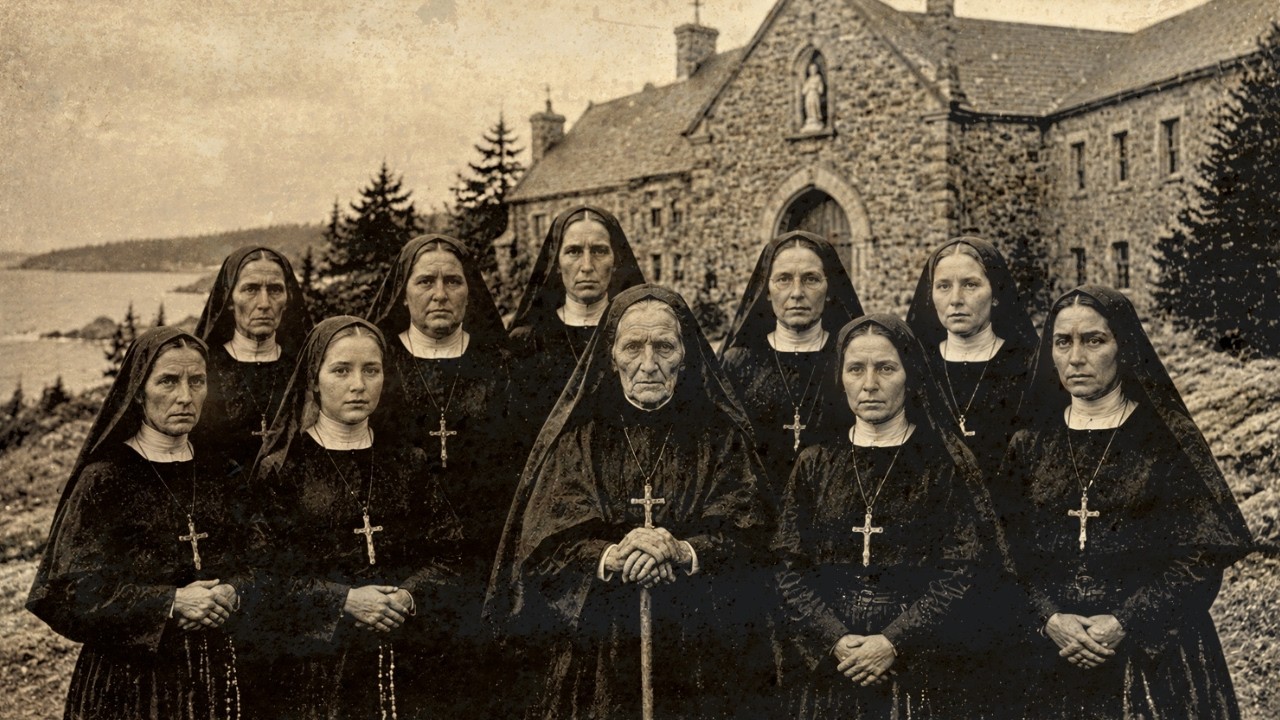
By the following evening, one was dead, her heart simply stopping as an old woman’s heart stops, though she had been young enough to dance at her cousin’s wedding two years earlier. A doctor summoned to the headland that night wrote in his private journal that in thirty years of practice he had never seen anything like it: a household aged forty years in a single long night, touched not by sickness or violence, but by time itself, arriving suddenly like a bill long overdue. He was not wrong about what he saw, only about what he failed to understand. The full explanation would not come for decades.
This is the story of the order of Whitcherme, the small cloistered convent on Graystone Point; the pale candle its nuns kept burning behind the main altar for more than thirty years to buy back their youth; the steady flow of young women consumed to keep that flame alive; and the reform-minded prioress whose single act of conscience brought the long-overdue reckoning in one merciless night. The order was founded in the autumn of 1866 by a wealthy, deeply devout widow named Augustine Fell, described in her surviving letters as severe rather than kind. Having buried her husband and two children within four years, she came to the coast seeking, as she told it, a remote place where grief could not reach her through the mail. She purchased a rocky, wind-exposed headland of spruce trees jutting into cold waters, and began, with six women who had followed her from a stricter community in Boston, to build a convent chapel on the old stone foundations already standing there.
From those old foundation stones, this story truly begins. The chapel Augustine Fell built was not the first structure on that headland. When her builders cleared brush and fallen timber to lay a solid foundation, they found, about six feet down, where they intended to place the altar, a chamber that was not part of any building they knew. It was small and round, perhaps eleven feet across, built of pale, polished stone that needed no mortar because none had been used.
The joints were so tight that a builder’s record preserved in the diocesan archive noted that no knife blade could be inserted anywhere in the wall. There was no maker’s mark on the stone, no date. There was a single shallow recess in the far wall, at waist height, and inside that recess, on a shelf of the same stone, sat a candle. It was, by every surviving account, no ordinary candle.
It was short and pale, the color of old bone, with no sign it had ever burned in living memory, though the wick at its center was black and charred, as if it had burned once, for a long time, and then simply stopped. Above the recess, carved in a script none of the builders or nuns who later examined it could read, ran a single line. Below that, in clearer English, three lines were carved. They read: Keep the pale candle burning and the years will stay far.
Give it its due before the flame fades, and give generously. What is given to the candle, it keeps. What is owed to it, it takes. Augustine Fell did not understand any of this at first.
She treated the chamber as a curious remnant of some vanished settlement, and ordered the chapel built directly over it, with a hidden stair descending from behind the vestry into the circular room. She left the candle in place, unlit, for nearly two years. What changed, according to the account left by Sister Odile Morrow many years later, was the winter of 1868, the coldest anyone on that stretch of coast had ever known. It killed two of the order’s oldest and most devoted nuns within a week.
In mid-January, in the middle of the night, Augustine Fell, a woman not yet fifty, exhausted and bowed by grief, went alone into the round chamber below the chapel, carrying a single candle from the cupboard to see by. In her desperation, she lit the old bone-colored candle from her own flame. It caught immediately, burning with a pale, almost cold flame. Kneeling before it, she raised what she thought was an ordinary, desperate prayer: that she be given the strength to keep the remaining sisters alive, that her worn body not fail the order before it could stand on its own.
She woke the next morning feeling better than she had in years. Her stoop was gone. Within a month, the sisters noticed the gray in her temples slowly darkening back to its original color. Augustine Fell, approaching fifty, lived another forty-one years, dying in 1907.
In every surviving photograph, she looks like a woman who never reached sixty. It took the order years to understand what had happened. The mechanism, as they eventually understood it, and as documented in a private ledger kept for decades by a later prioress named Genevieve Thorn, worked this way. The pale candle did not merely burn; it borrowed.
A living person kneeling before it in genuine, voluntary surrender, offering a portion of their remaining years, would find those years drawn from their future and folded somehow into the pale flame, which would burn brighter and slower for receiving them. And as long as that flame burned with a measure of borrowed years, another person, chosen or merely present, could draw warmth from it in the opposite direction, the same years folded into an aging body, fixing it, or nearly fixing it, at whatever age it had been when the borrowing began. Augustine Fell had not intended to offer part of her years. She had accidentally made herself the first recipient, the first nun to draw borrowed time from a flame that, for reasons no one in the order’s recorded history ever explained, had been fed before by hands far older than those of Whitcherme itself.
For the first decade of the order’s history, the giving remained rare and voluntary. A few older nuns, women who had buried husbands and children, who had watched their own mothers weaken and understood the price of weakness, asked in their own time to be granted the same mercy Augustine Fell had received without asking. The order’s private record describes these early gifts with great gentleness, as acts of deep sacrifice offered by elderly women whose bodies were failing, who freely chose to surrender their few remaining years to spare a sister they loved, a novice mistress, a prioress, an infirmarian the whole house depended on. The problem, and the reason this story exists, lies in what happened when a religious institution, built on a remote, struggling headland, realized that the flame did not care who was offered, only that the offering was willing.
And that an eleven-year-old orphan, with sixty years of life ahead of her, had, by the patient flame’s reckoning, far more to give than a woman in her sixties. The two decades between Augustine Fell’s first unintended gift and the arrival of Genevieve Thorn as prioress were, according to surviving correspondence, the order’s most prosperous and admired years. Word spread of the remarkable nuns of Graystone Point who did not age. Fishermen in the village supplied the convent and had every chance to notice that its older nuns changed little over a decade.
Wealthy Boston families sent daughters who recovered, in a few famous cases, from illnesses their doctors had quietly expected to be fatal, after a period of prayer quietly arranged in exchange for a generous donation at Whitcherme. The order never claimed to work miracles. It didn’t need to. It only needed visitors to notice and repeat how strangely young its older nuns looked, and how often its favored guests recovered, and to let the natural desire to believe in an available grace do the rest.
It was this prosperity, which Genevieve Thorn inherited in full upon her election in 1881, that gave her the resources and the incentive to transform what had been, under Augustine Fell’s hesitant and restrained hand, a rare and intermittent mercy, into a steady, managed harvest. Mother Genevieve Thorn, more than any other figure in this story, bears its true horror. She was a superb administrator. Within twenty years she turned a struggling coastal convent of perhaps a dozen nuns into a house of nearly forty, attracting wealthy benefactors from as far as Boston and New York.
Nearly every visitor whose letters survive noted the strikingly youthful appearance of the older nuns. Women who had taken vows in the 1860s were still described in the 1890s as no older than thirty. The order’s financial records confirm this reputation was not accidental but the engine of its prosperity. Wealthy families sent their daughters specifically because the nuns there were said to age very slowly, enjoying a special grace.
The benefactors gave generously to a house whose sanctity seemed, by the visible evidence on its members’ faces, to be publicly rewarded. Mother Genevieve Thorn kept, for nearly four decades, a private ledger of every gift made before the candle’s flame flickered out, coded by number and mark, alongside notes on how long the flame burned brighter afterward and which older sisters benefited. When this ledger was eventually compared with the order’s own admission records, a task completed only after a contemporary researcher spent most of a decade on it, a pattern emerged the order never acknowledged in any public correspondence. The majority of novices eagerly admitted during Genevieve Thorn’s decades of rule were orphans.
The majority were young women with no family to write letters asking after them. The rule never changed: give it its due before the flame fades, and give willingly. By every surviving account, Mother Genevieve Thorn never once forced a girl to light the candle. Instead, over four decades, she built an entire spiritual edifice, of education, isolation, and prolonged persuasion, designed with quiet patience to bring an orphaned girl of sixteen or seventeen to the point where she would kneel before the ancient flame and surrender most of her remaining years as a freely chosen sacrifice.
The order’s own record mentions, in the reserved language of religious biography, the names of at least nine young sisters during Thorn’s tenure whose deaths were recorded from sudden decline following a period of intense spiritual devotion. All were described as becoming feeble, their hair graying, their age advancing far beyond their years within weeks or months before they died peacefully in the convent infirmary. Cross-referenced with the private ledger, each of those nine names corresponds to a recorded gift. An orphan girl was brought in young, carefully prepared over a year or two for a state of voluntary surrender, then brought at last to the old alcove beneath the chapel, where she offered most of her remaining years, perhaps forty or fifty un-lived years, folded into the pale flame in a single hour of kneeling.
The gift did not kill her immediately. It aged her over the following weeks and months at a rate that compressed decades into one winter, until a girl of seventeen who entered the chapel that autumn looked, by the following spring, like a woman of sixty, and died shortly thereafter, for no reason more dramatic than the failure of an old woman’s heart. The doctor eventually called to the headland, a man named Ambrose Vennick, had served the parishes of that coast for nearly thirty years. His diary, preserved among his family’s papers, records a pattern that troubled him for decades without his being able to name its cause.
He was called to Graystone Point regularly, always to follow the decline of a young nun, and recorded again and again cases for which he had no medical explanation: girls of seventeen and eighteen with the joint problems, heart trouble, failing eyesight, and bone fragility of women three or four times their age. Girls whose hair turned from black to white within months. Girls who died not of any disease he knew but of what he privately began to call premature senescence. He never suspected the candle.
He had no reason to. No nun ever told him, and his access to the order’s inner life was strictly limited to the infirmary. He was never allowed into the sealed room beneath the chapel. In one entry from the spring of 1879, he wrote of examining the joints of an eighteen-year-old girl and finding in them changes he would expect in a woman of sixty, noting that the pattern had repeated often enough to rule out coincidence, though he could identify no other explanation.
In an entry from 1886, he recorded his direct question to the prioress as to whether the young nuns were subjected to some unusual physical regimen, fasting or exposure, and receiving only gentle reassurance. In the margin he noted he was not entirely convinced but had no grounds to question it. In a final entry from 1893, examining the body of a young woman at the order’s request, he found a corpse bearing every outward sign of advanced age, placed directly over a skeletal structure his instruments confirmed belonged to a girl who had not yet reached twenty. A contradiction he admitted he lacked the words in his entire medical training to describe.
Three of the nine names confirmed by the ledger and register together deserve full recording, for showing how ordinary the entire arrangement had become by the time Genevieve Thorn finished perfecting it. Sister Perpetua Raine joined the order in 1883 at age fourteen, an orphan referred from a Portland charity house that had kept no records of her parents. Her surviving letters show a slow, genuinely joyful deepening of devotion over four years, culminating in a final letter in the autumn of 1887 in which she wrote that she had seen a great and sacred secret she could not yet describe, and that she had never in her short life felt the certainty she felt now of her impending surrender. She died the following spring in the convent infirmary, aged nineteen.
Dr. Vennick’s private notes described a body that appeared, by every external and internal measure his instruments could register in 1888, to have exceeded seventy. Sister Margaret Colby arrived in 1891 at age fifteen, the illegitimate daughter of a Boston servant who died in childbirth. Unlike Perpetua, her novitiate was not smooth.
Her diary fragments record genuine doubt through her second year, a sense, never explicitly stated, that the special instruction she was receiving required something larger and stranger from her than ordinary religious surrender. This doubt delayed her gift by nearly two years from the order’s usual pace, a delay the ledger recorded with administrative frustration. She was finally brought to the round chamber in the winter of 1894 at age seventeen. The record of that night contains an unusual marginal note: after a long period of preparation.
Sister Theodora Vail is the third case, and the strangest, because she nearly did not surrender at all. She entered the order in 1896 at age sixteen, having been engaged before her father’s sudden death left her without a dowry, to a young fisherman named Josiah Kell, whose letters to her were preserved because the convent did not deliver some of them. He kept writing, and kept trying to see her, appearing twice at the convent gate, where his request was refused both times on Thorn’s direct instructions. Theodora’s diary shows a young woman torn for months between the increasingly urgent spiritual language of her formation and a stubborn private hope that Josiah would come for her before the appointed night.
He did not come in time. Theodora Vail died in the autumn of 1898. Her final diary entry, written only days before, does not describe sacred certainty at all, only that she had decided, since no other door seemed open to her, to believe that what she was doing was love, because the alternative was unbearable to think about. Josiah Kell never married, and kept until his death in the 1940s a small framed photograph of a girl in a dark coat standing at the convent gate.
It is in this long, carefully managed context of institutional exploitation that the long life of Sister Odile Morrow within the order must be understood. She was the only figure in this entire history who seemed from the start to grasp the truth and horror of what Whitcherme had become, and who spent most of sixty years trying, in her limited way, to prevent the worst of it. She joined in 1868 at age sixteen and witnessed the early voluntary gifts made by grieving elderly widows out of genuine love. She watched over the following decades as that early practice was slowly transformed under Genevieve Thorn’s long rule into what amounted to a harvest of the vulnerable.
Her own papers reveal a woman who lived most of her adult life in painful unresolved conflict. She never forced any girl to light the candle herself. She never disclosed what she knew to anyone outside the order, a silence she described in her last years, in a letter to a younger sister, as the great sin of her long religious life. But repeatedly, and at great personal cost, she intervened.
The clearest surviving example of this intervention concerns what the order’s private records attempt to soften as the Sister Honora problem. Honora Steed joined at age fifteen, an orphan with no family, no dowry. She was precisely the kind of girl Thorn’s program was designed to identify. But Honora resisted.
She wrote in fragments of a diary, hidden later by Odile Morrow herself, of a growing fear in her final months of novitiate, a sense that the spiritual guidance pushing her toward a great, unspecified surrender was asking for something she did not want to give. Her novice mistress pressed harder rather than yielding. On the appointed night, chosen to coincide with the flame burning unusually low after lean years, Honora Steed was brought to the round chamber and knelt before the old alcove in a state Odile Morrow, watching from the stair, described decades later as unwilling. What happened next is the only recorded case in the order’s entire history of the rule’s second, more terrible failure.
When an offering was made under coercion rather than willingly, the pale flame did not feed and burn steadily. It flickered violently, burning for long moments with a flame the color of a bruise. Instead of drawing its nourishment only from Honora Steed kneeling before it, it seemed to reach for every living person in the room and on the stair above. Odile Morrow herself felt pain in her knees and a blurring of her vision for nearly a minute before the flame settled.
Honora Steed did not survive the night. She was found in the morning, aged, according to every account, far beyond even the average age of voluntary givers. Dr. Vennick’s examination recorded an apparent age of eighty rather than sixty.
Two other sisters present that night, women who had never been meant to give anything at all, aged visibly and permanently in the following months, their hair graying years before its time. This incident more than any other cemented a fixed doctrine within the order’s inner circle: the gift must be voluntary. Unwilling giving did not merely fail; it disrupted the transaction itself. The leadership absorbed this lesson in the years after Honora’s death, not as a reason to question the practice but as a technical correction.
Formation was handled more patiently, spiritual pressure applied gradually, so that the chosen girl would experience her surrender not as coercion but as the fullest, warmest expression of her faith. The correction worked. In more than twenty years after Honora Steed’s death, no further case of violent instability in the flame was recorded. The harvest simply continued, more carefully managed, until the arrival of a new prioress in the late 1890s whose conscience would accomplish what neither Odile Morrow’s private doubts nor Honora Steed’s horrific death had achieved.
Mother Praxedes Ellerbee was appointed prioress of Whitcherme in 1897, partly, as later correspondence suggested, because the diocese felt the increasingly wealthy coastal convent would benefit from a prioress known for reformist zeal rather than administrative caution. She had spent the previous decade working among the poor of Boston, and arrived at Graystone Point, by every surviving account, with genuine deep horror of institutional cruelty hiding behind a mask of piety. She did not discover the pale candle’s secret quickly. What finally revealed it was her systematic curiosity about the convent’s finances, which led her in the winter of 1898 to the old private ledger of Mother Genevieve Thorn, left among her successor’s papers.
She spent most of a week with the ledger, comparing its coded entries with the admission record, before she understood what she was looking at, and what she was looking at, once she understood it, did something to her that never fully healed. She went to Odile Morrow, then a very old woman in her late seventies, and asked her directly whether what the ledger recorded was true. Odile Morrow did not lie to her. She confirmed everything: the ancient alcove, the pale candle, the true nature of the gifts, the long harvest of orphan girls that had built and sustained the order’s wealth, the unnatural youth of the older nuns.
But she also told Praxedes that the flame could not simply be abandoned. It was an established right. It had been fed for decades with borrowed years. Those years were, at that very moment, embodied in the bodies of nearly a dozen elderly nuns throughout the convent, women whose aging had been delayed, in some cases by thirty years or more, by a debt the flame, and whatever patient ancient intelligence lay behind it, expected to be repaid on its own terms.
She warned that letting the flame die would not end the agreement but demand full settlement. Every word Odile Morrow told her was true. But it came in language that could only sound to a reform-minded prioress, shocked by decades of institutional cruelty, like a frightened old woman defending the very system that had allowed her to live to old age. Praxedes Ellerbee was not in a state of mind in the winter of 1898 to hear an ancient rule about debts owed to a flame as anything but another part of the same self-serving myth that had justified thirty years of silent killing.
She thanked Odile Morrow with genuine kindness and told her that whatever the cost, the giving would end. In the months following directly, Praxedes’ surviving letters show her turning the problem over from every possible angle, seeking genuinely intelligent for a way to rescue the next scheduled girl and the elderly sisters whose borrowed years Odile had warned would come due. She considered gradual repayment rather than all at once, a smaller, less catastrophic source of years, and abandoned it within weeks because it offered no real exit from the same essential cruelty, only a slower, more deniable version. She considered removing the youngest candidates from the convent entirely.
That plan failed for an obvious reason: decades of Thorn’s selection had made the convent nearly entirely dependent, financially and practically, on the very girls she would have had to send away, and on the elderly nuns whose youth kept the operation running. Every path led back to the same two choices: more cautious, patient giving, or an ending whose true cost she could not calculate in advance. She did not act immediately. The order’s records show she spent nearly a year working cautiously, consulting quietly with a sympathetic diocesan official, and even attempting to have the chamber itself formally investigated by an outside party, an attempt that failed when the elderly bishop she appealed to dismissed the entire account as the fevered imagination of an overworked prioress.
By the autumn of 1899, with scheduled gifts having ceased for nearly two years due to her deliberate refusal, and with Odile Morrow herself, who warned her almost daily that the flame in the round chamber had begun to fail dangerously, Mother Praxedes Ellerbee made the decision that ends this story. On the night of the third of December 1899, she went down alone to the round chamber beneath the chapel, the same chamber where Augustine Fell had knelt more than thirty years before, and with her own hand she extinguished the pale candle. What happened in the hours that followed is recorded in fragments in three separate places: in the diary of Lucy Vance, the young nun who recorded that terrible night; in the convent infirmary where she was tasked with caring for the sisters as they began to fail; and in the diary of Dr. Ambrose Vennick, summoned in the early hours and arriving at a house he described as beyond his capacity to describe.
The debt accumulated on the flame for over thirty years did not dissipate quietly. It came due. In the main wing of the convent, in rooms occupied by women who, according to parish records, had taken vows as young nuns in the 1860s and 1870s, and who had gone to bed that evening looking no older than middle age, the borrowed decades arrived at once and without mercy. Lucy Vance’s diary describes first hearing a low continuous sound through the infirmary wall, which she slowly realized was the sound of dozens of women rising and falling in one long sustained cry of pain that did not stop for hours.
By the time Dr. Vennick arrived around three in the morning, six elderly sisters were already dead. His hasty notes recorded bodies bearing every sign of extreme old age: severe wasting, paper-thin skin, completely white hair, rigid twisted joints, despite parish records indicating none of them had been older than fifty that same day. Nine more sisters died over the following two days, their bodies suddenly and violently returned to an age their hearts and lungs had not aged gradually enough to survive.
Eleven other sisters survived the night but regained little of their former youth, living out their short remaining lives looking visibly decades older than they should have been. Mother Praxedes Ellerbee was among the dead by morning. Her final letter, brief, written in a hand trembling with the same sudden weakness that was killing the women around her, said only that she had believed with all her heart that ending cruelty was always right, and that she had realized too late that some kinds of cruelty, once accepted deeply and for a long time, could not simply be refused without the refusal itself becoming a kind of violence. The final line asked forgiveness from any girls who had joined the order before her arrival, and said she did not expect forgiveness from those she had failed to save that night, for her belated attempt to stop it.
Lucy Vance’s diary preserves individual moments from that long night worth recording here, as the only place in the surviving record where the collapse is described not as a pattern in a ledger but as lived experience. She writes of Sister Callista Rook, the convent’s infirmarian, who had taught Lucy herself to change bandages and set a splint, calling out in a voice suddenly high and weak and strange, and being found sitting upright in bed, her hands swollen and clawed as if from fifty years of arthritis, no longer able to hold the rosary she had been clutching an hour earlier. She writes of Mother Cecilia Strother, the choir mistress known throughout the convent for her strong clear voice, attempting to lead the dying wing in chanting a single line of compline, her voice breaking and stopping midway, and of the strange terrible mercy of the other sisters around her completing the line in trembling voices. And she writes, in the most quoted lines of her diary, that before dawn she realized she was not watching women die of disease, nor of violence, but of whole lives withheld from each of them quietly for thirty years, all arriving together in one night.
Sister Odile Morrow survived that night, one of the few of the older generation to do so, though her account suggests she had already lost whatever years she had left, and was simply old enough by the time of the collapse that there was little left to lose. She lived nine more years, dying finally in 1908, described by Vennick without irony as a completely natural old age. She was the only sister in this story allowed to die at her true age. The order of Whitcherme did not survive its catastrophe.
The remaining sisters, about a dozen younger ones including Lucy Vance herself, were quietly distributed to other houses within a year. The diocese moved unusually quickly to close the convent and seal the chapel, avoiding, as its surviving correspondence put it, any scandal from public knowledge of an entire community of nuns dying from what an internal diocesan report never publicly released described as a mysterious mass illness consistent with severe premature aging. The chapel was closed. The stair behind the vestry leading to the round chamber was bricked up rather than merely locked with a door, a decision the surviving correspondence attributes to the bishop’s personal insistence.
It is worth pausing before this story moves to its modern chapters concerning the older and stranger question behind it. The pale candle in its ancient seamless alcove did not begin with Augustine Fell, just as the cruelty of Whitcherme did not end with the death of Mother Praxedes Ellerbee. The round chamber beneath the chapel is far older than the convent. No one in this story, from the builders of 1866 to the contemporary researchers who catalogued the site, arrived at any definitive conclusion.
The stonework matches no known colonial or early American technique. The unreadable line of script above the clear English rule, according to at least one linguist consulted by an independent researcher decades later, has no clear match to any documented language, living or dead. The tool marks on the stone, examined by a contemporary stonemason called in during a 1920 survey, matched no craft practice he could identify from any period of American, European, or even older history. Augustine Fell did not build the chamber.
She only built her chapel over what was already there. This phrase deserves reflection, for it points to something this story shares with every other version told on this channel. Whoever built that seamless round chamber, whoever carved that unreadable line and the plain rule beneath it, whoever placed the first pale candle in its recess and taught or learned or simply arranged for someone to eventually understand what that candle could do, did not build a monument intended for admiration. They built a working system, a real mechanism with real cost and real benefit, and carved the terms of that system in stone clearly enough for anyone who found it to know how to use it.
Then, for reasons no one has recorded, they simply left. What Augustine Fell found in 1866 was not haunted ruins. It was a still-functioning piece of ordinary infrastructure from an older, more efficient world: a job someone had once done, and at some unknown time, stopped doing. She did not inherit a legend.
She inherited a function, understanding little of it, and then successive prioresses inherited it for forty years, until a woman arrived who understood enough of it to be horrified, but not enough to end it peacefully. The chapel at Graystone Point remained abandoned and unconsecrated for more than two decades. The story’s final thread runs through a state land survey conducted in 1926 by a young surveyor named Elias Craven, sent to assess the abandoned headland for inclusion in a protected coastal parcel the state was assembling. His surviving eleven-page field report is a genuinely strange document, beginning in methodical dryness with boundary markers and shoreline erosion before turning, in its closing section, to what Craven calls a deficiency in the old chapel’s foundations, which he recommends be formally excluded from any future public access.
He had gone looking for the bricked-up stair behind the old vestry out of purely professional thoroughness, expecting to find only a sealed cellar. Instead he found a portion of the old brick fill that had partially separated since its original sealing, revealing a narrow gap through which, by lamplight, he could see the upper steps of a stair leading down. He did not descend the full stair. He reported standing at the gap for several minutes, describing a faint persistent smell of burned candle smoke rising from the darkness below, a smell with no apparent source anywhere in the sealed and abandoned chapel above, and an inexplicable urgent desire, which he recognized even then as not entirely his own, to widen the gap and go down to see what was still waiting in the chamber beneath.
He did not go down. Elias Craven’s report ends with a single recommendation: permanently exclude the old Whitcherme chapel from the conservation parcel and reseal the vestry stair at the earliest opportunity. His superior accepted it without comment, and state records show the parcel boundary quietly redrawn around the chapel that same year. The full eleven-page report was never filed in the main state survey archive.
Due to what a later researcher determined was a minor filing error rather than a deliberate act, it was misclassified among the records of a neighboring coastal town, an error that proved decades later the only reason the report survived the fire of 1941 that destroyed most of the county’s original land records. Craven himself, according to surviving family accounts, spoke of that single evening on the headland only once, late in his final illness, telling them only that he had stood at the top of a dark stair once when he was a young man and smelled a smell he could never after encounter, the smell of a snuffed candle, without remembering it, and that he had made what he called the smartest decision of his entire career by simply turning around and going back out into the daylight rather than descending. The modern chapter of this story belongs to a records researcher named Rosalind Pembroke, who first identified the order of Whitcherme during a separate project on nineteenth-century coastal convents, and who spent, by her own account, nearly four years thereafter tracing the fragments of this record: the surviving papers of Odile Morrow, the diary of Lucy Vance kept by a distant descendant, the journal of Dr. Vennick kept by his family, the coded ledger of Genevieve Thorn unread for decades in a diocesan archive box, and finally, after great difficulty, the misplaced 1926 report of Elias Craven.
Pembroke visited Graystone Point herself during that research, a visit her notes describe with a caution that seems strange, for a careful and objective researcher. The old chapel still stands, private property of the descendants of the family that eventually bought the headland from the diocese. The interior has long been stripped and repurposed, though the current owners, according to Pembroke’s account, have never fully renovated the old vestry area, showing a marked and unjustified reluctance over two generations to disturb the re-sealed portion of the floor.