On the edge of Louisville, Kentucky, a concrete passageway cuts into Waverly Hill and slopes downward into darkness. It runs about 525 feet from what was once a hospital ward down to the base of the hill, wide enough for a stretcher and long enough to swallow footsteps entirely. For decades, those who built it offered a simple explanation: it existed to spare the dying the sight of the dead, to protect their morale by hiding how many of their neighbors never walked out the front door. That story was not entirely false, but it was not the whole truth.
The administration of Waverly Hills Sanatorium did not build the tunnel primarily to protect the patients. They built it to protect the institution’s reputation as a place where people recovered. Tuberculosis killed slowly and visibly, and the doctors believed hope mattered almost as much as medicine. A hospital that looked like it was losing was a hospital nobody wanted to enter.
So the bodies went underground, out of sight, while upstairs the city of recovery kept smiling for the cameras. Few people visit Waverly Hills today to learn any of that. They come for a nurse who may never have existed, for shadows said to move through that tunnel, for a ghost story that grew out of a real but smaller tragedy. The genuine horror of the place has been buried twice: first by the people who ran it, and later by the ones who turned it into a haunted house.
In 1883, Major Thomas H. Hayes bought high ground south of Louisville and built a family home there. When he needed a school for his children, he hired a young teacher named Lizzy Lee Harris, who named the one-room schoolhouse after Sir Walter Scott’s Waverley novels. Hayes liked the name so much he applied it to the entire property, and the spelling eventually settled as Waverly.
Neither could have known what the hill would become. Around the same time, Louisville was losing a war it could not see. Tuberculosis, the white plague, tore through the city at a rate that outpaced nearly anywhere else in the country. Low-lying geography trapped damp, stagnant air over the city; industrial smoke and overcrowded tenements spread infection through entire households within weeks.
By the turn of the century, tuberculosis accounted for roughly one in five deaths in Louisville. Health officials formed a board and began searching for land high enough to catch clean air, secluded enough to isolate the infected, and far enough away that the city would not have to face its own epidemic daily. They found all three on a quiet hill already bearing a name borrowed from fiction. Ground broke on Waverly Hill in 1908.
The hospital was modest: a two-story wooden building flanked by open-air pavilions, built for about $25,000 and designed around a theory rather than a cure. There was no effective drug for tuberculosis. Doctors believed that elevation, fresh air, rest, sunlight, and nutrition could let a weakened body win the fight alone. The sanatorium opened on July 26, 1910, with room for roughly forty to fifty patients.
Within two years, it was hopelessly undersized, and patients were being housed in tents on the lawn. A children’s pavilion was added in 1914, not only for sick children but for the children of patients who had nowhere else to go while their parents fought, and often lost, their own battles. By the early 1920s, the situation was unsustainable. In March 1924, construction began on a new building designed by architect D.
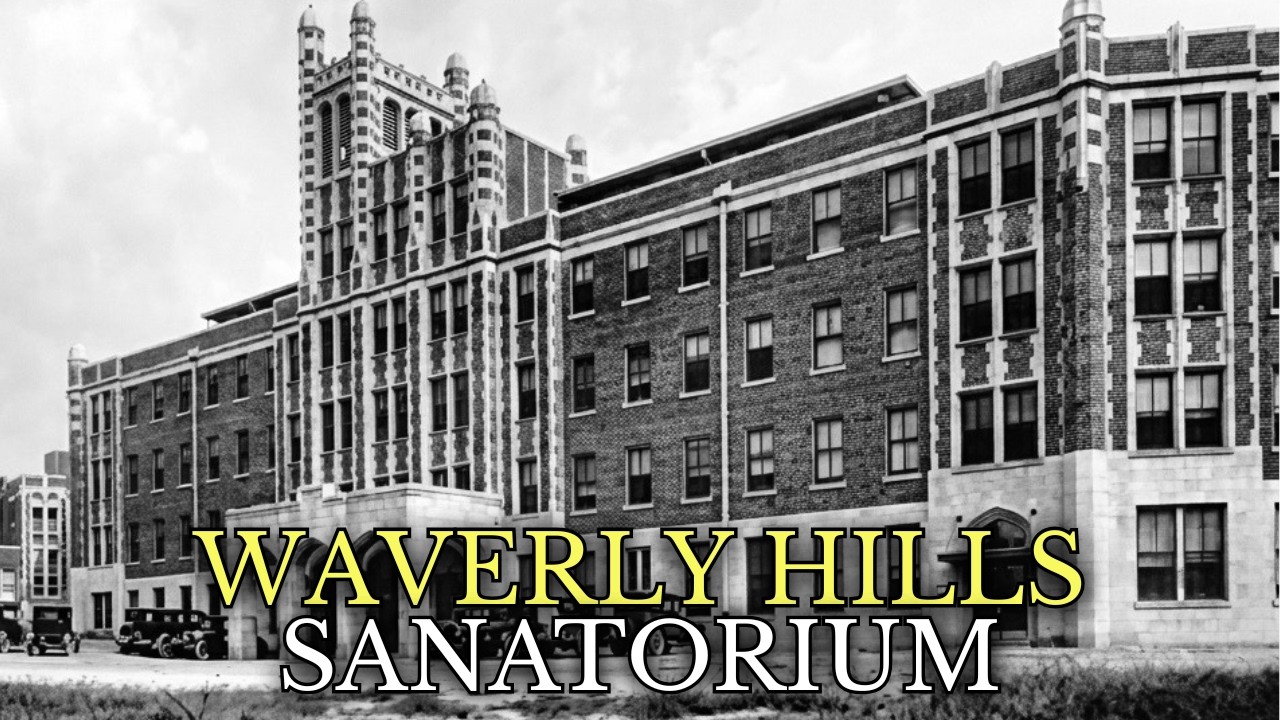
X. Murphy, known for structures that projected endurance. Five stories of brick and stone rose in the Tudor Gothic Revival style, pointed arches and ornamental brickwork making it look more like a cathedral than a hospital. It opened on October 17, 1926, after two and a half years of construction and more than one million dollars spent.
Inside, nearly everything was engineered around the era’s treatment philosophy. Wide open-air porches and solariums allowed patients to spend hours exposed to sunlight and moving air. The fifth floor was devoted largely to heliotherapy, where patients with tuberculosis of the bone lay beneath direct sun. The new building held four hundred patients, ten times the original capacity.
It was built to be self-sufficient, a small city on a hillside. Waverly Hills had its own water treatment plant, its own power plant, a farm and dairy, a bakery, laundry, maintenance garage, and even its own post office with its own zip code. It did not need the outside world, and in a sense it was designed so the outside world would not need to think about it either. But the triumph had a crack in it from the first day.
Waverly Hills in its new form was a whites-only institution. Black patients suffering the same disease were left behind in the old wooden dispensary structures, the very buildings the new construction had been meant to replace. While white patients rested on heliotherapy porches, black patients were treated in buildings health officials had already deemed too outdated, too cramped, and too dangerous to keep using. That arrangement did not meaningfully change until the 1940s.
There was still no cure. What the hospital offered was a long list of interventions. Heliotherapy was gentle. What followed was not.
Artificial pneumothorax involved deliberately collapsing an infected lung by injecting air into the chest cavity, a procedure repeated again and again for years. When that failed, surgeons performed thoracoplasty, removing ribs to collapse the chest wall permanently onto the damaged lung. Some patients endured multiple separate operations, losing another piece of their skeleton each time. For some, surgeons cut away infected portions of the lung or crushed the nerve controlling half the diaphragm to paralyze it.
These were educated gambles performed by doctors who genuinely believed they were doing all medical science allowed. Underneath it all sat a conviction held with total sincerity: that morale directly influenced survival. Hope was treated almost like a prescription, despair like a symptom that could spread through a ward as easily as bacteria. This belief shaped daily life.
Occupational therapy classes kept hands busy. Radio receptacles were wired into the walls so patients could listen to local stations through headphones. The intent was humane. But the same belief carried a darker implication.
If hope could keep a patient alive, then anything that damaged morale could help kill them. And nothing damaged morale faster than watching neighbors disappear one stretcher at a time. For most patients, life was defined by waiting. A diagnosis meant months, often years, with no fixed date of release and no guarantee of one.
Families waved through solarium windows. Children admitted without parents sometimes grew up almost entirely inside the institution. Running beneath it all was shame. Tuberculosis carried a social weight other illnesses did not.
Patients hid their diagnoses from friends and families, embarrassed to admit where they had gone. Lily Gilliam, diagnosed at fourteen in the late 1940s and admitted to the segregated ward, spent two years there watching her friends continue ordinary teenage life without her. She later described feeling too embarrassed to tell anyone where she had been, because tuberculosis was widely regarded as a feared and shameful disease. By the time the Gothic building had been open a few years, the hospital needed a way to move coal, food, and supplies up the hill without trucks grinding up the same drive patients used.
So a tunnel was cut through the hillside, running from the railroad tracks at the base up into the basement of the main building. On paper it was nothing more than infrastructure. But the same passage built to solve a supply problem soon took on a second purpose. Death at Waverly Hills was constant, and on the worst weeks a dozen or more patients might die within days.
Bodies were brought to the basement, placed onto the same rail carts used for coal, and lowered down the tunnel to a waiting hearse. From the moment a patient died until the body left the property, almost nobody upstairs saw it happen. The hospital protected its patients’ morale by hiding death, and protected its own reputation at the same time. The number of bodies that passed through that tunnel is itself disputed.
Modern retellings repeat figures between fifty thousand and sixty-three thousand deaths. The most carefully sourced estimate comes from Dr. J. Frank Stewart, a former assistant medical director, who stated that the worst single year saw 152 deaths.
Partial death indexes compiled from surviving records put the total across roughly fifty-one years of operation closer to six thousand to eight thousand. That is still a staggering number. It does not need exaggeration to be tragic. But fifty thousand sounds like a massacre, and it sells tickets.
The inflated number survived because it made the building sound more haunted than the historical record could support, and nobody had much incentive to check. In 1943, a researcher isolated a compound derived from soil bacteria. Streptomycin actually killed the tuberculosis bacterium. It reached Waverly Hills in meaningful supply around 1949.
Admissions declined steadily through the 1950s. By June 1961, the remaining patients were transferred elsewhere, and Waverly Hills Sanatorium closed as a tuberculosis hospital. Within about a year it reopened as Wood Haven Geriatric Center, a nursing home for elderly patients with dementia, mobility loss, and severe disabilities. It was chronically understaffed.
Reports of neglect began almost immediately. Former staff and visiting families described residents left unwashed, cockroach infestations throughout patient areas, and outdated and misused medical interventions. Many residents had no surviving family to advocate for them. In 1982, a grand jury investigation uncovered documented patient abuse and severe neglect, and the state closed Wood Haven permanently.
For nearly two decades the building sat empty. A developer proposed converting it into a prison, but local opposition killed the plan. Later, a man named Robert Albert Hasky purchased the property with the ambition of constructing the world’s tallest statue of Jesus Christ on the roof, with the hospital to become a chapel and gift shop. He raised about three thousand dollars of the estimated eight million needed.
During this period of abandonment, the building became famous for the wrong reasons. Trespassing teenagers and urban explorers wandered the halls, and the building’s modern ghost stories originated here, not in the epidemic years. The most famous centers on Room 502, where legend holds a nurse hanged herself in 1928 after an unwanted pregnancy. The story gained detail with each retelling and crystallized into apparent fact.
In 2001, Charlie and Tina Mattingley purchased the property. They founded the Waverly Hills Historical Society and began restoration, funded largely by the building’s reputation. Guided historical tours ran by day. Paranormal tours ran after dark.
A Halloween haunted house attraction became one of the largest revenue events of the year. The building now draws roughly forty thousand visitors annually, almost entirely on the strength of the supernatural rather than the historical. On those tours, visitors hear at length about Room 502 and shadow figures in the tunnel. They will almost certainly not hear about Lily Gilliam or the patients confined to the segregated wards, or the residents abused at Wood Haven.
That part of the history requires no embellishment to be disturbing. It is simply less marketable than a ghost. The real horror of Waverly Hills was never hard to find. It is in the death index, in the segregation records, in the grand jury findings.
A building where thousands of people died slowly of a disease that filled their lungs with fluid is today best known as a Halloween attraction with a famous tunnel and a ghost named Mary. The tunnel still slopes downward into the same darkness. Once it was built so the living would not have to see how many were dying.
Now it is the reason the living show up at all.