In 1889, the California legislature carved a new county out of the southern third of Los Angeles County. They named it for the crop that had made it rich. Orange County, they declared, existed because of the orange. At the time, it seemed like a sure bet: the futures of the county and the fruit were inseparable.
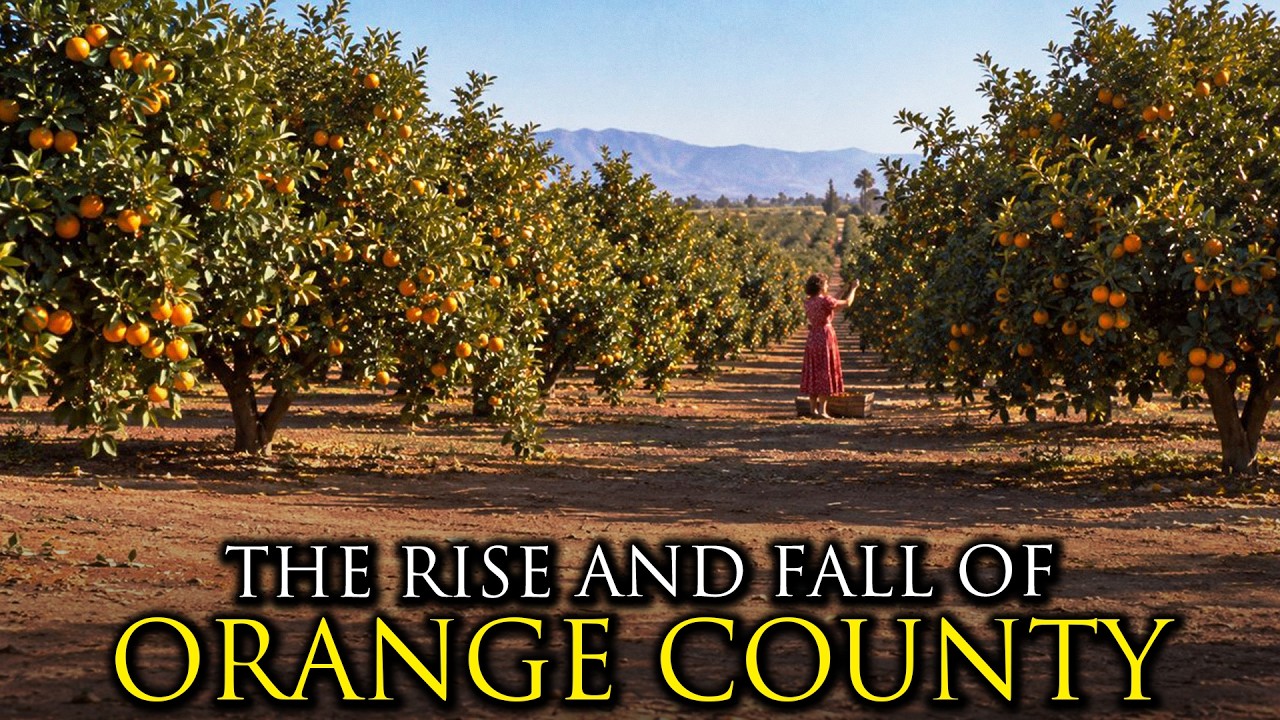
The land had already been reinvented once before. For most of the nineteenth century, it was cattle country, vast Mexican land grants of dry grassland that stretched from the coast to the mountains. After California became a state in 1850, those ranchos broke apart and were sold to American settlers. Then, in 1857, a group of roughly fifty German immigrant families pooled their money, about $750 each, and bought open land in the Santa Ana River Valley.
They called it Anaheim, built an irrigation ditch, and planted grapevines. Within two decades, they had created one of the most prosperous wine-producing communities in California. Then the vines died. In the early 1880s, a blight, later identified as Pierce’s disease spread by insects, destroyed nearly every grapevine in the settlement.
The community, built on a single crop, watched that crop vanish within a few seasons. Some ruined growers, casting about for something else to plant, tried oranges. Commercial citrus was a gamble in the 1880s. There was no railroad network for shipping fruit east, no refrigeration, no organized market.
But the soil in this stretch of Southern California was extraordinary: a deep, well-drained alluvial plain tempered by a mild coastal climate that almost never froze. One variety thrived there better than anywhere on the continent. The Valencia was a summer orange that ripened between May and October, reaching the market when no other American-grown orange was available. A fresh orange eaten in July anywhere in the United States in 1910 almost certainly came from a place like this.
That seasonal monopoly translated into premium prices. Valencia growers in the 1920s could earn tens of thousands of dollars a year, a fortune in an era when a doctor might make $5,000. Growers planted in earnest through the 1890s, and acreage expanded fast. Towns that had been dusty crossroads became grovetowns: Fullerton, Tustin, Placentia, Villa Park, Orange, Santa Ana.
By the time the growers lobbied for their own county, they wanted control over the tax money that was being spent forty miles away in Los Angeles. They named it after the thing they grew. In 1893, growers formed what became the California Fruit Growers Exchange, a farmer-owned cooperative that handled packing, shipping, and marketing. The exchange, later renamed Sunkist, standardized grading, built packing houses, negotiated freight rates, and controlled supply.
Most importantly, it branded fresh fruit, stamping its name on the rind and launching national advertising campaigns that sold not just oranges, but California itself: sunshine, blue skies, health, and prosperity. The advertisements told Americans their fruit came from paradise. Factory workers in Cleveland, clerks in Baltimore, and farmers in Iowa didn’t just buy oranges. They bought a dream.
Some of them packed up and moved to Southern California. By the mid-1930s, Orange County’s Valencia groves covered over 60,000 acres, perhaps approaching 70,000 by the early 1940s. The county, about 800 square miles, contained one of the densest concentrations of commercial citrus on earth. The orange was the economic engine of the region.
It paid the railroad workers, the ice plant operators, the crate manufacturers, the printers, and the shopkeepers in every county town. One agricultural study estimated that every dollar earned at the grove level generated three to four dollars of secondary economic activity. Pull the orange out, and the entire apparatus collapsed. The harvest brought hundreds of workers, mostly Mexican and Mexican-American men, moving through the groves with canvas bags and clippers.
Many arrived through the Bracero Program during and after World War II. Inside the packing houses, women stood at sorting lines for hours, processing thousands of oranges per shift. Entire communities ran on packing-house wages. The growers themselves, families like the Chapmans and the Bastanchurys, formed a landed gentry.
Charles C. Chapman, the “Valencia Orange King,” controlled hundreds of acres, served as mayor of Fullerton, and became a major philanthropist. Chapman University in Orange bears his name today. He died in 1944, just before the world he helped build began to come apart.
On cold nights, the rare nights when temperatures threatened the crop, thousands of smudge pots were lit across the valley, small oil-burning heaters that glowed orange low to the ground and filled the air with smoke and the smell of kerosene. Growers walked their rows with thermometers, wives brought coffee, and radio stations broadcast frost warnings. If you lost the crop, you might lose the grove, and you might lose the land. The land was about to change value forever.
The same advertising machine that had sold the orange had also sold the land, not as farmland, but as a place to live. During World War II, the federal government poured billions into Southern California’s defense industry. Douglas Aircraft was in Long Beach, the Santa Ana Army Air Base trained tens of thousands of airmen in the middle of the county. Workers flooded in, and they didn’t leave after the war.
The defense jobs became aerospace jobs at Hughes Aircraft and North American Aviation. The population exploded: 130,000 in 1940, 216,000 in 1950, 703,000 by 1960, and 1. 4 million by 1970. Every one of those new residents needed a house, a road, a school.
The GI Bill gave returning veterans low-interest home loans, and the houses they wanted required flat, cheap, buildable land. Orange County had thousands of acres of it. The fact that it currently had orange trees on it was, from a developer’s perspective, a temporary inconvenience. An acre of mature Valencia groves might earn a grower a few hundred dollars a year in profit.
That same acre, sold to a developer, might bring $10,000 or more in a single transaction. And even more destructive was the property tax system: when a subdivision went in across the road, the assessor revalued the grove next door at its development value, tripling its tax bill overnight. Every new subdivision raised the taxes on the farmland around it, making it impossible not to sell. It was a cascade that could not be stopped.
The freeways accelerated everything. The Santa Ana Freeway carved through the county, connecting it to Los Angeles. An interchange alone could consume forty or fifty acres. Then, on July 17, 1955, Disneyland opened on 160 acres of former orange groves in Anaheim.
The opening was nationally televised, and the cameras showed the country what Orange County was becoming. Within a few years, land values around the park skyrocketed. Groves planted before the turn of the century were sitting on some of the most valuable real estate in Southern California. The new subdivision residents complained about the smudge pots, whose smoke settled into their neighborhoods and left soot on their laundry.
It was a sign that the old economy and the new economy could not coexist. The groves lost. By the late 1950s, the county was losing thousands of acres of citrus a year. Entire groves were bulldozed, leveled, and subdivided in a matter of months.
The Williamson Act of 1965 tried to slow the process by assessing farmland at its agricultural value, but in Orange County it was too late. The 10-year commitment spooked growers who could see the development wave approaching. The single most important piece of land was the Irvine Ranch, roughly 93,000 acres assembled in the 1860s and 1870s, nearly one-fifth of the county. James Irvine II, who controlled it for the first half of the twentieth century, fiercely opposed development.
After his death in 1947, the property passed to a foundation, and decisions shifted from the family to trustees and real estate strategists. In 1960, the Irvine Company hired William Pereira to design a planned city on a portion of the ranch, organized around a new University of California campus, which opened in 1965. The city of Irvine was incorporated in 1971. The result was more orderly than the sprawl already consuming northern Orange County, but the trajectory was the same.
The orange trees came down. The county lost roughly 60,000 acres of commercial citrus in about 25 to 30 years, more than five acres a day, every day for a generation. The packing houses closed one by one. The labor camps were torn down.
The cooperative system unraveled as growers sold out. The tract homes that replaced the groves were named after the very thing destroyed: Orange Blossom Lane, Valencia Drive, Sunkist Street. The developers understood marketing too. The arithmetic was devastating and simple.
A grower earning $200 an acre could not compete with a developer offering $50,000 for that same acre. Every grower who sold made the most financially sensible decision available. Nobody killed the orange empire out of malice. It was killed by arithmetic.
By the 1980s, the commercial orange industry in Orange County was essentially gone. The oranges were still profitable; the land beneath them had simply become worth more for something else. The industry didn’t die because it failed. It died because the one place that had built an empire around the Valencia orange was worth more without it.
Today, the county carries the name of the fruit, but the living industry is gone. A few heritage trees stand behind plaques. The street signs say Valencia and Orchard and Grove. The three million people who live there drive past them every day.
And the thing itself, the working groves, the packing houses, the smudge pots glowing on cold nights, the smell of orange blossoms hanging over the valley in spring, all of it is gone.