On the morning of December 1, 1945, Anton Dostler was bound to a wooden stake in a firing range on the outskirts of Versailles. Twelve American soldiers stood before him, their rifles loaded, one of them carrying a blank round in the traditional gesture that spared no single man the certainty that his bullet had killed. A black hood was placed over Dostler’s head, and a white cloth was pinned to his chest to give the firing squad its mark. His last words were, “Long live Germany.
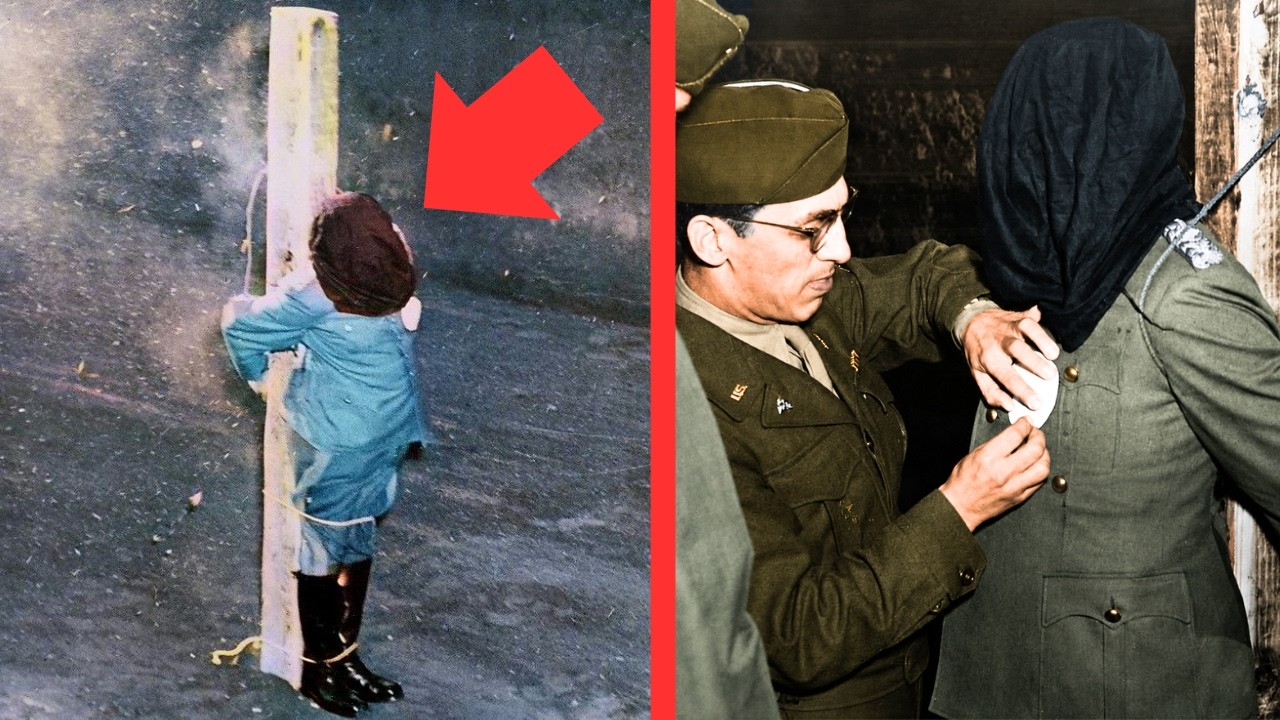
” The volley came, the bullets tore through his body, and the force of the shots split the wooden stake behind him. He was the first German general to be executed by an American firing squad after the end of the Second World War. His path to that stake began more than half a century earlier. Anton Dostler was born in 1891 and became a professional soldier at a young age, joining the German army in his late teens.
He served as a junior officer on the Western Front during the First World War, and when the conflict ended, he remained in the military even as the Treaty of Versailles reduced the German army to just one hundred thousand men. The trenches shaped him, and he stayed loyal to the profession of arms through the lean years of the Weimar Republic. When Adolf Hitler began rearming Germany in the 1930s, experienced officers like Dostler were needed to train and lead the new generation of recruits. By the beginning of the Second World War, Dostler had risen to chief of staff of the Seventh Army.
He commanded the 57th Infantry Division, then the 163rd Infantry Division, and later took charge of the LXXV Corps in Italy. Eventually he was appointed commander of the coastal sector around Venice. But it was an order issued in March 1944 that sealed his fate. That month, fifteen American soldiers landed on the Italian coast near La Spezia.
They were dressed in proper American field uniforms, not in civilian clothes or enemy uniforms, and they came as part of Operation Ginny II. Their mission was to destroy a railway tunnel at Framura and cut the rail line between La Spezia and Genoa, disrupting German supply routes. The operation was troubled from the start. The men were dropped at the wrong location, had to hide for a time while waiting for pickup, and were forced to discard much of their equipment.
An Italian fisherman spotted their rubber boats and alerted a local fascist militia, which in turn informed the Germans, who began sweeping the area. The fifteen Americans, hiding in a nearby barn, were quickly captured after a brief engagement with German forces. They were taken to the headquarters of the 135th Fortress Brigade for interrogation, and during questioning one of the soldiers revealed that they had been on a commando raid to blow up the tunnels. That information, including the word “commando,” was sent up the chain of command to General Dostler.
He passed it along to his own superior, Field Marshal Albert Kesselring, who ordered the Americans executed in accordance with Hitler’s Commando Order of 1942. That directive required all enemy commandos or saboteurs to be shot immediately, without trial, regardless of whether they were in uniform. Dostler relayed the order to the troops on the ground. The man tasked with carrying it out, Colonel Almers, was uncomfortable.
The fifteen Americans had been captured in their own uniforms, which meant they should have been treated as prisoners of war and given the legal protections that status conferred. Almers tried to delay the executions, but Dostler insisted that the men be shot. On March 26, 1944, the fifteen American soldiers, still in their uniforms, were lined up on a rocky outcrop overlooking the sea. A German firing squad shot all of them, and they were buried in a mass grave.
When the war in Europe ended, Dostler fell into American hands. The Americans discovered what had happened to the soldiers, and only days after the ceasefire, he was put on trial for war crimes. The proceedings took place in Italy and were the first war crimes trial conducted by the United States. Dostler was charged specifically with carrying out an unlawful order.
His defense rested on two arguments. He claimed that he had merely passed along the order from Kesselring and had not issued it himself, shifting blame to his superior. He also tried to invoke the defense of superior orders, arguing that he was only following instructions from above. Neither argument held.
The evidence showed that Dostler had actively pressed for the executions to be carried out, not simply relayed a command. He also claimed the Americans were saboteurs and commandos who had no right to protection, but because they had been captured wearing their own military uniforms, they were legally entitled to treatment as prisoners of war. During the war, it was lawful to execute spies, saboteurs, or enemy forces disguised in civilian clothes or opposing uniforms. It was not lawful to execute soldiers captured in their own national uniform, which is exactly what had happened to the fifteen Americans.
Dostler was convicted of war crimes and sentenced to death. His requests for clemency were rejected, and months passed before the sentence was carried out. In the final moments, the Americans extended him certain small mercies. He was allowed to walk to the stake unhindered, with a chaplain at his side.
He was not dragged. His steps were steady, and his hands were not bound behind his back until he stood at the post. He was permitted to be executed wearing his German general’s uniform and his officer’s cap, a recognition that this was a military proceeding conducted against a military man. The cap was removed, a white cloth was pinned over his chest, and the black hood was placed over his head so he could not see the rifles aimed at him.
The twelve-man firing squad took position. Half knelt in front while the others stood behind, and they raised their weapons. The order came, and the shots rang out. The bullets cut through Dostler’s body and split the stake behind him.
Smoke rose from the holes in his back. There was no need for a final shot to the head. His body was cut down, placed in a coffin in view of the witnesses, and later buried in a German war cemetery near Lazio. The execution itself was unusual.
The Americans rarely executed war criminals by firing squad, preferring to hang them as common criminals, as they did with the leading Nazis tried at Nuremberg. The photographs taken that morning, published in American media, showed the brutality of the moment. The power of the volley was so great that it partially knocked the black hood from Dostler’s face. The justice was swift and harsh.
Dostler had been a general who chose to enforce an unlawful order he knew to be illegal. Because of that choice, he faced his death bound to a stake, unable to see the men who killed him, yet walking to that end with what witnesses described as considerable courage.