For more than a decade, Iván Archivaldo Guzmán Salazar has been one of the most actively hunted fugitives on the planet. The United States government has placed a $10 million bounty on his head. His brothers have been captured, extradited, and now sit in American federal custody. He has been indicted in multiple federal jurisdictions since 2014.
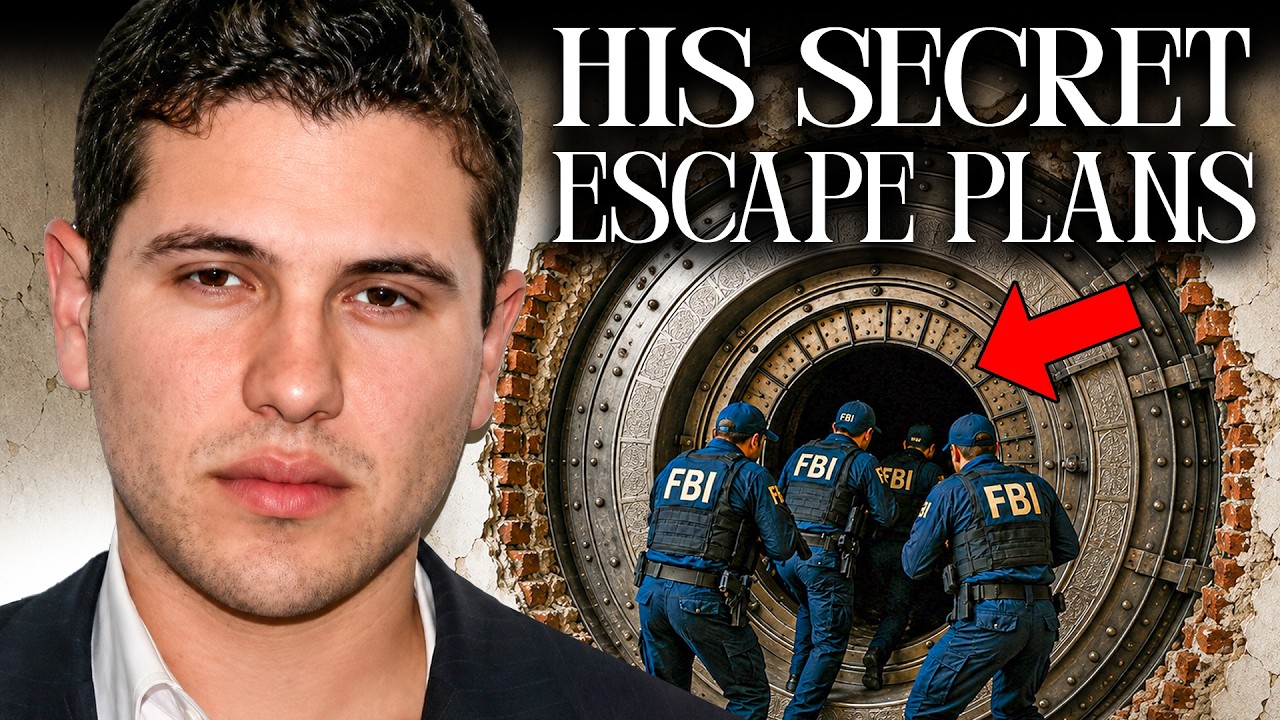
And yet, every time authorities have gotten close enough to reach for him, he has been gone before they could close their hand. Early in 2014, intelligence confirmed he was inside a seafood restaurant in Culiacán, Sinaloa. A joint operation involving the Mexican army and federal security forces moved in and locked the building down. No one in.
No one out. They were certain they had him. What followed became one of the most embarrassing episodes in the history of the manhunt. They searched that restaurant for more than nine hours, turning over every room and every corner large enough to conceal a person.
At the end of it, he was not there. He had put on a waiter’s apron, walked past the soldiers sent to capture him, stepped out the door, and disappeared. By February 2025, eleven years later, the Mexican government did not send a small tactical team. They deployed thousands of soldiers: army units, the National Guard, air support, backed by American intelligence resources.
They did not just target Iván. They dismantled his inner circle in a single operation. His financial operator, the man who ran the money and engineered the fentanyl network, was arrested. His personal security chief was arrested.
Two other senior commanders were arrested as well. And when they finally breached the door of a safe house in the Tierra Blanca neighborhood of Culiacán, where Iván had been confirmed present just minutes earlier, they found proof of his presence and an empty room. He was already gone, through a tunnel concealed beneath the property, out under the streets of the city before a single soldier reached the door. Two governments, a decade of intelligence work, billions of dollars in anti-cartel operations, elite special forces trained for exactly these moments, and the result, every single time, has been the same.
The reason this keeps happening is not luck. It is a survival system built with such precision and depth that authorities are no longer asking when they will catch him. They are asking whether they ever will. Iván Archivaldo Guzmán Salazar is the eldest son of Joaquín Guzmán Loera, known to the world as El Chapo, the most infamous drug lord of the modern era.
While his father built one of the most powerful criminal empires in history, Iván grew up inside that world, absorbing its culture, its networks, and its logic of survival. For years he operated in the shadow of his father’s overwhelming reputation. But when El Chapo was extradited to the United States in January 2017 and convicted in February 2019 to serve a life sentence, the question became who would take over. The organization was too vast for a single successor.
Power fragmented across multiple factions and commanders. But among those who moved into the vacuum, none moved more deliberately than Iván. Together with his brother Jesús Alfredo and their half-brothers Ovidio and Joaquín Guzmán López, the group became known as Los Chapitos, the little Chapos. As the pressure intensified, two of the brothers fell.
Ovidio was captured in 2023. Joaquín followed in 2024. Both now sit in United States custody. As of today, Iván Archivaldo and Jesús Alfredo are the last two leaders of Los Chapitos still operating, still directing the faction, still evading every attempt to bring them in.
What distinguished Iván from previous cartel leadership was his operational philosophy. While his father became famous for tunnels, corruption, and a theatrical flair for dominance, Iván built a reputation for something more disciplined and arguably more dangerous: flexibility, decentralization, and rapid adaptation. He built an organization designed to function under pressure, to keep moving when others would have frozen, and to survive the kind of sustained institutional targeting that had destroyed every major cartel figure who came before him. This was built on a foundation that took decades to construct.
The Sinaloa Cartel is not simply a criminal organization. It evolved through the 1980s and 1990s under figures like El Chapo and Ismael Zambada García, known as El Mayo, growing from a regional trafficking network into a global supply chain. At its peak, it controlled the majority of the drug supply entering the United States, managing operations across North America, Europe, Asia, and Australia. Its infrastructure was not just the product of violence but of extraordinary organizational sophistication: financial systems, logistics networks, regional alliances, political connections, and a distribution model that adapted faster than law enforcement could track.
When El Chapo went down, many assumed the cartel would fracture beyond repair. What happened instead was a managed transition. Los Chapitos inherited not just the brand but the infrastructure, the supply chains, the international contacts, and the armed wings. They moved quickly to consolidate that inheritance while modernizing it in ways their father had never managed.
The operation that most directly defines why the United States treats Iván as one of its highest-priority targets is fentanyl. According to the US Department of State, Iván shares direct leadership responsibility for coordinating fentanyl trafficking into the United States, including the sourcing of precursor chemicals shipped from China to Mexico for processing into the synthetic opioid responsible for tens of thousands of American deaths every year. Federal charges against him include coordination of fentanyl trafficking, cocaine and heroin distribution, methamphetamine production, money laundering conspiracy, possession of machine guns and destructive devices, and operating as part of a continuing criminal enterprise. A federal grand jury in the Northern District of Illinois returned a thirteenth superseding indictment against him in April 2023.
He was first charged in the Southern District of California in July 2014. By the government’s own accounting, he is the second most wanted drug trafficker in American federal law enforcement history. To understand why he has survived this long under this much pressure, you have to understand what his father’s fate taught him. El Chapo escaped from Mexican maximum security prisons twice.
His 2015 escape through a tunnel dug beneath the shower floor of his cell at the Altiplano prison became one of the most audacious jailbreaks in criminal history: a mile-long tunnel fitted with a motorcycle mounted on rails, lighting, ventilation, and access hatches, built right under the noses of the prison administration. And yet, for all that brilliance, his father ended up in a federal courtroom in Brooklyn, convicted on all ten counts, sentenced to life plus thirty years. Iván watched all of it. He watched the escapes, the extradition, the trial, the verdict.
What he concluded from that experience shaped everything that followed. His father’s problem was not that he built bad tunnels. His problem was that he kept getting caught in the first place. The escape was a contingency.
Iván decided the better strategy was to make sure the contingency was almost never needed. Not by hiding in one place. Not by building a single fortress. But by being so mobile, so compartmentalized, and so surrounded by early warning systems that authorities never get close enough to make the contingency necessary.
Start with the escape infrastructure. On February 19, 2025, the world got its clearest look at how that system works. Mexican special forces, in coordination with the National Guard and the Mexican Army, launched a major military operation across Culiacán. Among those arrested were José Ángel Canábio Inzunza, known as El Chuerito, identified as the financial operator of Los Chapitos and primary architect of the fentanyl network, and Kevin Alonso Gil Acosta, known as El 200, identified as the person directly responsible for Iván’s personal security and weapons procurement.
These were not peripheral figures. They were the people closest to him. And yet Iván himself was not there when authorities arrived. According to reporting by the Wall Street Journal in May 2025, corroborated by journalist José Luis Montenegro, Iván was present at a safe house in the Tierra Blanca neighborhood when the operation began.
The property contained a clandestine tunnel connecting it to a neighboring property. Iván and his close security escort, including a figure identified as Eric Bastidas, known as L09, disappeared before Mexican forces secured the area. The tunnel reportedly ran beneath a private street in the Artesanos residential area. The operation continued for hours.
Air surveillance maintained presence. And still he was gone. The tunnels and the disguises are just the most visible elements of a much deeper system. Investigative analysis describes what analysts call concentric rings of armed protection surrounding high-value cartel leadership.
The innermost ring consists of a small, highly trusted personal security team. Figures like El 200 manage this layer, selecting personnel, managing rotation, overseeing communications, and ensuring absolute loyalty. This inner ring controls Iván’s movement, schedule, access, and communications. Nothing reaches him that has not passed through this layer first.
Outside that ring sits a broader security apparatus: mobile response units capable of deploying quickly to block approaching forces or clear escape routes, groups maintaining overwatch on routes into whatever neighborhood he happens to be operating in, and personnel stationed at key intersections and elevated positions with lines of sight to approaches. Beyond that, running the intelligence layer, are the Halcones, meaning hawks or lookouts. Thousands of individuals, distributed across Sinaloa and beyond, whose entire function is observation and communication. They watch roads, airports, bus terminals.
They monitor military base activity. They notice when strangers appear in neighborhoods that do not normally receive visitors. When they see something, they report it almost instantly through encrypted messaging applications, radio chains, burner phones, and local word-of-mouth networks that can move information faster than some government communication systems. By the time a Mexican army convoy is moving toward a target neighborhood, the information has often already traveled through the Halcón network and reached the people who need to act on it.
Even a ten-minute warning changes the entire calculus of a raid. A twenty-minute warning makes the operation almost irrelevant before it begins. The event that most dramatically revealed the raw operational power behind this system happened on October 17, 2019, in what became known as the Culiacanazo. Mexican authorities, acting on intelligence, moved to arrest Ovidio Guzmán López at a residence in Culiacán.
They succeeded. They had him in custody. Then everything collapsed. Within hours, heavily armed cartel forces mounted a coordinated response across the entire city.
Roadblocks appeared on major arteries. Vehicles were set on fire to seal off military access routes. Gunmen attacked security forces in multiple locations. Soldiers and their families at on-base residences were taken hostage.
The city was effectively paralyzed. Faced with sustained urban combat, civilian casualties, and no clear extraction path, the Mexican government made a decision that shocked the world. They released Ovidio. They handed him back to the people who had just demonstrated they could bring an entire Mexican city to a standstill in under four hours.
Federal prosecutors later cited Iván’s central role in coordinating that armed response as one of the basis elements in the warrant for his arrest. What the Culiacanazo demonstrated was that Los Chapitos commanded an armed force capable of offensive military-style operations against a sovereign government. That reality permanently altered how authorities thought about attempting to arrest any of the brothers. Simply locating a target was no longer enough.
Future operations would require overwhelming deployment and planning that accounted for the possibility of a city-scale counterattack. That shift was visible in January 2023, when Ovidio was finally captured in a second operation involving thousands of military personnel. The cartel mounted attacks at the Culiacán airport and at military positions across the city, but this time the government was ready and held. Modern technology has added new dimensions to Iván’s survival architecture.
Investigative reporting describes cartel operations that increasingly incorporate encrypted communications platforms, operational compartmentalization in which each cell knows only what it needs to know, disposable electronic devices used once and discarded, and drone surveillance to monitor approaches to key locations. Movement protocols involve rapid relocation schedules that resist the kind of pattern analysis that brought down other high-value targets. El Chapo was eventually compromised in part because surveillance identified recurring patterns in his movements. Iván’s operational philosophy explicitly resists that model.
He does not stay in one place long enough to establish a pattern. Geography provides its own contribution. Sinaloa’s Sierra Madre Occidental offers terrain that has sheltered criminal operations for over a century: isolated valleys, hidden road systems, rural communities where families have lived within the cartel’s orbit for generations. And urban Culiacán is simultaneously one of the most cartel-saturated cities in the world and one of the most sophisticated cartel environments from a surveillance standpoint.
Authorities have not been standing still. The February 2025 operation that missed Iván nonetheless produced significant results. The arrest of El Chuerito removed the man described as the primary financial operator and fentanyl trafficking architect for Los Chapitos. The arrest of El 200 eliminated the individual responsible for Iván’s personal security and weapons logistics.
These were structural losses. When key personnel are removed, the chain connecting leadership to resources becomes slower and more fragile. Analysts argue that the degradation of cartel networks happens through sustained pressure on the supporting architecture rather than waiting for a single decisive capture. The broader question of why capturing cartel leaders has become categorically more difficult extends beyond Iván’s individual case.
Modern criminal organizations have studied the pattern of what brings them down. Decentralized leadership structures mean that no single arrest can cut the head off an organization designed not to have one critical head. Regional cells absorb the loss of a central figure and continue functioning. Succession planning means the strategic value of any single arrest is lower than it was decades ago.
This does not mean capturing Iván would be meaningless. His removal would be a significant operational disruption. It would trigger a transition period, create internal competition, and force reorganization under external pressure. But it would not end Los Chapitos, and it would not end the Sinaloa Cartel.
Compare Iván’s strategy to his father’s. El Chapo built a personal legend on the dramatic escape. The motorcycle in the tunnel. The helicopter in a Guadalajara parking lot.
It was operationally brilliant and psychologically powerful. But it also required getting caught before it could be deployed. Every escape was preceded by a capture, and each capture exposed the organization to extraordinary risk. Iván appears to have concluded that the better paradigm is to make the initial capture as operationally difficult as possible rather than to plan for escaping after it.
You cannot extradite someone who is never arrested. You cannot prosecute someone who is never in custody. The history of organized crime does not support the idea of permanent invincibility. El Chapo himself spent years on the list of untouchables before Sinaloa’s mountains eventually gave him up.
Pablo Escobar lasted fifteen months after going underground before a phone call gave away his location. What brings these figures down, when they eventually come down, is almost never a single dramatic operational success. It is the slow accumulation of intelligence. An associate who talks.
A pattern that surveillance eventually identifies. A financial transaction that creates a thread to pull. A location used one too many times. The mechanisms of capture are almost always quieter than the mythology suggests.
The perception of invincibility has its own operational consequences. It affects the willingness of potential informants to cooperate. It affects the morale of institutions pursuing him. And the myth does real work on Iván’s behalf, which is itself a form of operational advantage.
The pursuit of Iván Archivaldo Guzmán Salazar is not just about punishing one individual. It is about whether government institutions, operating under the constraints of law, resources, politics, and geography, can develop the sustained capacity to dismantle a network specifically designed to defeat them. The tunnels can be mapped. The lookout networks can be disrupted.
The financial infrastructure can be traced, sanctioned, and frozen. The inner circle, as February 2025 demonstrated, can be arrested one at a time until the protective architecture becomes thin enough that what once seemed impossible becomes inevitable. Iván Archivaldo Guzmán Salazar remains free today. He has a $10 million bounty.
He has federal indictments from multiple American districts. He has watched the men closest to him taken away in handcuffs. He reportedly escaped through a tunnel while his city was locked down by the Mexican army. And by every account available to the public, he is still out there, still directing, still operating, still moving.
Every operation that ends without him in handcuffs is another data point in the same direction. So far, across more than a decade of trying, it has not been him. And nothing on the horizon suggests that is about to change.