A single number has dominated the story of ancient copper mining around Lake Superior for decades: two billion pounds. It circulates with the authority of a government document and a famous name, usually attached to an 1863 report by geologist Charles Whittlesey, published by the Smithsonian Institution. People have repeated that figure so often that few have ever questioned where it actually came from. But when the full text of Whittlesey’s report is actually opened and searched, the word billion appears nowhere.
Neither does the word million. There is no total, no estimate, no claim about how much copper the ancient miners removed. Whittlesey never attempted such a figure and never indicated he thought one could be reached. The largest numbers in his report belong to individual masses of metal, not to ancient extraction.
There are descriptions of waterworn lumps weighing 1,500 pounds, an ingot recorded by a seventeenth-century French writer at more than 800 pounds, and one mass of 3,000 pounds. A figure of 53 tons appears in the report, but it refers to what a nineteenth-century mining company with steam equipment took out of one location. Whittlesey’s point in that passage was that the ancient miners could not move large masses at all. The famous two billion pounds actually comes from a different place entirely.
In 1961, two men named Roy Drier and Octave Du Temple privately published a compilation called Prehistoric Copper Mining in the Lake Superior Region from an address in Hinsdale, Illinois. Inside that privately printed book is an estimate of roughly 750,000 tons of copper removed in antiquity, which works out to one and a half billion pounds. The number later became two billion in retellings. The gap between the Smithsonian report and the private Illinois printing is ninety-eight years, but somewhere in the retelling, the number simply moved to the older, more impressive document.
Even the 1961 figure did not survive contact with archaeologists. Susan Martin, an archaeologist at Michigan Technological University, examined the basis for it in a 1995 paper and then in a 1999 book. Her conclusion, shared by others who looked at the same material, was that the estimate rested on exaggerated and in places simply incorrect assumptions. The phrase that stuck to the big numbers in the literature was “ill constructed estimates.
” The honest current position is that the total is unknown and that the people who produced confident totals were not in a position to produce them. Whittlesey’s report, the foundational document of this entire subject, contains exactly one account of what Ojibwe people told him about the mines. He was quite specific about how alone that account was, noting that if the Ojibwe had traditions about ancient mines, the Jesuit missionaries would have heard and recorded them, and they did not. Then he wrote about one man, an old Chippewa chief who had resided some years since at Fond du Lac on Lake Superior.
According to Whittlesey, this chief told him about mines wrought by his tribe on Isle Royale in times long past, when his fathers were much happier and had larger canoes than his contemporaries. The one recorded Ojibwe tradition in the foundational document does not say strangers came. It says our people did this. The man had a name: Lone’s Foot, a Chippewa leader at Fond du Lac.
He told a white geologist in the middle of the nineteenth century that his own ancestors mined Isle Royale. Whittlesey wrote the testimony down and dismissed it in the same sentence, calling it sufficiently imaginative. The testimony was never missing. It was collected, printed, and set aside.
Then a century later, people began saying the Ojibwe had described strangers. Whittlesey’s own conclusion was explicit. He gave it a heading: “By whom were the ancient mines wrought? ” His answer began with the statement that it was not the present Indian race.
His reasons were revealing. He noted that no remains of cities, graves, dwellings, or highways had been found in the copper region. Then he argued that since the race appeared to have been farther advanced in civilization than their successors, they probably had better means of transportation than the bark canoe. That was not an archaeological argument.
It was a ranking. The mines were impressive, therefore the people who made them were advanced, therefore they were not the people who are here now. The most damaging sentence in the entire subject is also Whittlesey’s. Modern versions of the story require the miners to be a Bronze Age people, with ships crossing the Atlantic and copper moving to the Old World to fuel the European Bronze Age.
But bronze requires melting copper and adding tin. Without smelting and alloying, there is no bronze. Whittlesey, on page 14 of the very report cited as the authority for the Bronze Age theory, wrote that the ancient miners had not discovered the art of melting copper. He described the large masses they had worked at and abandoned, noting there were neither marks of a cutting tool upon them nor of the action of fire.
The picture in the actual report is of people hammering native copper in the cold, pounding it with stone mauls weighing from five to fifteen pounds, beating metal into shape without ever melting it. It was a real and genuinely impressive technology that produced hardened edges, but it was precisely, specifically not a Bronze Age. The second document in this story appeared in 1894. The Twelfth Annual Report of the Bureau of Ethnology, published by the Smithsonian Institution through the Government Printing Office in Washington, runs to 344,000 words.
Most of the volume is a single enormous study by Cyrus Thomas, titled Report on the Mound Explorations of the Bureau of Ethnology. The report was directed at settling a belief that had dominated American thinking for most of the nineteenth century: that the earthworks and mounds spread across the eastern half of the continent had been built by somebody other than American Indians, a vanished lost race, more civilized, more organized, and conveniently gone. That belief was mainstream. It was in textbooks and lecture halls, and it had consequences that were not academic at all, because a country that believes the people it is removing were not the builders of anything has given itself permission.
The Bureau of Ethnology put agents in the field for years. They dug, measured, recorded, and compared. In the opening pages, director John Wesley Powell described the romantic fallacy he was setting out to dismantle, writing that the ghosts of a vanished nation had ambuscaded in the vast solitudes of the continent. Thomas spent the report demolishing the lost race theory site by site, object by object.
His summary was not hedged. He wrote that the evidence was so interlocked as to leave no hiatus into which the theory of a lost race could possibly be thrust, forming an unbroken chain connecting the mound builders and historical Indians which no sophistry or reasoning could break. Thomas also addressed the copper region directly. He noted that at Sault Ste.
Marie, Marquette, Houghton, Calumet, Ontonagon, Bayfield, Ashland, and Fond du Lac, the statement from long-resident traders and trappers was unanimous that no mounds were to be found. The rocky region about Lake Superior was destitute of mounds and defensive works on all sides. The absence of earthworks in the copper country was a fact about the copper country, a regional pattern holding across the whole northern rock zone. Whittlesey read that absence as evidence of a foreign race.
Thirty-one years later, the federal survey read the same absence as a property of the landscape. Thomas also traced the lost race theory to its first publication, identifying Dr. Benjamin S. Barton’s 1797 work New Views on the Origin of the Tribes of America as the beginning of the whole thing.
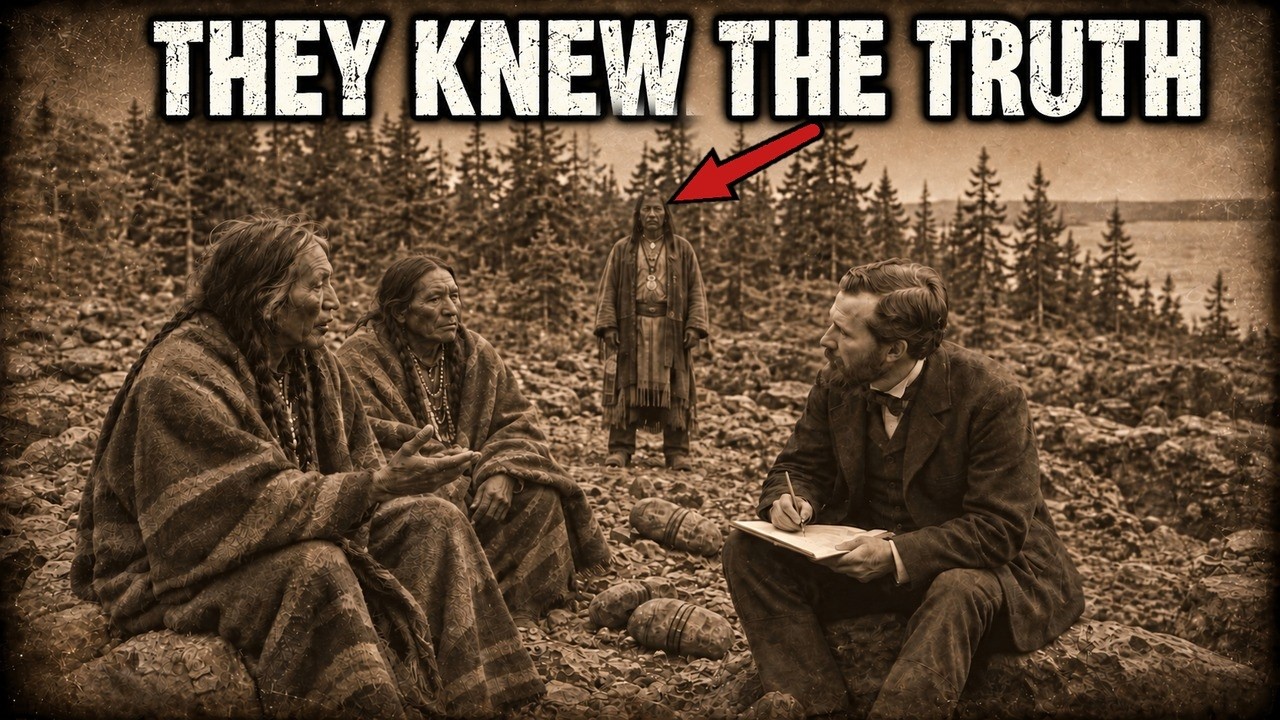
There is one genuine record of a man with a notebook sitting with an Ojibwe elder on the shore of Lake Superior. It happened in 1855, and the man was German. His name was Johann Georg Kohl, a travel writer and geographer who went to La Pointe on Madeline Island in what is now Wisconsin and stayed among the Lake Superior Ojibwe, listening. His book, Kitchi-Gami: Wanderings Round Lake Superior, came out in 1860.
Kohl recorded that the dwellers on Lake Superior seemed to feel the most superstitious reverence for copper, carrying small pieces of copper ore in their medicine bags, wrapped in paper, handed down from father to son, with wonderful power ascribed to them. When Susan Martin wrote the standard modern book on ancient copper working in the basin in 1999, she took her title from that line: Wonderful Power. Kohl recorded one story at length. An old fur trader at La Pointe told him that in 1827, while working at the mouth of the Ontonagon River, he had become friendly with a chief named Kitanau.
Kitanau kept saying he wished he could do the trader some good, so the trader asked not for a mine or a map, but to be shown the lump of metal that Kitanau’s family kept in the forest. Kitanau went silent for a long time. Then he said the trader was asking far more than if he had demanded one of his daughters. The lump of copper in the forest was a great treasure.
It had been sold to his father and grandfather. It was their hope and their protection. Through it, he had caught many beavers, killed many bears, been victorious in all his battles, and remained healthy into great age. They bargained.
The price was cloth, silk ribbons, thirty pairs of silver earrings, two white blankets, and ten pounds of tobacco. It had to be done at night in secret. At midnight, Kitanau came and woke the trader. They went upriver into the forest, where Kitanau stopped and said, “Look down.
You are standing on its head. ” They cleared away rotten leaves, earth, fresh spring flowers, and large pieces of birch bark. Underneath was a lump of pure copper about the size and shape of a hat, weighing around fifty or sixty pounds, with a thick vein of silver running through it. While the trader examined it in the moonlight, Kitanau, trembling, took the rest of his tobacco and laid it in the hole where the copper had been as a sacrifice, covering it back over with the bark and leaves.
Then they paddled back down in silence. That is the record. A named Ojibwe leader in a specific year at a specific rivermouth explained in his own reported words what copper was and what it cost him to give it up. Fifty pounds of it, one piece guarded across three generations, worth more than a daughter’s marriage.
Another unnamed chief, complaining about land cessions at a council, said, “We did not know that such great treasures of copper were hidden in our land. ” Hidden, not taken. Unknown to them, and then worth a great deal to somebody else. As for who actually mined the copper, a team led by David Pompeani working out of the University of Pittsburgh went at the question from underneath.
They took sediment cores from the bottom of McCargoe Cove on Isle Royale, beside the largest known ancient workings. Lake bottoms stack up in layers year after year and record what was in the water. The cores showed a layer with elevated lead and copper and elevated potassium, which comes off the fires used in mining and annealing. At the peak, the concentrations ran an order of magnitude above background.
The signal started about 6,500 years ago, peaked around 6,000, ran for roughly a thousand years, and then stopped abruptly. That is a physical record written by the mining itself into mud, independent of every document in the story. It says intensive copper working happened on Isle Royale by the early native peoples of the region in what archaeologists call the Old Copper Complex. The signal is concentrated in one cove, local and readable in one place.
A very long, very serious, very localized working of one deposit, and then a stop. The claim that European Bronze Age artifacts can be traced to Lake Superior copper also collapses under examination. In 2024, a study by Ryan Peterson and colleagues appeared in the journal Archaeometry. They took forty samples of native copper from deposits across the Lake Superior basin and ran lead isotope analysis on them.
The result was that the signatures overlapped heavily. The paper’s own conclusion was that lead isotope analysis is not recommended for sourcing native copper within the Lake Superior basin. A method that cannot separate two neighboring deposits in the same basin cannot pick a Michigan fingerprint out of an artifact dug up in Denmark. The mines are real.
Thousands of pits across the Keweenaw and Isle Royale and along the shores, with stone mauls left where they were set down and fire-cracked rock in the shafts. Whittlesey mapped it in 1863 and his maps hold up. The age is real, six and a half thousand years at the deep end on Isle Royale, older than the pyramids. The skill is real, cold hammering native copper into worked tools, a genuine technology that took generations to develop.
The people who did it were metal workers. What is not real is the number, which came from a private printing in Illinois in 1961. What is not real is the year attached to the supposed testimony about strangers, which drifts from 1888 to 1894 to 1970 depending on which version is being told, and never brings a name or a page with it. What is not real is the testimony about strangers.
The one Ojibwe account in the foundational document says the opposite. It says my tribe on Isle Royale, when my fathers had larger canoes. What is not real is the Bronze Age, which dies on page 14 of the very report cited to prove it, in a sentence saying these miners had not discovered the art of melting copper. Nothing here was hidden.
Whittlesey’s report was published by the Smithsonian and has been in print and online for decades. The Twelfth Annual Report of the Bureau of Ethnology was printed by the Government Printing Office in 1894, and the whole of it is a free download. Kohl’s book has been available since 1860. Every single document in this story is public, in English, with a name attached.
The testimony of the Ojibwe people was on the record all along. None of them described strangers. All of them described copper as something that belonged to them, mattered to them, and was taken from them. The mystery built over the top of their statements required their authors to be treated as witnesses to somebody else’s story.
They were not. They were talking about themselves.