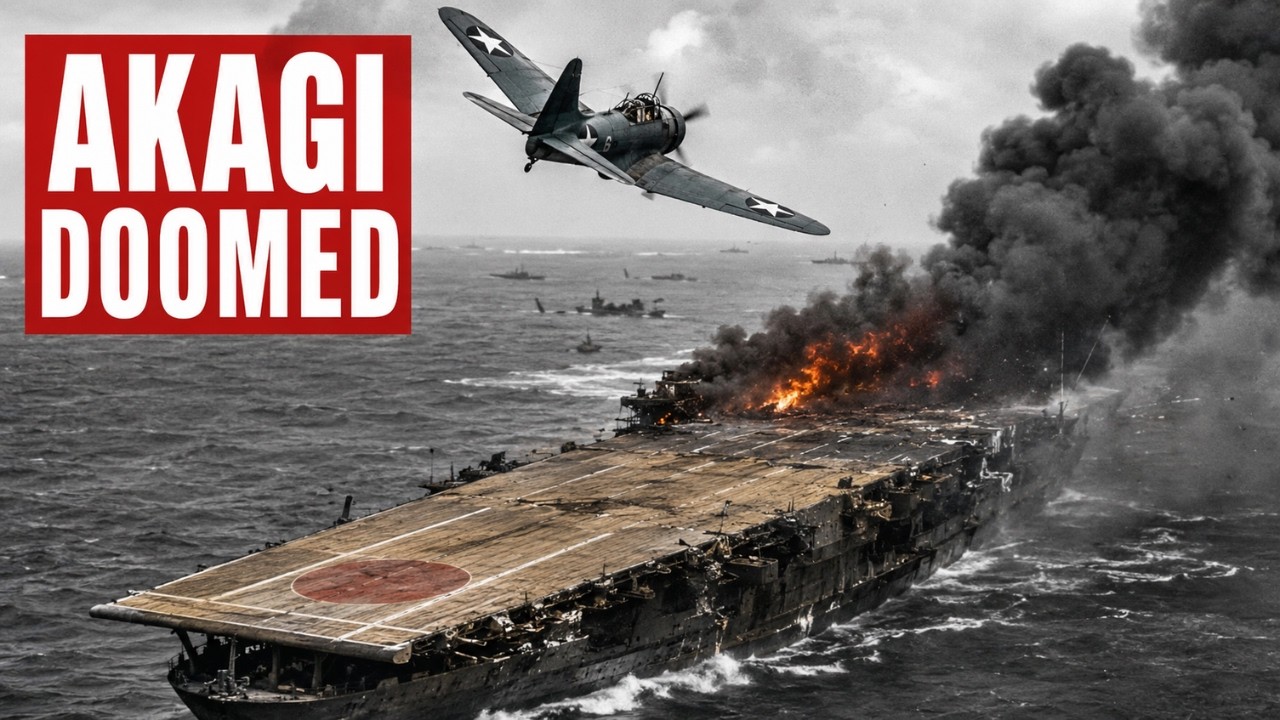
On the morning of June 4, 1942, just before the dawn broke over the northern Pacific, the great red castle began to die. The Akagi, pride of Japan and the sword of the empire, burned from bow to stern. Her flight deck, once the launching platform for the attack that stunned the world at Pearl Harbor, twisted into a wound of deformed metal. Around her, four Japanese destroyers waited silently, watching the flagship of the Kido Butai with the eyes of men preparing a funeral.
They had not come to save her. They had come to sink her. The Akagi had not been born to be an aircraft carrier. Her keel was laid in December 1920 as a battle cruiser of the Amagi class, a massive and fast warship designed to chase down the American Pacific Fleet with 14-inch guns at thirty knots.
The Washington Naval Treaty of 1922 changed everything, forcing the great powers to freeze their naval arms race and scrap their battle cruisers. But the treaty left one small loophole: two hulls could be converted into aircraft carriers. The Japanese Navy chose the Kaga and the Akagi. The battle cruiser that might have thundered across the Pacific as a gun platform became something no one had ever seen before, something no one yet knew how to use.
Completed in 1927 with a strange three-tiered flight deck, the Akagi was reconstructed between 1935 and 1938 into a single flat-deck carrier of 41,000 tons, capable of more than thirty knots and carrying sixty-six aircraft. Named for Mount Akagi, meaning Red Castle, she was meant to suggest power, grandeur, and an impregnable fortress. By 1941 she was the flagship of the Kido Butai, the most powerful concentration of naval air power ever assembled, commanded by Vice Admiral Chuichi Nagumo, a torpedo officer who did not know how to fly. He had been given the command by seniority, not skill.
Behind him stood his chief of staff, Admiral Ryunosuke Kusaka, and aboard the ship were Captain Taiji Aoki, the brilliant tactical officer Commander Minoru Genda, and Commander Mitsuo Fuchida, the legendary air leader of Pearl Harbor. On December 7, 1941, from the flight deck of the Akagi, Nagumo launched 353 aircraft against the sleeping American fleet at Pearl Harbor. In two hours, they killed 2,403 Americans, sank or disabled nineteen ships, and destroyed 188 aircraft. But the American carriers were not there.
Enterprise, Lexington, and Saratoga all survived to fight again. This cold little fact would haunt Nagumo for the rest of his life. Over the next six months, the Akagi and her sisters ravaged a quarter of the world. They struck Rabaul, crushed Darwin, covered the invasion of the Dutch East Indies, and chased the British Royal Navy out of the Indian Ocean.
In six months of war, the Kido Butai ranged from Hawaii to Ceylon without losing a single carrier. This string of victories produced a condition the Japanese Navy called victory disease, a belief that nothing could go wrong. It infected the high command, the planners, and even Admiral Isoroku Yamamoto, the architect of Pearl Harbor. Yamamoto knew America.
He had studied at Harvard and served in Washington. He warned that if the war lasted more than a year, Japan would be crushed. So he devised a desperate final attempt to lure the surviving American carriers into a decisive battle and destroy them. His chosen target was a small, remote coral atoll in the middle of the Pacific called Midway.
The American codebreakers knew he was coming. In a windowless basement room in Pearl Harbor called the Dungeon, Commander Joseph Rochefort had spent months reading the Japanese naval code JN25. He learned that a massive operation was underway, with a target the Japanese referred to simply as AF. Rochefort believed AF was Midway, but his superiors in Washington doubted him.
So he set a trap. He arranged for Midway to broadcast a false report that its freshwater distilling plant had broken down. Within two days, a Japanese listening station transmitted its own coded report: AF was short of fresh water. Rochefort had his proof.
Admiral Chester Nimitz trusted the codebreaker and gambled everything. He ordered his three remaining carriers to sea. There was a problem. Only two carriers were ready.
The third, USS Yorktown, was a wreck after the Battle of the Coral Sea, with estimates of three months needed for repairs. Nimitz gave her seventy-two hours. More than 1,400 workers flooded aboard, cutting twisted steel, patching holes below the waterline, and welding new plates over the shattered flight deck. On May 30, 1942, the Yorktown sailed out of Pearl Harbor under her own power, half-repaired, still leaking oil, ready to fight.
Three American carriers and 233 aircraft headed directly into the path of the strongest naval force in the world: four Japanese fleet carriers and 248 aircraft. At 4:30 a. m. on June 4, 1942, Nagumo launched his first wave of 108 aircraft against Midway.
The island defenses, warned by long-range Catalina patrol planes, fought back, but the Japanese failed to destroy the runways. At 7:00 a. m. , Lieutenant Joichi Tomonaga radioed that Midway required a second strike.
Nagumo ordered the reserve aircraft, armed with torpedoes for a possible attack on American ships, to be rearmed with ground-attack bombs. It was a task that normally took hours. In their haste, some crews stacked the removed torpedoes and bombs along the sides of the hangar instead of returning them to the magazines below. That decision would be their undoing.
One Japanese scout plane had been delayed thirty minutes by a catapult malfunction. When it finally launched at 7:00 a. m. and flew its assigned sector, it found the American fleet.
At 7:28, the pilot reported ten enemy surface ships, warships, 240 miles to the northeast. There were no carriers in the report, but Nagumo realized the Americans knew he was coming. His flight decks were in chaos, his hangars were a depot of unsecured ammunition, and his first strike was returning low on fuel. He chose to wait, receive his aircraft, rearm properly, and launch a full coordinated attack.
It was the correct choice according to every rule of Japanese carrier doctrine. It was also the choice that destroyed his fleet. While Nagumo waited, the American torpedo squadrons arrived. Torpedo Eight, fifteen slow, obsolete Devastators led by Commander John Waldron, found the Japanese fleet at 9:28.
They attacked without fighter cover, without any chance of survival. Waldron had told his men that morning that most of them would not come back. He was right. All fifteen aircraft were shot down.
Twenty-nine of thirty men died. Torpedo Six and Torpedo Three followed, attacking alone, losing squad after squad. By 10:00 a. m.
, forty-one American torpedo planes had attacked the Kido Butai. Thirty-five were shot down. Not one torpedo hit a Japanese ship. On the bridge of the Akagi, the officers celebrated, believing this was another glorious victory.
They had not seen what was coming. While every Zero fighter in the sky was at sea level chasing the last American torpedo planes, three squadrons of American dive bombers were silently descending from the sun at 20,000 feet. Commander Wade McClusky, leading thirty-three Dauntless dive bombers from the Enterprise, had flown to the expected interception point and found the sea empty. Fuel was running low.
He could have turned back. Instead, he began a search pattern. Below him he spotted a single white wake: the destroyer Arashi, racing to rejoin the fleet after depth-charging an American submarine. McClusky followed the destroyer, and within minutes he saw the four Japanese carriers spread across the horizon.
There was no combat air patrol above them. Every Zero was low, killing torpedo planes. Then everything went wrong. McClusky, a former fighter pilot who did not know dive-bomber doctrine, dove on the nearest carrier, the Kaga.
Commander Richard Best, watching from behind, knew the doctrine required his squadron to attack the far target. He signaled his two wingmen, pulled out of his dive, and angled toward the Akagi. Three planes against the flagship of the Japanese fleet. It should not have been enough.
At approximately 10:26 a. m. , Best released his 1,000-pound bomb from 1,800 feet. It fell for three seconds.
It struck the Akagi dead center, just behind the middle elevator, pierced the flight deck, and exploded in the upper hangar where the reserve aircraft sat half-armed, half-fueled, surrounded by piles of abandoned torpedoes and bombs. The hangar became a furnace in an instant, consuming the carrier in a chain of explosions that ripped a column of fire 200 feet into the sky. The great Red Castle began to die. For decades, the world believed a different story, a dramatic tale of five fatal minutes in which the Japanese were caught fully armed and ready to launch a counterstrike.
Modern historians, through careful examination of Japanese records, proved it false. The aircraft were not on the flight decks. They were still below, still being armed. Nagumo could not have launched a counterattack.
The truth was stranger and more terrible: all it took to destroy the flagship of Japan was one bomb, dropped by one exhausted young lieutenant commander from New Jersey, into a hangar that hours of confused and contradictory orders had turned into a floating powder keg. The Akagi did not die quickly. Fires burned through the upper hangar, exploding torpedo warheads and ammunition in endless chains. Firefighting crews were killed by the heat before they could approach.
The rudder, damaged by a near miss, was jammed hard over. The ship sailed in slow circles, unable to fight, unable to signal. Nagumo refused to leave, but his chief of staff, Admiral Kusaka, told him that the commander of a fleet who dies with his ship abandons that fleet. Nagumo transferred his flag to the light cruiser Nagara at about 10:46 a.
m. Captain Aoki remained aboard, fighting for seven hours against the flames. By early afternoon, the Akagi was drifting helplessly in a wide slick of oil and wreckage. Her boilers were dead, her steering gone, her radios silent.
That same dreadful evening, the rest of the Kido Butai was dying. The Kaga, hit by four bombs, sank at 7:25 p. m. The Soryu, hit by three bombs, exploded and sank at 7:13 p.
m. Only the Hiryu survived the first American strike, launching counterattacks that fatally damaged the Yorktown with three bombs and two torpedoes. But by dusk, American dive bombers found the Hiryu and dropped four bombs on her flight deck. By dawn on June 5, she too was finished, scuttled by her own destroyers.
On the evening of June 4, Captain Aoki finally accepted what everyone around him knew. The Akagi could not be saved. At about 6:00 p. m.
, he ordered the crew to abandon ship. The remaining men went over the side to the destroyers Nowaki and Arashi. Aoki, by tradition, intended to die with his ship. His officers refused to leave without him.
When persuasion failed, they physically carried him from the bridge. He left the Akagi against his will and would live with that for the rest of his life. The Akagi drifted alone through the night, still burning, visible from miles away as a small floating sunrise. On the battleship Yamato, Admiral Yamamoto received the reports of disaster in silence.
For a few hours he considered a rescue attempt, but in the early hours of June 5 he gave the order: sink the Akagi. The destroyers Arashi, Maikaze, and Nowaki moved into position. At about 4:50 a. m.
, the first torpedo struck, then the second, the third, and the fourth. The great Red Castle shuddered, tilted, and settled. At approximately 5:20 a. m.
, the flagship that had begun the Pacific War raised her stern high toward the rising sun and slid beneath the surface. Two hundred sixty-seven of her men went down with her. More than 1,300 survived. Those survivors did not return to a nation that welcomed them in grief.
The Imperial Japanese Navy could not bear to admit what had happened. The loss of four carriers, hundreds of aircraft, thousands of trained men, and dozens of irreplaceable senior officers was so catastrophic that the truth was hidden even from other branches of the Japanese military. The survivors were sent to isolation, then straight to the Solomon Islands and Guadalcanal, where many of them died. Families of the men lost at Midway were not told the truth until after the war.
Wives waited for husbands who would never return. Mothers received no bodies. Children grew up not knowing how their fathers died. For three years, the greatest naval defeat in Japan’s modern history was buried under official silence.
The Akagi lay on the bottom of the Pacific, six kilometers down, forgotten except by the men who watched her sink. In October 2019, the research vessel RV Petrel, funded by the estate of Microsoft co-founder Paul Allen, found her with sonar at a depth of nearly 18,000 feet, upright on the seafloor, remarkably intact. The flight deck still showed the scar of the bomb that killed her. The gash at the middle elevator, where the fatal explosion began, was visible in the lights of the remotely operated vehicle.
The cold, dark, oxygen-poor water had preserved her as if the battle had ended yesterday. The crew did not disturb her. They scanned her, photographed her, and left her where she lay. The loss of the Akagi and her three sister carriers at Midway changed the course of World War II.
Japan could never again launch a strategic offensive on the scale of Pearl Harbor. The Imperial Japanese Navy fought on for three more years with ferocity and courage, but it fought the rest of the war on the defensive, without carriers, without trained pilots, without fuel, without the hope that had carried it across the Pacific in the first six months of the war. The Americans won not just a battle but a future. Within two months, Marines were landing at Guadalcanal.
Within two years, American factories were launching new Essex-class carriers at the rate of nearly one per month. Within three years, the Japanese home islands were burning. At the heart of that turning point was one ship, one bomb, one three-second fall, and one turn of the wheel of history.
Somewhere in the cold, dark depths six kilometers down, the great Red Castle of Japan still lies where she fell, held by the bones of the 267 men who never left her, a monument in silence and salt water to the day the tide of the Pacific War turned forever.